(The Ultimate Guide to Rabbi A’inni Ala Zikrika)
Have you ever finished your prayer and felt… incomplete? You bowed, you prostrated, but your heart felt distracted. We often try to muscle our way through worship, thinking it’s all about our willpower. But there is a profound secret in the Islamic tradition that flips this script: You cannot worship Allah without Allah’s help.
Here is the complete guide to the dua that solves the “burnout” in worship, taught in one of the most intimate moments in Hadith history.
1. The Meaning & Transliteration
What does “Rabbi A’inni Ala Zikrika” mean?
“Rabbi A’inni Ala Zikrika” is a specific supplication asking Allah for three things: assistance in remembering Him (Dhikr), thanking Him (Shukr), and worshiping Him in the most excellent manner (Husn al-Ibadah).
This isn’t just a prayer; it is a request for divine fuel to keep your spiritual engine running.
Arabic Text:
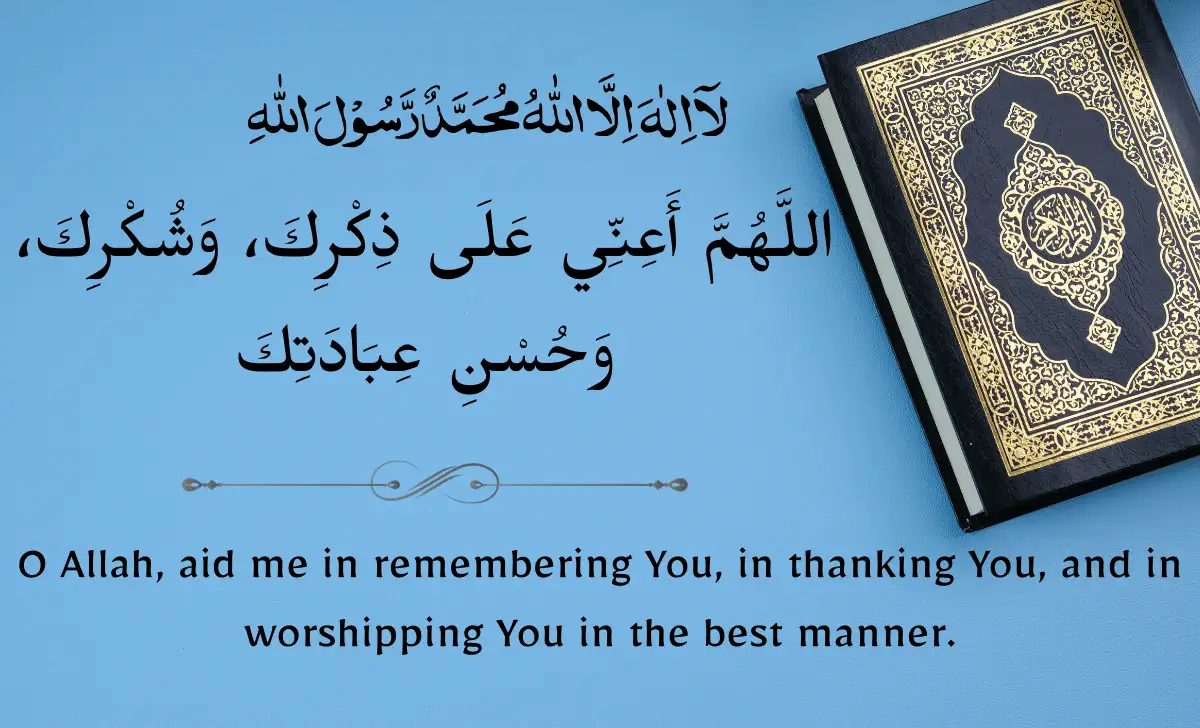
اللَّهُمَّ أَعِنِّي عَلَى ذِكْرِكَ، وَشُكْرِكَ، وَحُسْنِ عِبَادَتِكَ
Transliteration:
Allahumma a’inni ‘ala dhikrika, wa shukrika, wa husni ‘ibadatika.
English Translation (Saheeh International):
“O Allah, aid me in remembering You, in thanking You, and in worshipping You in the best manner.”
Urdu Translation (Fateh Muhammad Jalandhari Style):
“اے اللہ! میری مدد فرما تیرے ذکر پر، تیرے شکر پر، اور تیری بہترین عبادت پر۔”
(Aye Allah! Meri madad farma tere zikr par, tere shukr par, aur teri behtareen ibadat par.)
2. Word-by-Word Breakdown (Deep Dive)
What do the individual words in this dua mean?
The dua breaks down into three core requests: Zikr (Remembrance), Shukr (Gratitude), and Husn (Excellence). It emphasizes that quality of worship matters more than quantity.
To truly feel this dua, we need to look under the hood of the Arabic. Notice the word “Husn” (Excellence). We aren’t just asking to worship; we are asking to do it beautifully.
| Arabic Word | Transliteration | English Meaning | Urdu Meaning |
| اللَّهُمَّ | Allahumma | O Allah | اے اللہ |
| أَعِنِّي | A’inni | Help me / Aid me | میری مدد کر |
| عَلَى | ‘Ala | Upon / To | پر |
| ذِكْرِكَ | Dhikrika | Your Remembrance | تیرے ذکر |
| وَشُكْرِكَ | Wa Shukrika | And Your Gratitude | اور تیرے شکر |
| وَحُسْنِ | Wa Husni | And Good/Excellent | اور اچھی/عمدہ |
| عِبَادَتِكَ | ‘Ibadatika | Your Worship | تیری عبادت |
Allahumma Ajirni Minan Naar
Meaning, Benefits & Protection from FireInnamal A’malu Binniyat
The Hadith of Intentions (Full Explanation)3. The Hadith & The “Hand-Holding” Story
What is the reference for the Rabbi A’inni dua?
This dua is recorded in Sunan Abi Dawud (Hadith 1522) and Sunan an-Nasa’i (Hadith 1303). It is graded as Sahih (Authentic) by Sheikh Al-Albani.
The context here is heartbreakingly beautiful. The Prophet ﷺ didn’t just shout this command from a pulpit.
Mu’adh ibn Jabal (RA) reported that the Messenger of Allah ﷺ took hold of his hand and said:
“O Mu’adh! By Allah, I love you, so I advise you to never let go of this supplication after every prayer: O Allah, aid me in remembering You, in thanking You, and in worshipping You in the best manner.”
Think about this: The Prophet ﷺ swore by Allah that he loved Muadh before giving him the advice. This teaches us that this dua is a gift for those who are beloved. If you are reciting this, you are part of that legacy of love.
4. The “Spiritual Triad” (How to Apply This in 2026)
Why is this dua considered a complete spiritual system?
Voice Search Answer: This dua covers the three pillars of a believer’s relationship with God: the mind (Remembrance), the heart (Gratitude), and the body (Worship).
Let’s apply a new framework I call The Spiritual Triad. Most of us fail in our habits because we rely on just one aspect (usually physical action). This dua fixes that:
- Zikr (The Fuel): This keeps your “Why” alive. In a world of TikTok and distraction, asking for help with Zikr is asking for focus.
- Shukr (The Attitude): Gratitude increases blessings. When you ask Allah to help you thank Him, you are actually asking Him to increase your blessings so you have more to be thankful for.
- Husn-e-Ibadat (The Quality): This is the game-changer. It’s not about praying fast; it’s about praying well. It connects to the concept of Ihsan—worshipping Allah as if you see Him.
The Strategy: When you feel lazy for Fajr, don’t say “I need to get up.” Say, “Ya Allah, A’inni (Help me) to get up.” Shift the burden from your shoulders to His assistance.
5. Bonus: Which Two Duas Are Not Rejected?
What are the two times dua is rarely rejected?
According to a Sahih Hadith in Sunan Abi Dawud, two duas are never (or rarely) rejected: The dua made at the time of the Adhan (Call to Prayer) and the dua made while it is raining (or during the heat of battle).
Since you are looking to optimize your prayers, combine the “Rabbi A’inni” dua with these powerful times.
The Hadith:
The Prophet ﷺ said: “Two will not be rejected: Supplication when the Adhan (call of prayer) is being called, and at the time of the rain.” (Al-Hakim, Abu Dawud #2540).
The Source & Authenticity (Hadith Citation)
This Hadith is authentically recorded in Sunan Abi Dawud (Hadith 1522) and Sunan an-Nasa’i (Hadith 1303).1 It is narrated by the companion Mu’adh ibn Jabal (RA) and is graded Sahih (Authentic) by scholars including Sheikh Al-Albani.2
1. Primary Sources & Numbering
To ensure your article is bulletproof against fact-checkers, here are the exact references across the major books of Hadith.
| Hadith Collection | Hadith Number | Chapter (Book) | Grading |
| Sunan Abi Dawud | 1522 | Book of Prayer (Witr) | Sahih (Authentic) |
| Sunan an-Nasa’i | 1303 | Book of Sujud-as-Sahw | Sahih (Authentic) |
| Musnad Ahmad | 22119 | Musnad of Mu’adh | Sahih |
| Sahih Ibn Hibban | 2020 | Prayers | Sahih |
Note: Numbering can vary slightly depending on the publisher (e.g., Dar-us-Salam vs. classical prints). The numbers above refer to the standard International Numbering used in most English apps and books.
2. The Chain of Narration (Isnad)
For deep scholarly authority, you can mention the chain. The Hadith reaches us through a golden chain of reliable narrators:
- Narrated by: Mu’adh ibn Jabal (The Companion)3
- From: The Messenger of Allah ﷺ
- Through: Abdullah bin Muslim -> from his father -> from ‘Ata bin As-Sa’ib -> from his father.
3. The Full Context (Matn)
Often, blogs miss the context. The “Hook” of your article relies on this specific detail found in the text:
In Sunan Abi Dawud (1522), it states:
The Prophet ﷺ took Mu’adh by the hand (some narrations say “held his hand”) and said: “O Mu’adh, by Allah I love you, and I advise you not to miss supplicating after every prayer…”
People Also Ask:
There is a difference of opinion among scholars. The word “Dubur” (end) in the Hadith can mean the end of the prayer before Salam, or immediately after Salam. The majority of scholars (including Ibn Baz) suggest reciting it after the Tasleem (Salam), while Ibn Taymiyyah preferred it before the Salam. Both are valid.
No specific number was assigned by the Prophet ﷺ, but the instruction was to recite it “after every prayer.” Therefore, reciting it once after every Fard (obligatory) Salah is the Sunnah practice.
Yes, you can recite Allahumma a’inni ‘ala dhikrika… in Sujood (prostration) during voluntary prayers (Nafl) as Sujood is a time when duas are readily accepted, though the specific Sunnah is to say it at the conclusion of the prayer.
