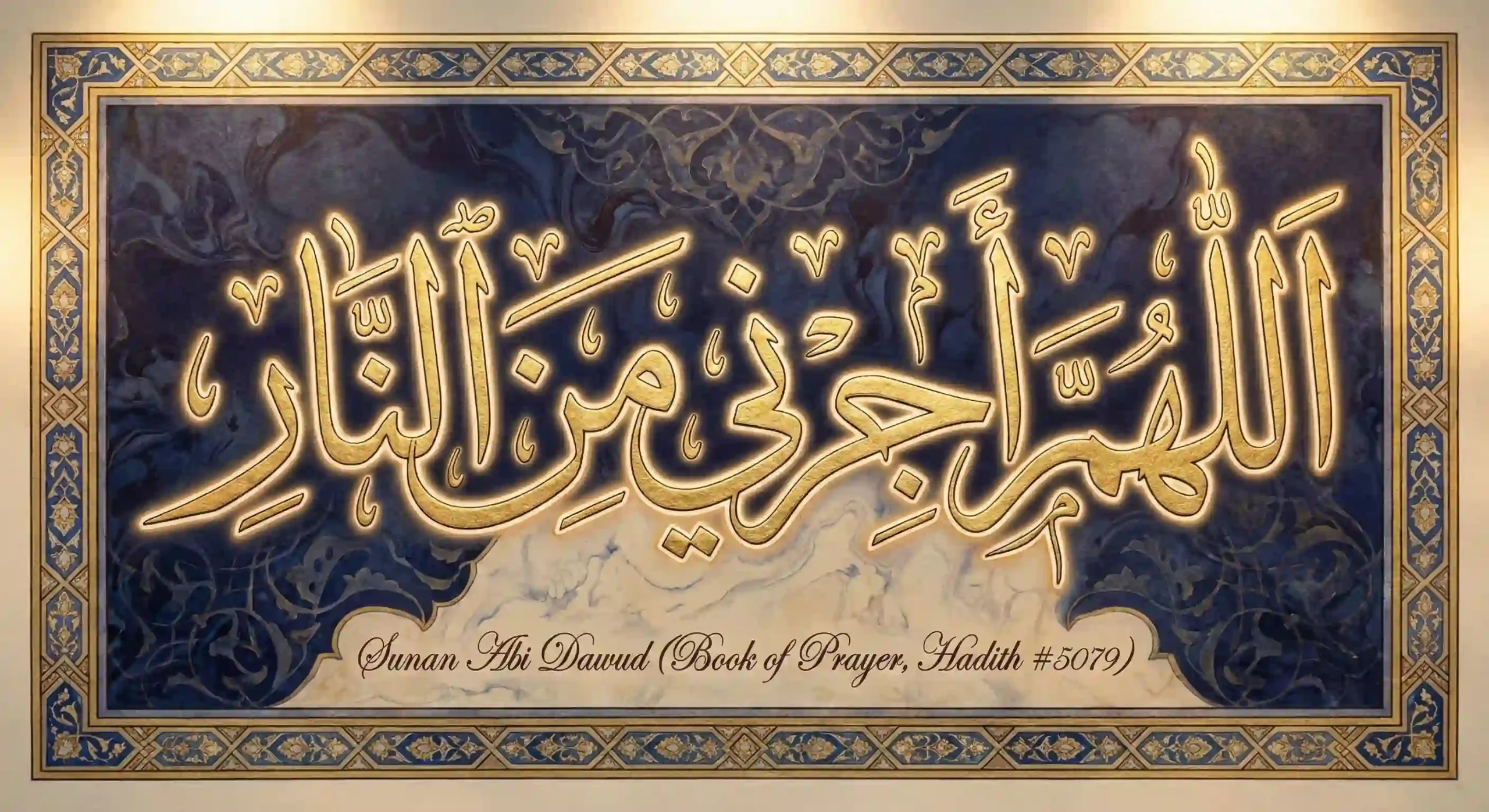
Have you ever wished you could erect an invisible shield around yourself that guarantees your safety, no matter what mistakes you might make during the day? We often start our mornings rushing—checking emails, worrying about traffic—leaving our souls completely exposed. But the Prophet ﷺ taught us a “Spiritual Firewall” that takes less than 60 seconds to activate. It is a protection contract signed at dawn and dusk, promising you safety from the ultimate danger: the Fire.
Is This a Verse from the Quran?
Answer: No, “Allahumma Ajirni Minan Naar” is not a verse (Ayah) from the Quran. It is a Hadith (a saying of the Prophet Muhammad ﷺ). While it is not found in the Quran, it is recorded in authoritative books of Prophetic tradition such as Sunan Abi Dawud and Musnad Ahmad.
What is the Meaning of Allahumma Ajirni Minan Naar?
Direct Answer:
“Allahumma Ajirni Minan Naar” is a powerful Arabic supplication (Dua) that means “O Allah, protect me from the Fire.” It is recited seven times immediately after the Fajr (dawn) and Maghrib (sunset) prayers to seek God’s guaranteed protection from Hellfire for that day or night.
The Full Dua (Trilingual Authority Block)
Here is the complete supplication. To unlock the full reward, recite it with focus on the meaning.
Arabic Text:
اللَّهُمَّ أَجِرْنِي مِنَ النَّارِ
Transliteration:
Allahumma ajirni minan naar.
English Translation (Sahih International):
“O Allah, protect me from the Fire.”
Urdu Translation (Fateh Muhammad Jalandhari):
Urdu Script: اے اللہ! مجھے آگ (جہنم) سے پناہ دے۔
Roman Urdu: Ae Allah! Mujhe aag (Jahannum) se panah de.
Word-by-Word Breakdown
Understanding the individual words helps you visualize the dua. “Allahumma” calls upon God, “Ajirni” asks for refuge or asylum, and “Minan Naar” specifies the danger being avoided: the Fire.
| Arabic | Transliteration | English Meaning | Grammatical Note |
| اللَّهُمَّ | Allahumma | O Allah | Calling upon God directly. |
| أَجِرْنِي | Ajirni | Protect me / Grant me refuge | From the root j-w-r (protection). |
| مِنَ | Min | From | Preposition of origin. |
| النَّارِ | An-Naar | The Fire (Hell) | The specific punishment. |
When & How to Recite This Dua (The “Before Moving” Rule)
You should recite this Dua seven times immediately after the Fajr and Maghrib prayers. The Hadith specifies doing this before you speak to anyone and before you change your sitting position (folding your legs) from the prayer.
The Spiritual Firewall
Think of your soul like a smartphone. When you wake up (Fajr) and when the day ends (Maghrib), your spiritual “operating system” is vulnerable.
The Prophet ﷺ didn’t just say “read this.” He gave specific conditions—“Before you move your feet” and “Before you speak.”
Why? This is the Priority Protocol. By refusing to check your phone, talk to your family, or even get up until you have said this, you are telling Allah: “My safety with You is more important than anything else in this world.” It establishes a massive psychological anchor that centers your entire day.
Hadith Reference & Authenticity
The narration is recorded in Sunan Abi Dawud (Hadith 5079) and Musnad Ahmad. While some scholars grade the chain as “Da’if” (weak) due to a specific narrator, others classify it as “Hasan” (good) for the purpose of virtuous deeds, and it is widely accepted and practiced by scholars across history.
The Hadith Text:
The Prophet ﷺ said to Al-Harith ibn Muslim at-Tamimi:
“When you pray Fajr, then say before speaking to any of the people, ‘O Allah, protect me from the Fire’ seven times. Then, if you die on that day, Allah will grant you protection from it. And when you pray Maghrib, say before speaking to any of the people, ‘O Allah, protect me from the Fire’ seven times. Then, if you die on that night, Allah will grant you protection from it.”
(Sunan Abi Dawud)
Scholarly Context:
- Imam An-Nawawi included similar invocations in his collection of Adhkar.
- Sheikh Al-Albani initially graded it weak but the practice remains a staple in the Sunnah due to the corroborating reports supporting the general concept of seeking refuge from Hellfire morning and evening.
- Consensus: Even if the chain has technical weakness, the meaning is sound, and asking for Jannah (Paradise) and refuge from Naar (Fire) is a commanded act of worship in the Quran.
Benefits of Reciting 7 Times
Reciting this Dua seven times acts as a divine insurance policy. If you pass away during the day after reciting it at Fajr, you are granted protection from Hell; the same applies if you pass away at night after reciting it at Maghrib.
- Immediate Security: It removes anxiety about the afterlife for that specific 12-hour cycle.
- Discipline Builder: It forces you to pause and focus before diving into worldly distractions.
- Divine Connection: It utilizes the number 7, a number frequently associated with completion and divine power in Islam (7 heavens, 7 circumambulations of Kaaba).
Unlock Hidden Blessings: The 9 Miraculous Benefits of “Mashallah La Quwwata Illa Billah”
The Verse of Mercy: Understanding “Innallaha Wa Malaikatahu Yusalluna Alan Nabi”
FAQs:
Yes, absolutely. This is a Dua (supplication), not Salah (prayer) or Quran recitation. Women can recite this during menstruation to maintain their spiritual protection.
If you move or speak by accident, do not worry. Allah is Most Merciful. Recite it as soon as you remember. While you missed the specific reward of the “strict protocol,” you will still be rewarded for the remembrance of Allah.
Yes, some narrations mention adding “Wa adkhilnal Jannata ma’al abrar” (And enter us into Paradise with the righteous). However, the core protection comes from the short version: Allahumma ajirni minan naar.
The Prophet ﷺ specified the number seven. In Islamic theology, we follow specific numbers as “keys” to unlock specific rewards, even if we don’t fully understand the metaphysical reason behind the number.
