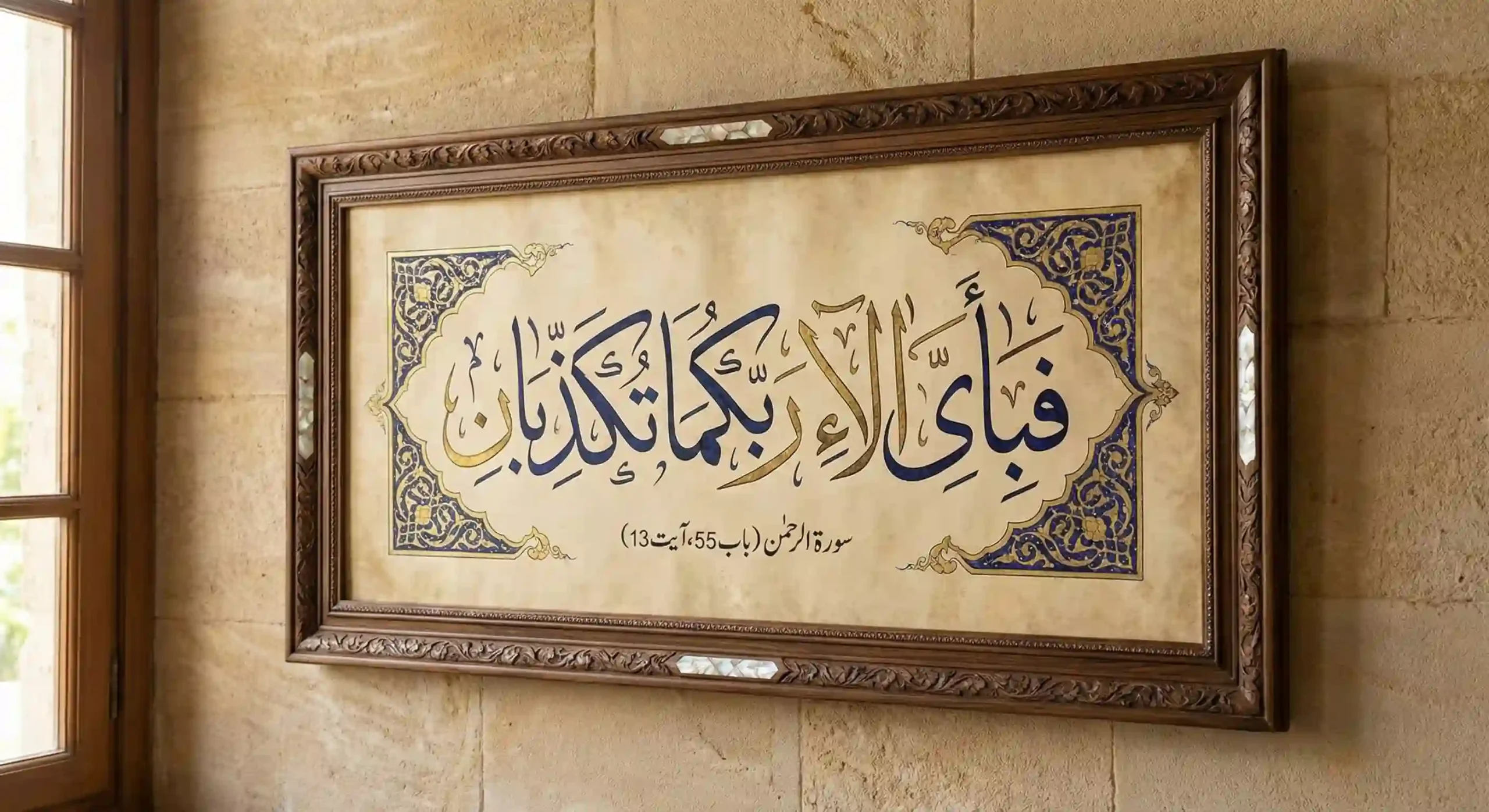
Ever felt like you are drowning in a sea of “I need more”? In a world obsessed with what we lack—better phones, bigger houses, faster success—one Quranic phrase stands as the ultimate cure for the restless soul. It isn’t just a question; it is a rhythm that resets your heart 31 times.
What Does Fabiayyi Ala I Rabbikuma Tukazziban” Mean?
This Arabic phrase means “So which of the favors of your Lord would you deny?” It is the recurring verse in Surah Ar-Rahman (Chapter 55, Verse 13), repeated 31 times to emphasize gratitude and challenge both humans and Jinn to acknowledge God’s countless blessings.
To truly understand the weight of this verse, we must look at it through the lens of the original language alongside the translations you trust.
The Multilingual Evidence
| Language | Text / Translation |
| Arabic | فَبِأَىِّ ءَالَآءِ رَبِّكُمَا تُكَذِّبَانِ |
| Transliteration | Fabiayyi ala i rabbikuma tukazziban |
| English (Saheeh Intl) | So which of the favors of your Lord would you deny? |
| Urdu (Fateh Jalandhari) | تو تم اپنے پروردگار کی کون کون سی نعمت کو جھٹلاؤ گے؟ |
Word-by-Word Analysis
The phrase is composed of “Fa” (So), “Bi-ayyi” (Which), “Ala” (Favors/Blessings), “Rabbikuma” (Lord of you two – addressing Humans and Jinn), and “Tukazziban” (You both deny). It grammatically addresses dual audiences, proving the Quran is meant for both mankind and the unseen world.
Here is the breakdown so you can visualize the structure:
- Fa (فَ): So / Then (A connector).
- Bi-ayyi (بِأَىِّ): With which / Which of.
- Ala (ءَالَآءِ): Favors / Bounties / Blessings.
- Rabbikuma (رَبِّكُمَا): The Lord of you two (Dual form addressing Men and Jinn).
- Tukazziban (تُكَذِّبَانِ): You both deny / belie / lie about.
Why Is This Verse Repeated 31 Times? (Tafsir & Context)
The verse is repeated 31 times to serve as a spiritual wake-up call, breaking the cycle of human ungratefulness. According to classical scholars like Ibn Kathir, the repetition is categorized: it appears after describing creation, judgment, Hellfire, and the two levels of Paradise, forcing the reader to find gratitude in every aspect of existence.
The Scholarship
Renowned scholar Imam Ibn Kathir explains that this repetition isn’t redundancy; it is affirmation. Just as a teacher repeats a vital lesson to a student who isn’t listening, Allah (SWT) repeats this question to penetrate the hardened heart.
The Structural Breakdown of the 31 Repetitions:
- 8 times after mentioning the miracles of creation.
- 7 times after the description of Hell (Jahannam)—reminding us that being saved from it is a favor.
- 8 times after describing the first two gardens of Paradise.
- 8 times after describing the second two gardens of Paradise.
The Divine Anchor A 2026 Perspective
The Divine Anchor strategy uses this verse as a psychological “reset button” for anxiety. Instead of mindless repetition, a believer uses the phrase to “anchor” themselves in the present moment, acknowledging one specific blessing every time the verse is recited, shifting the mind from scarcity to abundance.
Think of it this way:
We live in an era of “Notification Anxiety.” Our phones buzz, and our stress spikes. We are programmed to look for problems.
Surah Ar-Rahman offers a counter-program. The Divine Anchor technique works like this:
- You recite the verse.
- Pause.
- Identify one thing immediately around you (your breath, the roof over your head, your eyesight).
- Realize that this is the favor you cannot deny.
It turns the recitation from a ritual into a real-time mental health intervention.
Hadith and Benefits of Surah Ar-Rahman
The Prophet Muhammad (ﷺ) referred to Surah Ar-Rahman as the “Bride of the Quran” due to its beauty. A key Hadith in Jami` at-Tirmidhi mentions that when the Prophet recited this Surah to the Jinn, they responded to this specific verse by saying, “We do not deny any of Your favors, O our Lord! Praise be to You.”
The Evidence
Hadith Reference: Jami` at-Tirmidhi 3291
- Arabic:
- فَقَالَ ” لَقَدْ قَرَأْتُهَا عَلَى الْجِنِّ لَيْلَةَ الْجِنِّ فَكَانُوا أَحْسَنَ مَرْدُودًا مِنْكُمْ كُنْتُ كُلَّمَا أَتَيْتُ عَلَى قَوْلِهِ : ( فَبِأَىِّ آلاَءِ رَبِّكُمَا تُكَذِّبَانِ ) قَالُوا لاَ بِشَىْءٍ مِنْ نِعَمِكَ رَبَّنَا نُكَذِّبُ فَلَكَ الْحَمْدُ
- English:
- The Prophet (ﷺ) said: “I recited it to the Jinn on the Night of the Jinn, and they had a better response than you. Whenever I came to His saying: ‘So which of the favors of your Lord would you deny?’ They said: ‘We do not deny any of Your favors, O our Lord! Praise be to You.’“
- Urdu:
- نبی اکرم ﷺ نے فرمایا: ”میں نے اسے جنوں والی رات جنوں کو سنایا، تو وہ تم سے زیادہ اچھا جواب دینے والے تھے، جب بھی میں اللہ کے قول «فبأي آلاء ربكما تكذبان» پر پہنچتا تو وہ کہتے: ”اے ہمارے رب! ہم تیری نعمتوں میں سے کسی بھی چیز کو نہیں جھٹلاتے، تیرے ہی لیے حمد ہے۔“
Surah Ar-Rahman Verse in Urdu (PDF)
The Hidden Architecture of the 31 Repetitions
Most readers gloss over the repetition, assuming it is just for emphasis. However, Classical Tafsir reveals a deliberate architectural pattern. The 31 repetitions are not random; they act as “divine punctuation,” separating four distinct themes of existence.
Here is the scholarly breakdown of where and why the question is asked.
1. The Favors of Cosmic Balance (Verses 1–30)
The first eight repetitions occur during the description of creation, emphasizing the precise mathematical order of the universe. From the calculation of the sun and moon to the laws of justice in weighing scales, the “favor” here is that God created a predictable, safe, and just environment for life to flourish.
Key Verse Analysis: The Sun & The Moon (Verse 5)
- Arabic: الشَّمْسُ وَالْقَمَرُ بِحُسْبَانٍ
- Translation: “The sun and the moon [move] by precise calculation.”
- Tafsir Insight: Before asking “Which favor would you deny?”, Allah highlights Husban (Calculation). Imagine if the sun rose randomly or gravity fluctuated. Life would end. The “Favor” being denied here is the silent, terrifyingly complex machinery of the universe that runs smoothly without our help.
- The Lesson: We take the “boring” consistency of physics for granted.
2. The Mercy in the Warning of Hell (Verses 31–45)
The next seven repetitions appear after graphic descriptions of Judgment Day and Hellfire. Scholars like Al-Qurtubi explain that the “favor” here is the warning itself. Just as a sign warning of a cliff is a blessing that saves your life, Allah’s description of punishment is a mercy designed to steer believers away from it.
Key Verse Analysis: The Fragmentation of the Sky (Verse 37)
- Arabic: فَإِذَا انْشَقَّتِ السَّمَاءُ فَكَانَتْ وَرْدَةً كَالدِّهَانِ
- Translation: “And when the heaven is split open and becomes rose-colored like oil.”
- Tafsir Insight: This verse describes the breakdown of the cosmic order we just praised. The sky turning “rosy like oil” (or burning hide) signifies the terrifying reality of the Last Day.
- Why is this a Favor? Immediately after this terrifying image, the refrain follows: Fabiayyi ala i rabbikuma tukazziban. The favor is that you are being told about this now, while you still have time to prepare, rather than finding out when it is too late.
3. The Two High Gardens: For the “Muqarraboon” (Verses 46–61)
The next eight repetitions describe the first set of two gardens. These are reserved for “those who feared the standing before their Lord.” Tafsir scholars note that these gardens contain flowing springs and paired fruits, representing the highest reward for the Muqarraboon (those brought near to Allah).
Key Verse Analysis: The Fear of Standing (Verse 46)
- Arabic: وَلِمَنْ خَافَ مَقَامَ رَبِّهِ جَنَّتَانِ
- Translation: “But for he who has feared the position of his Lord are two gardens.”
- Tafsir Insight: Note the specificity. These gardens aren’t for everyone; they are for those who acted with Ihsan (excellence) because they were conscious of standing before God.
- The Description: The water here is described as “flowing” (Tajriyan). The fruit is of every kind, in pairs. This represents dynamic, active enjoyment.
4. The Two Lower Gardens: For the Righteous (Verses 62–78)
The final eight repetitions describe a second set of two gardens, distinct from the first. These are often interpreted as the reward for the Ashab al-Yameen (Companions of the Right). While still magnificent, their description—”dark green” with “gushing” springs—indicates a different, peaceful tier of Paradise compared to the active luxury of the first two.
Key Verse Analysis: Dark Green Mudhammatan (Verse 64)
- Arabic: مُدْهَآمَّتَانِ
- Translation: “Dark green [in color].”
- Tafsir Insight: The word Mudhammatan is unique. It implies greenery so intense and dense that it appears black/dark green.
- The Contrast:
- Springs: In the first gardens, springs were “flowing” (Tajriyan). Here, they are “gushing” (Naddakhatan)—still abundant, but different.
- Fruits: In the first, “every kind” of fruit. Here, specific fruits (Date palms and Pomegranates) are mentioned.
- The Takeaway: Allah’s mercy is tiered. He has prepared levels of success so that everyone who believes has a space that fits their spiritual rank. He does not deny reward to the average believer just because they didn’t reach the level of the greatest saints.
- The Contrast:
FAQs:
The main message is the infinite mercy of Allah (Ar-Rahman) and the obligation of gratitude. It contrasts the temporary nature of the world with the eternal nature of God’s majesty.
While many Muslims recite it for blessings in marriage and sustenance (Rizq), there is no specific Sahih Hadith limiting it to these purposes. However, reciting it to seek Allah’s mercy is always beneficial for any life difficulty.
Surah Ar-Rahman, verse 13 says:
“So which of the favors of your Lord would you deny?”
(Fa-bi-ayyi ālā’i rabbikumā tukadhdhibān)
Surah Ar-Rahman is known as Aroos-ul-Quran (The Bride of the Quran) because of its linguistic beauty and the recurring rhythmic verse.

1 thought on “Fabiayyi Ala I Rabbikuma Tukazziban- Surah Ar-Rahman ”