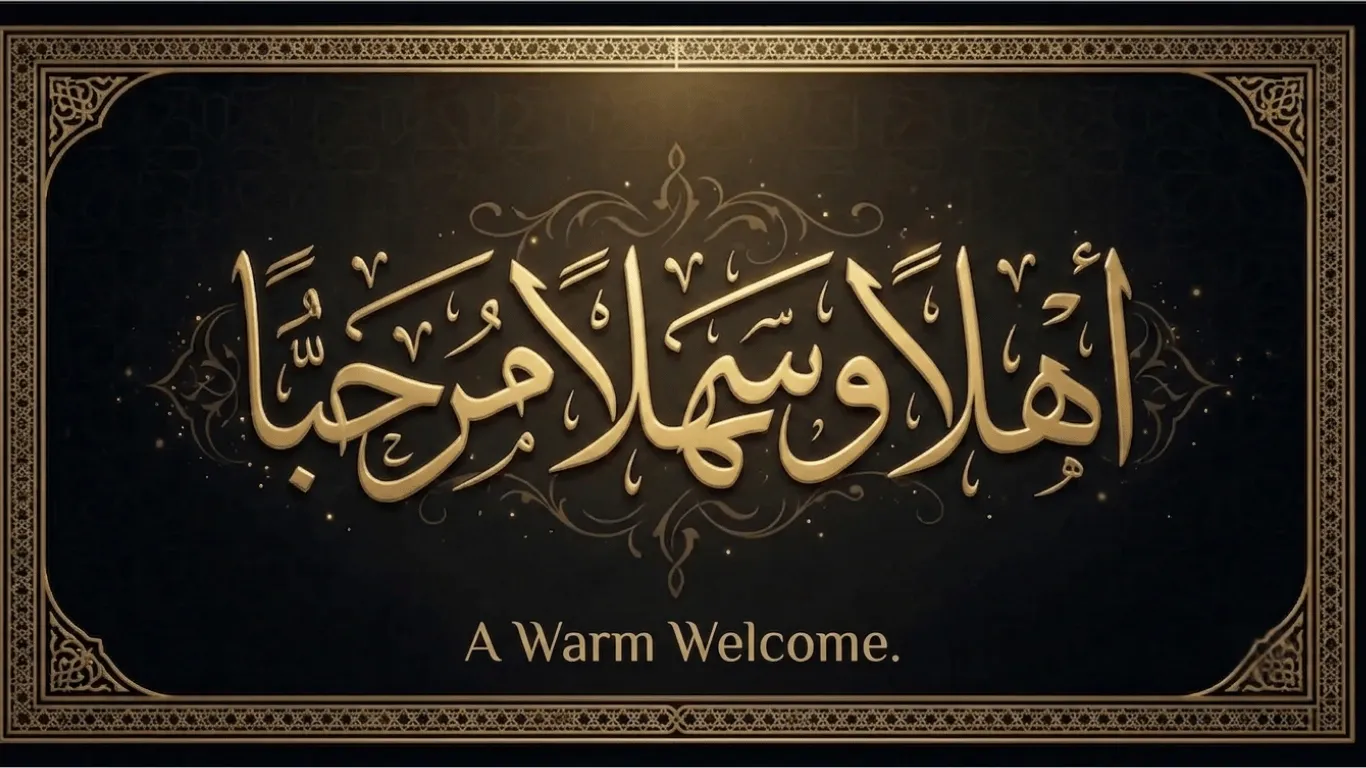
What if the three words you’ve heard as simply “welcome” actually tell someone they’re no longer a stranger—but family?
In mosques, homes, and Muslim communities across Pakistan, India, and the global Ummah, you hear it regularly: “Ahlan wa Sahlan Marhaba.” But what if almost everyone—including many Muslims—has only understood half its meaning?
Here’s something that changes everything: this isn’t just a greeting. It’s a spiritual promise rooted in Prophet Ibrahim’s legacy, encoded in Arabic grammar with hidden verbs, and designed to transform how we treat strangers, neighbors, and newcomers today.
Let’s understand the real meaning—and why reviving this complete welcome might be exactly what modern Muslim communities need to combat isolation and build genuine belonging.
What Does “Ahlan wa Sahlan Marhaba” Actually Mean?
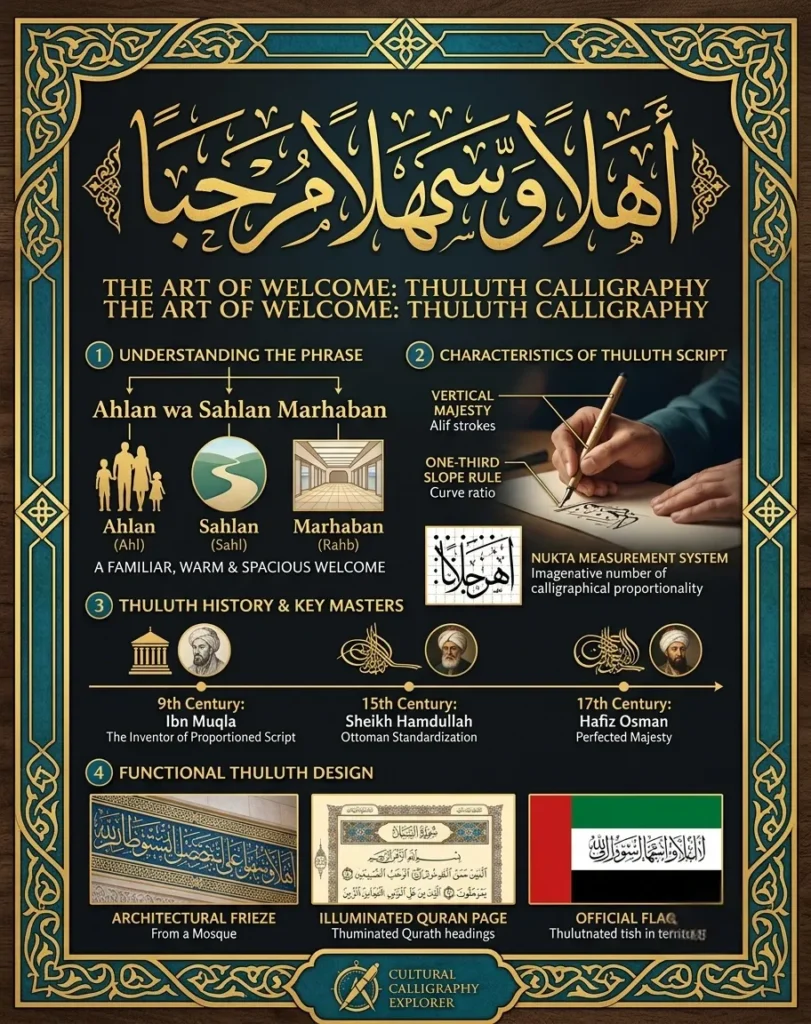
Ahlan wa Sahlan Marhaba (أهلاً وسهلاً مرحباً) is the complete traditional Islamic greeting of welcome meaning “You are now among family, your path is smooth and easy, and you have found a spacious, welcoming place.” It combines three distinct Arabic expressions that together tell a guest: “You are not a stranger—you belong here.”
While Western translations reduce it to “welcome,” the full meaning is far deeper. Each word carries its own reconstructed sentence from classical Arabic grammar:
- Ahlan = “You have come to your own kith and kin”
- Sahlan = “You are on firm ground, neither sandy nor stony”
- Marhaba = “You have come to a spacious place”
This becomes important when you look at how Prophet Ibrahim practiced hospitality—and how Islam elevates guest-honor to a sign of faith itself.
Word-by-Word Breakdown: Ahlan, Sahlan, Marhaba
Ahlan (أهلاً): “You Are Among Family”
Ahlan comes from the root word Ahl (أهل), meaning “family” or “people.” When you say Ahlan to someone, you’re telling them: “You are now among Ahl—not strangers, but family.” This transforms the guest from outsider to insider instantly.
The linguistic root connects to the broader Semtic family where AHL = family/people. In Islamic context, this reminds the Ummah of brotherhood (ukhuwwah) and creates genuine belonging for newcomers, strangers, and travelers.
Arabic Text:أهلاًTransliteration: Ahlan
English:“You are among family”Urdu: “آپ اب خاندان کی ہوتے ہیں” (You are now of the family)
Sahlan (سهلاً): “Your Path Is Smooth”
Sahlan derives from Sahl (سهل), meaning “easy,” “plain,” or “even ground.” It tells the guest: “Your path here is smooth—no hardship, no difficulty.” In Bedouin culture, this meant the traveler found firm ground, not sandy desert or rocky terrain that makes walking painful.
This word carries profound practical relevance. When we welcome someone Sahlan, we’re committing to make their journey with us comfortable—not adding obstacles, judgment, or barriers.
Arabic Text:سهلاًTransliteration: Sahlan
English:“Your path is smooth/easy”Urdu: “آپ کا راستہ آسان ہے” (Your path is easy)
Marhaba (مرحباً): “You Have Spacious Belonging”
Marhaba comes from the root Rahiba (رحب), meaning “spacious,” “wide,” or “open place.” It declares: “You have found room here—there’s space for you, no crowding, no exclusion.” Some scholars suggest Marhaba may have Syriac origins, though this remains unconfirmed.
The implication is powerful: true hospitality isn’t just opening a door—it’s opening space. Physical space, emotional space, community space.
Arabic Text:مرحباًTransliteration: Marhaba
English:“You have found spacious belonging”Urdu: “آپ نے وسیع جگہ पाया ہے” (You have found a spacious place)
The Hidden Grammar: Reconstructed Sentences Behind Each Word
Classical Arabic grammarians reveal that Ahlan wa Sahlan Marhaba is actually a shortened form of complete sentences where verbs were omitted for emphasis. Each word reconstructs to a full sentence: Ahlan = “Laqad ṣādaftum ʔahlan” (You have come to your kith and kin); Sahlan = “Wa-waṭiʔtum sahlan” (You trod on even ground); Marhaba = “Qad ʔadāftum mahraban” (You came to a spacious place).
This grammatical structure uses maṣdar (verbal nouns) where the original verbs have been dropped. The full reconstructed phrase would be:
لَقَدْصَادَفْتُمْأَهْلًاوَوَطِئْتُمْسَهْلًا
Laqad ṣādaftum ʔahlan wa-waṭiʔtum sahlan
Translation: “You have come across your own people and you have trodden on even ground.”
Here’s why this matters: understanding the hidden verbs reveals this wasn’t casual language—it was formal, elevated speech reserved for honoring guests with maximum dignity.
Quranic Reference: Where Does “Ahlan wa Sahlan” Appear in the Quran?
The phrase Ahlan wa Sahlan appears in Surah Sad (38:60), describing the greeting in Paradise: “Adkhulūha salāman, hāʔā forms, tubtum, fa-dkhulūha khalīdūn” — “Enter it in safety; this is the day of eternity… Ahlan wa Sahlan” (Welcome).
Let’s look at the complete verse with multilingual proof:
Arabic Text:
هَٰذَهِْيَٰوْΈٰتٌ تَبْتَ، فَادْخُلُوهَا خَٰلِدِيْنَ. أَهْلاً وَسَهْلًا
Transliteration:“Hāʔā tilqā tubtum, fa-dkhulūhā khalīdīn. Ahlan wa Sahlan.”
English Translation (Sahih International):“This is what you were promised—enter it eternally. Ahlan wa Sahlan (Welcome).” [Quran 38:60]
Urdu Translation:
“یہی وہ چیز ہے جو تمہیں دی گئی تھی، اس میں داخل ہو کر مستقل رہو۔ اهلاً وسهلاً (خوش آمدید).”
Tafseer Insight (Ibn Kathir):Ibn Kathir explains that Ahlan wa Sahlan in Paradise represents the ultimate welcome—where believers enter without fear, hardship, or exclusion. On earth, when we use this greeting, we’re mirroring Allah’s promise of belonging.
Hadith References: Islamic Hospitality as a Sign of Faith
Prophet Muhammad (PBUH) connected hospitality directly to faith in multiple Hadith: “Whoever believes in Allah and the Last Day, let him honor his guest” (Sahih Bukhari 6020). Another narration states hospitality is a sign of faith itself, with a three-day rule: first day is highest honor, second day is respect, third day is mere kindness.
Key Hadith with Multilingual Proof:
Arabic Text (Sahih Bukhari 6020):
مَنْ كَانَ يُؤْمِنُ بِاللَّهِ وَالْيَوْمِ الْآخِرِ فَلْيُقِلْ صَبْرَهُ عَلَى جَارِهِ
Transliteration:“Man kāna yu’minu billāhi wa-l-yawmi-l-ākhir fal-yuqilṣ-abra ʿalā jārihi”
English Translation:“Whoever believes in Allah and the Last Day, let him honor his guest.” [Sahih Bukhari 6020]
Urdu Translation:“
جو اللہ اور آخرت کے دن پر ایمان رکھتا ہے، وہ اپنے مہمان کی عزت کرے۔”
Scholarly Commentary (Imam Nawawi):Imam Nawawi explains “honor his guest” (yuqilṣ-abra) means providing food, drink, comfortable accommodation, and respectful treatment for up to three days.
The Story of Prophet Ibrahim: Origin of Islamic Hospitality
The origin of Ahlan wa Sahlan Marhaba traces to Prophet Ibrahim (PBUH), renowned in Islamic tradition as the master of guest hospitality. When angels visited him unrecognized, Ibrahim immediately offered food, shelter, and comfort—demonstrating that true hospitality treats strangers as family before knowing their identity.
In Surah Adh-Dhariyat (51:24–27), the Quran recounts angels arriving at Ibrahim’s home. Without waiting for them to ask, he:
- Prepared fresh food immediately
- Offered comfortable lodging
- Treated them as honored family members
This becomes important when you connect it to modern life: Ibrahim’s hospitality wasn about knowing who guests were—it was about assuming they deserved family treatment regardless.
Practical Application: When someone new joins your mosque, neighborhood, or workplace, don’t wait for introductions. Offer Ahlan first—treat them as family before knowing their story.
Why “Ahlan wa Sahlan Marhaba” Matters Today
In 2026, Muslims face rising isolation, urban fragmentation, and immigrant integration challenges. Reviving the complete Ahlan wa Sahlan Marhaba spirit transforms mosques and neighborhoods from isolated spaces into genuine belonging communities—where newcomers feel like family, not visitors.
Three Modern Problems This Greeting Solves:
scholar Anna Mahjar-Barducci notes that in French, hôte refers to both host AND guest as “two sides of the same coin”—hospitality involves dual responsibility. The guest responds with Ahlēn (“In you, I see my family”)—undertaking respect in return.
How Many Times Should You Recite “Ahlan wa Sahlan Marhaba”?
There’s no specific Quranic or Hadith command About reciting Ahlan wa Sahlan Marhaba a fixed number of times as a wazifa (devotional repetition). However, Islamic tradition emphasizes using it whenever welcoming guests—invited visitors, strangers, travelers, or new community members. The emphasis is on sincerity, not repetition count.
Some cultural variations exist:
- Ahlēn = “Two welcomes” (doubled)
- Ahlān fīk = “Welcome to you”
- Ya mīt ahlan wa sahlan = “100x welcome” (exaggerated honor)
These are cultural expressions of maximum warmth, not religious requirements.
Benefits of Understanding the Complete Meaning
When Muslims understand Ahlan wa Sahlan Marhaba‘s full meaning—not just “welcome” but “family + smooth path + spacious belonging”—they transform from casual greeting to character-building practice that cultivates generosity, eliminates selfishness, and creates Ummah unity.
Five Spiritual & Practical Benefits:
- Cultivates Genuine Generosity – Recognizing provisions as Allah’s trust, not personal ownership
- Eliminates Selfishness – Challenges hoarding blessings; forces sharing with strangers
- Builds Community Unity – Creates belonging spaces that combat isolation
- Develops Humility – Reminds hosts: “I’m not the owner; Allah is”
- Mirrors Paradise Welcome – Earthly hospitality reflects Allah’s promise to believers
Urdu and Hindi Translations for Multilingual Families
For Urdu/Hindi-speaking Muslims in Pakistan, India, and diaspora communities, here are accurate translations:
Urdu Translation:
اهلاً وسهلاً مرحباً“Aap ab khandaan ke hote hain, aap raasta aasaan paaya hai, aap ne veerya jagah paaya hai.”
Meaning: “You are now of the family, you found an easy path, you found spacious belonging.”
Hindi Translation:
अहलान व साहलान मरहबा“Aap ab parivaar ke hain, aapka raasta saghaal hai, aapne vishaal jagah paayi hai.”
Meaning: “You are now family, your path is smooth, you found spacious place.”
People Also Ask:
Ahlan wa Sahlan = “family + smooth path” (2 words). Marhaba alone = “spacious place” (1 word). Combined, they’re the complete traditional welcome. Any can be used individually, but never use Sahlan alone.
The phrase appears in Quran 38:60 as Paradise greeting, but it’s not a full verse—it’s part of a larger passage describing eternal welcome.
Common responses: Ahlēn (two welcomes), Ahlān fīk (welcome to you), or Marhabtayn (double generosity from guest).
Yes. It’s an Arabic cultural greeting of hospitality, not exclusively Islamic theology. Non-Muslims use it warmly in Arabic-speaking countries.
No fixed wazifa exists. Use it naturally when welcoming guests—the reward comes from honoring them, not repetition count.
No, “Ahlan wa Sahlan Marhaba” is not a wazifa meant for repetitive recitation. It’s a practical greeting of hospitality from Arabic/Islamic tradition that you use when welcoming guests — whether invited visitors, strangers, travelers, or new community members. The spiritual reward comes from how you use it (honoring guests with sincerity), not from counting repetitions.
Key Difference:
Wazifa = Devotional phrase recited X times for spiritual benefit (e.g., “Ayat al-Kursi” 11 times before sleep)
Ahlan wa Sahlan Marhaba = Social greeting used once per guest encounter with genuine warmth
Islamic Source: Prophet Muhammad (PBUH) said: “Whoever believes in Allah and the Last Day, let him honor his guest” (Sahih Bukhari 6020). The reward is in honoring the guest through food, shelter, and respectful treatment for up to 3 days — not in repeating the phrase.
When to Use It:
✅ When someone enters your home/mosque
✅ When welcoming new neighbors
✅ When greeting guests at events
❌ Not for repetitive devotional counting
Bottom Line: Don’t recite it 100 times as wazifa. Instead, say it once sincerely to each person you welcome, and follow it with actual hospitality (tea, food, comfortable space). That’s where the Barakah lies.
Final Thought: The Digital Sunnah
In WhatsApp messages, Instagram comments, and email threads, we’ve reduced Ahlan wa Sahlan Marhaba to “welcome.” But what if we’re losing something sacred?
Every time you greet someone with the complete phrase—not shortened, not英文化—you’re doing three things:
- Telling them: “You’re family, not stranger”
- Committing: “Your path with me will be smooth“
- Offering: “There’s spacious room for you here”
That’s not just grammar. That’s Sunnah. That’s mirroring Paradise. That’s building the Ummah Allah promised.
Ahlan wa Sahlan Marhaba—to you, to your family, to every stranger walking into your mosque today.
Sources: Slough Islamic Trust Dictionary, Ata Layar Academic Article, Sahih Bukhari 6020, Quran 38:60, Ibn Kathir Tafseer, Imam Nawawi Hadith Commentary
