What if a simple meal could become a moment of worship, gratitude, and nearness to Allah? The dua after eating food turns an ordinary daily habit into a beautiful Sunnah that even children can learn and practice.
What is the dua after eating food?
This is the short supplication recited after finishing a meal to thank Allah for the food, drink, and blessing of Islam. It is a very simple dua, but it carries deep meaning because it trains the heart to remember the One who provided the meal.
The dua after eating food is a Sunnah expression of gratitude said after finishing a meal. It reminds a believer that food is not only a physical need but also a blessing from Allah. This habit is easy to learn, easy to teach children, and powerful in daily life.
Arabic dua
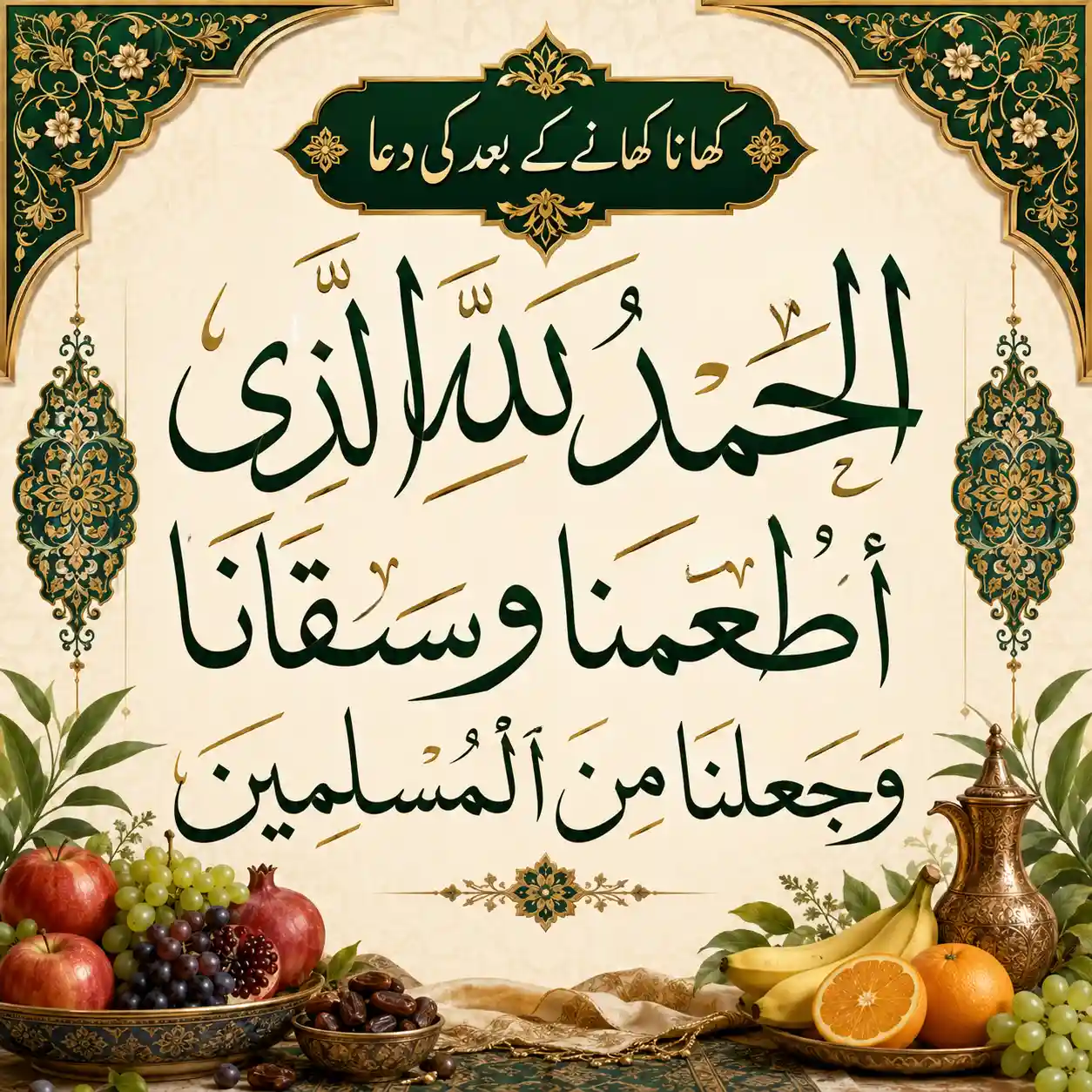
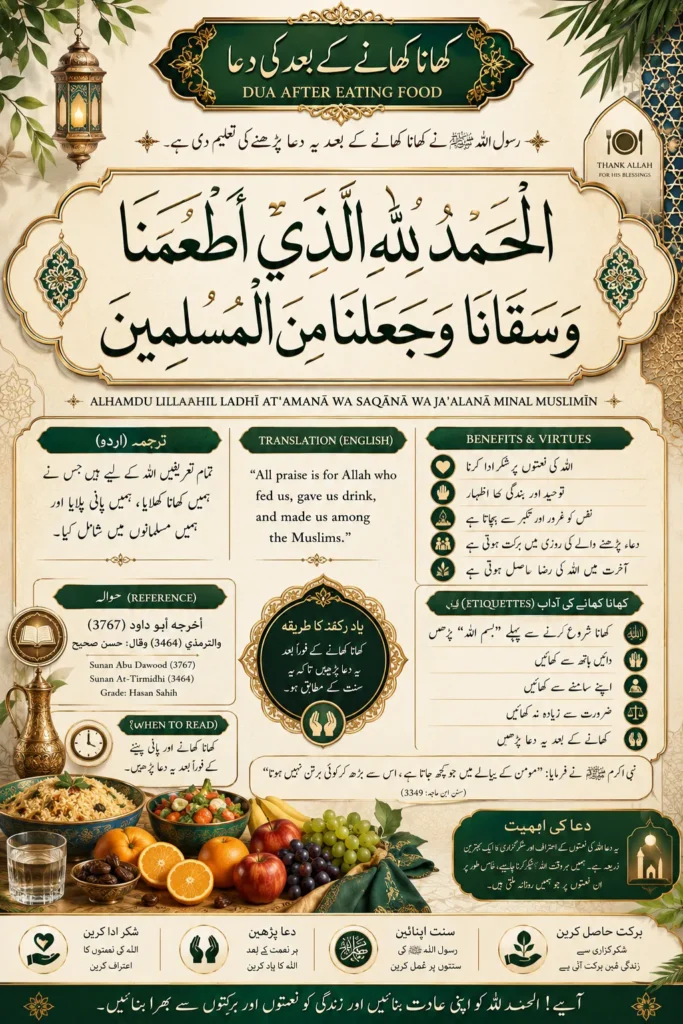
الْحَمْدُ لِلَّهِ الَّذِي أَطْعَمَنَا وَسَقَانَا وَجَعَلَنَا مِنَ الْمُسْلِمِينَ
Transliteration:
Alhamdu lillahi alladhi at’amana wa saqana wa ja’alana min al-muslimin
Urdu meaning:
تمام تعریفیں اللہ کے لیے ہیں جس نے ہمیں کھلایا، پلایا اور ہمیں مسلمانوں میں شامل فرمایا۔
English meaning:
All praise is due to Allah who fed us, gave us drink, and made us Muslims.
Word by word meaning
This section helps beginners and kids understand the dua slowly and clearly.
The words of this dua are short and meaningful. “Alhamdu” means praise, “lillahi” means for Allah, “at’amana” means He fed us, “saqana” means He gave us drink, and “ja’alana min al-muslimin” means He made us among the Muslims.
- Alhamdu = all praise.
- Lillahi = belongs to Allah.
- Alladhi = the One who.
- At’amana = fed us.
- Wa saqana = and gave us drink.
- Wa ja’alana = and made us.
- Min al-muslimin = among the Muslims.
Hadith basis
This dua is taught through the Sunnah of the Prophet Muhammad, and the meaning of thanking Allah after eating is strongly supported in hadith literature. The core idea is that a believer should not finish a meal and move on carelessly; instead, he or she should acknowledge Allah’s blessing with praise and gratitude.
The post-meal dua is rooted in authentic Islamic teaching about gratitude after eating. Hadith sources mention praising Allah after meals, and scholars use these narrations to explain the Sunnah of thanking Allah once food is finished. The practice is simple, authentic in spirit, and deeply recommended.
Some narrations mention closely related wordings of post-meal praise, and scholars note that slight differences in wording can appear across reports. That does not weaken the central message: after eating, a Muslim should remember Allah and thank Him sincerely.
Quranic connection
The dua itself is from hadith tradition, but the Quran gives the broader foundation for it. The clearest Quranic connection is the command to eat lawful provision and be grateful to Allah.
Quran 16:114 teaches believers to eat what is lawful and good and to show gratitude to Allah. This verse does not present the exact post-meal wording, but it gives the spiritual principle behind the dua. The Quran builds gratitude into everyday life, and this dua is one beautiful expression of that gratitude.
Arabic:
فَكُلُوا مِمَّا رَزَقَكُمُ اللَّهُ حَلَالًا طَيِّبًا وَاشْكُرُوا نِعْمَتَ اللَّهِ
English meaning:
So eat of the lawful and good things that Allah has provided for you and be grateful for the favor of Allah.
Urdu meaning:
پس اللہ کے دیے ہوئے حلال اور پاکیزہ رزق میں سے کھاؤ اور اللہ کی نعمت کا شکر ادا کرو۔
Why this dua matters
This dua is important because it changes the heart. Food can easily become something we take for granted, but gratitude turns it into a sign of worship. A person who remembers Allah after eating learns humility, contentment, and consistency in faith.
This dua matters because gratitude protects the heart from forgetfulness. It teaches us that every meal is a gift, every sip is a blessing, and every family table can become a place of remembrance. It is a small Sunnah with a large spiritual effect.
Here is why it matters in daily life:
- It strengthens gratitude.
- It teaches children good Islamic manners.
- It keeps the heart attached to Allah.
- It makes daily eating a Sunnah-based habit.
- It reminds us that provision comes from Allah alone.
Khana khane ke baad ki dua for kids
Children learn best through short repetition and simple action. If parents teach the dua after every meal, kids begin to connect food with thankfulness from a young age. This makes the dua part of their daily memory, not just a line they hear once.
For kids, the best method is to keep the dua short, repeat it after every meal, and make it part of family routine. Children do not need a long lecture first. They need a simple phrase, a warm example, and regular practice at the dining table.
A good teaching method is:
- Finish the meal.
- Say Alhamdulillah first.
- Repeat the full dua slowly.
- Ask the child to say it back.
- Praise them gently when they remember it.
You can also make it a “family gratitude moment” after eating. That way, the dua becomes a happy habit, not a forced lesson.
Urdu translation
Many Urdu readers search for the meaning in simple language. A clear Urdu translation helps the dua feel familiar and practical.
The Urdu translation of the dua is easy to understand and suitable for families and children. It says that all praise belongs to Allah, who gave us food, drink, and the blessing of Islam. This makes the dua both devotional and deeply personal.
Urdu translation:
تمام تعریفیں اللہ کے لیے ہیں جس نے ہمیں کھلایا، پلایا اور ہمیں مسلمانوں میں شامل فرمایا۔
Simple Urdu explanation:
اس دعا میں ہم اللہ کا شکر ادا کرتے ہیں کہ اس نے ہمیں کھانا، پانی اور اسلام جیسی بڑی نعمت عطا کی۔
About the hadith
The hadith tradition around eating and thanking Allah shows that Islam cares about everyday actions. Eating is not only about filling the stomach; it is also about remembering the Provider. That is why scholars discuss post-meal praise as part of good adab and Sunnah.
The hadith teaching here is simple: after eating, a Muslim should thank Allah. This is not a complicated fiqh issue. It is a heart-training practice that makes daily life more spiritual, more mindful, and more connected to the Sunnah.
Imam Nawawi and other scholars emphasize gratitude as a central Islamic ethic. Classical tafsir works also repeatedly connect lawful provision with remembrance of Allah. So even when the exact dua comes from hadith, the Quranic and scholarly framework around it is firmly about thankfulness.
Is it in the Quran?
The exact words of this dua are not found as a direct verse in the Quran. However, the Quran strongly teaches gratitude after receiving blessings, and that is the foundation of this supplication.
No, the exact dua is not a Quran verse. But the Quran clearly commands believers to eat what is lawful and to be grateful. So the dua is a Sunnah expression of a Quranic value, not a verse itself.
This distinction is important for accuracy. It helps readers trust the article and understand the difference between Quranic text, hadith wording, and scholarly explanation.
How to teach the dua
Teaching this dua should feel natural. The best time is immediately after eating, when the family is already gathered and the moment is easy to remember. Repetition is more effective than long explanation.
Teach the dua after every meal by making it part of the routine. Say it slowly, repeat it often, and let children hear it from parents regularly. When a habit is attached to mealtime, it becomes easy to remember and easy to live.
A simple family routine:
- Say Bismillah before eating.
- Finish the meal calmly.
- Say Alhamdulillah after eating.
- Recite the full dua together.
- Encourage children with praise and smiles.
Digital Sunnah
This article also fits a modern Digital Sunnah framework. In a noisy online world, even the smallest Sunnah can be turned into a visible, shareable reminder that benefits families, students, and children. A short dua graphic, a saved phone wallpaper, or a printable table card can help people remember it daily.
Digital Sunnah means using modern tools to preserve simple Islamic habits. A dua card, a phone reminder, or a family poster can help children and adults remember gratitude after meals. The goal is not decoration alone; it is consistent remembrance.
This is especially helpful for:
- Parents teaching kids.
- Teachers in Islamic classrooms.
- Content creators making reminder graphics.
- Families who want daily Sunnah habits.
Related duas
If you are building a dua-learning article cluster, this is the best sequence:
- Dua after eating food.
- Masnoon duas for eating fruit.
- Dua before eating.
- Dua after drinking water.
- Dua for drinking milk.
Related duas help readers build a full Sunnah routine around eating and drinking. If someone learns the post-meal dua, the next natural steps are fruit dua, milk dua, and the dua before eating. That creates a complete and practical Islamic habit set.
khana khane ke baad ki dua (PDF)
People Also Ask:
It is a short supplication said after finishing a meal to thank Allah for food, drink, and the blessing of Islam.
It means the supplication recited after eating food, to show gratitude to Allah.
Yes, Islamic hadith literature teaches praising Allah after eating, and scholars explain this as a Sunnah of gratitude.
Children learn it best through repetition, family routine, and short daily practice after meals.
The exact wording is not in the Quran, but the Quran strongly teaches gratitude for Allah’s provision.
Final reminder
The dua after eating food is short, beautiful, and easy to remember, but its impact is big. It teaches gratitude, strengthens the Sunnah, and helps families turn an everyday meal into a moment of worship.
