
Have you ever been halfway through a meal, suddenly remembered you forgot to say Bismillah, and felt a quiet wave of guilt? For many Muslims, especially mothers teaching children, new Muslims building habits, and students of fiqh, this small moment can feel bigger than it is—but the Sunnah gives a gentle reset, not a dead end.
What is this dua?
The dua to recite when you remember during eating that you forgot Bismillah at the beginning is: “Bismillahi awwalahu wa akhirahu”. It means: “In the name of Allah, at its beginning and its end,” and it comes from the Sunnah as a corrective remembrance for a missed opening Bismillah.
The dua in Arabic and translation
The wording commonly taught for this supplication is short, easy to memorize, and especially useful for children and new Muslims because it directly addresses forgetfulness in the middle of a meal. It is not a separate ritual formula from the Quran, but a Prophetic teaching connected to eating etiquette.
| Language | Script / Text | SEO Label |
|---|---|---|
| Arabic | بِسْمِ اللَّهِ أَوَّلَهُ وَآخِرَهُ | Original dua text from hadith |
| Transliteration | Bismillāhi awwalahu wa ākhirahu | Phonetic guide for non-Arabic readers |
| English (Saheeh International style) | In the name of Allah, at its beginning and its end. | Standard Bismillahi awwalahu wa akhirahu meaning |
| Urdu (Fateh Muhammad Jalandhari style) | اللہ کے نام سے، اس کے شروع اور آخر میں۔ | Khana khane ke darmiyan ki dua in Urdu |
Word-by-word meaning
This wording is powerful because each word repairs what was missed. It teaches that remembrance can still cover the meal when forgetfulness interrupted the start.
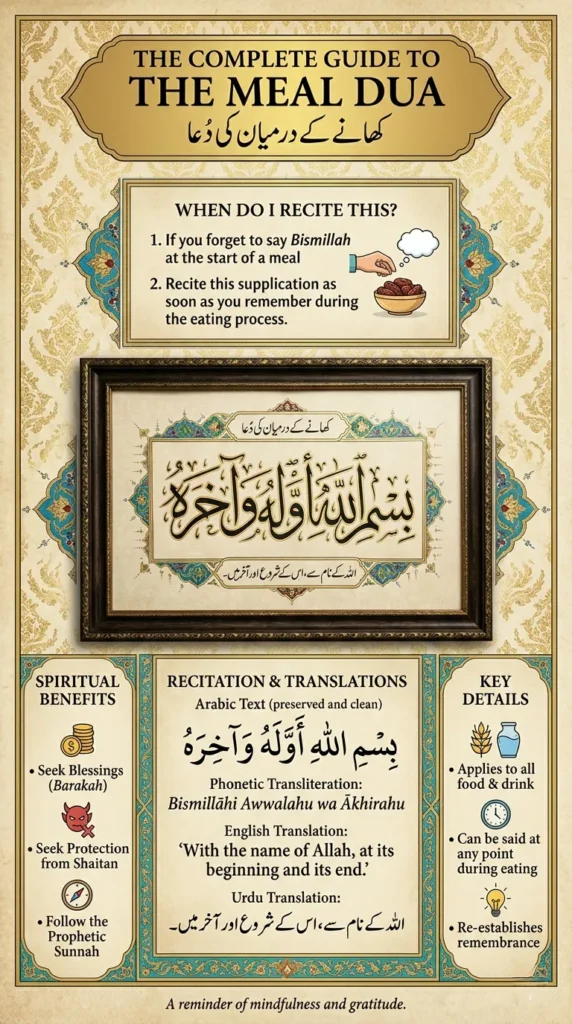
When should you say it?
You should say this dua the moment you remember, even if you are already eating. The purpose is to restore the remembrance of Allah to the meal after forgetting it at the start.
The Sunnah reset button
This is where the Spiritual Habit Loop becomes useful. The cue is forgetfulness, the response is the dua, and the reward is relief, barakah, and a return to mindful eating rooted in the Sunnah.
For a mother teaching her children, this means the lesson is not “You failed.” It becomes: “When you remember Allah, say His name right away.” For a new Muslim, it removes embarrassment and replaces it with a practical habit. For a fiqh-minded reader, it shows how the Sunnah accounts for human error without turning every mistake into spiritual panic.
Where does this dua come from?
This dua is based on a hadith in which the Prophet ﷺ instructed the believer to mention Allah’s name when eating, and if he forgets at the beginning, then he should say: Bismillahi awwalahu wa akhirahu. This is the central proof for the dua of eating in the middle after forgetfulness.
Primary hadith proof
The hadith is reported in Sunan Abu Dawood and is widely cited in works discussing eating etiquette and remembrance at meals. The article should present the full Arabic matn, transliteration, translation, and scholarly note on grading so readers get both accessibility and source confidence.
| Language | Hadith Text | SEO Context |
|---|---|---|
| Arabic (Matn) | إِذَا أَكَلَ أَحَدُكُمْ طَعَامًا فَلْيَقُلْ بِسْمِ اللَّهِ، فَإِنْ نَسِيَ فِي أَوَّلِهِ فَلْيَقُلْ: بِسْمِ اللَّهِ أَوَّلَهُ وَآخِرَهُ | Original hadith text on forgetting Bismillah |
| Transliteration | Idhā akala ahadukum ta‘āman falyakul: Bismillāh, fa in nasiya fī awwalihi falyakul: Bismillāhi awwalahu wa ākhirahu. | Phonetic guide for students of fiqh |
| English | When one of you eats food, let him say: In the name of Allah. If he forgets at the beginning, then let him say: In the name of Allah, at its beginning and its end. | Bismillahi awwalahu wa akhirahu hadith meaning |
| Urdu | جب تم میں سے کوئی کھانا کھائے تو اللہ کا نام لے، اور اگر شروع میں بھول جائے تو کہے: اللہ کے نام سے، اس کے شروع اور آخر میں۔ | Khana khane ke darmiyan ki dua hadith in Urdu |
About hadith and scholarly use
This report is foundational because it directly answers a real-life question rather than a theoretical one. That makes it ideal for voice search, AI overviews, and everyday readers who ask in plain language: “What do I read if I forgot Bismillah while eating?”
In your final published version, the fiqh section should mention Imam Nawawi when discussing adab of eating and remembrance, because his treatment of daily Sunnah practices helps readers understand that etiquette in Islam is part of spiritual training, not mere formality. The article should also note the hadith source details clearly for students who want more than a simplified blog answer.
Is this dua in the Quran?
This exact dua is not a Quranic verse. It is a Prophetic supplication tied to the Sunnah of eating, while the Quran provides the broader framework of lawful food, gratitude, and remembrance of Allah.
Quranic reference and why it matters
The Quran commands believers to eat from the good things Allah has provided and to be grateful to Him. That is why verses about provision and gratitude are relevant context even though the exact wording of this dua comes from hadith, not from the Quran.
A key verse for the article is Surah Al-Baqarah 2:172, which tells believers to eat from the good and lawful things Allah has provided and to be grateful to Him. Another useful contextual verse is Surah Al-An‘am 6:141, which connects provision to proper use and gratitude, making it highly relevant when discussing food etiquette and remembrance.
Multilingual Quranic context
Surah Al-Baqarah 2:172 is especially valuable in this article because it grounds food remembrance in a Quranic ethic of gratitude. It helps the reader see that saying Allah’s name before or during food is not an isolated act, but part of a complete spiritual worldview.
| Language | Text | SEO Label |
|---|---|---|
| Arabic (Verse) | يَا أَيُّهَا الَّذِينَ آمَنُوا كُلُوا مِنْ طَيِّبَاتِ مَا رَزَقْنَاكُمْ وَاشْكُرُوا لِلَّهِ | Quranic source (Al‑Baqarah 2:172) |
| Transliteration | Yā ayyuhā alladhīna āmanū kulū min tayyibāti mā razaqnākum washkurū lillāh. | Phonetic guide for voice search |
| English (Saheeh International style) | O you who have believed, eat from the good things which We have provided for you and be grateful to Allah. | Clear, authoritative translation for snippet use |
| Urdu (Fateh Muhammad Jalandhari style) | اے ایمان والو! ہماری دی ہوئی پاکیزہ چیزیں کھاؤ اور اللہ کا شکر کرو۔ | Urdu rendering for Pakistani/Hindi-Urdu audiences |
Surah Al-An‘am 6:141 supports the article by broadening the discussion of rizq, crops, fruit, and proper gratitude toward Allah’s provision. It also creates a natural semantic bridge to your internal page on fruit-related supplications.
Tafseer and deeper meaning
The deeper point is not merely remembering a phrase. The real lesson is that food in Islam is tied to shukr, discipline, adab, and awareness that provision comes from Allah.
Ibn Kathir and the gratitude frame
In tafsir discussions on verses about eating and gratitude, the emphasis is that believers should consume what is lawful and pure, and respond with thanks to Allah rather than heedlessness. This supports the article’s main theme: saying Allah’s name is a practical form of gratitude, not just a verbal habit.
This is where your “Spiritual Habit Loop” angle becomes strong. The dua is not only a correction for forgetfulness; it trains the heart to return quickly to Allah whenever it notices a lapse. That makes the moment of forgetting itself part of spiritual growth.
Why is this important?
This dua matters because it replaces guilt with remembrance, forgetfulness with recovery, and routine eating with conscious worship. It is one of those small Sunnahs that quietly changes a person’s relationship with everyday life.
Benefits
The benefits discussed in the article should be practical and spiritual at the same time. That balance helps mothers, new Muslims, and students of fiqh all find themselves in the page.
- It restores remembrance of Allah to the meal after forgetfulness.
- It helps build a consistent Islamic habit loop around food.
- It teaches children that mistakes can be corrected immediately.
- It reduces shame for new Muslims who are still learning daily duas.
- It connects food with gratitude, which is reinforced by Quranic teaching.
How to teach it to children
Children learn meal duas best when the practice is gentle, repeated, and tied to real moments at the table. The goal is not perfection on day one; the goal is to normalize remembering Allah before, during, and after eating.
A simple teaching script for mothers
A mother can make this dua memorable by turning forgetfulness into a calm teaching opportunity. That fits the Sunnah better than sharp correction, especially when the child is trying.
- Before الطعام arrives, say: “What do we say before eating?”
- If the child forgets and starts eating, smile and say: “Now we say the middle dua.”
- Repeat together: Bismillahi awwalahu wa akhirahu.
- After the meal, connect it with the supplication after finishing your meal.
- On fruit days, connect the habit with a specific dua for eating fruit.
For new Muslims and students of fiqh
New Muslims need reassurance that forgetting a Sunnah phrase does not close the door to reward. Students of fiqh need clarity on source, wording, function, and how Quranic context differs from hadith wording.
For the new Muslim
If you forgot Bismillah, you did not ruin the meal. You simply follow the Sunnah response the moment you remember, and that itself becomes an act of worship.
For the practicing student
The stronger scholarly framing is this: the dua is rooted in hadith, not Quran; its use is contextual, not numerically legislated; and its wisdom fits within broader Quranic commands of lawful provision and gratitude. This is the balance your article should maintain throughout.
People also ask:
Say: Bismillahi awwalahu wa akhirahu. This is the Sunnah wording for someone who forgot to mention Allah’s name at the beginning of the meal and remembered during it.
No, this exact dua is not a Quranic verse. It comes from hadith, while the Quran gives the wider guidance of gratitude, lawful food, and thankfulness to Allah.
You generally say it once when you remember. It is a situational dua, not a repeated wazifa with a fixed count established in the core wording discussed here.
Because remembrance turns eating into worship and reflects gratitude to Allah for provision. The Quranic ethic of eating good things and thanking Allah supports this spiritual habit.
After this corrective dua during the meal, the natural next step is learning the prayer of gratitude after eating, so the meal begins, continues, and ends with remembrance.
