
Rabbana lakal hamd means “Our Lord, to You alone belongs all praise.” Say it immediately after rising from ruku in salah, right after the imam says “Sami Allahu liman hamidah.” This simple phrase, taught by the Prophet Muhammad (peace be upon him), anchors your prayer in pure gratitude to Allah.
Rooted in Sunnah, it fills the heavens with your tahmid. Here’s why this matters for you in daily life.
Word-by-Word Meaning
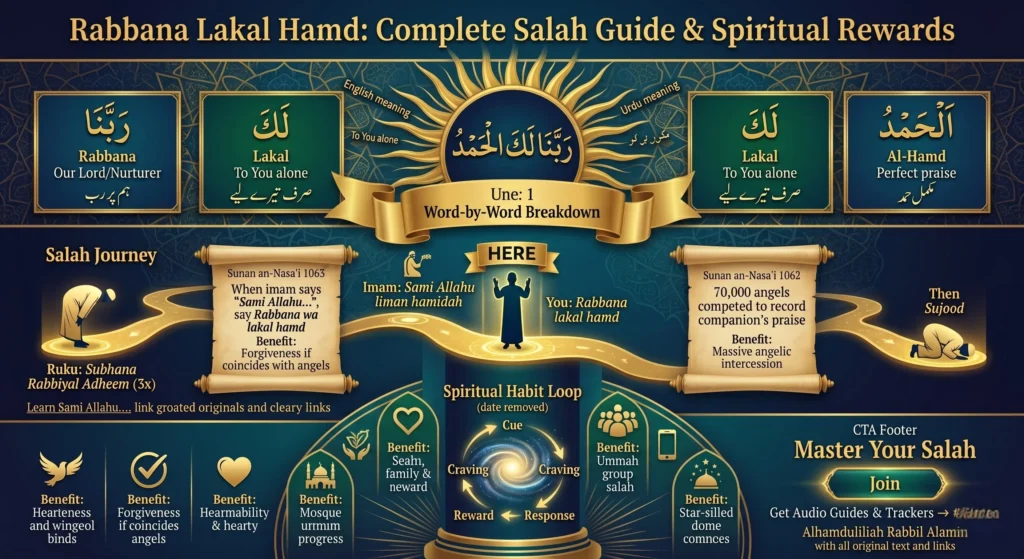
Break it down simply: Rabbana (our Lord and Nurturer), lakal (to You exclusively), hamd (perfect, abundant praise—not just thanks).
| Arabic | Transliteration | English (Saheeh Int. style) | Urdu (Jalandhari) |
|---|---|---|---|
| رَبَّنَا لَكَ الْحَمْدُ | Rabbana lakal hamd | Our Lord, to You be praise | اے ہمارے رب! تیری ہی حمد ہے |
Imam Nawawi in Sharh Muslim highlights “hamd” as worship that purifies the heart from shirk.
When and How in Salah
Recite Rabbana lakal hamd standing straight after ruku, in every rak’ah. Both imam and followers say it aloud in jama’ah; silently if alone. Time it perfectly: After “Sami Allahu liman hamidah,” pause briefly, then respond.
Link this to learn Sami Allahu liman hamidah that precedes it.
Multilingual Proof (Sunan an-Nasa’i 1063):
| Arabic | Transliteration | English | Urdu |
|---|---|---|---|
| قَالَ رَسُولُ اللَّهِ صَلَّى اللَّهُ عَلَيْهِ وَسَلَّمَ: إِذَا قَالَ الْإِمَامُ سَمِعَ اللَّهُ لِمَنْ حَمِدَهُ فَقُولُوا رَبَّنَا وَلَكَ الْحَمْدُ | Qala Rasul Allah: Idha qala al-imam sami Allahu liman hamidah, faqulu rabbana wa lakal hamd | Messenger said: When imam says Allah hears who praises Him, say Our Lord to You praise | رسول نے فرمایا: جب امام کہے اللہ سننے والے کی حمد سنتا ہے تو کہو اے رب ہمارا، تیری ہی حمد |
Ibn Kathir ties this to Fatiha’s praise theme (1:2), though not a direct ayaat.
Key Hadiths and Benefits
The Prophet said: “Whoever says it coinciding with angels reaches his Lord with no sins” (Nasa’i 1063). One companion extended it, drawing 70,000 angels (Nasa’i 1062).
Benefits hit hard: Instant forgiveness, angelic intercession, heart purification. In 2026’s fast world, it combats spiritual disconnection—your cue to reset amid notifications.
Build on praise with Alhamdulillah Rabbil Alamin meaning.
Extended Hadith (Nasa’i 1066):
| Arabic | Transliteration | English | Urdu |
|---|---|---|---|
| اللَّهُمَّ رَبَّنَا لَكَ الْحَمْدُ مِلْءَ السَّمَاءِ وَمِلْءَ الْأَرْضِ وَمِلْءَ مَا شِئْتَ مِنْ شَيْءٍ بَعْدُ | Allahumma rabbana lakal hamd mil’a as-samawati wa mil’al-ard wa mil’a ma shi’ta min shay’in ba’d | O Allah our Lord to You praise filling heavens earth and what You will after | اے اللہ ہمارے رب، تیری حمد آسمانوں بھر، زمین بھر اور جو چاہے بعد |
Why So Important? Tafsir Insights
This phrase cements tawhid: Praise belongs to Allah alone, no partners. Nawawi calls it the essence of slave-to-Master bond; Ibn Kathir links to creation’s purpose (Quran 51:56).
Miss it? Prayer feels mechanical. Master it, and salah transforms into living gratitude.
The Spiritual Habit Loop
Ever fumble pronunciation or timing, leaving you disconnected? Use this modern loop: Cue (ruku rise + imam’s words), Craving (urge to praise), Response (recite fully), Reward (peace + angels). Track via 2026 prayer apps for reminders—turn confusion into habit.
Here’s why this matters for you: It bridges ancient Sunnah to chaotic days.
Complete Salah Guide
- Bow in ruku: “Subhana Rabbiyal Adheem” (3x).
- Rise: Hear “Sami Allahu…” → Say Rabbana lakal hamd.
- Hands on chest, then sujud. Repeat per rak’ah.
People Also Ask:
No direct, but echoes Fatiha’s hamd theme.
Aloud following imam; silent solo (Hanafi view allows without “wa”).
Builds daily gratitude habit, easing anxiety per hadith rewards.
Practice post-ruku with audio—start short.
Ready to deepen your salah?
