
You’re tired. Your day has been long, your mind is racing, and you’ve just bowed in ruku. You stand up, mumble a few familiar syllables, and immediately drop your forehead to the floor. But what if that three-second transition is the exact moment the Creator of the universe is leaning in to listen to you?
We often treat the physical movements of Salah as a race to the finish line. Yet, the phrase we say when standing up holds a psychological trigger designed to snap us out of our worldly distractions. Let’s look at the heart of the issue and uncover what you are actually saying when you rise.
What Does Sami Allahu Liman Hamidah Mean?
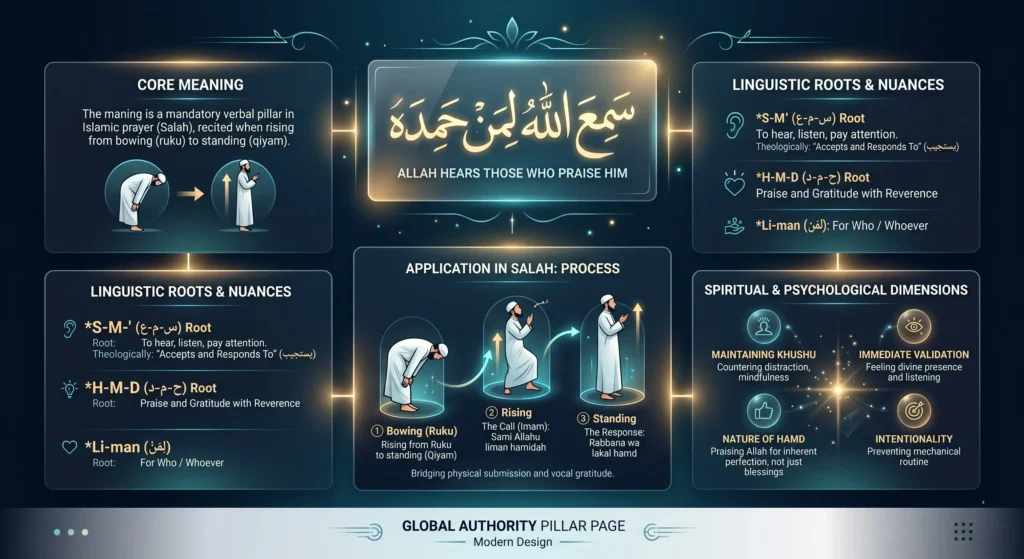
“Sami Allahu liman hamidah” translates to “Allah hears those who praise Him.” It is a required Islamic phrase recited during Salah when rising from the bowing position (ruku) to a standing position. This connects your physical submission directly to vocal gratitude.
To truly grasp the weight of this moment, we need to break down the vocabulary word by word:
- Sami’a (سَمِعَ): Coming from the root S-M-‘, this doesn’t just mean passive hearing. In Islamic theology, it means to accept and respond.
- Allahu (اللَّهُ): The divine name of the Creator.
- Li-man (لِمَنْ): A combination of “li” (to/for) and “man” (whoever).
- Hamidah (حَمِدَهُ): From H-M-D, meaning deep, reverent praise and gratitude.
When you put it together, you aren’t just stating a fact; you are triggering a promise. You are declaring that Allah is actively accepting the gratitude of whoever praises Him right now.
سَمِعَ اللَّهُ لِمَنْ حَمِدَ
Transliteration:
Sami’a Allahu liman hamidah
English Translation:
“Allah hears those who praise Him.”
Urdu Translation: “
اللہ نے اس کی سن لی جس نے اس کی تعریف کی۔”
(Allah ne uss ki sun li jis ne uss ki tareef ki.)
The Response: Rabbana Wa Lakal Hamd
“Rabbana wa lakal hamd” means “Our Lord, to You belongs all praise.” You recite this key supplication immediately after standing upright. When praying behind an Imam, the Imam says “Sami Allahu liman hamidah,” and the congregation follows with this response.
This pairing is an interactive dialogue. The first phrase is the “call,” announcing that Allah is listening. The second phrase is your immediate “response,” ensuring you don’t miss the opportunity to offer that praise.
There are longer, highly rewarding variations of this dua from the Sunnah. A prominent one includes adding: Hamdan katheeran tayyiban mubarakan feeh (Praise that is abundant, pure, and blessed).
The Multilingual Quadrant: Proof from the Sunnah
The practice of reciting these exact phrases is firmly established in authentic hadith. Prophet Muhammad (peace be upon him) commanded believers to match these specific words with the physical movements of standing up from the bowing position.
To ensure complete clarity, here is the foundational proof from Sahih al-Bukhari regarding a companion who added to the praise, prompting an angel to rush to record it:
- Arabic: رَبَّنَا وَلَكَ الْحَمْدُ حَمْدًا كَثِيرًا طَيِّبًا مُبَارَكًا فِيهِ
- Transliteration: Rabbana wa lakal hamd, hamdan katheeran tayyiban mubarakan feeh.
- English (Saheeh Int. Style): “Our Lord, to You be praise, abundant, good, and blessed praise.”
- Urdu (Fateh Muhammad Jalandhari Style): اے ہمارے رب، تیرے ہی لیے تمام تعریفیں ہیں، بہت زیادہ، پاکیزہ اور برکت والی تعریفیں۔
Classical scholars, including Imam Nawawi, noted that adding these words of profound gratitude is highly recommended, as it fills the spiritual space between bowing and prostrating.
Is Sami Allahu Liman Hamidah in the Quran?
No, “Sami Allahu liman hamidah” is not a direct verse found in the Quran. It is an established practice derived from the authentic Sunnah of Prophet Muhammad. However, the themes of Allah hearing our prayers are foundational Quranic concepts.
While you won’t find the exact phrase in a specific Surah, the command to bow, prostrate, and praise Allah is repeated throughout the Quran. The Prophet (PBUH) provided the practical, step-by-step application of those Quranic commands through these words.
The Spiritual Habit Loop Strategy
Applying the Spiritual Habit Loop to Salah helps maintain focus. Rising from ruku acts as your physical trigger, reciting the phrase is the routine, and gaining Allah’s immediate attention is your spiritual reward, preventing prayer from feeling like a chore.
Here is why this matters for you in 2026. Our attention spans are fractured. We are conditioned by notifications and infinite scrolling. By viewing this specific prayer transition as a “Habit Loop,” you can retrain your brain to find stillness.
When you internalize that Allah is actively listening to your praise in that exact millisecond, it builds an immense sense of security. It reinforces the divine protection from worldly anxieties promised to believers who trust Him completely. You stop rushing. You stand still.
If you still find your mind wandering during Salah or struggle to feel the weight of these words, you are not alone. Pairing this reflection outside of prayer with a powerful dua for ease in difficulty can help reset your spiritual focus and clear the mental fog before you stand on your prayer mat.
The Blueprint Sami Allahu Liman Hamidah (PDF)
People Also Ask:
Immediately after standing up and hearing or saying “Sami Allahu liman hamidah,” you should say “Rabbana wa lakal hamd,” which means “Our Lord, and to You belongs all praise.
Yes, it is an established Sunnah to raise your hands to the level of your shoulders or earlobes (Raf’ al-Yadayn) while rising from the bowing position and saying this phrase.
Saying it with deep sincerity aligns you with the angels. According to a hadith in Sahih Al-Bukhari, if your saying of this phrase coincides with the angels saying it, your previous minor sins are forgiven.
If you are praying behind an Imam, the majority of scholars state you only need to say “Rabbana wa lakal hamd” when the Imam says “Sami Allahu liman hamidah.” If you are praying alone, you say both.
Sami Allahu Liman Hamidah: The Blueprint
Download the free, high-resolution visual guide and spiritual habit loop sheet.
