You lift your hands to your ears. You say Allahu Akbar, severing connection with your phone, your work desk, and your family conversations. Your arms fold across your chest. Yet before you reach the second syllable of the opening supplication, your mind has already slipped back into your inbox, your pending bills, or an argument from three hours ago.
Your lips recite Subhanakallahumma wabihamdika entirely from muscle memory. You learned it at age seven, and you speak it today with the exact same mechanical detachment.
This state is called “autopilot Salah.” It leaves you feeling spiritually empty, wondering why five daily prayers do not seem to relieve your anxiety. The Sunnah offers an immediate remedy. The opening supplication, known in classical texts as Dua al-Istiftah and colloquially across South Asian traditions as the Sana, is not an idle introductory ritual. It is a precise psychological valve. When recited with deliberate consciousness, it shuts down worldly noise and anchors your heart before your lips articulate a single word of the Quran.
Quick Answer: The Sana at a Glance
- What It Is: The prophetic opening supplication (Dua al-Istiftah) recited immediately after Takbeer Tahreema and before reciting Surah Al-Fatihah.
- The Core Declaration: An explicit affirmation of Allah’s absolute perfection (Tanzih), supreme greatness (Jadd), and exclusive right to worship (Tawhid).
- Legal Ruling: A confirmed, highly recommended Sunnah (Sunnah Mu’akkadah) across the Hanafi and Hanbali traditions; omitting it does not invalidate the prayer.
Table of Contents
- What is the Full Meaning of Subhanakallahumma Wabihamdika?
- Word-by-Word Arabic Breakdown
- When Do You Recite Sana in Prayer?
- The 90-Second Reset: How to Break Autopilot Prayer
- Ruling and Comparisons: Mandatory vs. Sunnah Acts
- Western Application: Finding Focus Under Modern Pressures
- Frequently Asked Questions
- Action Steps for Your Next Salah
What is the Full Meaning of Subhanakallahumma Wabihamdika?
The Sana is an opening declaration that acknowledges Allah is completely free from every imaginable flaw, human limitation, and deficiency. By praising Him before asking for guidance, you align your mind with divine sovereignty, creating immediate humility and silencing internal self-importance before beginning the recitation of the Quran.
Here is the authentic text as preserved across major classical collections:
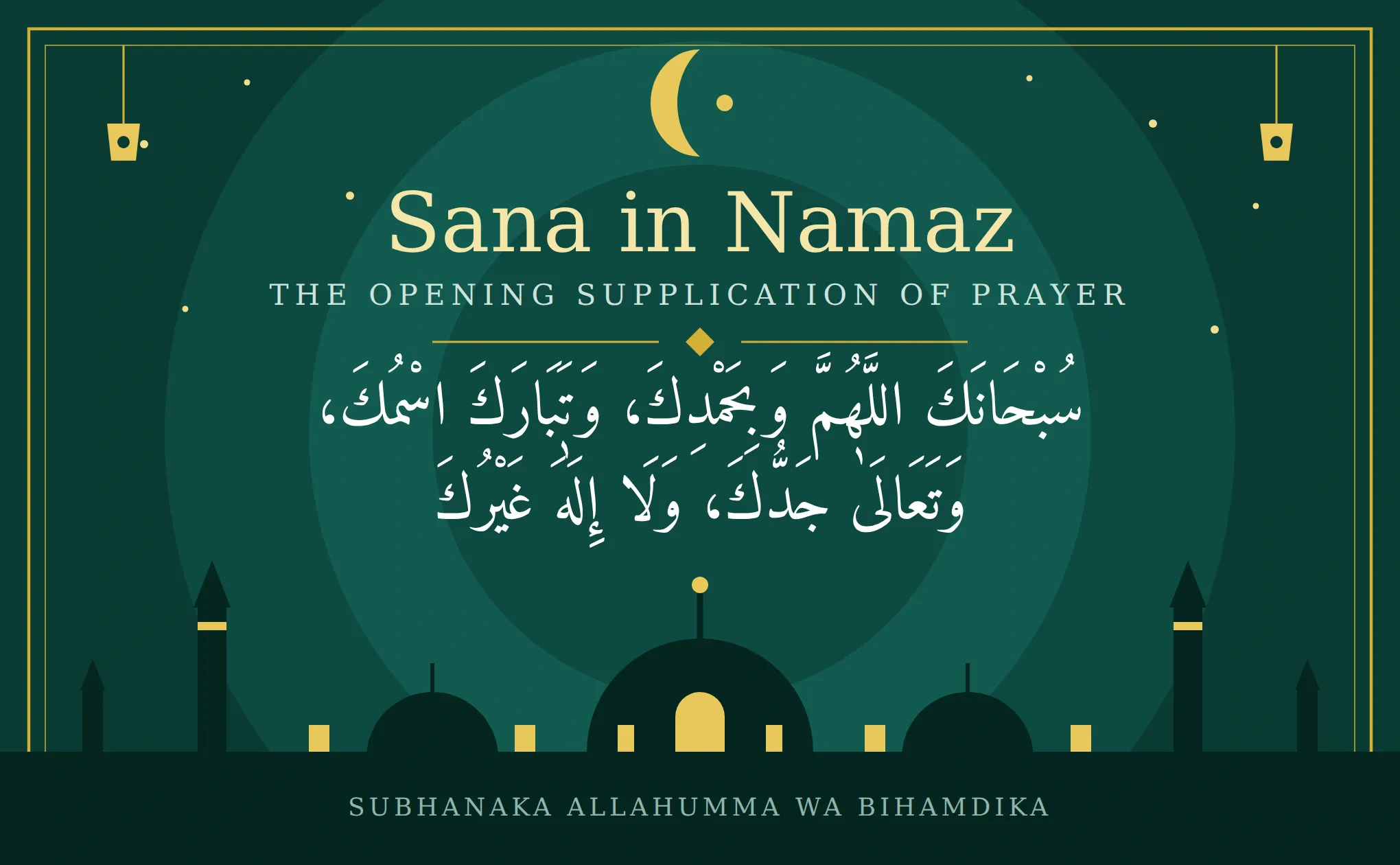
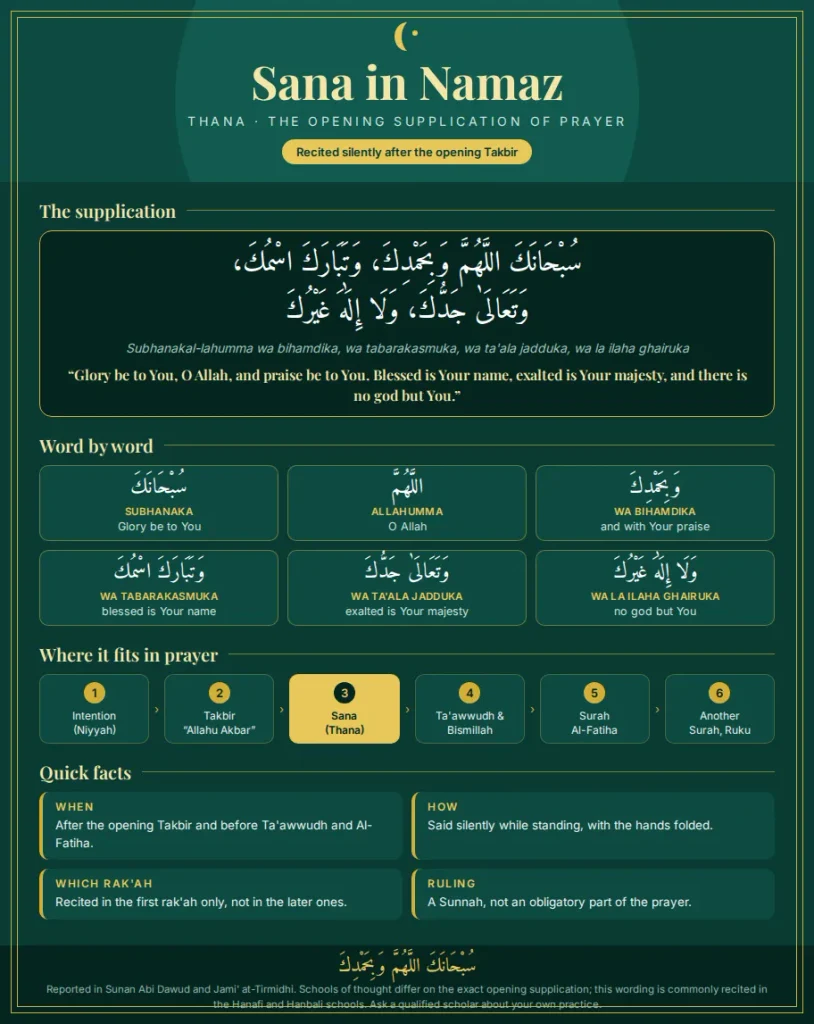
- Arabic verse: سُبْحَانَكَ اللَّهُمَّ وَبِحَمْدِكَ، وَتَبَارَكَ اسْمُكَ، وَتَعَالَىٰ جَدُّكَ، وَلَا إِلَٰهَ غَيْرُكَ
- Transliteration: Subḥānakallāhumma wa-biḥamdika, wa-tabārakasmuka, wa-ta‘ālā jadduka, wa-lā ilāha ghayruk.
- English Translation: “Glory be to You, O Allah, and all praise is Yours. Blessed is Your name, exalted is Your majesty, and there is no deity worthy of worship besides You.”
- Urdu Translation: “اے اللہ! تو پاک ہے اور تیری ہی تعریف ہے، اور تیرا نام برکت والا ہے، اور تیری شان بہت بلند ہے، اور تیرے سوا کوئی معبود نہیں۔”
- Hindi Translation: “ऐ अल्लाह! तू पाक है और तेरी ही तारीफ़ है, और तेरा नाम बरकत वाला है, और तेरी शान बहुत बुलंद है, और तेरे सिवा कोई मा’बूद नहीं।”
- Primary Source: Recorded in Sunan Abi Dawud (Book of Prayer, Hadith 775) and Jami` at-Tirmidhi (Hadith 242) from Aisha (may Allah be pleased with her); also established as the regular audible opening of Umar ibn al-Khattab (may Allah be pleased with him) in Sahih Muslim (Hadith 399).
Word-by-Word Arabic Breakdown
To dismantle mechanical recitation, your intellect must register every morpheme. When your intellect understands what your tongue articulates, wandering thoughts cannot occupy the cognitive foreground.
| Arabic | Transliteration | Root Meaning & Nuance | English Translation |
| سُبْحَانَكَ | Subḥānaka | From s-b-h (to swim/float above). To declare Allah high above any flaw, error, partner, or weariness. | Glory be to You / You are Pure |
| اللَّهُمَّ | Allāhumma | Direct vocative invocation combining the divine name Allah with the terminal mim of supreme reverence. | O Allah |
| وَبِحَمْدِكَ | Wa-biḥamdik | Pairing transcendence (Tasbeeh) with active gratitude (Tahmeed). His praise is intrinsic and eternal. | And with Your praise |
| وَتَبَارَكَ | Wa-tabāraka | From b-r-k (enduring abundance). His name imparts infinite grace and divine blessings to whatever it touches. | And blessed is |
| اسْمُكَ | Ismuka | The designation by which the Creator makes Himself known to creation. | Your name |
| وَتَعَالَىٰ | Wa-ta‘ālā | Elevated beyond human comprehension, spatial limits, or royal pretensions. | And exalted is |
| جَدُّكَ | Jadduka | Classical linguistic meaning: grandeur, majesty, all-encompassing self-sufficiency, and power. | Your majesty / glory |
| وَلَا إِلَٰهَ | Wa-lā ilāha | Absolute categorical negation: not a single thing in the universe possesses divine authority. | And there is no god |
| غَيْرُكَ | Ghayruka | Exclusionary emphasis: the Creator alone commands total obedience, devotion, and love. | Other than You |
When Do You Recite Sana in Prayer?
You recite the Sana exclusively in the first Rakat (unit of prayer), immediately after the opening Takbeer Tahreema and before seeking refuge from Satan (Ta’awwudh). It is uttered in a low, whisper-level voice across all prayers, whether the subsequent recitation is loud or silent.
To follow the prophetic sequence accurately, ensure your progression follows these verified procedural steps:
- The Entry Threshold: After the iqamah establishes the prayer, pronounce the Takbeer Tahreema. The moment your hands settle, you enter the sacred boundary of Salah. For visual posture placement, review our step-by-step guide to Namaz.
- The Quiet Whispering: Recite the Sana silently to yourself. Even during audible prayers such as Fajr and Maghrib, the opening supplication remains silent (Sirri).
- Congregational Etiquette: According to the Hanafi school, the follower (Muqtadi) recites the Sana silently behind the Imam during the brief silence following the Imam’s opening Takbeer.
- Transition to Quranic Recitation: Once finished, begin reciting seeking refuge (Ta’awwudh) and Basmalah, moving seamlessly into the mandatory recitation of Surah Al-Fatihah.
The 90-Second Reset: How to Break Autopilot Prayer
Autopilot prayer is broken by creating an intentional micro-pause before your lips begin moving. The 90-Second Reset uses the three conceptual shifts of the Sana to anchor your attention before the onset of mental fatigue or intrusive thoughts.
[SCHOLAR ANECDOTE: “Over my years of teaching, the most frequent complaint I hear from young students is that their mind wanders the exact moment they fold their hands. A few years ago, I began assigning them a strict rule: do not let your tongue move for two full seconds after the opening Takbeer. Those two seconds of deliberate silence forced them to transition from the chaos of their day into the presence of their Creator. Invariably, they return to me weeks later, explaining how that tiny, intentional pause completely broke their habit of mechanical recitation and finally brought true peace to their Salah.”]
- Beat 1: The Cosmic Reality Check (Subḥānaka). Before vocalizing the letters, visualize the gap between your flawed human existence and Allah’s absolute perfection. You carry missed deadlines and emotional fatigue. By saying Subhanaka, you announce that Allah needs nothing from this prayer, yet He has granted you permission to speak with Him.
- Beat 2: The Severing of Material Dependence (Jadduka). The word Jadd signifies complete worldly dominance and greatness. When anxiety consumes your mind, it is usually because an earthly challenge feels unmanageable. By declaring Wa-ta‘ālā jadduka, you reduce that massive problem back down to its proper human scale.
- Beat 3: The Radical Monotheism Anchor (Wa-lā ilāha ghayruk). Finish the supplication by consciously casting aside secondary attachments. You declare that no corporate title or domestic stress possesses power over your soul. This deliberate internal focus acts as a protective shield against the whispers of distraction (waswasa) that typically attack a believer at the start of worship.
Ruling and Comparisons: Mandatory vs. Sunnah Acts
Reciting the Sana is a recommended Sunnah (Sunnah Mustahabbah), not an obligatory pillar (Fard). If your mind slips and you immediately begin Surah Al-Fatihah, your prayer remains fully valid without needing to perform prostrations of forgetfulness (Sajdah as-Sahw).
| Action in Prayer | Fiqh Category | Legal Consequence if Forgotten | Spiritual Objective |
| Takbeer Tahreema | Fard (Pillar) | Prayer does not initiate; invalid. | Absolute severance from the world. |
| Reciting Sana | Sunnah (Recommended) | Prayer is fully valid; no penalty. | Preparing the heart for divine speech. |
| Surah Al-Fatihah | Fard / Wajib | Invalid or requires Sajdah Sahw. | Direct dialogue with Allah. |
| Ruku & Sujood | Fard (Pillar) | Prayer is invalid; must be repeated. | Physical manifestation of humility. |
Frequently Asked Questions
Is the Sana mandatory for my prayer to be accepted?
Reciting the Sana is a confirmed prophetic Sunnah, not a mandatory pillar (Fard). If you accidentally omit it and begin reciting Surah Al-Fatihah, continue your prayer normally. Your Salah is valid, and you are not required to perform Sajdah as-Sahw.
Do I recite the Sana in every single Rakat?
You recite the Sana exclusively in the first Rakat of the prayer immediately after the opening Takbeer. After the initial unit, subsequent Rakats begin directly with Ta’awwudh or Surah Al-Fatihah. It is never repeated in the second, third, or fourth Rakat.
What should I do if I join the congregation late?
If you arrive while the Imam is standing and reciting aloud, recite your opening Takbeer, then listen attentively without saying the Sana. If the Imam is reciting silently (such as in Zuhr), you may recite the Sana swiftly before listening.
Which hadith collections authenticate this specific phrasing?
This exact phrasing is recorded in Sunan Abi Dawud (Hadith 775), Jami` at-Tirmidhi (Hadith 242), Sunan an-Nasa’i (Hadith 899), and Sunan Ibn Majah (Hadith 804). The foundational report is graded authentic (Sahih) by classical and contemporary hadith scholars.
Action Steps for Your Next Salah
Rebuilding mindfulness in your daily prayer begins with changing how you approach the very first sentence you speak on the prayer mat today.
- Ensure your physical state matches your spiritual state by reading the supplications after making wudu before standing on the mat.
- Pause for two seconds after raising your hands for Takbeer before reciting Subhanakallahumma.
- Complement your presence by learning the supplications after completing prayer to maintain emotional peace throughout your day.
Content reviewed and approved by Shshab Khan. This educational guide is designed for personal spiritual enrichment and does not replace professional pastoral counseling.
