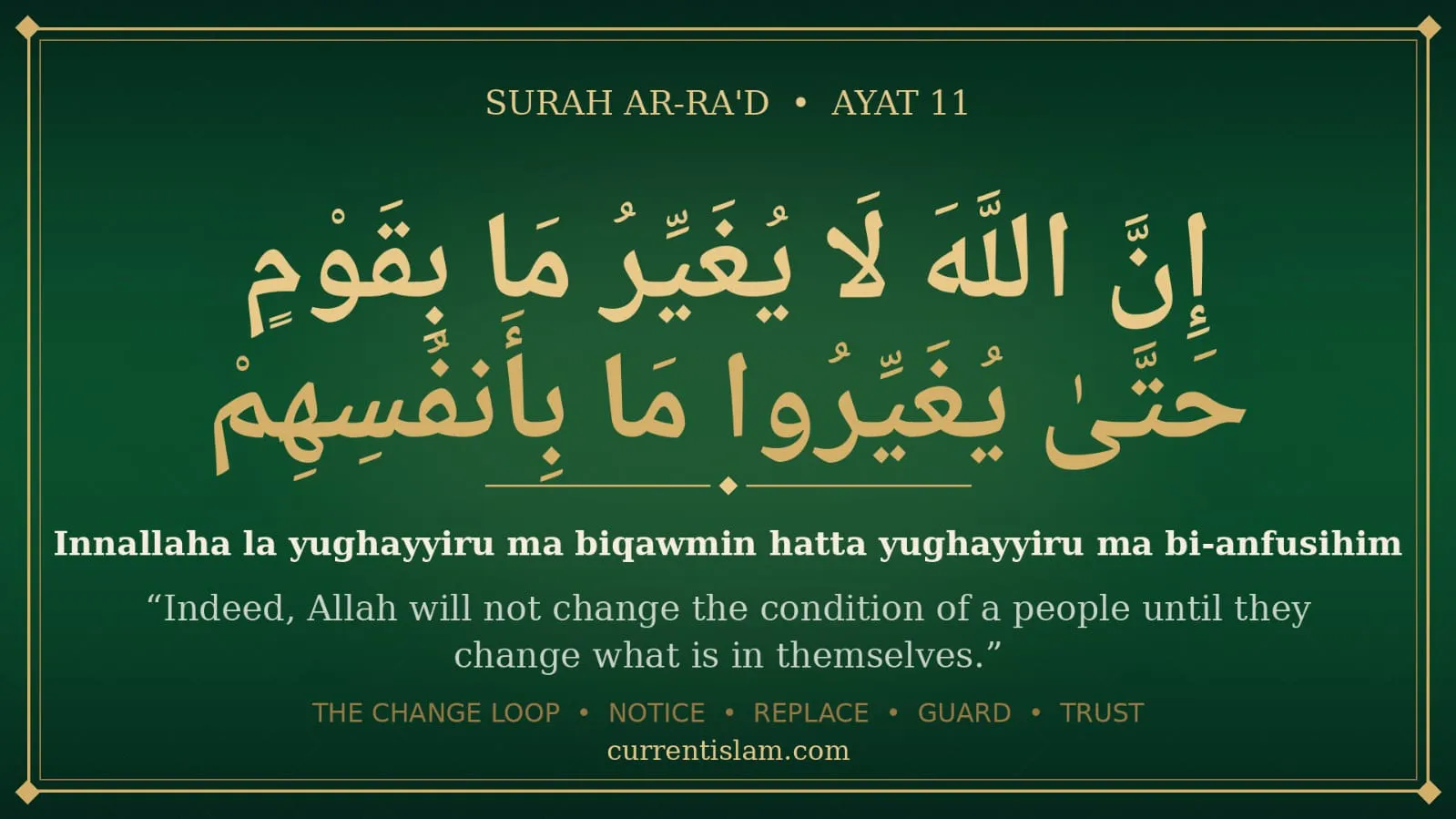
“Allah will not change the condition of a people until they change what is in themselves.” You have heard this sentence a hundred times. But most of us quote only the middle of the verse — and a half-quoted verse can mislead as easily as it can inspire. Before it, Allah speaks of angels guarding you, before and behind, by His decree. After it, He warns that when He intends harm for a people, no one can turn it back. The full verse is bigger — and harder — than the slogan. This article reads all of Surah Ar-Ra’d 13:11: the guards you cannot see, the change that must start inside, and the warning that keeps the promise honest.
The Verse in Full
Arabic:
لَهُۥ مُعَقِّبَـٰتٌ مِّنۢ بَيْنِ يَدَيْهِ وَمِنْ خَلْفِهِۦ يَحْفَظُونَهُۥ مِنْ أَمْرِ ٱللَّهِ ۗ إِنَّ ٱللَّهَ لَا يُغَيِّرُ مَا بِقَوْمٍ حَتَّىٰ يُغَيِّرُوا۟ مَا بِأَنفُسِهِمْ ۗ وَإِذَآ أَرَادَ ٱللَّهُ بِقَوْمٍ سُوٓءًا فَلَا مَرَدَّ لَهُۥ ۚ وَمَا لَهُم مِّن دُونِهِۦ مِن وَالٍ
Transliteration: Lahu mu’aqqibatun min bayni yadayhi wa min khalfihi yahfazunahu min amrillah. Innallaha la yughayyiru ma biqawmin hatta yughayyiru ma bi-anfusihim. Wa idha aradallahu biqawmin su’an fa la maradda lah, wa ma lahum min dunihi min wal.
English (Sahih International): For him [i.e., each one] are successive [angels] before and behind him who protect him by the decree of Allah. Indeed, Allah will not change the condition of a people until they change what is in themselves. And when Allah intends for a people ill, there is no repelling it. And there is not for them besides Him any patron. (Sahih International)
Urdu:
ہر شخص کے آگے اور پیچھے یکے بعد دیگرے آنے والے فرشتے ہیں جو اللہ کے حکم سے اس کی حفاظت کرتے ہیں۔ بے شک اللہ کسی قوم کی حالت نہیں بدلتا جب تک وہ خود اپنے آپ کو نہ بدل ڈالیں۔ اور جب اللہ کسی قوم کے ساتھ برائی کا ارادہ کر لے تو اسے کوئی ٹال نہیں سکتا، اور اس کے سوا ان کا کوئی مددگار نہیں۔
Hindi: हर व्यक्ति के आगे और पीछे एक के बाद एक आने वाले फ़रिश्ते हैं, जो अल्लाह के हुक्म से उसकी हिफ़ाज़त करते हैं। निस्संदेह अल्लाह किसी क़ौम की हालत नहीं बदलता, जब तक वे स्वयं अपने आपको न बदल डालें। और जब अल्लाह किसी क़ौम के साथ बुराई का इरादा कर ले, तो उसे कोई टाल नहीं सकता, और उसके सिवा उनका कोई मददगार नहीं।
| Arabic Word | Transliteration | English Meaning |
|---|---|---|
| إِنَّ اللَّهَ | Inna Allaha | Indeed, Allah |
| لَا يُغَيِّرُ | la yughayyiru | will not change |
| مَا بِقَوْمٍ | ma biqawmin | what is with a people / their condition |
| حَتَّىٰ يُغَيِّرُوا | hatta yughayyiru | until they change |
| مَا بِأَنفُسِهِمْ | ma bi-anfusihim | what is within themselves |
Guarded Before and Behind
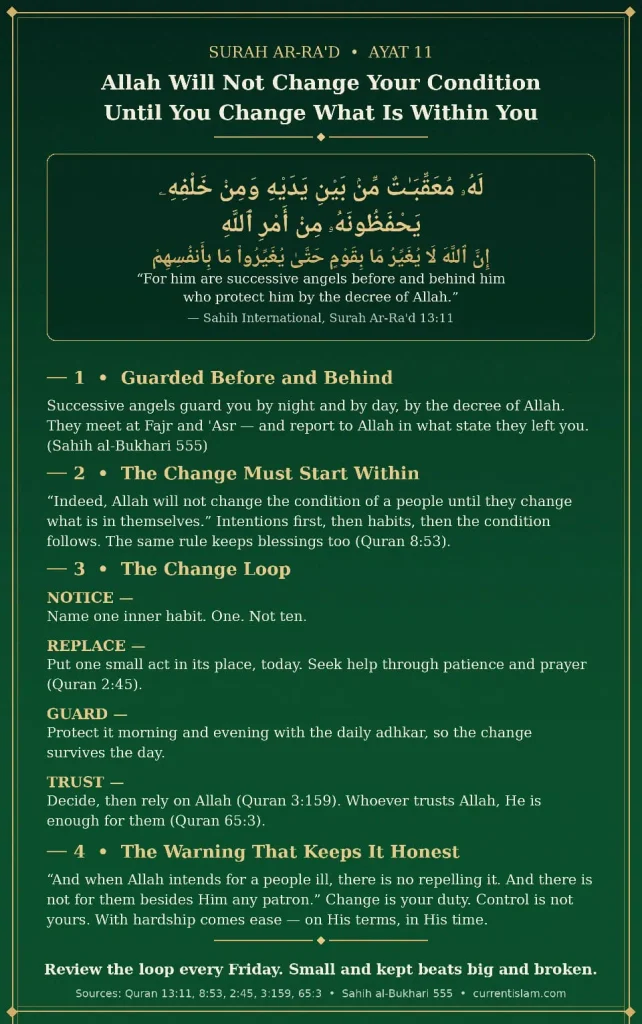
The verse opens with a fact most of us forget by noon: “For him are successive angels before and behind him who protect him by the decree of Allah.” Mu’aqqibat means those who come one after another, in turns — one group by night, another by day — and you are never left unguarded, not for a single hour. That protection is not a reward for being good; it is Allah’s decree for every person. The Manzil, the daily shield of protection is built on exactly this: asking the Guardian to keep what He already guards.
The Prophet (peace be upon him) described how it works: “Angels come to you in succession by night and day and all of them get together at the time of the Fajr and ‘Asr prayers… The angels reply: ‘When we left them they were praying, and when we reached them, they were praying.’” (Sahih al-Bukhari 555) The angels’ report about you is written at the two prayers — and it can say, “we left them praying.” Ayatul Kursi, the greatest verse of protection carries the same truth: He neither slumbers nor sleeps while He guards you.
And notice whose decree does the guarding. The angels are the means; Allah is the Protector. That is why the verse says “by the decree of Allah” — so you thank Him, not them, and call on Him by His names when you feel unprotected. Among them are Ya Hafizu Ya Salamu, the Guardian and the Peace — the One who preserves you, and the One whose very name is peace.
“Until They Change What Is in Themselves”
Then comes the turn — the sentence everyone quotes. “Indeed, Allah will not change the condition of a people until they change what is in themselves.” A people’s condition means everything around them: their safety, their provision, their dignity, their unity. And Allah ties its changing to one place: what is within themselves. Not wealth, enemies or luck — intentions, habits, and turning from disobedience back to obedience. Actions are judged by intentions — so the change starts where no one can see it but Him.
The same rule runs the other way, too. Allah says: “That is because Allah would not change a favor which He had bestowed upon a people until they change what is within themselves.” (Surah Al-Anfal 8:53) Blessings are kept by the same inner change that brings them. And the inward turn has a name you already know: dua — Allah is near and answers the caller — “And when My servants ask you concerning Me, indeed I am near. I respond to the invocation of the supplicant when he calls upon Me.” (Surah Al-Baqarah 2:186)
Be honest about what this verse does not promise. It is not a self-help guarantee that positive thinking will make you rich, or that one good habit buys a new life. It is Allah’s way with peoples: the outward follows the inward, and the outcome stays His. No fixed wazifa count is prescribed for this verse, and none is given here — the verse asks for a turned heart and a moved hand, not a number.
The Change Loop: Four Small Steps, Every Day
If the change must start within, it must also start small. Big resolutions collapse by Friday; small acts survive. Here is the loop the verse teaches — four steps, repeated daily, reviewed weekly.
- 1. Notice. Name one inner habit, honestly, without blaming anyone else: the complaint you repeat each morning, the prayer you always delay, the grudge you keep rehearsing. One habit — not ten.
- 2. Replace. Put one small act in its place, today, not “from Monday”: one page of Quran, one prayer on time, one kind word to the person you avoid. When the old habit pulls back, seek help through patience and prayer (Quran 2:45).
- 3. Guard. Protect the new habit the way the angels protect you: morning and evening. Tie it to something you never skip — Fajr, breakfast, the walk to work — and guard it with the daily remembrances.
- 4. Trust. Decide, then rely on Allah. Do your step, and leave the result with Him. The loop only works if the last step is trust, not control.
Patience is not waiting; it is holding the new habit while the old one protests. Prayer is the fuel, not a pause. That is why the loop is daily — seek help through patience and prayer — every day, not only when hardship peaks.
Guard it with the same rhythm the angels keep: morning and evening. The morning and evening adhkar are short and fixed — a shield you put on twice a day, so the change made at Fajr still stands at Maghrib.
Then trust. “And when you have decided, then rely upon Allah.” (Surah Al-Imran 3:159) Decide first — the decision is yours. Then rely — the outcome is His. Once you decide, put your trust in Allah — and keep the decision small enough to keep.
And Allah promises the one who trusts Him: “And whoever relies upon Allah — then He is sufficient for him.” (Surah At-Talaq 65:3) Whoever puts their trust in Allah will find Him enough — and a way out from where they never expected it.
Review every Friday: did the inside move, even a little? If yes, keep the step and add nothing. If no, shrink it — five minutes instead of thirty, one verse instead of one page — but do not abandon it. Small and kept beats big and broken.
The Warning in the Third Part
The verse does not end with the promise. It ends with a warning: “And when Allah intends for a people ill, there is no repelling it. And there is not for them besides Him any patron.” No army, no wealth, no connection and no plan can push it back, and no one besides Him can protect them. This is the verse’s guardrail: change is your duty, but control is not yours. The same verse that gives you agency takes away your arrogance — and that is why it can be trusted. A verse that only promised ease would be a slogan; this one tells the whole truth.
So hold both halves together. Your part is the inward turn: the intention, the small act, the guarded habit. Allah’s part is the outcome: the opening, the protection, the change of condition. And between the two sits the hardest lesson — ease comes on His terms and in His time. With hardship comes ease — not always at once, not always as you pictured it, but surely, because He said so. Your job is to stay in the loop until it comes.
Frequently Asked Questions
No. Allah’s help comes from His grace, not as a wage for your effort. The verse states His way: He ties outward change to an inward turning. You move — and you ask Him for the outcome. The help is His; the turning is yours.
Intentions, repentance, and habits — one small act at a time. A prayer kept on time. A sin left alone. A grudge released. The verse speaks of a people, but it starts with one person: you.
Angels who come one after another, by night and by day, guarding each person by Allah’s decree. The Prophet (peace be upon him) said they meet at the Fajr and ‘Asr prayers, and report to Allah in what state they left His servants (Sahih al-Bukhari 555).
A Greeting That Outlives the Moment
You are guarded by angels you cannot see, commanded to change what only you can reach, and warned that no protector besides Allah exists. That is the whole of Ar-Ra’d 13:11 — and it is enough for a lifetime. Start the loop today: notice one inner habit, replace it with one small act, guard it morning and evening, and trust the outcome to Him. If you have already fallen far from where you want to be, start anyway — do not despair of the mercy of Allah — the door of return is open, and the change of a people has always begun with the change of one person. Indeed, Allah will not change the condition of a people until they change what is in themselves. Change what is in yourself — and leave the rest to Him.
Sources
- Quran 13:11 and 8:53 — Sahih International translation, verified live via the Quran.com API on 2026-11-23. Arabic text is the Uthmani script.
- Quran 2:45, 2:186, 3:159, 65:3 — quoted in Sahih International wording.
- Sahih al-Bukhari 555 — angels in succession by night and day, meeting at Fajr and ‘Asr; verified live on Sunnah.com on 2026-11-23.
- Urdu and Hindi renderings in this article are the author’s own; a scholar should check them against the printed Fateh Muhammad Jalandhari (Urdu) and Maulana Azizul Haque al-Umari (Hindi) editions before those edition names are added. See ar-rad-13-11-review.md.
- No fixed wazifa count is prescribed for this verse. No hadith numbering beyond Bukhari 555 is cited.
