Quick Answer
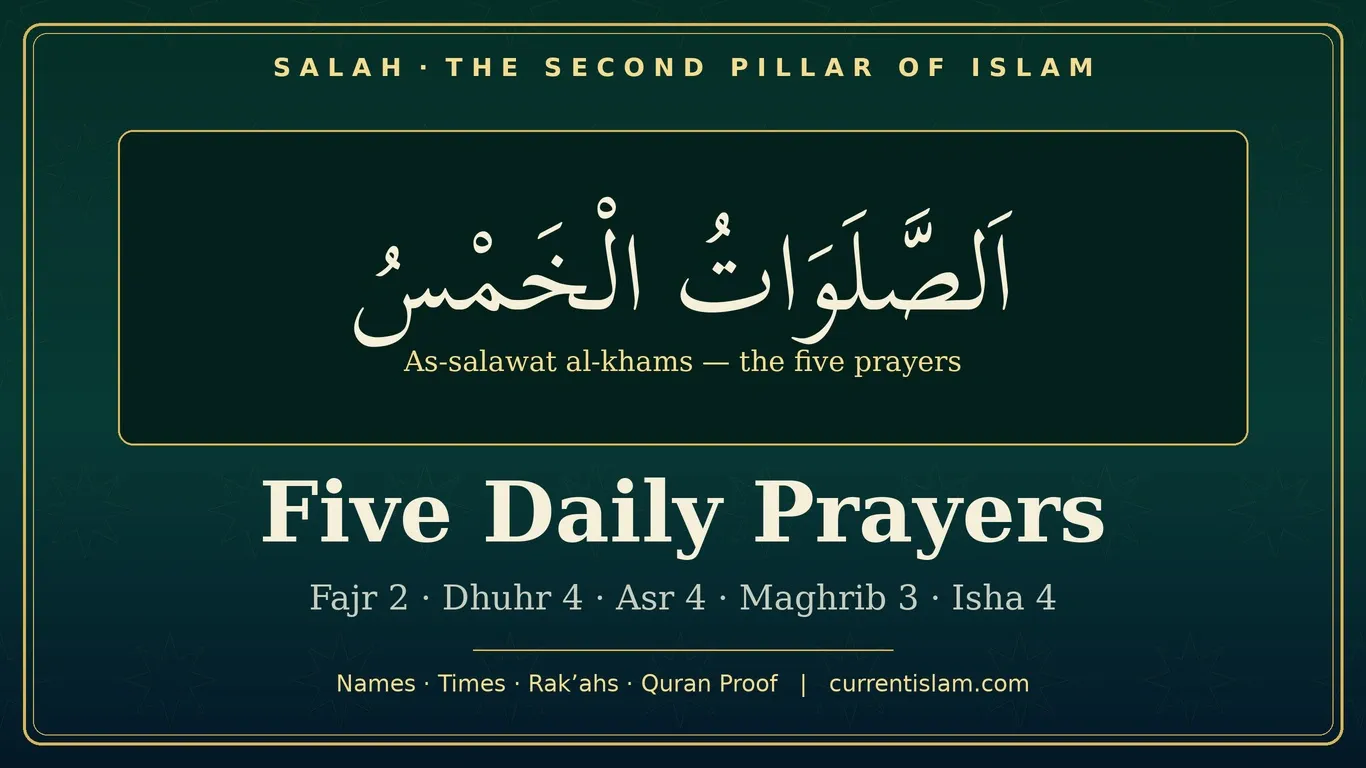
The five daily prayers are Fajr (dawn, 2 rak’ahs), Dhuhr (midday, 4), Asr (afternoon, 4), Maghrib (sunset, 3) and Isha (night, 4) — 17 obligatory rak’ahs in total.
Each prayer has a window set by the sun, not the clock, so times move a little every day and differ by city.
Short on time or just starting? Pray the obligatory rak’ahs first, inside their windows. That is the duty itself.
Picture a weekday that runs away from you. The alarm goes, the commute fills up, messages stack in the family group chat, and by the time you sit down at night you cannot say where the hours went.
Salah, the ritual prayer, is Allah’s own answer to that drift. The five daily prayers are the five set prayers — Fajr, Dhuhr, Asr, Maghrib and Isha — that every adult Muslim prays inside their sun-set windows, returning to Allah before the day pulls them too far. See our Salah & Daily Prayers guides for each prayer in detail.
This page gives you the whole picture in one place: the names, windows, counts, Quran and hadith proof, and a plain way to hold all five on a working day.
Start here:
[New to Islam? Start with what the five prayers are](#what-are) · [Returning to prayer? Jump to fitting five prayers into your day](#fit-your-day) · [Sent this link? Read the Quran evidence first](#in-the-quran)
Contents
What are the five daily prayers?
Are the five daily prayers in the Quran?
The five prayers, one by one
Why do Muslims pray five times a day?
How do you fit five prayers into a working day?
What happens if you miss a prayer?
Frequently asked questions
What are the five daily prayers?
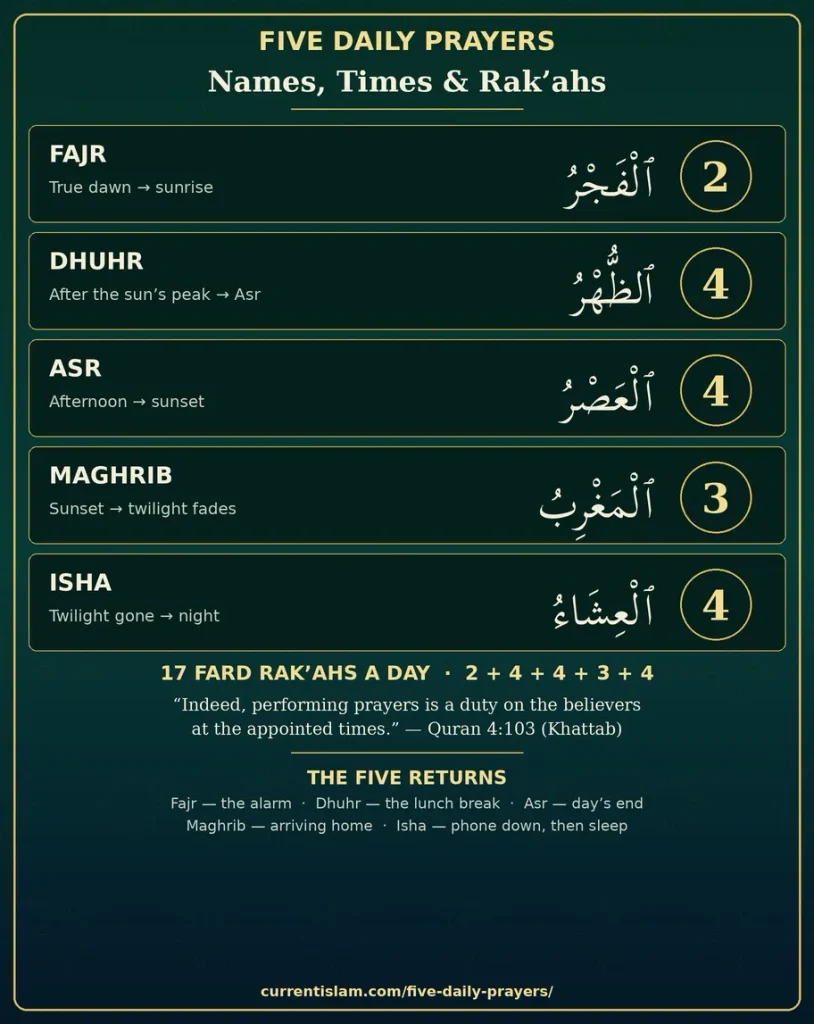
The five daily prayers are Fajr at dawn, Dhuhr after midday, Asr in the afternoon, Maghrib just after sunset, and Isha at night. Together they hold seventeen obligatory rak’ahs, the units of prayer: two, four, four, three, and four, prayed inside set windows daily.
A rak’ah, one unit of prayer, is a single cycle of standing and reciting, bowing, and two prostrations. Fard means obligatory: the part of each prayer that is a duty, distinct from the extra sunnah rak’ahs, the units the Prophet ﷺ prayed regularly around it. The namaz rakat table counts them prayer by prayer.
Salah is the second of the five pillars of Islam, the five foundations of Muslim practice. The Prophet ﷺ stated the count plainly to a man who had come asking what Islam required of him:
“You have to offer prayers perfectly five times in a day and night (24 hours).” The man asked, “Is there any more (praying)?” Allah’s Messenger (ﷺ) replied, “No, but if you want to offer the Nawafil prayers (you can).” (Sahih al-Bukhari 46)
Nawafil means voluntary prayers, offered beyond the duty. That exchange settles two things: five is the obligation, and anything beyond five is a gift you choose, never a burden placed on you.
| Prayer | Window opens | Window closes | Fard rak’ahs | Recitation |
|---|---|---|---|---|
| Fajr | True dawn | Sunrise | 2 | Aloud |
| Dhuhr | After the sun passes its peak | When Asr begins | 4 | Quiet |
| Asr | Afternoon, by shadow length | Sunset | 4 | Quiet |
| Maghrib | Sunset | When twilight fades | 3 | First two aloud |
| Isha | When twilight has gone | Later in the night | 4 | First two aloud |
Are the five daily prayers in the Quran?
The Quran commands prayer at fixed times and marks the day’s turning points, while the Prophet ﷺ fixed the number at five in practice. Surah An-Nisa 4:103 calls prayer a duty at appointed times, and Surah Al-Isra 17:78 spans from midday decline to the dawn prayer itself.
No single verse lists all five names in a row, and honesty matters here. What the Quran gives is the frame: prayer tied to set times, and windows described by the sun. The Sunnah, the Prophet’s ﷺ practice and teaching, fills that frame with five named prayers.
فَإِذَا قَضَيْتُمُ ٱلصَّلَوٰةَ فَٱذْكُرُوا۟ ٱللَّهَ قِيَـٰمًا وَقُعُودًا وَعَلَىٰ جُنُوبِكُمْ ۚ فَإِذَا ٱطْمَأْنَنتُمْ فَأَقِيمُوا۟ ٱلصَّلَوٰةَ ۚ إِنَّ ٱلصَّلَوٰةَ كَانَتْ عَلَى ٱلْمُؤْمِنِينَ كِتَـٰبًا مَّوْقُوتًا
Fa-idha qadaytum as-salata fadhkurullaha qiyaman wa qu’udan wa ‘ala junubikum, fa-idha itma’nantum fa-aqimu as-salah, inna as-salata kanat ‘ala al-mu’minina kitaban mawquta.
English (Khattab, The Clear Quran): “When the prayers are over, remember Allah—whether you are standing, sitting, or lying down. But when you are secure, establish regular prayers. Indeed, performing prayers is a duty on the believers at the appointed times.” (Surah An-Nisa 4:103)
Urdu (Jalandhari):
پھر جب تم نماز تمام کرچکو تو کھڑے اور بیٹھے اور لیٹے (ہر حالت میں) خدا کو یاد کرو پھر جب خوف جاتا رہے تو (اس طرح سے) نماز پڑھو (جس طرح امن کی حالت میں پڑھتے ہو) بےشک نماز کا مومنوں پر اوقات (مقررہ) میں ادا کرنا فرض ہے
| Arabic phrase (4:103) | Transliteration | Meaning |
|---|---|---|
| ٱلصَّلَوٰةَ | as-salata | the prayer |
| كَانَتْ | kanat | is, has always been |
| عَلَى ٱلْمُؤْمِنِينَ | ‘ala al-mu’minina | upon the believers |
| كِتَـٰبًا | kitaban | a written decree, a duty |
| مَّوْقُوتًا | mawquta | fixed to appointed times |
أَقِمِ ٱلصَّلَوٰةَ لِدُلُوكِ ٱلشَّمْسِ إِلَىٰ غَسَقِ ٱلَّيْلِ وَقُرْءَانَ ٱلْفَجْرِ ۖ إِنَّ قُرْءَانَ ٱلْفَجْرِ كَانَ مَشْهُودًا
Aqim as-salata li-duluk ash-shamsi ila ghasaq al-layli wa Qur’an al-fajr, inna Qur’an al-fajr kana mashhuda.
English (Khattab, The Clear Quran): “Observe the prayer from the decline of the sun until the darkness of the night and the dawn prayer, for certainly the dawn prayer is witnessed ˹by angels˺.” (Surah Al-Isra 17:78)
Urdu (Jalandhari):
(اے محمدﷺ) سورج کے ڈھلنے سے رات کے اندھیرے تک (ظہر، عصر، مغرب، عشا کی) نمازیں اور صبح کو قرآن پڑھا کرو۔ کیوں صبح کے وقت قرآن کا پڑھنا موجب حضور (ملائکہ) ہے
Read together, the verses cover the arc of a day. Surah Hud 11:114 commands prayer at both ends of the day and in the early part of the night. Surah Al-Baqarah 2:238 tells believers to observe the prayers and singles out the middle prayer, which Jalandhari’s Urdu names directly as Asr.
حَـٰفِظُوا۟ عَلَى ٱلصَّلَوَٰتِ وَٱلصَّلَوٰةِ ٱلْوُسْطَىٰ وَقُومُوا۟ لِلَّهِ قَـٰنِتِينَ
Hafizu ‘ala as-salawati was-salat al-wusta wa qumu lillahi qanitin.
English (Khattab, The Clear Quran): “Observe the ˹five obligatory˺ prayers—especially the middle prayer—and stand in true devotion to Allah.” (Surah Al-Baqarah 2:238)
Urdu (Jalandhari):
(مسلمانو) سب نمازیں خصوصاً بیچ کی نماز (یعنی نماز عصر) پورے التزام کے ساتھ ادا کرتے رہو۔ اور خدا کے آگے ادب سے کھڑے رہا کرو
Surah An-Nur 24:58 also names two prayers outright, speaking of the time before the dawn prayer and after the late evening prayer. Fajr and Isha stand in the text by name; the rest stand by their times.
The five prayers, one by one
Fajr — the prayer that opens the day
Fajr runs from true dawn, when light first spreads across the horizon, until sunrise, and it holds two fard rak’ahs recited aloud. It is the window sleep fights hardest. Set the alarm across the room, and let this prayer set the day’s direction before your phone does. Our Fajr prayer guide gives the steps.
Dhuhr — the midday pause
Dhuhr, also spelled Zuhr, begins once the sun has passed its highest point and runs until Asr, holding four quiet fard rak’ahs. For most people it lands inside work or school, and its gift is this: a short pause at the busiest hour. A lunch break, a quiet corner, ten unhurried minutes. The Zuhr namaz rakat guide gives the method.
Asr — the middle prayer, guarded
Asr holds four quiet fard rak’ahs in the afternoon. Its start is where schools of law, the madhhab traditions, differ: when a shadow equals the object’s length, or twice it in the Hanafi school. Your local timetable follows one ruling; follow it, and pray Asr before the light turns.
Maghrib — pray it promptly
Maghrib begins the moment the sun has set and ends when the twilight fades, the shortest window of the five. It holds three fard rak’ahs, the only odd count in the day, the first two recited aloud. Because the window is brief, the habit is simple: pray before you sit down to eat or scroll.
Isha — closing the day with Allah
Isha begins when the twilight has fully gone and holds four fard rak’ahs, the first two aloud. It is the day’s closing conversation, prayed at home or in congregation before sleep. Many Muslims pray Witr, an extra night prayer, after it; Witr is not one of the five, and its ruling differs by school. Our Isha rakats page counts them.
Why do Muslims pray five times a day?
Muslims pray five times a day because Allah made five prayers the duty in a day and night, no more and no less. The Prophet ﷺ received the command on the Night Journey, and he confirmed the number plainly when a new Muslim asked him directly.
The Night Journey, Al-Isra wal-Mi’raj, is the night the Prophet ﷺ was taken from Makkah upward through the heavens. Sahih al-Bukhari 349 records that fifty prayers were first enjoined, then reduced as he returned to ask, until Allah said:
“These are five prayers and they are all (equal to) fifty (in reward) for My Word does not change.” (Sahih al-Bukhari 349)
Five that a working person can actually keep, carrying the reward of fifty. The reduction is mercy, not a loophole, and it explains why the number is five rather than a round ten or a symbolic three.
The Prophet ﷺ also gave the five a picture no one forgets. He pictured a river at a person’s door, used for bathing five times a day, and said:
“That is the example of the five prayers with which Allah blots out (annuls) evil deeds.” (Sahih al-Bukhari 528)
Tawakkul, trusting Allah with outcomes, and sabr, patient endurance, both grow in that rhythm. You return before the day’s small failures harden, and you hand the day back to its Owner five times instead of once.
How do you fit five prayers into a working day?
Fit the five prayers into a working day by building the day around their windows instead of squeezing prayer into leftover minutes. Check the day’s times each morning, attach each prayer to an event you never skip, and pray the fard first whenever time runs short.
Call the method the Five Returns. Each prayer is a return: you leave work, school, the commute or the family chat for a few minutes, stand before Allah, and come back. Five returns a day means you are never more than a few hours from your last one.
Anchor each return to something fixed. Fajr to the alarm. Dhuhr to the lunch break, prayed before you eat. Asr to the end of the work or school day. Maghrib to arriving home, before you sit down. Isha to the last thing before sleep, with the phone already down.
Wudu, the washing before prayer, is part of the return, not a delay before it. Water on your face and arms at midday breaks the screen trance by itself. Keep a prayer mat at work if you can, and know your nearest quiet room before you need it.
Being the only Muslim in the room gets easier when the request is small and early. Most managers and teachers accept a ten-minute break more readily than a surprise disappearance. Ask once, plainly, and be the person whose break is always short.
The Five Returns Card — save this
Fajr — alarm across the room; pray before the phone.
Dhuhr — lunch break; prayer first, food second.
Asr — end of work or school; pray before the commute home.
Maghrib — on arriving home; pray before you sit down.
Isha — phone down; pray, then sleep.
Short day? Fard only: 2 · 4 · 4 · 3 · 4 = 17 rak’ahs.
Start tonight, not next Monday. Pray Isha before you sleep, set one alarm for Fajr, and check tomorrow’s five times before bed. One full day held loosely beats a perfect plan abandoned by Friday, and a missed return is repaired at the next one, not mourned all week.
What happens if you miss a prayer, travel, or cannot pray on time?
If you miss a prayer through sleep or forgetfulness, pray it when you remember, and if you fall behind, return at the next window and make up what you owe. Travellers shorten the four-rak’ah prayers to two. Deliberate delay past a window is the thing to avoid.
Qada means a prayer made up after its window has closed. Every school agrees the fard you owe does not vanish because the window passed. Pray it, repent for the delay, and fix the cause — usually the alarm, the meeting, or the phone — rather than carrying guilt into the next prayer. Our qada prayer guide explains how.
On a journey, the four-rak’ah prayers, Dhuhr, Asr and Isha, shorten to two rak’ahs; Fajr and Maghrib never change. That shortening is called qasr. The exact distance and stay length that count as travel differ by school, so follow the teaching you already trust.
One honest limit belongs on this page. Popular posts promise specific worldly results for set counts of extra prayer. No verified source opened for this article promises those outcomes, so this page promises none. Prayer is worship first; what Allah gives through it is His to give.
Health sits under the same honesty. Pray sitting or lying down when standing is not possible, and keep taking the care your doctor has prescribed. Salah steadies the heart; it was never given as a substitute for treatment.
Frequently asked questions
The five prayers in order are Fajr at dawn, Dhuhr after the sun passes its peak, Asr in the afternoon, Maghrib just after sunset, and Isha at night. The order follows the sun across one day, which is why the same order holds in every country on earth.
The obligatory rak’ahs are two for Fajr, four for Dhuhr, four for Asr, three for Maghrib, and four for Isha, which makes seventeen fard rak’ahs each day. Sunnah rak’ahs prayed around them raise the total, and charts differ only because they count those extra units differently.
The Quran commands prayer at appointed times in Surah An-Nisa 4:103, spans the day in Surah Al-Isra 17:78, and names Fajr and Isha in Surah An-Nur 24:58. No verse lists all five names together; the Prophet ﷺ fixed the number five in his teaching and practice.
The middle prayer is the prayer Surah Al-Baqarah 2:238 singles out after commanding believers to observe all the prayers. Jalandhari’s Urdu translation names it directly as Asr, the afternoon prayer, which is why many Muslims guard Asr with special care against delay and distraction at work.
Muslims pray at times set by the sun: Fajr at dawn, Dhuhr after midday, Asr in the afternoon, Maghrib at sunset, and Isha at night. Clock times therefore change daily and differ by city, so Muslims check a local timetable or mosque schedule rather than memorizing fixed hours.
No. Each prayer belongs to its own window, and praying a prayer before its time begins does not count as that prayer. Pray each one inside its window where you are. If a window passes through sleep or forgetfulness, pray that prayer when you remember it.
Learn the fard first: wudu, facing the qiblah, the direction of the Kaaba in Makkah, and the two, four, four, three, four rak’ahs inside their windows. Add the sunnah rak’ahs gradually as the habit settles. A simple prayer prayed daily outweighs a complicated routine abandoned within a week.
Yes, for every adult Muslim who is able, the five prayers are a duty, not an optional devotion. The Prophet ﷺ told a man asking about Islam that five prayers in a day and night were required, and that anything beyond them was voluntary, in Sahih al-Bukhari 46.
Send this to someone who needs it — a friend who keeps meaning to start, or a family chat where the question keeps coming up.
Next step
Count every unit: the namaz rakat table for all five prayers and Jumu’ah.
Start with dawn: the Fajr prayer guide, step by step.
Missed a window? The qada prayer guide shows the make-up method.
Close each prayer well: the dua after salah collection.
Last reviewed: 19 November 2026 · Author: SHAHAB KHAN · Reviewed by: ATIF KHAN
