You missed years of salah. Maybe months. Maybe yesterday’s Fajr.
And now a quiet question follows you:
“Is it too late for me?”
Here’s why this matters for you: the door of tawbah is still open. Qaza namaz is not a reminder of failure — it is your return ticket to Allah. Let’s walk this path correctly, calmly, and with real scholarship behind us.
What Is Qaza Namaz?
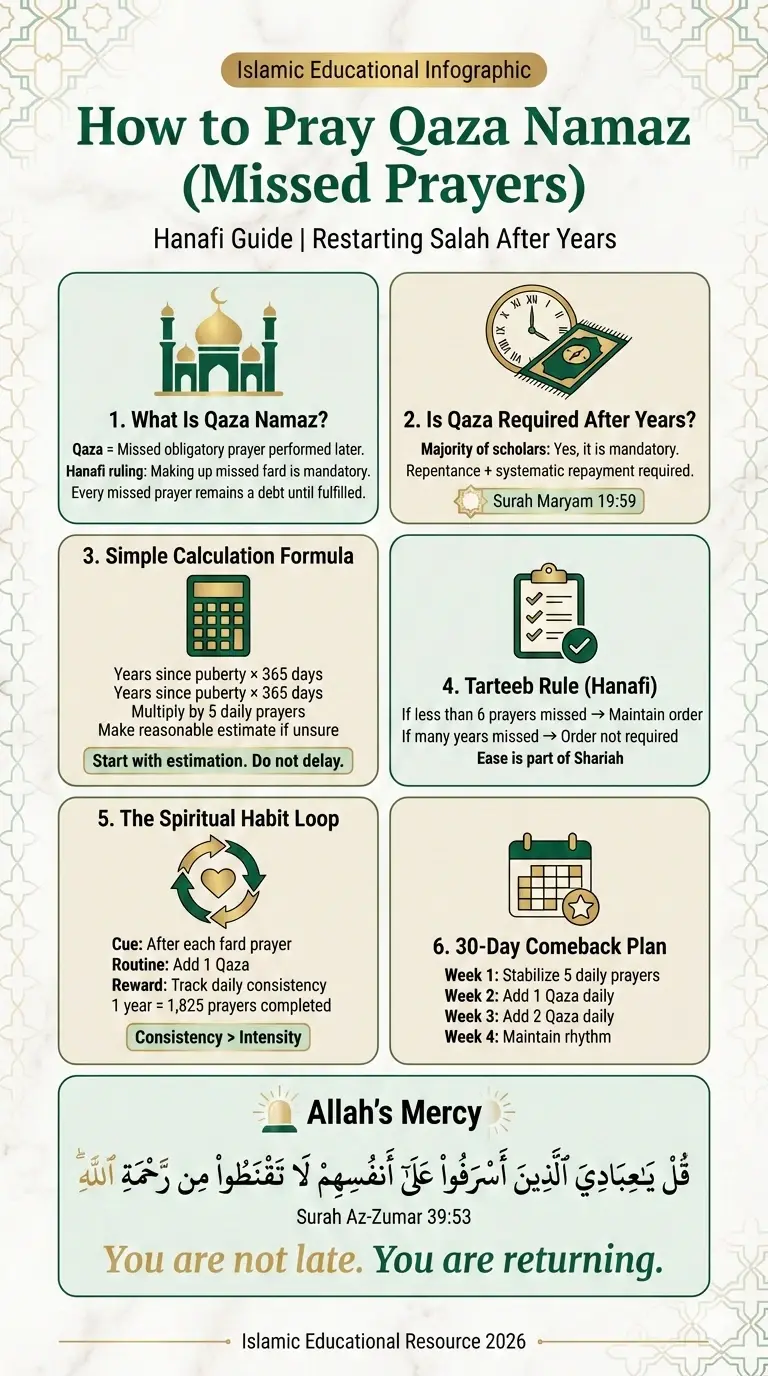
Qaza namaz means performing a missed obligatory prayer after its time has passed. In the Hanafi school, making up missed fard prayers is mandatory whether they were missed due to sleep, forgetfulness, or negligence. One must sincerely repent and begin systematic repayment.
Qaza (قضاء) linguistically means “to complete” or “to fulfill.” In fiqh, it refers to performing an obligation outside its prescribed time.
According to the Hanafi madhhab, founded by Imam Abu Hanifa, every missed fard prayer remains a debt until fulfilled.
Is Qaza Mandatory If I Stopped Praying for Years?
According to the majority of scholars — including the Hanafi, Maliki, Shafi‘i, and Hanbali schools — a person who deliberately abandoned prayer must repent and make up all missed prayers. Repentance alone does not remove the obligation of unpaid salah.
Qur’anic Warning About Neglecting Salah
Arabic
فَخَلَفَ مِنۢ بَعْدِهِمْ خَلْفٌ أَضَاعُوا۟ ٱلصَّلَوٰةَ وَٱتَّبَعُوا۟ ٱلشَّهَوَٰتِ فَسَوْفَ يَلْقَوْنَ غَيًّا
Transliteration
Fa khalafa min ba‘dihim khalfun aḍāʿū ṣ-ṣalāh wattabaʿū sh-shahawāt fa sawfa yalqawna ghayyā.
English (Saheeh International)
“But there came after them successors who neglected prayer and pursued desires; so they are going to meet evil.”
Urdu (Fateh Muhammad Jalandhari)
پھر ان کے بعد ایسے ناخلف لوگ آئے جنہوں نے نماز کو ضائع کر دیا اور خواہشوں کے پیچھے لگ گئے، سو وہ عنقریب گمراہی سے دوچار ہوں گے۔
— Surah Maryam (19:59)
Classical mufassir Ibn Kathir explains that “neglecting prayer” includes delaying and abandoning it.
What About the Hadith on Making Up Missed Prayer?
The Prophet ﷺ clearly instructed that missed prayers must be performed when remembered. Scholars use this hadith as foundational evidence that obligations remain due until fulfilled.
From Sahih al-Bukhari and Sahih Muslim
Arabic
مَنْ نَسِيَ صَلَاةً أَوْ نَامَ عَنْهَا فَكَفَّارَتُهَا أَنْ يُصَلِّيَهَا إِذَا ذَكَرَهَا
Transliteration
Man nasiya ṣalātan aw nāma ʿanhā fakaffāratuhā an yuṣallīyahā idhā dhakarahā.
English (Saheeh International)
“Whoever forgets a prayer or sleeps through it, its expiation is to pray it when he remembers.”
Urdu (Jalandhari)
جو شخص نماز بھول جائے یا سو جائے تو جب یاد آئے اسے پڑھ لے، یہی اس کا کفارہ ہے۔
Imam Nawawi explains that if prayer must be made up for sleep, then deliberate abandonment is more deserving of repayment.
How Do I Calculate Years of Missed Prayers?
In the Hanafi school, you must estimate from the age of puberty until today, subtract valid excuses like menstruation or unconsciousness, then calculate the total number of daily fard prayers missed. If exact numbers are unknown, make a reasonable estimate and begin repayment.
Friendly Method
- Determine puberty age (approx. 12–15).
- Count years until today.
- Multiply by 365 days.
- Multiply by 5 daily prayers.
Do not freeze in perfectionism. Start with estimation.
Do I Pray Qaza in Order? (Tarteeb Rule)
In the Hanafi school, maintaining sequence (tarteeb) is required only if fewer than six prayers are owed. If many prayers are outstanding, sequence is no longer obligatory, and you may pray qaza without strict order.
This ruling prevents hardship for long-term absentees.
How Should I Start If I Feel Overwhelmed?
Begin by praying your current five daily prayers consistently. Then attach one extra qaza prayer to each obligatory salah. This gradual system prevents burnout and creates sustainable spiritual momentum.
The Spiritual Habit Loop (Modern Framework)
Cue → After Fard Salah
Routine → Add 1 Qaza
Reward → Track completion daily
Within one year, you can repay 1,825 missed prayers.
This is not punishment. This is reconstruction.
Does Allah Forgive Someone Who Missed Salah for Years?
Yes. Allah forgives all sins when repentance is sincere. You must stop the sin, feel remorse, resolve never to return, and make up missed obligations. No matter how many years passed, the door of mercy remains open.
Qur’anic Foundation of Hope
Arabic
قُلْ يَٰعِبَادِىَ ٱلَّذِينَ أَسْرَفُوا۟ عَلَىٰٓ أَنفُسِهِمْ لَا تَقْنَطُوا۟ مِن رَّحْمَةِ ٱللَّهِ
Transliteration
Qul yā ʿibādiya alladhīna asrafū ʿalā anfusihim lā taqnaṭū min raḥmatillāh.
English (Saheeh International)
“Say, O My servants who have transgressed against themselves, do not despair of the mercy of Allah.”
Urdu (Jalandhari)
کہہ دو کہ اے میرے بندو جنہوں نے اپنی جانوں پر ظلم کیا ہے، اللہ کی رحمت سے ناامید نہ ہو۔
— Surah Az-Zumar (39:53)
Madhhab Comparison (Brief Overview)
All four Sunni schools agree that missed prayers must be made up. Differences exist in details such as intention wording, sequence, and priority over voluntary prayers. The Hanafi school emphasizes structured repayment and minimizing voluntary prayers until obligations are cleared.
Practical 30-Day Comeback Plan
Focus first on praying all five daily prayers on time for 30 days. Add one qaza daily during week one. Increase to two daily by week three. Build stability before intensity. Consistency is superior to emotional bursts.
Week 1 → Stabilize Fard
Week 2 → +1 Qaza Daily
Week 3 → +2 Qaza Daily
Week 4 → Maintain System
People Also Ask:
Pray as many as manageable without neglecting current prayers. One to five daily is sustainable for most people.
Yes, except during sunrise, zenith, and sunset in the Hanafi school.
Intend the specific missed prayer in your heart. Verbal intention is not required.
In Hanafi fiqh, prioritize qaza over voluntary prayers, except emphasized Sunnah of Fajr.
Final Reflection
You are not defined by your past gaps in salah.
You are defined by your return.
Every qaza prayer is a brick in rebuilding your covenant with Allah.
Start today. One prayer at a time.
