Quick Answer
Surah Al Nasr is the 110th surah of the Quran: 3 verses, 19 Arabic words, revealed in Madinah.
It means: Allah’s help and the victory come, people enter His religion in crowds — so glorify your Lord with praise and seek His forgiveness.
Ibn Abbas understood it as the sign that the Prophet’s ﷺ mission was complete and his death was near (Sahih al-Bukhari 4970).
Start here:
New to the Quran? Go to What is Surah Al Nasr?
Returning to practice and you know it from prayer? Go to the word-for-word text
Just here for the meaning? Go to what to do when you win
Contents:
What is Surah Al Nasr, and why does it matter at a moment of success?
What does Surah Al Nasr say, word for word?
Why did Ibn Abbas hear a farewell in a victory surah?
The Finish With Praise Loop: what do you do when you win?
How did the Prophet ﷺ live verse 3 in his own prayer?
How can you practise Surah Al Nasr today, wherever you live?
What mistakes and wazifa claims should you avoid?
Frequently asked questions
You have just finished something you worked at for months. The exam result is good, the project shipped, the family group chat is full of congratulations. Then a quieter feeling follows: pride, relief, and a fear of sounding arrogant if you celebrate. Maybe you have felt that mix after a promotion, a passed driving test, or a child doing well at school. Surah Al Nasr speaks into that exact moment. It does not tell you to hide your success. It gives you three moves for the moment success arrives: name whose help it was, praise Him, and ask His forgiveness.
What is Surah Al Nasr, and why does it matter at a moment of success?
Surah Al Nasr is the 110th chapter of the Quran, a Madani surah (revealed in Madinah) of three short verses and nineteen Arabic words. It announces Allah’s help and the victory, shows people entering Islam in crowds, and commands praise and seeking forgiveness.
That definition is the whole surah in one sentence, and it is why the chapter sits near the end of the mushaf (the bound book of the Quran). It is the sixth surah in the last 10 surahs of the Quran, and at three verses it is the second-shortest surah after Al-Kawthar. Its name comes from its first word for help, nasr, in the opening line Iza ja a nasrullah, “when the help of Allah comes.” Short does not mean slight. These three verses closed a mission that had run for twenty-three years, and the Companions heard both a victory and a farewell in them.
| Fact | Surah Al Nasr Details |
|---|---|
| Number and name | 110 — An-Nasr, “The Divine Support” (Quran.com) |
| Verses and words | 3 verses, 19 Arabic words (5 + 7 + 7, counted from Quran.com API word positions) |
| Revealed | Madinah; revelation order 114 — the last complete surah revealed |
| Place in the mushaf | Juz 30, page 603; sixth of the last ten surahs — see how many surahs in Quran for the full map |
| One-line theme | When help and victory come, answer with praise and istighfar, not pride |
What does Surah Al Nasr say, word for word?
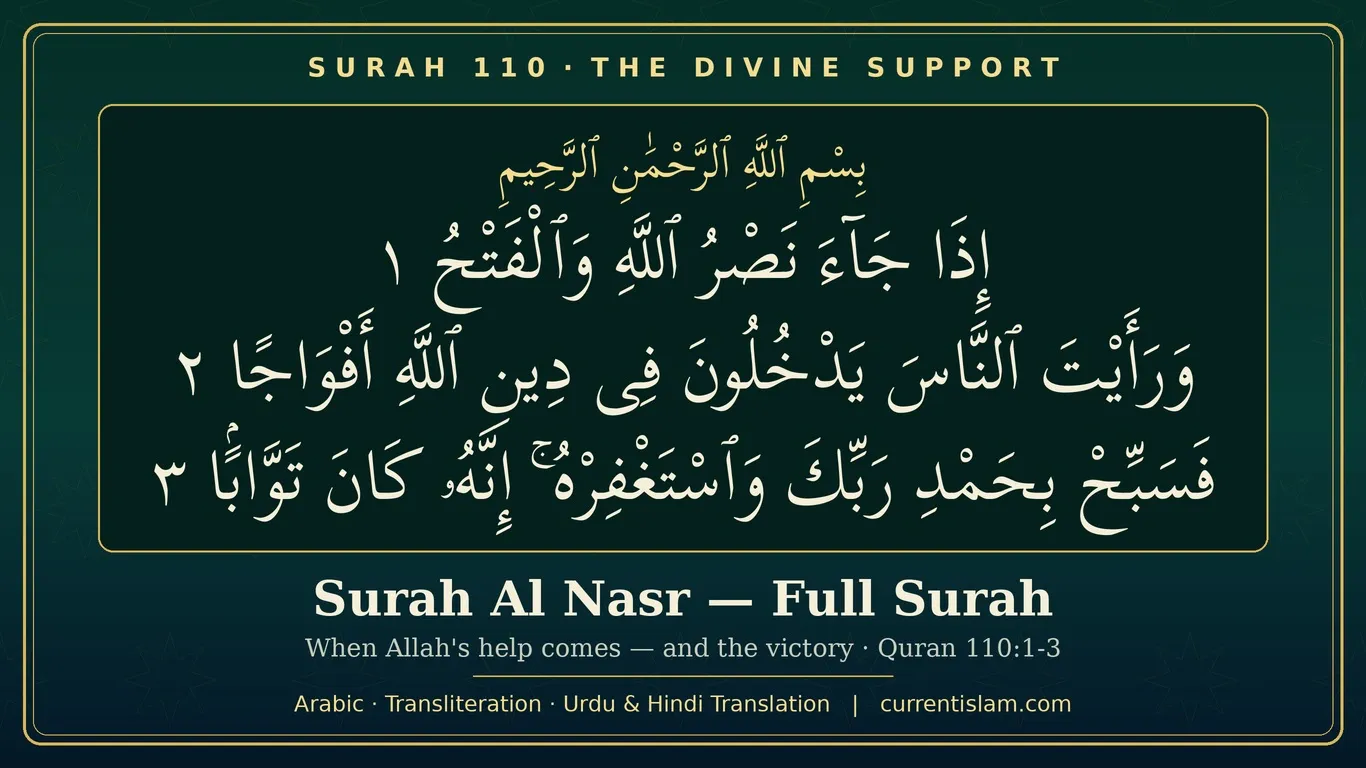
The complete surah is three verses: Allah’s help and the victory arrive, people enter Allah’s religion in crowds, and the Prophet ﷺ is told to glorify his Lord with praise and seek His forgiveness, because Allah is ever Accepting of Repentance.
بِسْمِ ٱللَّهِ ٱلرَّحْمَٰنِ ٱلرَّحِيمِ
Bismillahir-Rahmanir-Rahim
— “In the Name of Allah—the Most Compassionate, Most Merciful” (Khattab, Quran.com).
Verse 1 — the help arrives first
إِذَا جَآءَ نَصْرُ ٱللَّهِ وَٱلْفَتْحُ
surah nasr transliteration: Idha ja’a nasrullahi wal-fath.
English (Khattab): “When Allah’s ˹ultimate˺ help comes and the victory ˹over Mecca is achieved˺,”
Urdu (Jalandhari):
جب خدا کی مدد آ پہنچی اور فتح (حاصل ہو گئی)
Hindi (al-Umari): (ऐ नबी!) जब अल्लाह की सहायता एवं विजय आ जाए।
Al-fath, the victory or opening, is understood by Ibn Kathir as the conquest of Makkah, the city that had driven the Prophet ﷺ out years earlier. Notice the order. Help is named before victory, and both are named as Allah’s, not as the believers’ achievement. The verse teaches you to read any success backwards: before the result, there was help you did not control.
Verse 2 — people enter in crowds
وَرَأَيْتَ ٱلنَّاسَ يَدْخُلُونَ فِى دِينِ ٱللَّهِ أَفْوَاجًا
Wa ra’ayta an-nasa yadkhuluna fi dinillahi afwaja.
English (Khattab): “and you ˹O Prophet˺ see the people embracing Allah’s Way in crowds,”
Urdu (Jalandhari):
اور تم نے دیکھ لیا کہ لوگ غول کے غول خدا کے دین میں داخل ہو رہے ہیں
Hindi (al-Umari): और आप लोगों को देखें कि वे अल्लाह के धर्म में दल के दल प्रवेश कर रहे हैं।
For years people had entered Islam one by one, often at real cost. Afwaja, in crowds, describes the change after Makkah opened: whole delegations arrived in Madinah to accept Islam together. Quran.com’s chapter information, drawing on classical reports, calls the following period the year of deputations. Faith stopped looking like a lonely stand and became a shared, public life.
Verse 3 — the only command in the surah
فَسَبِّحْ بِحَمْدِ رَبِّكَ وَٱسْتَغْفِرْهُ ۚ إِنَّهُۥ كَانَ تَوَّابًۢا
Fasabbih bihamdi rabbika wastaghfirh, innahu kana tawwaba.
English (Khattab): “then glorify the praises of your Lord and seek His forgiveness, for certainly He is ever Accepting of Repentance.”
Urdu (Jalandhari):
تو اپنے پروردگار کی تعریف کے ساتھ تسبیح کرو اور اس سے مغفرت مانگو، بے شک وہ معاف کرنے والا ہے
Hindi (al-Umari): तो आप अपने पालनहार की प्रशंसा के साथ उसकी पवित्रता का वर्णन करें और उससे क्षमा माँगें, निःसंदेह वह बहुत तौबा क़बूल करने वाला है।
Verse three is the command the whole surah was building toward. Tasbih (declaring Allah perfect and above every flaw), hamd (praise and thanks), and istighfar (seeking forgiveness) are packed into one line. Success does not end the conversation with Allah. It starts a specific one, and the reason given is His name At-Tawwab, the ever Accepting of Repentance.
| Arabic Word | Transliteration | Plain Meaning |
|---|---|---|
| نَصْرُ | nasru | help, divine support |
| ٱلْفَتْحُ | al-fath | the victory, the opening |
| أَفْوَاجًا | afwaja | in crowds, in waves |
| فَسَبِّحْ | fasabbih | so glorify |
| بِحَمْدِ | bihamdi | with the praise of |
| وَٱسْتَغْفِرْهُ | wastaghfirh | and seek His forgiveness |
| تَوَّابًا | tawwaba | ever Accepting of Repentance |
Why did Ibn Abbas hear a farewell in a victory surah?
Ibn Abbas, the Prophet’s ﷺ young cousin known for Quranic understanding, explained that the victory was a sign the Prophet’s ﷺ task was complete and his death was near. Umar, the caliph, said he knew nothing about the surah beyond what Ibn Abbas had said.
The scene is in Sahih al-Bukhari 4970. Umar used to seat Ibn Abbas with the older veterans of Badr, and some of them resented a boy among them. So Umar asked them what the opening verse meant. Some gave the plain answer: praise Allah and seek forgiveness when help comes. Ibn Abbas said no, there was more. A completed mission meant a departing messenger. Read that way, the surah trains a hard skill: recognising when a chapter of work is finished, and closing it with worship instead of clinging to it. That is also why this short surah sits so naturally beside its neighbours — the Surah Al-Kausar calligraphy page carries the surah just before it in the last-ten route, given to the Prophet ﷺ at a moment of loss rather than victory.
The Finish With Praise Loop: what do you do when you win?
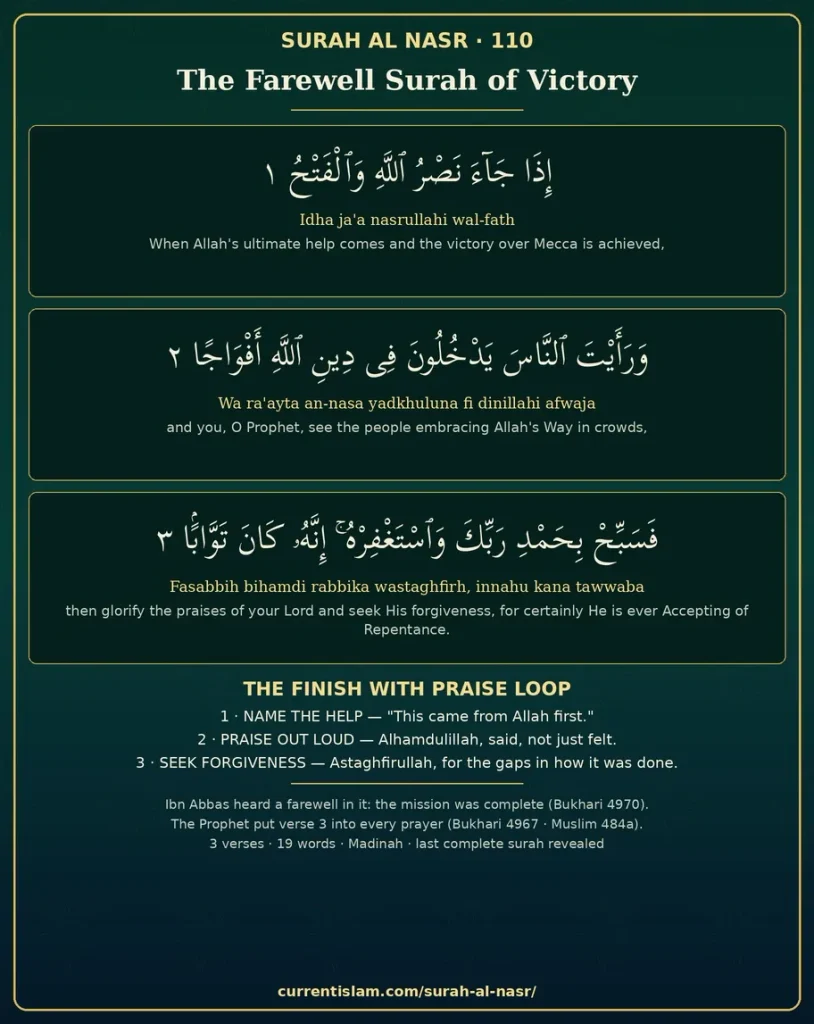
Use the Finish With Praise Loop whenever something succeeds: first name the help, then praise Allah out loud, then seek forgiveness for the gaps in how you did it. Three steps, taken in that order, straight from verse three and the two verses before it.
Step one, name the help, works against the first sentence most of us say: “I did it.” You did work, and the surah does not deny effort. It reorders credit. Before you post the news or tell your family, say whose help came first. Step two, praise out loud, gives the celebration a direction. A spoken Alhamdulillah in the car, at your desk, or on the bus home turns relief into worship — the same pairing of glorifying and praising that fills the Subhanallahi wa bihamdihi dhikr. Step three, seek forgiveness, is the step people skip. Every finished project has rough edges: a sharp word, a missed prayer, a shortcut. Istighfar closes the file cleanly instead of letting success paper over them. Then the loop resets. The next task starts with a person who expects help, not a person guarding a reputation.
Save this — the Finish With Praise Card
Name the help: “This came from Allah first.”
Praise out loud: Alhamdulillah, said, not just felt.
Seek forgiveness: Astaghfirullah, for the gaps in how it was done.
Quotable lines: “Victory is described in this surah. Praise is commanded.” · “Help is named before victory, and both are named as Allah’s.” · “Istighfar closes the file cleanly.” · “The next task starts with a person who expects help.”
How did the Prophet ﷺ live verse 3 in his own prayer?
After this surah was revealed, Aisha reported, the Prophet ﷺ did not offer a prayer without saying in it: Subhanaka Rabbana wa bihamdika, Allahumma ighfirli — glory be to You, our Lord, and praise be to You; O Allah, forgive me.
That report is Sahih al-Bukhari 4967, and Sahih Muslim 484a records the same words said often in bowing and prostration, “thus complying with the Quran.” He put verse three inside the prayer itself, not in a speech about the victory. That placement matters for you. The words fit the quiet middle of salah (the ritual prayer), on an ordinary weekday, long after any crowd has gone home. You do not need a ceremony to answer success the way he did. You need the next prayer. If you want a fuller forgiveness wording for that same moment, the Sayyidul Istighfar dua is the one the Prophet ﷺ called the best form of seeking forgiveness.
How can you practise Surah Al Nasr today, wherever you live?
Start tonight: recite the three verses slowly after one prayer, say the Prophet’s ﷺ words once in prostration, and name one recent success out loud, praising Allah for it and asking forgiveness for how you handled it. The whole practice takes about two minutes.
Build it on cues you already have. After Fajr or before sleep works in any time zone, because the anchor is the prayer, not the clock or the season. At work, the loop fits the minute after good news lands: read the email, close the laptop lid for ten seconds, and run the three steps before you reply to anyone. In a family group chat, it changes what you type first. Praise goes in the message before the photo does. If you are the only Muslim in the room when your success is announced, the loop is silent and internal, and it still works. Nobody has to hear it for it to reorder your heart. The same three-step habit is why the short surahs at the end of the Quran repay slow reading together — the 4 Quls in English carry the protection side of that same closing stretch.
What mistakes and wazifa claims should you avoid?
The most common mistake is treating Surah Al Nasr as a formula for winning: recite it a set number of times and success is owed to you. No verse in the surah and no report opened for this article promises that, in any count.
Counts travel fast online: forty-one times for success at work, one hundred and eleven times for a promotion, seventy times a day for eleven days for a need. None of those counts was found in the Quran, in Sahih al-Bukhari, or in Sahih Muslim in the sources checked for this article. Reciting the surah is worship, and asking Allah for help is always open to you. A guaranteed result tied to a number is a claim, and claims need a source. A second mistake is the opposite one: reading the farewell in the surah and turning every success into sadness. Ibn Abbas heard an ending because this mission was complete. Your exam, your project, and your new job are not prophecies. Take the response the surah commands, not a mood it does not. A third mistake is skipping the surah’s neighbour in the mushaf: the next chapter answers arrogance of a different kind, and the Tabat surah explainer shows why it carries that name.
Keep the surah where you will meet it. It sits inside salah naturally, since any short surah can follow Al-Fatihah in prayer, and its three verses are short enough to memorise this week from the Arabic and transliteration on this page. When the next good result arrives, you will know the order: help named, praise spoken, forgiveness sought. Pair it with the transliteration of Surah An-Nas, the closing surah, and the end of the mushaf feels close. Send this to someone who has just finished something big and is not sure how to feel about it.
Frequently asked questions
It is the opening of verse one: “When the help of Allah comes.” Iza means when, ja’a means comes or has come, nasrullah means the help of Allah, and the verse continues wal-fath, “and the victory,” which Ibn Kathir records as the conquest of Makkah.
Surah Al Nasr, Quran 110, has three verses and nineteen Arabic words: five in verse one, seven in verse two, and seven in verse three, counted from the word positions on Quran.com. It is the second-shortest surah in the Quran, after Surah Al-Kawthar, which also has three verses.
Its meaning is a complete response to success in three moves. Allah’s help and victory arrive first, people then enter His religion in crowds, and the believer answers not with pride but by glorifying Allah with praise and seeking His forgiveness, because He accepts repentance again and again.
Because Ibn Abbas understood its victory as the sign that the Prophet’s ﷺ mission was complete and his death was near, an explanation Umar confirmed in Sahih al-Bukhari 4970. A surah announcing success was, at the same time, announcing a departure, which is why readers called it a farewell.
Surah Al Nasr is reported as the last complete surah revealed to the Prophet ﷺ. Quran.com gives its revelation order as 114, last of all, and Ibn Kathir records Ibn Abbas confirming to Ubaydullah ibn Abdullah ibn Utbah that An-Nasr was the last surah of the Quran to be revealed.
No count was verified in the sources opened. Numbers shared online, such as forty-one or one hundred and eleven recitations for a job or promotion, appear in the Quran, Sahih al-Bukhari, and Sahih Muslim nowhere in those checks. Recite it as worship, and ask Allah freely, without a guaranteed number.
Aisha reported that after Surah An-Nasr was revealed, the Prophet ﷺ did not offer a prayer without saying in it, “Subhanaka Rabbana wa bihamdika, Allahumma ighfirli,” glory be to You, our Lord, and praise be to You, O Allah, forgive me (Sahih al-Bukhari 4967; Sahih Muslim 484a).
On this page, every verse carries three translations side by side: Khattab in English, Jalandhari in Urdu, and al-Umari in Hindi, each quoted from its published edition through Quran.com. Read the Arabic first, then the translation in the language you think in, then the short explanation under each verse.
Next step
Read the surah in its route: last 10 surahs of the Quran
Go one surah back in practice: Surah Al-Fil in English, where the route begins
Pair praise with protection: Surah Falaq English translation
Last reviewed: 17 November 2026 · Author: SHAHAB KHAN · Reviewed by: ATIF KHAN
