Have you ever felt like your heart is “heavy”? Not physically, but spiritually. It’s that clutter in the back of your mind—the mistakes of yesterday, the stress of today, and the fear that you just aren’t doing enough.
In 2026, we are obsessed with productivity. We want “hacks” for everything. But what if I told you the Prophet Muhammad (ﷺ) gave us the ultimate productivity hack 1,400 years ago? It is a phrase that takes less than 2 minutes to repeat, yet it carries the weight of a mountain on your Scale of Deeds.
It is SubhanAllahi wa Bihamdihi SubhanAllahil Azeem.
What is SubhanAllahi Wa Bihamdihi SubhanAllahil Azeem?
SubhanAllahi wa Bihamdihi SubhanAllahil Azeem is a powerful Islamic Dhikr (remembrance) that means “Glory be to Allah and His is the praise, Glory be to Allah the Almighty.” The Prophet Muhammad (ﷺ) described these words as being light on the tongue, heavy on the scales, and beloved to the Most Merciful.
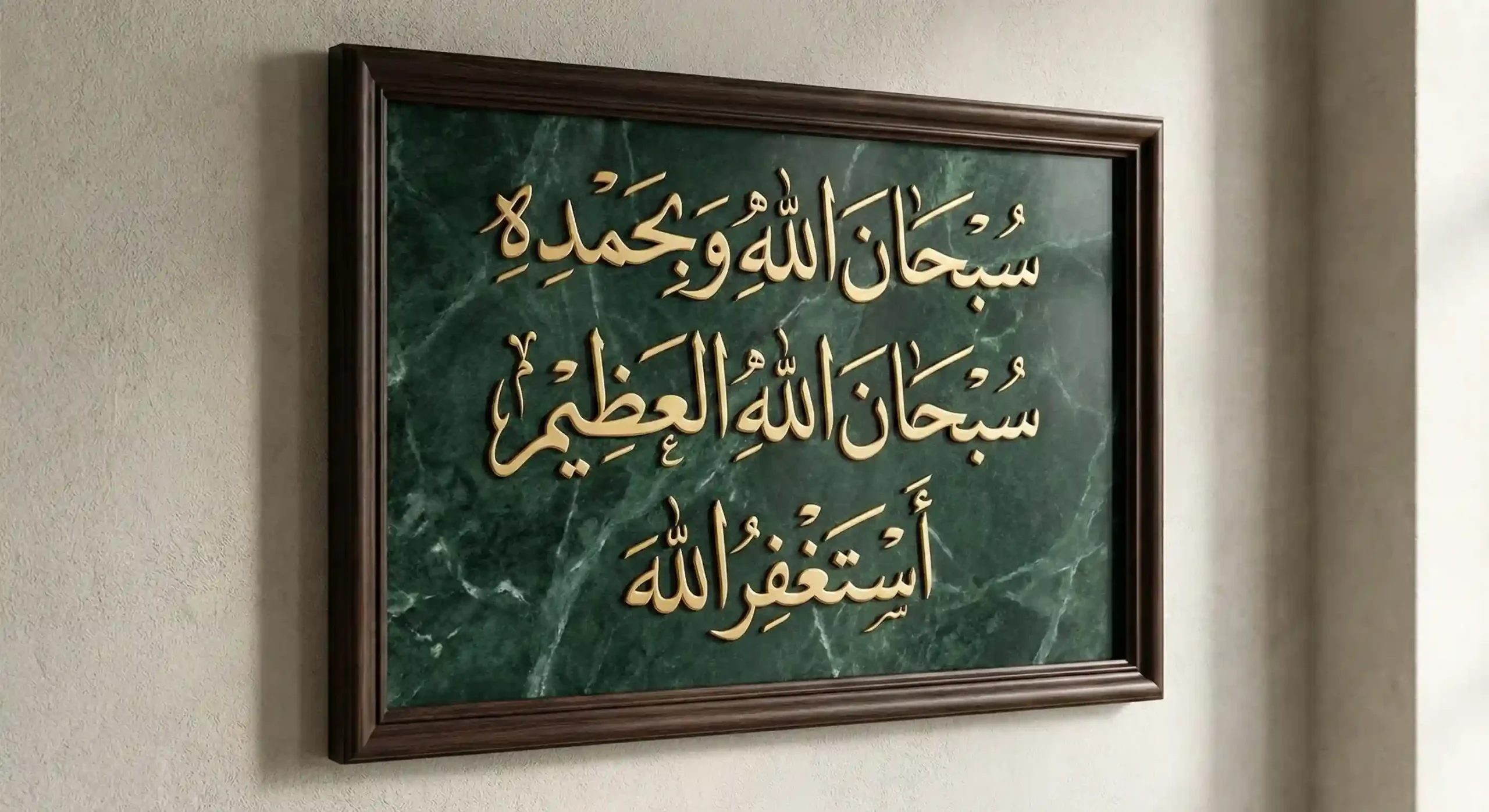
سُبْحَانَ اللَّهِ وَبِحَمْدِهِ، سُبْحَانَ اللَّهِ الْعَظِيمِ، أَسْتَغْفِرُ اللَّهَ
The Linguistic Breakdown (Word-by-Word)
To truly feel the khushoo (focus), you must understand what you are whispering. Here is the deep breakdown:
| Arabic | Transliteration | Meaning | Context |
| سُبْحَانَ | Subhan | Glory be to… | Declaring Allah is perfect, free from all flaws. |
| اللَّهِ | Allah | Allah | The One True God. |
| وَبِحَمْدِهِ | Wa Bihamdihi | And with His praise | We combine His perfection with our gratitude. |
| الْعَظِيمِ | Al-Azeem | The Mighty/Great | The One whose greatness cannot be comprehended. |
The “100 Times” Promise: Wiping Sins Like Sea Foam
If you recite “SubhanAllahi wa Bihamdihi” 100 times a day, your minor sins are forgiven, even if they are as immense as the foam of the sea. This is based on a Sahih Hadith from Al-Bukhari, offering believers a daily “spiritual reset” for their mistakes.
The Evidence (Dalil)
This isn’t just a saying; it is a promise from the Messenger of Allah (ﷺ).
The Hadith:
“Whoever says, ‘Subhan Allah wa bihamdihi,’ one hundred times a day, will be forgiven all his sins even if they were as much as the foam of the sea.”
(Sahih al-Bukhari 6405)
Multilingual Reference:
- Arabic:
- مَنْ قَالَ سُبْحَانَ اللَّهِ وَبِحَمْدِهِ فِي يَوْمٍ مِائَةَ مَرَّةٍ حُطَّتْ خَطَايَاهُ، وَإِنْ كَانَتْ مِثْلَ زَبَدِ الْبَحْرِ
- Urdu (Fateh Muhammad Jalandhari):جو شخص دن میں سو دفعہ سُبْحَانَ اللَّهِ وَبِحَمْدِهِ کہے گا اس کے گناہ معاف کر دیے جائیں گے اگرچہ وہ سمندر کی جھاگ کے برابر ہی کیوں نہ ہوں۔
- Roman Urdu:Jo shakhs din mein 100 dafa ‘SubhanAllahi wa Bihamdihi’ kahega, uske gunah maaf kar diye jayenge agarche woh samundar ki jhaag ke barabar hi kyun na hon.
The “Productivity” Hadith: Light vs. Heavy
The Prophet Muhammad (ﷺ) called “SubhanAllahi wa Bihamdihi SubhanAllahil Azeem” the two phrases that are “light on the tongue” but “heavy on the scales.” This makes them the easiest way to gain massive rewards on Judgment Day without requiring physical exertion.
Think of it this way:
In the gym, you have to lift heavy weights to build muscle. In Islam, Allah (SWT) allows you to lift “light” words to build a “heavy” afterlife.
The Hadith:
“There are two statements that are light for the tongue to remember, heavy in the Scales and are dear to the Merciful: ‘Subhan-Allahi wa bihamdihi, Subhan-Allahil-Azim’.”
(Sahih al-Bukhari 6406)
The “Micro-Habit” for 2026
We often fail at Dhikr because we try to do too much at once. Instead, let’s use the “Transition Rule.”
You do not need to sit on a prayer mat to finish your 100 times. Use the “dead time” in your day:
- The Commute: While walking to the bus or driving. (Approx. 3 minutes)
- The Kettle Boil: While waiting for your tea/coffee water to heat up. (Approx. 2 minutes)
- The Scroll-Block: Before you open Instagram or TikTok, pay your “toll” of 33 recitations.
The result? By the time your head hits the pillow, you have wiped your slate clean. The anxiety of “did I do enough?” fades because you know you completed the task beloved to Ar-Rahman (The Most Merciful).
The 7-Day “Light on Tongue” Challenge
Goal: Build a habit of 100x SubhanAllahi wa Bihamdihi without feeling overwhelmed.
Instructions: Do not try to do it all at once. Use the “Triggers” to fit it into your 2026 life.
| Day | The Theme | The Goal (Count) | The 2026 “Trigger” (When to do it) |
| Day 1 | The Warm-Up | 33 Times | The “Kettle” Rule: Recite it while waiting for your morning tea/coffee to brew or the microwave to ping. |
| Day 2 | The Commute | 66 Times | The “Door” Rule: Start reciting the moment you lock your front door until you reach your vehicle or bus stop. |
| Day 3 | The Clean Slate | 100 Times | The “Sea Foam” Day: Complete the full 100. Split it: 50 after Fajr, 50 after Asr. Remind yourself: My minor sins are being washed away. |
| Day 4 | Focus on Meaning | 33 Times (Slow) | The “Deep Work” Rule: Don’t rush. Say it slowly. Visualize the meaning: Allah is Flawless, and I praise Him. |
| Day 5 | The “Azeem” Addition | 100 Times | Add SubhanAllahil Azeem to the end. Do this while walking or doing house chores (dishes/folding laundry). |
| Day 6 | The Digital Detox | 100 Times | The “Scroll Tax”: You cannot open Instagram, TikTok, or YouTube until you have done 33 repetitions. |
| Day 7 | The Master Habit | 100x AM / 100x PM | The “Sahaba” Mindset: 100 in the morning to protect your day, 100 in the evening to protect your night. |
The Summary: Wiping the Slate Clean- Urdu (PDF)
💡 How to “Sell” This in Your Article (The CTA)
To make sure people actually download this (and boost your SEO time-on-page), place this Call to Action (CTA) at the very bottom of your blog post:
“Finding it hard to stay consistent?”
Shaitan loves to make Dhikr feel ‘heavy’ or ‘boring.’ Let’s trick him. I’ve designed a Free 7-Day Dhikr Tracker that fits into your busy schedule—no prayer mat required.
People Also Ask:
It is pronounced as Sub-han Allahi Wa Bi-ham-di-hi. Ensure you pronounce the ‘H’ in ‘Subhan’ and ‘Bihamdihi’ sharply (from the throat), not softly like an English ‘H’.
Yes, you can recite SubhanAllah and other forms of Dhikr without Wudu (ablution). While being in Wudu is preferred and more rewarding, it is not a requirement for general remembrance of Allah.
The consensus of Islamic scholars (including Ibn Kathir and Al-Nawawi) is that this Hadith refers to minor sins (Saghirah). Major sins (Kabirah), such as neglecting prayer or harming others, require sincere Tawbah (repentance) and specific corrective actions.
In Urdu, SubhanAllahi Wa Bihamdihi means: “Allah paak hai aur usi ki tareef hai.” (اللہ پاک ہے اور اسی کی تعریف ہے).
Your Next Step
Don’t just read this. Action it.
Right now, before you close this tab, say it just one time with full concentration:
SubhanAllahi wa Bihamdihi, SubhanAllahil Azeem.
