Quick Answer
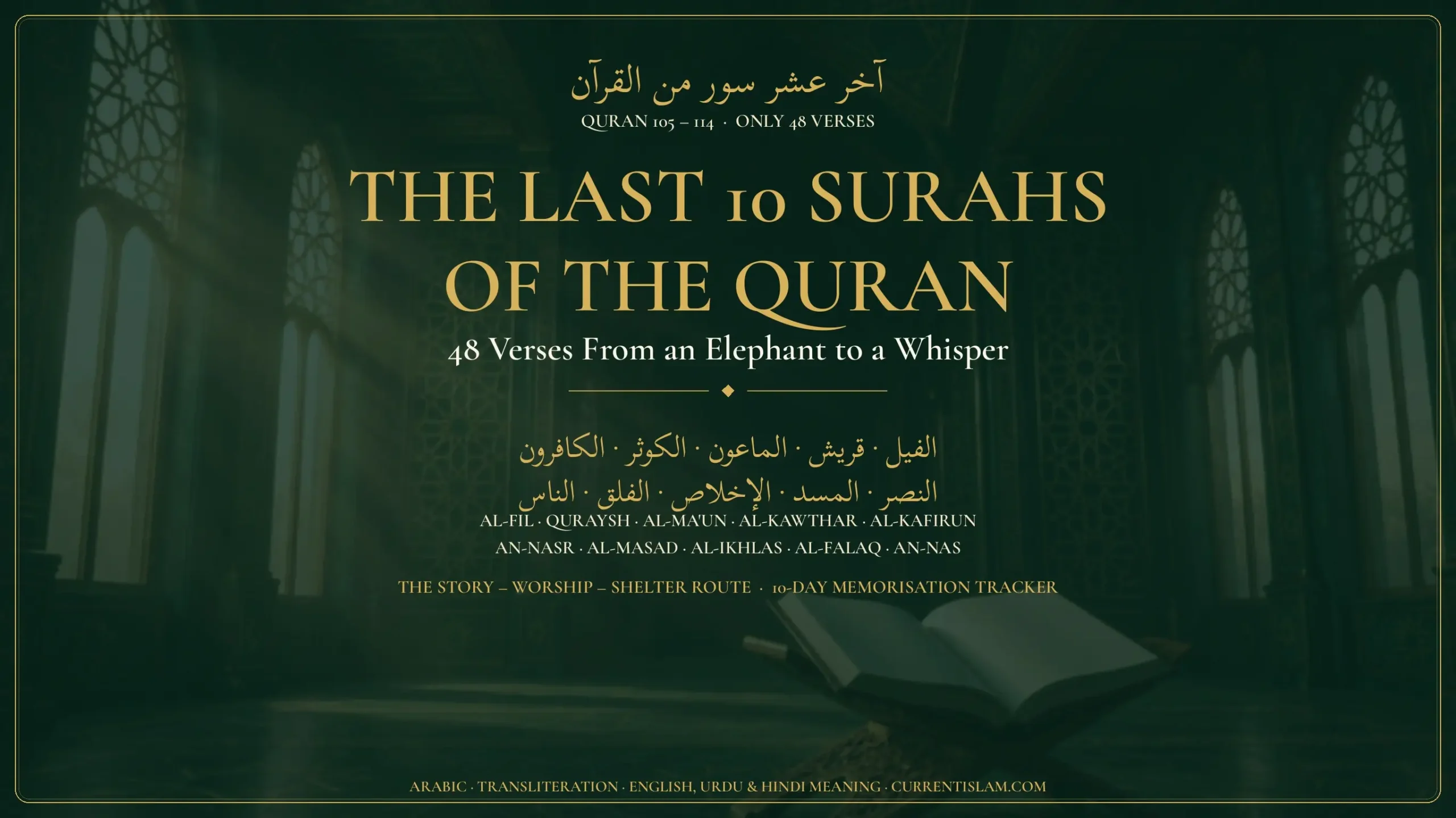
– The last 10 surahs of the Quran are: 105 Al-Fil, 106 Quraysh, 107 Al-Ma’un, 108 Al-Kawthar, 109 Al-Kafirun, 110 An-Nasr, 111 Al-Masad, 112 Al-Ikhlas, 113 Al-Falaq and 114 An-Nas.
– Together they hold just 48 verses: nine were revealed in Makkah and one, Surah An-Nasr (110), in Madinah.
– This page gives each surah its own section with the full Arabic, transliteration, English meaning, Urdu meaning and Hindi translation, so you can read, understand and memorize all ten in one place.
Which surahs do you recite most in your daily prayers?
Ask yourself which surahs you reach for in salah, day after day. For most of us, the honest answer is these ten. They are short enough to memorize one by one, yet they carry worship, history and protection in a handful of lines each. A child learning to pray often starts here. An adult who has prayed for decades still returns here in almost every rak’ah after Al-Fatiha.
All ten sit at the end of the mushaf, inside Juz ‘Amma, the thirtieth part of the Quran. That final juz is where many readers begin their memorization journey, and these surahs form its closing stretch. If you have ever wondered how long the Quran is from cover to cover, this end section is the most familiar part of it for a simple reason: it is the part we repeat the most.
Why do these ten matter so much? Because they are complete. In 48 short verses you meet Allah’s protection of His House, a call to feed the poor and help your neighbor, the purest statement of who Allah is, and two surahs of refuge for the morning and the night. They also complete the count of the Book itself: the Quran holds 114 surahs, and our guide to how many surahs are in the Quran shows where each one sits. These are the final ten of that 114, in the exact order you find them when you open the mushaf at its last pages.
What are the last 10 surahs of the Quran?
Here is the full list in mushaf order, with the meaning of each name, the number of verses, and where each surah was revealed.
| No. | Surah | Arabic Name | Meaning of the Name | Verses | Revealed In |
|---|---|---|---|---|---|
| 105 | Al-Fil | الفيل | The Elephant | 5 | Makkah |
| 106 | Quraysh | قريش | Quraysh | 4 | Makkah |
| 107 | Al-Ma’un | الماعون | The Small Kindnesses | 7 | Makkah |
| 108 | Al-Kawthar | الكوثر | The Abundance | 3 | Makkah |
| 109 | Al-Kafirun | الكافرون | The Disbelievers | 6 | Makkah |
| 110 | An-Nasr | النصر | The Divine Help | 3 | Madinah |
| 111 | Al-Masad | المسد | The Palm Fiber | 5 | Makkah |
| 112 | Al-Ikhlas | الإخلاص | The Sincerity | 4 | Makkah |
| 113 | Al-Falaq | الفلق | The Daybreak | 5 | Makkah |
| 114 | An-Nas | الناس | Mankind | 6 | Makkah |
Read the table once and one surah stands out. Surah An-Nasr (110) is the only one of the ten revealed in Madinah; the other nine are Makki. It also came last in the order of revelation, number 114 of 114, even though it sits five places before the end of the mushaf. Order in the Book and order in revelation are two different things, and this little surah proves it.
How do the last 10 surahs fit together?
Ten short surahs can feel like a loose collection. They are not. Read them in order and they move in three clear movements, and we call this the Story – Worship – Shelter Route. Learn the route once, and you can recall what each surah is doing, and why it sits where it sits, without opening a commentary.
The Stories: what Allah did
Four surahs tell you what Allah did in history. Surah Al-Fil recalls how He protected the Kaaba from an army with elephants. Surah Quraysh follows straight on, naming the blessings that same protection gave the tribe of Quraysh. Surah An-Nasr looks to the end of the Prophet’s ﷺ mission, when help from Allah and victory arrived together. Surah Al-Masad closes the movement with a warning: wealth and family ties did not save Abu Lahab when he opposed the truth.
The Worship: how you respond
Four surahs then turn from history to you. Surah Al-Ma’un measures worship by how you treat people, down to refusing a small kindness. Surah Al-Kawthar answers loss with abundance, and directs the Prophet ﷺ, and us, to prayer and sacrifice. Surah Al-Kafirun draws a firm line: no compromise in worship. Surah Al-Ikhlas states, in four verses, exactly who Allah is and who He is not.
The Shelter: where you take refuge
The Book ends with two surahs of seeking refuge, known together as the Mu’awwidhatayn. Surah Al-Falaq seeks refuge in the Lord of the daybreak from every harm outside you. Surah An-Nas seeks refuge in the Lord of mankind from the whispering inside you. Story, then worship, then shelter: the Quran closes by teaching you what Allah did, how to answer Him, and where to run when you are afraid.
How should you use this page?
Use it as a ten-day plan. Each surah below has its own full section with the complete Arabic, the transliteration, the English meaning, the Urdu meaning and the Hindi translation, and one surah a day is a pace almost anyone can hold. The shortest hold only three verses; the longest, Al-Ma’un, holds seven. By the end of day ten you will have worked through all 48 verses, and the 10-Day Memorization Tracker that comes with this page lets you tick off each verse as you secure it, then mark the surah for revision in your prayers.
One point of clarity before you start. Four of these ten surahs also appear in our guide to the 4 Quls, because the 4 Quls are the four surahs that begin with the word “Qul” (Say). This page is different: it covers the final ten surahs in mushaf order, all ten, whether they begin with “Qul” or not. If you want only the four, that guide is the shorter route. If you want the complete ending of the Quran, stay here and begin with Al-Fil.
The Last 10 Surahs of the Quran — 48 Verses From an Elephant to a Whisper
1. Surah Feel — Surah Al-Fil (105), The Elephant
The last ten surahs open with a story, and most of us meet it by ear long before we see it written down. Spoken aloud, its name sounds like “Feel” — which is why the surah fil of the mushaf is so often searched for as Surah Feel. It is a short Makki surah, five verses and just 23 Arabic words, and it tells how Allah defended His House against an army that came with an elephant. Ask a child to start “the alam tara kaifa surah” and this is the one they will recite.
Surah Feel — English transliteration, with the full Arabic and meaning

بِسْمِ ٱللَّهِ ٱلرَّحْمَـٰنِ ٱلرَّحِيمِ
*Bismillahir-Rahmanir-Raheem*
— In the name of Allah, the Most Compassionate, Most Merciful.
Verse 1 — Alam tara kaifa (105:1)
Urdu (Jalandhari):
کیا تم نے نہیں دیکھا کہ تمہارے پروردگار نے ہاتھی والوں کے ساتھ کیا کیا
Hindi (al-Umari): क्या तुमने नहीं देखा कि तुम्हारे पालनहार ने हाथी वालों के साथ किस तरह किया?
Verse 2 (105:2)
Urdu (Jalandhari):
کیا ان کا داؤں غلط نہیں کیا؟ (گیا)
Hindi (al-Umari): क्या उसने उनकी चाल को विफल नहीं कर दिया?
Verse 3 (105:3)
Urdu (Jalandhari):
اور ان پر جھلڑ کے جھلڑ جانور بھیجے
Hindi (al-Umari): और उनपर झुंड के झुंड पक्षी भेजे।
Verse 4 (105:4)
Urdu (Jalandhari):
جو ان پر کھنگر کی پتھریاں پھینکتے تھے
Hindi (al-Umari): जो उनपर पकी हुई मिट्टी (खंगर) की कंकड़ियाँ फेंक रहे थे।
Verse 5 (105:5)
Urdu (Jalandhari):
تو ان کو ایسا کر دیا جیسے کھایا ہوا بھس
Hindi (al-Umari): तो उसने उन्हें खाए हुए भूसे की तरह कर दिया।¹
What does Surah Al-Fil teach?
Read as a whole, Surah Al Fil is the shortest history lesson in the Quran, and its point is who acts in it. Makkah had no army to send out; the defence of the Kaaba is entirely Allah’s. The surah does not even name the army’s leader — the tafsir and sirah books name Abraha of Yemen — because the name does not matter to the lesson: a plotted scheme (*kayd*) met the Lord of the House, and it ended as chewed straw. The commentators explain the word *ababeel* as flocks of birds following one after another, which is why the sky, not a battlefield, decides the outcome. Hold that thought as you pray: the God who guarded His House without an army is the God you are standing before.
The very next surah, Surah Quraysh, picks up exactly where this one ends, naming the safety and provision that this protection gave to the tribe of Quraysh.
If you want to stay with this one surah longer — its word-by-word breakdown and the Elephant account in full — our complete guide to Surah Al-Fil goes through it verse by verse.
2. Surah Quraish (106) — Quraysh
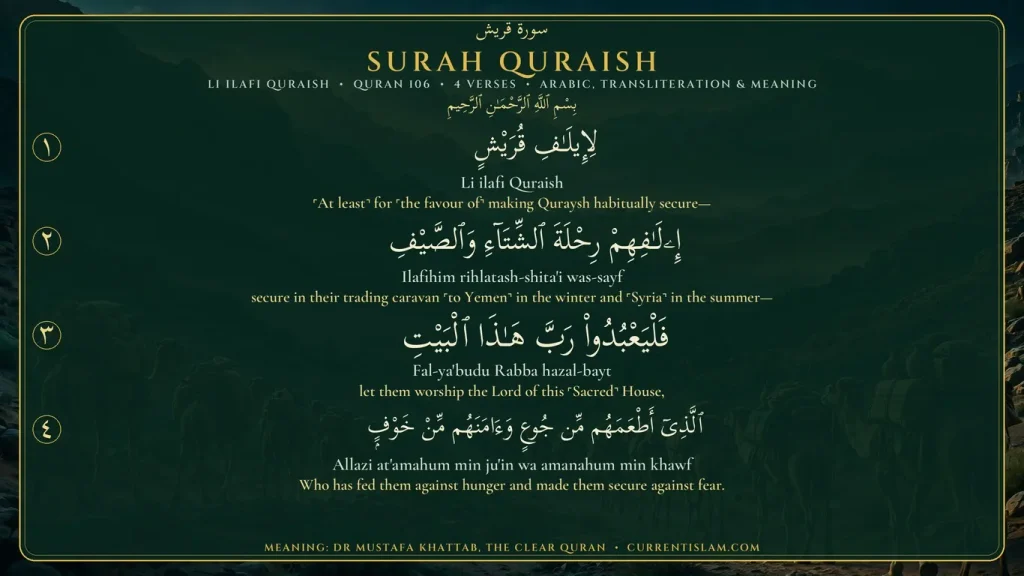
Some surahs stand alone; this one arrives holding the hand of the surah before it. Read straight after the Elephant, Surah Quraish explains what that protection was *for*: the tribe of Quraysh could load its caravans and cross the desert in safety because the House in their city was guarded. People type the name both ways — surah quraish, quraish surah — and both land on the same four verses, seventeen Arabic words that turn a history lesson into an account of gratitude. Its first word, *li ilafi* — “for the accustomed safety of” — is the hinge the whole surah swings on.
Surah Quraish transliteration, with the full Arabic and meaning
Verse 1 — Li ee lafi Quraish (106:1)
Urdu (Jalandhari):
قریش کے مانوس کرنے کے سبب
Hindi (al-Umari): क़ुरैश को मानूस कर देने के कारण।
Verse 2 (106:2)
Urdu (Jalandhari):
(یعنی) ان کو جاڑے اور گرمی کے سفر سے مانوس کرنے کے سبب
Hindi (al-Umari): उन्हें जाड़े तथा गर्मी की यात्रा से मानूस कर देने के कारण।¹
Verse 3 (106:3)
Urdu (Jalandhari):
لوگوں کو چاہیئے کہ (اس نعمت کے شکر میں) اس گھر کے مالک کی عبادت کریں
Hindi (al-Umari): अतः उन्हें चाहिए कि इस घर (काबा) के मालिक की इबादत करें।¹
Verse 4 (106:4)
Urdu (Jalandhari):
جس نے ان کو بھوک میں کھانا کھلایا اور خوف سے امن بخشا
Hindi (al-Umari): जिसने उन्हें भूख में खिलाया तथा उन्हें भय से सुरक्षित किया।
What does Surah Quraish teach?
The surah names the two fears every society lives with — hunger and danger — and says Allah removed both for Quraysh: He fed them and He made them secure. Their wealth ran on two journeys a year, the winter caravan to Yemen and the summer caravan to Syria, and both routes were safe only because other tribes respected the guardians of the Kaaba. So the surah’s single command follows from its facts: if the Lord of this House gave the food and the safety, then the Lord of this House is the One to worship. Gratitude here is not a feeling; it is a direction — blessings traced back to their Giver, and prayer aimed at Him alone.
It begins, though, one surah earlier: the protection of the House in Surah Al-Fil is the reason this safety existed at all, and the two surahs are best memorised as a pair.
For the deeper look at these four verses — the caravan routes, the word *ilaf*, and the link to Al-Fil in full — see our Surah Quraish Li Ilafi Quraish.
3. Surah Maun — Surah Al-Ma’un (107), The Small Kindnesses
After two surahs about what Allah did for Makkah, this one turns the camera around and asks what Makkah’s people did for each other. Surah Maun is the sharpest of the ten: seven verses that judge a person’s religion not by their claims but by how they treat an orphan, a hungry neighbour, and the small things a neighbour asks to borrow. It opens with a question about the one who denies the Judgment — and then, instead of describing a creed, it describes behaviour.
Surah Maun — English translation and transliteration, with the full Arabic

Verse 1 — Araital lazi yukazzibu biddin (107:1)
Urdu (Jalandhari):
بھلا تم نے اس شخص کو دیکھا جو (روزِ) جزا کو جھٹلاتا ہے؟
Hindi (al-Umari): (ऐ नबी!) क्या आपने उसे देखा, जो बदले के दिन को झुठलाता है?
Verse 2 (107:2)
Urdu (Jalandhari):
یہ وہی (بدبخت) ہے، جو یتیم کو دھکے دیتا ہے
Hindi (al-Umari): तो यही है, जो अनाथ (यतीम) को धक्के देता है।
Verse 3 (107:3)
Urdu (Jalandhari):
اور فقیر کو کھانا کھلانے کے لیے( لوگوں کو) ترغیب نہیں دیتا
Hindi (al-Umari): तथा ग़रीब को खाना खिलाने के लिए प्रोत्साहित नहीं करता है।¹
Verse 4 (107:4)
Urdu (Jalandhari):
تو ایسے نمازیوں کی خرابی ہے
Hindi (al-Umari): तो विनाश है उन नमाज़ियों के लिए,¹
Verse 5 (107:5)
Urdu (Jalandhari):
جو نماز کی طرف سے غافل رہتے ہیں
Hindi (al-Umari): जो अपनी नमाज़ से लापरवाह हैं।
Verse 6 (107:6)
Urdu (Jalandhari):
جو ریا کاری کرتے ہیں
Hindi (al-Umari): वे जो दिखावा करते हैं।
Verse 7 (107:7)
Urdu (Jalandhari):
اور برتنے کی چیزیں عاریتہً نہیں دیتے
Hindi (al-Umari): तथा साधारण बरतने की चीज़ भी माँगने से नहीं देते।¹
What does Surah Al-Ma’un teach?
The surah builds its case in layers. Denying the Day of Judgment shows itself first in cruelty that costs nothing to avoid: pushing the orphan away, never urging anyone to feed the poor. Then it moves into the prayer itself — woe to those who pray but are careless with their prayers, praying to be seen. And it lands on the smallest test of all: *al-ma’un*, which the commentators explain as the everyday help a neighbour borrows — a bucket, an axe, a pot. A person can fake devotion in public, but refusing to lend a bucket tells the truth about them. The lesson for the reader is a mirror: before asking whether your prayer is accepted, ask what your prayer has made you give.
The surah before it ended with feeding and safety as Allah’s gifts; this one asks whether those gifts move through us to others — Surah Quraysh gives the blessing, Al-Ma’un gives the test.
Our full Surah Al-Ma’un page works through each of the seven verses and the reports about their revelation.
4. Surah Kausar — Surah Al-Kawthar (108), The Abundance
This is the shortest surah in the entire Quran — three verses, ten Arabic words — and it is a gift announced in a moment of grief. The commentators relate that when the Prophet’s ﷺ son died, his enemies called him *abtar*: cut off, a man whose name would end with him. Surah Kausar is Allah’s answer. It does not argue with the mockers; it simply names what the Prophet ﷺ has already been given, tells him what to do with it, and lets the last verse settle who is truly cut off.
Surah Kausar in English, with transliteration and the full Arabic

Verse 1 (108:1)
Urdu (Jalandhari):
(اے محمدﷺ) ہم نے تم کو کوثر عطا فرمائی ہے
Hindi (al-Umari): (ऐ नबी!) हमने आपको कौसर प्रदान किया है।¹
Verse 2 (108:2)
Urdu (Jalandhari):
تو اپنے پروردگار کے لیے نماز پڑھا کرو اور قربانی دیا کرو
Hindi (al-Umari): तो आप अपने पालनहार ही के लिए नमाज़ पढ़ें तथा क़ुर्बानी करें।¹
Verse 3 (108:3)
Urdu (Jalandhari):
کچھ شک نہیں کہ تمہارا دشمن ہی بےاولاد رہے گا
Hindi (al-Umari): निःसंदेह आपका शत्रु ही बे नाम व निशान है।¹
What does Surah Al-Kawthar teach?
What does Surah Al-Kawthar teach?
Al-Kawthar means abundance upon abundance — goodness that does not run out. In a well-known narration, the Prophet ﷺ described it as a river in Paradise that Allah had promised him, and the commentators carry both meanings together: the river, and every good that flows from his message to this day. Notice the shape of the answer Allah gives to grief. He does not promise the mockers will stop; He points the Prophet ﷺ back to prayer and sacrifice — worship first, and let the verdict on his enemies be Allah’s, not his. That is the pattern this tiny surah leaves with anyone who has been called finished: what Allah has given you is the fact; what people say is weather.
It also closes a small arc in this route: protection in Al-Fil, provision in Quraysh, conduct in Al-Ma’un — and now comfort, before the line is drawn in Surah Al-Kafirun.
Read back one step: Surah Al-Ma’un, the surah before this one, tests whether Allah’s gifts move through us to others; Al-Kawthar is the comfort placed right after that test.
For this surah as artwork, our Surah Al-Kausar Arabic calligraphy page presents it as Islamic wall art with the Urdu translation.
*CurrentIslam has no separate full article for Surah Al-Kawthar yet — this section is its fullest text treatment on the site, and a full Kawthar page is a planned spoke.*
5. Surah Kafiroon — Surah Al-Kafirun (109), The Disbelievers
Every route has a point where the line is drawn, and in the last ten surahs this is it. The leaders of Quraysh had offered the Prophet ﷺ a compromise — worship our gods for a year, and we will worship yours — and Surah Kafirun is the refusal, delivered without anger and without a single insult. Searchers spell it both ways, surah kafirun as well as Kafiroon, because the Arabic ending is heard more than it is read; the six verses they reach are the Quran’s clearest statement that worship is not a thing to be traded.
Surah Kafiroon transliteration, with the full Arabic and meaning

Verse 1 — Qul ya ayyuhal Kafirun (109:1)
Urdu (Jalandhari):
(اے پیغمبر ان منکران اسلام سے) کہہ دو کہ اے کافرو!
Hindi (al-Umari): (ऐ नबी!) आप कह दीजिए : ऐ काफ़िरो!
Verse 2 (109:2)
Urdu (Jalandhari):
جن (بتوں) کو تم پوچتے ہو ان کو میں نہیں پوجتا
Hindi (al-Umari): मैं उसकी इबादत नहीं करता, जिसकी तुम इबादत करते हो।
Verse 3 (109:3)
Urdu (Jalandhari):
اور جس (خدا) کی میں عبادت کرتا ہوں اس کی تم عبادت نہیں کرتے
Hindi (al-Umari): और न तुम उसकी इबादत करने वाले हो, जिसकी मैं इबादत करता हूँ।
Verse 4 (109:4)
Urdu (Jalandhari):
اور( میں پھر کہتا ہوں کہ) جن کی تم پرستش کرتے ہوں ان کی میں پرستش کرنے والا نہیں ہوں
Hindi (al-Umari): और न मैं उसकी इबादत करने वाला हूँ, जिसकी इबादत तुमने की है।
Verse 5 (109:5)
Urdu (Jalandhari):
اور نہ تم اس کی بندگی کرنے والے (معلوم ہوتے) ہو جس کی میں بندگی کرتا ہوں
Hindi (al-Umari): और न तुम उसकी इबादत करने वाले हो, जिसकी मैं इबादत करता हूँ।
Verse 6 (109:6)
Urdu (Jalandhari):
تم اپنے دین پر میں اپنے دین پر
Hindi (al-Umari): तुम्हारे लिए तुम्हारा धर्म तथा मेरे लिए मेरा धर्म है।¹
What does Surah Al-Kafirun teach?
The repetition is the teaching. Twice the Prophet ﷺ says he does not and will not worship what they worship; twice he states they do not worship what he worships — the commentators explain that the doubling closes the door in both directions and for all time: this is not a pause in negotiations, it is a settled matter. Then comes the ending that keeps the refusal civil: *lakum dinukum wa liya din* — you have your way, and I have my Way. No compulsion follows it, no abuse precedes it. For the reader memorising these verses, the surah trains a rare combination: total firmness about Allah’s right to be worshipped alone, and total calm toward the people who refuse Him.
The closing verse has its own dedicated study on the site — Lakum Dinukum Waliya Din — where its wording and the reports around it are opened up in full.
Ahead, the route changes mood again: after this refusal comes the only Madani surah of the ten, Surah An-Nasr, and with it the end of the Prophet’s ﷺ mission in sight.
6. Surah Al-Nasr (110) — The Help
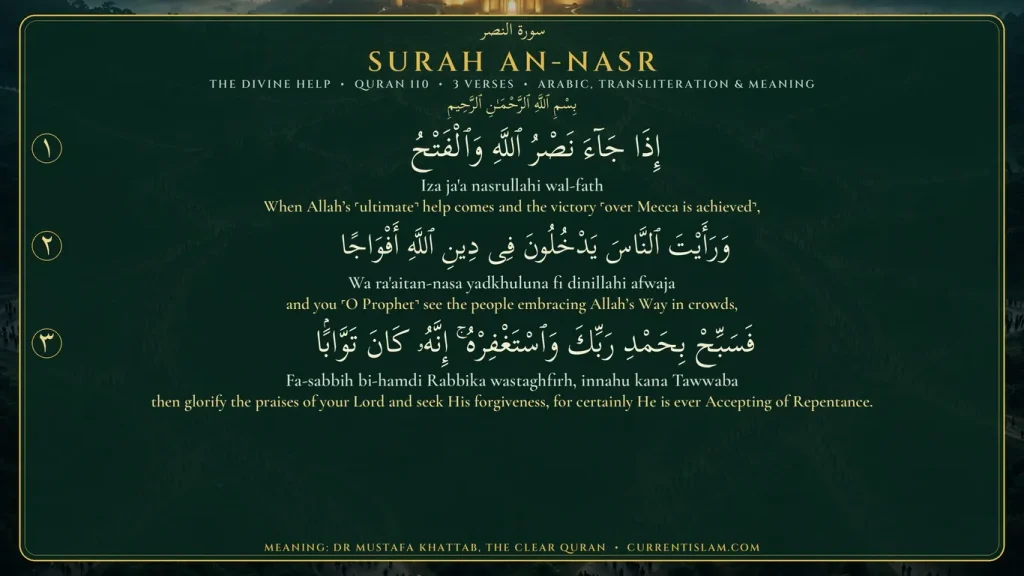
Nine of the last ten surahs were revealed in Makkah; this one alone came in Madinah, and it carries the weight of an ending. Surah Al-Nasr is widely reported to be the last complete surah revealed to the Prophet ﷺ, and its three verses describe the scene he had worked toward for twenty-three years: Allah’s help arrived, the victory complete, and people entering Islam not one by one but in crowds. Yet the surah contains no celebration of the Prophet ﷺ at all — its only commands are praise and seeking forgiveness.
Surah Al-Nasr — transliteration, with the full Arabic and meaning
Verse 1 — Iza ja a nasrullah (110:1)
Urdu (Jalandhari): جب خدا کی مدد آ پہنچی اور فتح (حاصل ہو گئی)
Hindi (al-Umari): (ऐ नबी!) जब अल्लाह की सहायता एवं विजय आ जाए।
Verse 2 (110:2)
Urdu (Jalandhari): اور تم نے دیکھ لیا کہ لوگ غول کے غول خدا کے دین میں داخل ہو رہے ہیں
Hindi (al-Umari): और आप लोगों को देखें कि वे अल्लाह के धर्म में दल के दल प्रवेश कर रहे हैं।¹
Verse 3 (110:3)
Urdu (Jalandhari): تو اپنے پروردگار کی تعریف کے ساتھ تسبیح کرو اور اس سے مغفرت مانگو، بے شک وہ معاف کرنے والا ہے
Hindi (al-Umari): तो आप अपने पालनहार की प्रशंसा के साथ उसकी पवित्रता का वर्णन करें और उससे क्षमा माँगें, निःसंदेह वह बहुत तौबा क़बूल करने वाला है।¹
What does Surah An-Nasr teach?
Ibn Abbas understood something in this surah that the other companions did not at first: if the mission was complete and the crowds had come, then the Messenger’s ﷺ own time was near — a reading the Prophet ﷺ confirmed. That is why its mood is farewell, not triumph. And its instruction is the one a believer needs at every finish line, not only at the end of a prophethood: when the help of Allah has come and the work has succeeded, the response is *tasbih* and *istighfar* — glorify Him, and ask His forgiveness for every shortcoming inside the success. Victory, in this surah, is a reason to bow lower, not to stand taller.
Placed where it sits, the surah also looks backward and forward at once: back to the refusal in Surah Al-Kafirun, which made this victory clean.
And it looks forward to a warning about the one enemy who never accepted that victory, in Surah Al-Masad.
*CurrentIslam has no separate page for Surah An-Nasr yet — this section is its fullest treatment on the site.*
7. Surah Lahab — Surah Al-Masad (111), The Palm Fibre
This surah carries two names, and each name is taken from its own words. Most people know it as Surah Lahab, from Abu Lahab — the Prophet’s ﷺ own uncle, named in its first verse by his nickname, “father of flame.” Others search for the same five verses as Surah Masad, from the rope of palm fibre in its closing line. Between those two names the whole story sits: a man of wealth, family and standing who used all three against the message, and a wife who helped him — and what both of them earned by it.
Surah Al-Masad — transliteration, with the full Arabic and meaning

Verse 1 — Tabbat yada abi lahab (111:1)
Urdu (Jalandhari):
ابولہب کے ہاتھ ٹوٹیں اور وہ ہلاک ہو
Hindi (al-Umari): अबू लहब के दोनों हाथ नाश हो जाएँ! और वह (स्वयं) विनष्ट हो गया।¹
Verse 2 (111:2)
Urdu (Jalandhari):
نہ تو اس کا مال ہی اس کے کچھ کام آیا اور نہ وہ جو اس نے کمایا
Hindi (al-Umari): उसका धन तथा जो कुछ उसने कमाया था, उसके काम नहीं आया।
Verse 3 (111:3)
Urdu (Jalandhari):
وہ جلد بھڑکتی ہوئی آگ میں داخل ہو گا
Hindi (al-Umari): जल्द ही वह लपट वाली आग में दाख़िल होगा।¹
Verse 4 (111:4)
Urdu (Jalandhari):
اور اس کی جورو بھی جو ایندھن سر پر اٹھائے پھرتی ہے
Hindi (al-Umari): तथा उसकी पत्नी (भी जहन्नम में जाएगी), जो ईंधन उठाने वाली है।
Verse 5 (111:5)
Urdu (Jalandhari):
اس کے گلے میں مونج کی رسّی ہو گی
Hindi (al-Umari): उसकी गर्दन में मज़बूत बटी हुई रस्सी होगी।¹
What does Surah Al-Masad teach?
Read slowly, Surah Al Masad is the Quran’s proof that nearness is not protection. Abu Lahab was not a distant enemy; he was the Prophet’s ﷺ uncle, close enough that his hostility is recorded from the very first days of the call, when he answered the Prophet’s ﷺ first public invitation with a curse — and this surah answers that curse word for word. The commentators describe his wife, Umm Jamil, scattering thorny branches in the Prophet’s ﷺ path, which is why she is named by her load: the carrier of firewood. The verdict on both is stated in the present tense of certainty, and history kept it: Abu Lahab never believed, and neither his wealth nor his gains stood between him and the end the surah announced. Kinship, money and status — the three shields people trust — are each named here, and each one fails.
It is a hard surah to sit between two gentle ones, but its place is deliberate: after the farewell of Surah An-Nasr, it clears away the last illusion.
What follows it is the purity of Surah Al-Ikhlas — the creed with nothing left to remove.
*CurrentIslam has no separate page for Surah Al-Masad yet — this section is its fullest treatment on the site.*
This surah is also known by its first word, Tabbat — our explainer on why it is called Tabat Surah traces the name and the account behind it.
8. Surah Ikhlas (112) — The Sincerity
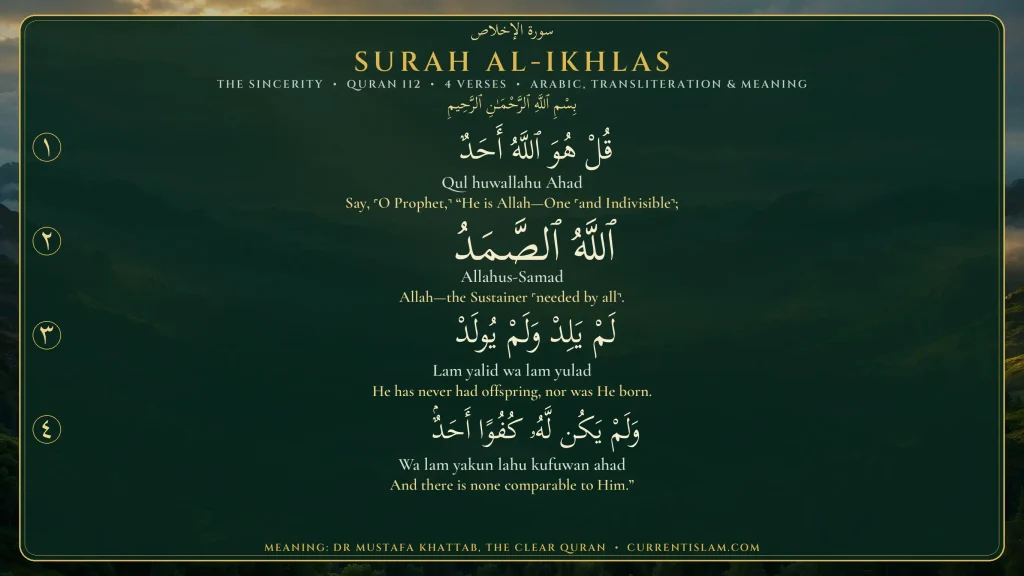
Four verses, fifteen Arabic words — and the Prophet ﷺ described this surah as equal to one-third of the Quran. Surah Ikhlas is the creed of Islam with everything else stripped away: who Allah is, and who He is not, in words a child can memorise in a day and a scholar can study for a lifetime. The tafsir reports that the idolaters once asked the Prophet ﷺ to describe the lineage of his Lord, and this surah is the answer that came down: Allah needs no lineage, because He is not one being among others. He is the One.
Surah Ikhlas with English transliteration, with the full Arabic and meaning
Verse 1 — Qul hu Allahu Ahad (112:1)
Urdu (Jalandhari):
کہو کہ وہ (ذات پاک جس کا نام) الله (ہے) ایک ہے
Hindi (al-Umari): (ऐ रसूल!) आप कह दीजिए : वह अल्लाह एक है।¹
Verse 2 (112:2)
Urdu (Jalandhari):
معبود برحق جو بےنیاز ہے
Hindi (al-Umari): अल्लाह बेनियाज़ है।
Verse 3 (112:3)
Urdu (Jalandhari):
نہ کسی کا باپ ہے اور نہ کسی کا بیٹا
Hindi (al-Umari): न उसकी कोई संतान है और न वह किसी की संतान है।
Verse 4 (112:4)
Urdu (Jalandhari):
اور کوئی اس کا ہمسر نہیں
Hindi (al-Umari): और न कोई उसका समकक्ष है।¹
What does Surah Al-Ikhlas teach?
Each verse removes a mistake. *Ahad* — He is One, not one of a series and not a unity that can be divided. *As-Samad* — the One everyone turns to for every need, while He needs nothing and no one; the commentators gather its meanings as the Eternal, the Self-Sufficient, the Refuge. Then the two denials: He has no offspring and He was not born, which cuts away every family tree people have ever drawn for God. And the close: nothing is comparable to Him, so every picture the mind forms falls short by definition. This is why the surah carries the weight it does in the daily prayers — said with understanding, it is tawhid itself, and the route of the last ten turns here from stories and warnings to the One they were all about.
From here the pillar enters its final movement, shelter: Surah Al-Falaq seeks refuge from the evils outside us, and An-Nas from the whisper within.
The dedicated page goes further into this surah’s virtues and its place in the daily adhkar — our Surah Ikhlas guide.
For these same four verses in Urdu only, see our Surah Ikhlas translation in Urdu.
9. Surah Falaq (113) — The Daybreak
With this surah the last ten change their posture: the reader stops being told and starts asking. Surah Falaq is a prayer for protection, five verses that open with *Qul* — “Say” — because Allah is teaching His Prophet ﷺ, and through him every reader, the exact words with which to take shelter. Together with the surah that follows it, it forms the pair known as al-Mu’awwidhatayn, the two surahs of seeking refuge, which the Prophet ﷺ would recite before sleep along with Al-Ikhlas, as recorded in Sahih al-Bukhari.
Surah Falaq in English, with the Surah Al-Falaq transliteration and full Arabic

Verse 1 — Qul auzu bi rabbil falaq (113:1)
Urdu (Jalandhari):
کہو کہ میں صبح کے پروردگار کی پناہ مانگتا ہوں
Hindi (al-Umari): (ऐ नबी!) कह दीजिए : मैं सुबह के पालनहार की शरण लेता हूँ।
Verse 2 (113:2)
Urdu (Jalandhari):
ہر چیز کی بدی سے جو اس نے پیدا کی
Hindi (al-Umari): उस चीज़ की बुराई से, जो उसने पैदा की।
Verse 3 (113:3)
Urdu (Jalandhari):
اور شب تاریکی کی برائی سے جب اس کااندھیرا چھا جائے
Hindi (al-Umari): तथा अंधेरी रात की बुराई से, जब वह छा जाए।¹
Verse 4 (113:4)
Urdu (Jalandhari):
اور گنڈوں پر (پڑھ پڑھ کر) پھونکنے والیوں کی برائی سے
Hindi (al-Umari): तथा गाँठों में फूँकने वालियों की बुराई से।
Verse 5 (113:5)
Urdu (Jalandhari):
اور حسد کرنے والے کی برائی سے جب حسد کرنے لگے
Hindi (al-Umari): तथा ईर्ष्या करने वाले की बुराई से, जब वह ईर्ष्या करे।¹
What does Surah Al-Falaq teach?
The refuge is taken in *Rabbil-falaq* — the Lord of the daybreak, the One who splits the darkness open every single morning — and then the evils are named one by one, all of them outside the reader: whatever harm exists in creation, the evil of the night when it deepens, those who blow on knots (the workers of sorcery, as the commentators explain), and the envier when envy moves him to act. Notice the order of the prayer: the Lord is named before any fear is. The surah does not teach the reader to study the dangers; it teaches the reader to arrive at Allah’s door first, and let the list of dangers be spoken from inside His protection, not outside it.
Its pair completes the shelter in the final section, Surah An-Nas, where the danger moves from the world outside to the whisper inside the chest.
For the fuller treatment — the surah’s background, its use in the morning and evening adhkar, and its pairing with An-Nas — see our Surah Al-Falaq page.
The final verse — the evil of the envier when he envies — is treated on its own in our page on min sharri hasidin iza hasad.
10. Surah Nas (114) — Humankind
The Quran ends here, and it ends the way a traveller ends a journey: by asking for protection on the last stretch of road. Surah Nas is the second of the two refuge surahs, six verses that turn from the evils of the world outside — the subject of Al-Falaq — to the one enemy who works from within: the whisperer who slips suggestions into the chest and withdraws the moment Allah is remembered. There is no more fitting close to the Book. The reader who began at Al-Fatiha asking to be guided finishes at An-Nas asking to be guarded.
Surah Nas transliteration, with the full Arabic and meaning
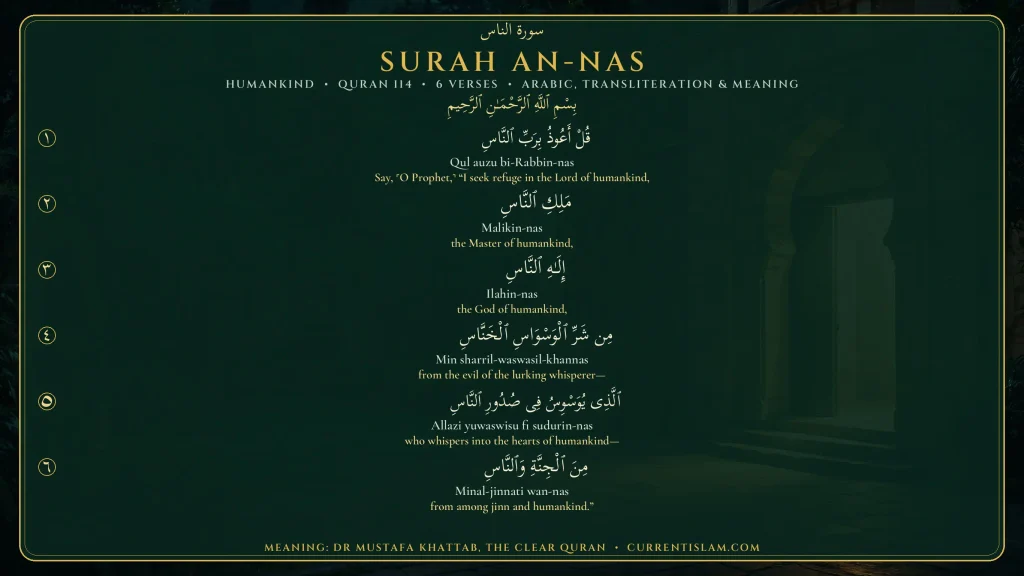
Verse 1 — Qul auzu bi rabbin nas (114:1)
Urdu (Jalandhari):
کہو کہ میں لوگوں کے پروردگار کی پناہ مانگتا ہوں
Hindi (al-Umari): (ऐ नबी!) कह दीजिए : मैं शरण लेता हूँ लोगों के पालनहार की।
Verse 2 (114:2)
Urdu (Jalandhari):
(یعنی) لوگوں کے حقیقی بادشاہ کی
Hindi (al-Umari): लोगों के बादशाह की।
Verse 3 (114:3)
Urdu (Jalandhari):
لوگوں کے معبود برحق کی
Hindi (al-Umari): लोगों के सत्य पूज्य की।¹
Verse 4 (114:4)
Urdu (Jalandhari):
(شیطان) وسوسہ انداز کی برائی سے جو (خدا کا نام سن کر) پیچھے ہٹ جاتا ہے
Hindi (al-Umari): वसवसा डालने वाले, पीछे हट जाने वाले की बुराई से।
Verse 5 (114:5)
Urdu (Jalandhari):
جو لوگوں کے دلوں میں وسوسے ڈالتا ہے
Hindi (al-Umari): जो लोगों के दिलों में वसवसे डालता है।
Verse 6 (114:6)
Urdu (Jalandhari):
وہ جنّات میں سے (ہو) یا انسانوں میں سے
Hindi (al-Umari): जिन्नों और इनसानों में से।¹
What does Surah An-Nas teach?
Before any enemy is named, Allah is named three times — the Lord of humankind, the Master of humankind, the God of humankind — as if the prayer insists on arriving fully at the door before describing what it fears. Then the enemy is described with precision: *al-waswas al-khannas*, the lurking whisperer who retreats when Allah is mentioned, working in the chests of people, and drawn from both jinn and humankind. The lesson the whole Quran closes on is that the last and nearest danger is a voice, and the defence against a voice is another Voice — the words of Allah themselves, recited and remembered. That is the end of the route this pillar set out: story, worship, shelter — and the shelter is a sentence you carry.
It pairs with the section before it — Surah Al-Falaq guards the outside, An-Nas guards the inside.
And when you finish it, the route simply begins again at Surah Al-Fil.
For a slower read of these six verses alone, the site carries a dedicated Surah An-Nas transliteration page.
Verse 4’s whisperer gets a page of his own: min sharril waswasil khannas works through that single verse in full.

1 thought on “Last 10 Surahs of Quran — Arabic, Transliteration & Meaning”