| QUICK ANSWER What it is: The 106th chapter of the Quran — 4 short verses revealed in Mecca about Allah’s blessings on the Quraish tribe. What it says: Because Allah gave the Quraish safe trade journeys and food, they should worship the Lord of the Kaaba alone. How to use it: Recite it in prayer, before meals, or when worried about provision — then name three blessings out loud. |
CONTENTS
What Is Surah Quraish About? ·
Arabic, Transliteration & Translation ·
What Does Each Verse Mean? ·
The Winter and Summer Journeys ·
Benefits of Reciting It ·
When to Recite: 90-Second Plan ·
For Modern Life ·Common Mistakes ·
At a Glance ·
The Quraish Gratitude Loop ·
Checklist ·
FAQ.
Your rent is due, the fridge is half empty, and the job market feels like a locked door. That tight feeling in your chest has a name in every language. Fourteen centuries ago, an entire tribe lived with a version of it — and then Allah sent them four verses that still answer it today.
Surah Quraish does not promise you a promotion. It does something better: it points at the food already on your table and the safety of your last journey, and asks who sent them. Once you see the Giver, the worry changes shape. Here is the surah, what it means, and a 90-second practice you can start tonight.
What Is Surah Quraish About?
Surah Quraish is the 106th surah of the Quran, revealed in Mecca (a Makki surah — one revealed before the Prophet’s ﷺ migration to Medina). In 4 verses, it reminds the Quraish tribe that their safe trade caravans and steady food came from Allah, and calls them to worship the Lord of the Kaaba in gratitude.
The surah is short enough to memorize in one sitting and deep enough to return to for a lifetime. Its logic is simple: blessing recognized → Giver acknowledged → worship offered. That three-beat rhythm is the backbone of this article — and of the practice plan below.
Surah Quraish in Arabic, Transliteration, and English Translation
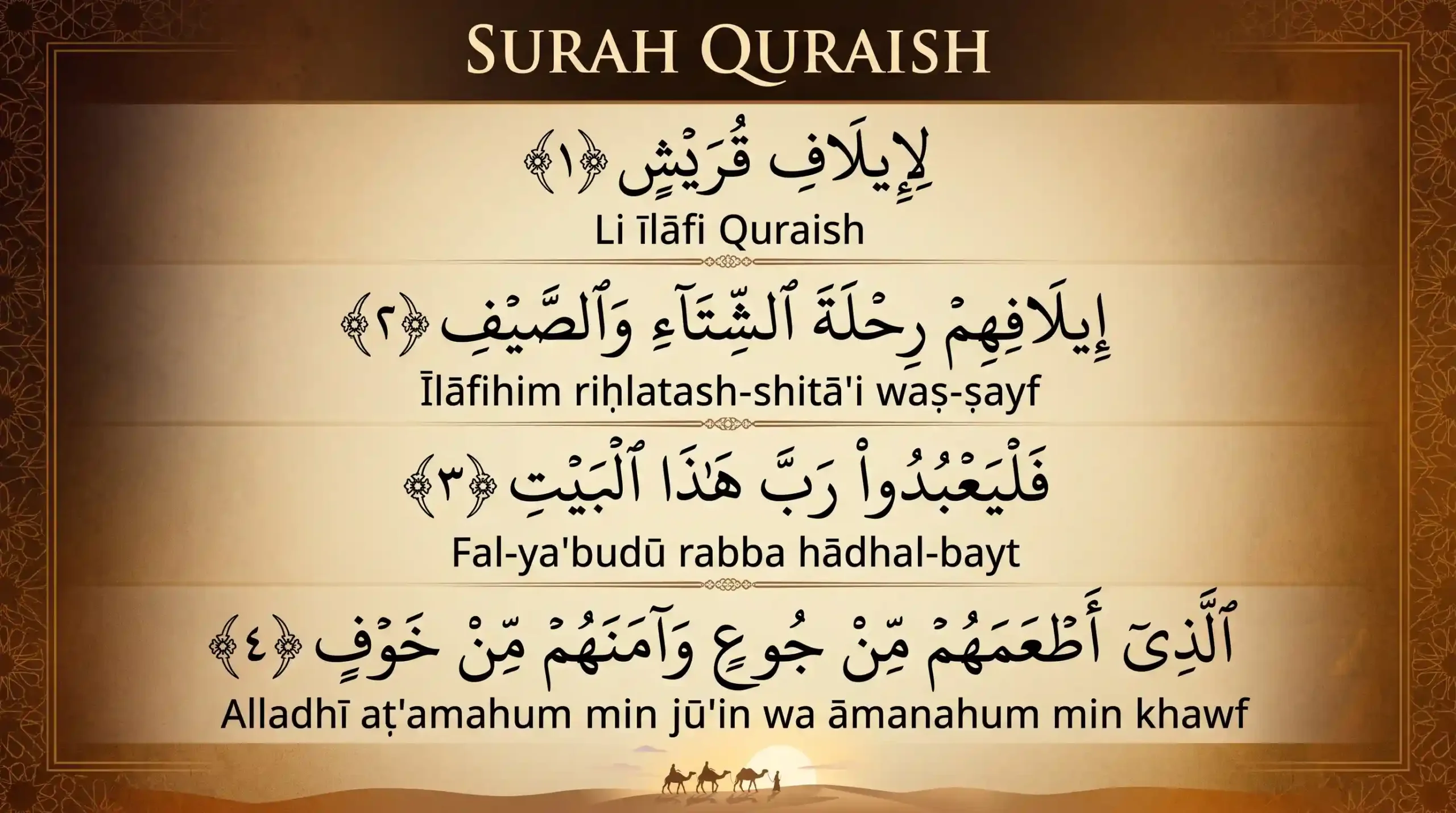
لِإِيلَافِ قُرَيْشٍ ﴿١
إِيلَافِهِمْ رِحْلَةَ الشِّتَاءِ وَالصَّيْفِ ﴿٢
فَلْيَعْبُدُوا رَبَّ هَٰذَا الْبَيْتِ ﴿٣
الَّذِي أَطْعَمَهُمْ مِنْ جُوعٍ وَآمَنَهُمْ مِنْ خَوْفٍ ﴿٤
Transliteration:
1. Li īlāfi Quraish
2. Īlāfihim riḥlatash-shitā’i waṣ-ṣayf
3. Fal-ya’budū rabba hādhal-bayt
4. Alladhī aṭ’amahum min jū’in wa āmanahum min khawf
English translation (Sahih International):
1. For the accustomed security of the Quraysh —
2. Their accustomed security [in] the caravan of winter and summer —
3. Let them worship the Lord of this House,
4. Who has fed them, [saving them] from hunger and made them safe, [saving them] from fear.
What Does Each Verse Mean?
Verse 1 names the blessing: the Quraish’s settled, secure way of life.
Verse 2 specifies it: safe winter and summer trade journeys.
Verse 3 gives the command: worship the Lord of the Kaaba.
Verse 4 gives the reason: He fed them against hunger and secured them against fear.
Word-by-word breakdown:
| Arabic | Transliteration | Meaning |
|---|---|---|
| لِإِيلَافِ | li-īlāf | for the accustomed security of |
| قُرَيْشٍ | Quraish | the Quraish (tribe) |
| رِحْلَةَ | riḥlah | journey / caravan trip |
| الشِّتَاءِ | ash-shitā’ | the winter |
| وَالصَّيْفِ | waṣ-ṣayf | and the summer |
| فَلْيَعْبُدُوا | fal-ya’budū | so let them worship |
| رَبَّ | rabba | the Lord of |
| هَٰذَا الْبَيْتِ | hādhal-bayt | this House (the Kaaba) |
| الَّذِي | alladhī | the One who |
| أَطْعَمَهُمْ | aṭ’amahum | fed them |
| مِنْ جُوعٍ | min jū’ | against hunger |
| وَآمَنَهُمْ | wa āmanahum | and made them safe |
| مِنْ خَوْفٍ | min khawf | from fear |
Tafsir (commentary) in brief: Classical commentators, including Ibn Kathir, read this surah together with Surah Al-Fil, revealed just before it (105). In Al-Fil, Allah destroyed Abraha’s army and protected the Kaaba. In Quraish, He tells the tribe what that protection was for: secure trade, full tables, safe roads — so they would worship Him alone instead of the idols they had placed around the very House He protected. The surah moves from gift (verses 1–2) to obligation (verse 3) to the Giver’s credentials (verse 4) — the name Ar-Razzaq, the Provider, who feeds against hunger and secures against fear.
Why Were the Winter and Summer Journeys So Important?
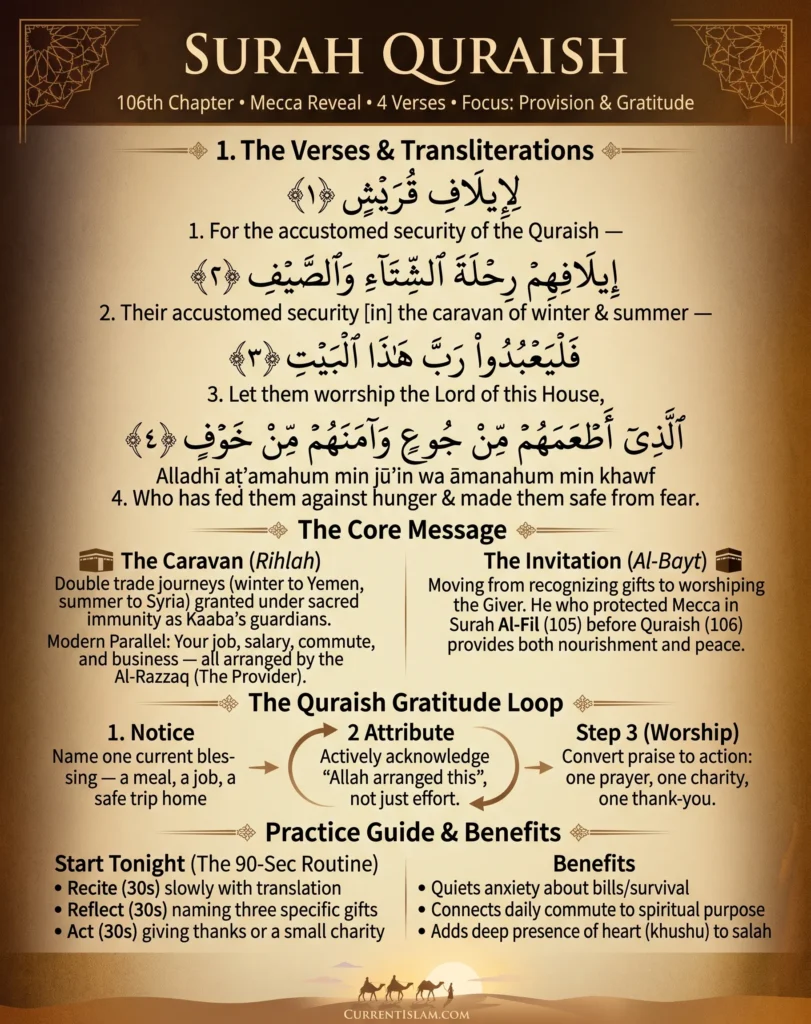
The Quraish ran two great trade caravans each year: south to Yemen in winter, north to Syria in summer. As custodians of the Kaaba, they traveled under a sacred immunity other tribes respected. These journeys were their entire economy — food, wealth, and status all rode on them.
Lose the caravans and Mecca starves; keep them and the city thrives. That is why the surah names them: Allah is saying, “Your whole livelihood — the thing you lie awake worrying about — was My arrangement.” For a modern reader, replace “caravan” with salary, business, or benefits check — and before any real journey, pair the recitation with a travel dua for safe journeys. The question lands the same way.
What Are the Benefits of Reciting Surah Quraish?
The surah’s themes are provision, security, and gratitude. Reciting it with understanding reminds the heart that rizq (provision) comes from Allah, which calms anxiety about money and safety.
What is established is the surah’s own message: the One who fed and secured the Quraish feeds and secures you. The Quran gives Him the title directly: Allah, the Best of Providers (Quran 62:11).
Readers report three practical effects:
(1) meals begin with conscious gratitude instead of autopilot;
(2) financial worry gets a counter-argument from revelation;
(3) its brevity makes it a sustainable daily recitation, unlike longer passages people abandon. Pair the recitation with a dua for rizq and lawful provision to turn the reminder into a request.
When Is the Best Time to Recite Surah Quraish?
Any time — it is valid in any prayer after Surah Al-Fatiha and outside prayer too. The highest-impact moments are before eating (to acknowledge provision), before travel or a workday (to ask for safety), and at night when financial anxiety peaks. Pair it with the 90-second routine below.
The 90-second routine (start tonight):
- Recite slowly (30 seconds): Read the 4 verses aloud, in Arabic if you can, transliteration if you cannot. Do not rush.
- Name three blessings (30 seconds): Say out loud three provisions from today — a meal, a safe trip, a working phone. Specificity matters.
- One act of thanks (30 seconds): Give a small charity, text someone you appreciate, or make one dua for continued provision.
Once the habit sticks, widen it with other short surahs for daily prayer — the goal is a set you can sustain, not a list you abandon.
Before meals, open with the dua before eating, then run the routine: gratitude before the first bite.
Note: spiritual practice supports wellbeing; it complements professional help for anxiety or financial hardship and never replaces it.
How Does Surah Quraish Apply to Modern Life?
The surah reframes every paycheck, grocery run, and safe commute as a “winter and summer journey” — provision arranged by Allah. At work, it checks greed; at school, it steadies exam anxiety; as the only Muslim in the room, it turns difference into quiet confidence: your Provider travels with you.
Commuting becomes a caravan. The monthly budget meeting becomes verse 2. When colleagues credit “the market” for your stability, the surah hands you the deeper ledger. You do not need to preach it; you need to see it, and the seeing changes how you spend, save, and thank.
What Mistakes Do People Make with This Surah?
Three common ones. First, racing through it in prayer without knowing what it says. Second, treating it as a magic formula for wealth rather than a call to gratitude and worship. Third, mispronouncing īlāf (accustomed security) — slowing down on verse 1 fixes most errors.
A related misconception: that the surah is “only about the Quraish tribe.” The tribe is the occasion; the message — provision has a Giver, so worship the Giver — addresses every reader. Another: that short surahs are “lesser.” The Prophet ﷺ recited short surahs regularly; brevity is a feature, not a flaw.
Surah Quraish at a Glance
| Fact | Detail |
|---|---|
| Number in the Quran | 106th surah |
| Verses | 4 |
| Revealed | Mecca (Makki) |
| Core theme | Gratitude for provision and security |
| Key command | Worship the Lord of the Kaaba (106:3) |
| Key promise | He fed them against hunger and secured them from fear (106:4) |
| Pairs with | Surah Al-Fil (105) — protection before provision |
| Recite when | In salah, before meals, before travel, when anxious about rizq |
The Quraish Gratitude Loop
This is the article’s core framework — three steps, memorable enough to quote:
- Notice the caravan. Name one provision in your life right now — the job, the meal, the safe drive home.
- Name the Giver. Say it plainly: “Allah arranged this.” Not luck, not only effort — arrangement.
- Worship with action. One prayer, one charity, one thank-you. Gratitude that stays in the heart is incomplete; the surah commands worship, not just feeling.
Run the loop daily and provision stops being background noise. It becomes evidence.
Quotable lines:
- “Your salary is your caravan. Your safety is your winter journey. Who sent them?”
- “Gratitude is worship with receipts.”
- “The Quraish had trade routes. You have a morning commute. Same Giver.”
- “Four verses. Ninety seconds. A lifetime of perspective.”
- “Security and food are not background noise. They are the message.”
Save-This Checklist: Your First 7 Days
- Day 1: Memorize verse 1 — Li īlāfi Quraish — and say it before dinner.
- Day 2: Add verse 2. Recite both before leaving for work.
- Day 3: Add verse 3. Notice one blessing on your commute and name the Giver.
- Day 4: Add verse 4. Full surah memorized — recite it in one prayer today.
- Day 5: Run the full 90-second routine before a meal.
- Day 6: Teach the 4 verses to one person — a child, spouse, or friend.
- Day 7: Give a small charity “for the accustomed security” — and note how it felt.
Frequently Asked Questions
What does “li ilafi quraish” mean?
It means “for the accustomed security of the Quraish.” Īlāf means a settled, familiar arrangement — the safe, regular trade journeys Allah granted the tribe. The verse opens the surah by naming the blessing before naming the obligation.
Is Surah Quraish Makki or Madani?
It is a Makki surah, revealed in Mecca before the Prophet’s ﷺ migration to Medina. It addresses the Quraish tribe directly, reminding them of blessings they received while still in Mecca — which is why worship of the Lord of the Kaaba is its central command.
Which surah comes before Surah Quraish?
Surah Al-Fil (105) comes immediately before it. The two are deeply connected: Al-Fil describes Allah destroying Abraha’s army to protect the Kaaba, and Quraish explains what that protection was for — secure trade and provision, so the tribe would worship Him alone.
Can I recite Surah Quraish in salah?
Yes. It is permissible in any obligatory or voluntary prayer, recited after Surah Al-Fatiha. Its brevity makes it ideal for daily prayers, and understanding its meaning — gratitude for provision and safety — adds presence of heart (khushu) to the recitation.
What were the winter and summer journeys?
The Quraish ran two annual trade caravans: to Yemen in the cooler winter months and to Syria in summer. As custodians of the Kaaba, they enjoyed safe passage through tribal lands. These journeys were Mecca’s entire economy — its food and wealth.
How many verses are in Surah Quraish?
Four short verses — among the shortest chapters in the Quran. Its brevity is why it is widely memorized, frequently recited in prayer, and ideal for beginners, children, and anyone building a daily recitation habit.
What to Read Next
- Surah Al-Fil with translation — the protection that came before the provision.
- Dua for rizq — ask for provision the Sunnah way.
- The 4 Quls in English — build your daily short-surah set.
- All 114 surahs in order — see the full map.
Found this useful? Share it with someone learning the short surahs.
