It is late. Your child asks you to say the Quls together before bed, and you stall. You grew up hearing them, but the Arabic letters blur. The roman spelling you found online looks different on every site. You want to get it right, and you want a routine short enough to keep.
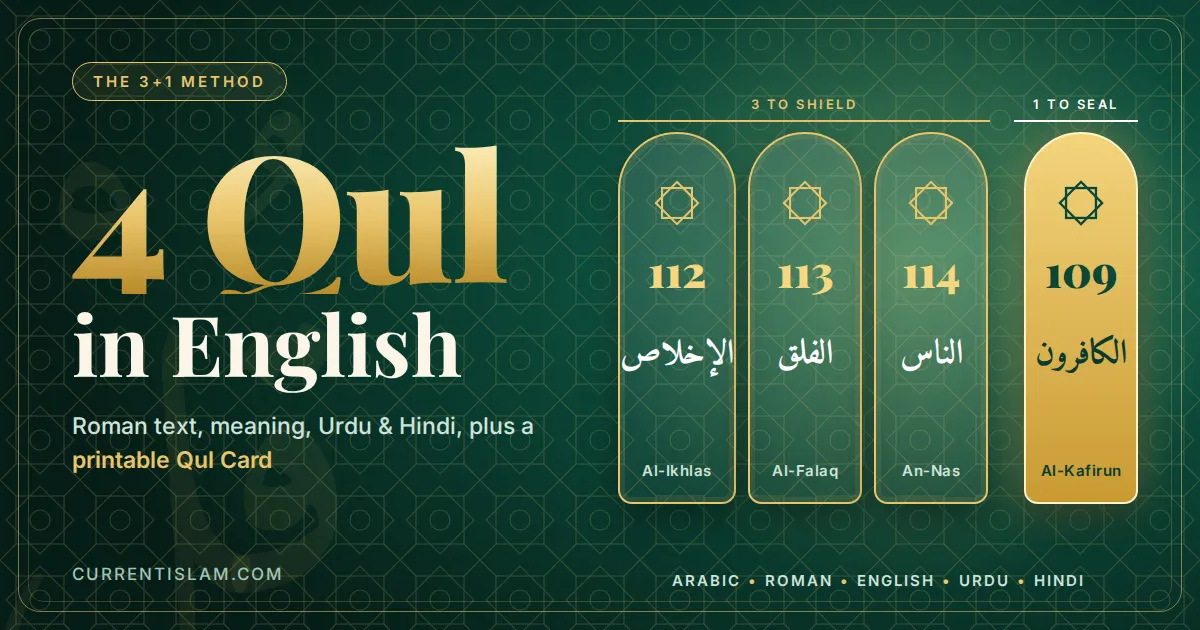
The 4 Quls are four short surahs (chapters) of the Quran that begin with the word qul, meaning “say”: Al-Kafirun (109), Al-Ikhlas (112), Al-Falaq (113) and An-Nas (114). This guide gives each one in Arabic, roman English and English. Then it shows which routines come from authentic reports and which are only habit.
What does the story of ‘Uqbah ibn ‘Amir teach about Al-Falaq and An-Nas?
[‘Uqbah ibn ‘Amir (may Allah be pleased with him) was leading the Prophet’s ﷺ camel on a journey when the Prophet asked, “Shall I not teach you two of the best surahs?” He taught him Al-Falaq and An-Nas. ‘Uqbah did not seem very pleased, and some commentators suggest he expected something longer. At Fajr, the Prophet ﷺ led the people and recited both. Then he asked, “O ‘Uqbah, what do you think?” In another version he adds: “Recite them every time you go to sleep and get up.” (Abu Dawud 1462; Nasa’i 5437
Quick Answer
- The 4 Quls are Surahs 109, 112, 113 and 114. Each starts with “Qul” (say).
- Authentic reports link three of them (Al-Ikhlas, Al-Falaq, An-Nas) with bedtime, morning and evening. A separate report links Al-Kafirun with sleep. We call this the 3+1 Method.
- Tonight: recite the three, wipe over your body as the Prophet ﷺ did, then finish with Al-Kafirun.
In this guide
- What are the 4 Quls?
- What is the 3+1 Method?
- How do you read each Qul?
- Which Qul is which?
- When should you recite them?
- What is the Night Shield routine?
- How can you learn them in 4 nights?
- How do the Quls fit work, school and family life?
- What are common mistakes?
- FAQ
What are the 4 Quls?
The 4 Quls are Surah Al-Kafirun (109), Al-Ikhlas (112), Al-Falaq (113) and An-Nas (114). Each opens with “Qul,” Arabic for “say.” The name is a common grouping, not a title used in the Quran or hadith. The surahs are short, easy to memorize and widely taught to children.
A hadith is a reported saying or action of the Prophet ﷺ. The hadith collections name these surahs one by one. They do not use the phrase “4 Quls.” Al-Falaq and An-Nas are also called al-Mu’awwidhatayn, “the two surahs of seeking refuge.” Al-Ikhlas, Al-Falaq and An-Nas are often called “the three Quls.”
[SCHOLAR: add a precise Ibn Kathir tafsir (explanation) reference for the 4 surahs, or skip]
What is the 3+1 Method?
The 3+1 Method keeps your routine tied to sources. The “3” are Al-Ikhlas, Al-Falaq and An-Nas, reported together at bedtime and in the morning and evening. The “+1” is Al-Kafirun, reported separately for the moment before sleep. Memory line: three to shield, one to seal.
“Three to shield, one to seal” is a memory aid, not a hadith. The reports behind it are real. A man asked the Prophet ﷺ what to say. He answered that Al-Ikhlas and the two surahs of refuge, said morning and evening, “will serve you for every purpose” (Sunan Abi Dawud 5082, graded hasan, meaning good). Another report tells a man to recite Al-Kafirun and then sleep, because it is a disavowal of shirk, the association of partners with Allah (Abu Dawud 5055; Tirmidhi 3403).
How do you read each Qul?
Roman English is a bridge. It shows the sounds, but it cannot capture every Arabic letter. Each table below puts the Arabic, roman English, English, Urdu and Hindi side by side, verse by verse. Use it with audio from a qualified reciter. We use one spelling system across the whole page. Translation: Sahih International.
How do you read Surah Al-Ikhlas (112)?
Surah Al-Ikhlas (112) has four verses about Allah’s oneness. Read it as: Qul huwal-lahu ahad, Allahus-samad, lam yalid wa lam yulad, wa lam yakun lahu kufuwan ahad. It means Allah is One, the Eternal Refuge, neither begets nor is born, and has no equal.
بِسْمِ اللَّهِ الرَّحْمَٰنِ الرَّحِيمِ
Bismillahir-rahmanir-rahim
| Verse | Arabic | Roman English | English (Sahih International) | Urdu (draft) | Hindi (draft) |
|---|---|---|---|---|---|
| 1 | قُلْ هُوَ اللَّهُ أَحَدٌ | Qul huwal-lahu ahad | Say, “He is Allah, [who is] One, | کہہ دو: وہ اللہ ایک ہے۔ | कहो: वह अल्लाह एक है। |
| 2 | اللَّهُ الصَّمَدُ | Allahus-samad | Allah, the Eternal Refuge. | اللہ بے نیاز ہے (سب اسی کے محتاج ہیں)۔ | अल्लाह बेनियाज़ है (सब उसके मोहताज हैं)। |
| 3 | لَمْ يَلِدْ وَلَمْ يُولَدْ | Lam yalid wa lam yulad | He neither begets nor is born, | نہ اس کی کوئی اولاد ہے اور نہ وہ کسی کی اولاد ہے۔ | न उसकी कोई संतान है और न वह किसी की संतान है। |
| 4 | وَلَمْ يَكُن لَّهُ كُفُوًا أَحَدٌ | Wa lam yakun lahu kufuwan ahad | Nor is there to Him any equivalent.” | اور کوئی اس کے برابر کا نہیں۔ | और कोई उसके बराबर का नहीं। |
Source: Quran 112:1-4. Deeper guide: Surah Ikhlas transliteration.
![An ornate teal and gold Islamic graphic displaying the English translation of Surah Al-Ikhlas (112) inside an illuminated arched frame. The text lists all four verses, beginning with "Say, 'He is Allah, [who is] One," and is decorated with crescent moons, stars, an open Quran, and a mosque silhouette at the bottom.](https://currentislam.com/wp-content/uploads/2026/10/SurahAl-Ikhlas-1024x559.webp)
How do you read Surah Al-Falaq (113)?
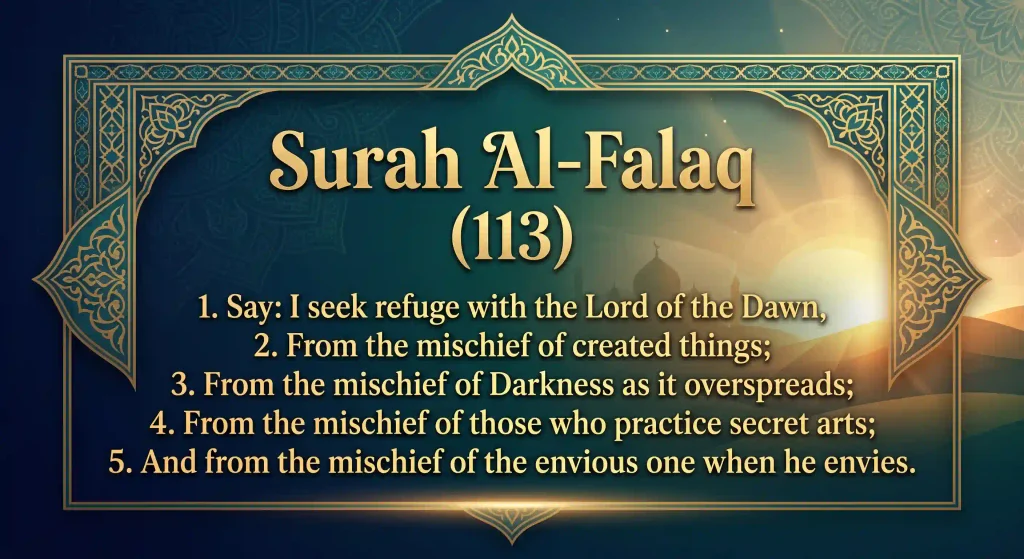
Surah Al-Falaq (113) has five verses asking Allah for refuge from harm. It opens Qul a’udhu bi-rabbil-falaq, “Say, I seek refuge in the Lord of daybreak.” It names harm from creation, darkness, the blowers in knots and the envier. Read the full text below.
بِسْمِ اللَّهِ الرَّحْمَٰنِ الرَّحِيمِ
Bismillahir-rahmanir-rahim
| Verse | Arabic | Roman English | English (Sahih International) | Urdu (draft) | Hindi (draft) |
|---|---|---|---|---|---|
| 1 | قُلْ أَعُوذُ بِرَبِّ الْفَلَقِ | Qul a’udhu bi-rabbil-falaq | Say, “I seek refuge in the Lord of daybreak, | کہہ دو: میں صبح کے رب کی پناہ مانگتا ہوں۔ | कहो: मैं सुबह के रब की पनाह माँगता हूँ। |
| 2 | مِن شَرِّ مَا خَلَقَ | Min sharri ma khalaq | From the evil of that which He created, | ہر اس چیز کے شر سے جو اس نے پیدا کی۔ | हर उस चीज़ की बुराई से जो उसने पैदा की। |
| 3 | وَمِن شَرِّ غَاسِقٍ إِذَا وَقَبَ | Wa min sharri ghasiqin idha waqab | And from the evil of darkness when it settles, | اور اندھیری رات کے شر سے جب وہ چھا جائے۔ | और अँधेरी रात की बुराई से जब वह छा जाए। |
| 4 | وَمِن شَرِّ النَّفَّاثَاتِ فِي الْعُقَدِ | Wa min sharrin-naffathati fil-‘uqad | And from the evil of the blowers in knots, | اور گرہوں میں پھونکنے والیوں کے شر سے۔ | और गिरहों में फूँकने वालियों की बुराई से। |
| 5 | وَمِن شَرِّ حَاسِدٍ إِذَا حَسَدَ | Wa min sharri hasidin idha hasad | And from the evil of an envier when he envies.” | اور حسد کرنے والے کے شر سے جب وہ حسد کرے۔ | और हसद करने वाले की बुराई से जब वह हसद करे। |
Source: Quran 113:1-5. Deeper guide: Surah Falaq meaning.
How do you read Surah An-Nas (114)?
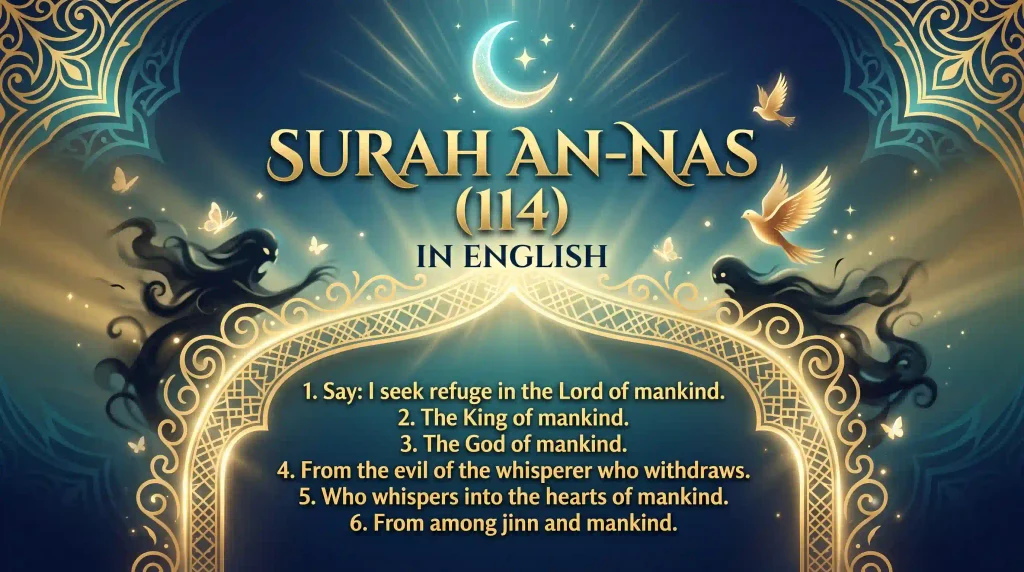
Surah An-Nas (114) has six verses seeking refuge in Allah, the Lord, King and God of mankind, from the whisperer who whispers in people’s hearts. It opens Qul a’udhu bi-rabbin-nas, “Say, I seek refuge in the Lord of mankind.” Read the full text below.
بِسْمِ اللَّهِ الرَّحْمَٰنِ الرَّحِيمِ
Bismillahir-rahmanir-rahim
| Verse | Arabic | Roman English | English (Sahih International) | Urdu (draft) | Hindi (draft) |
|---|---|---|---|---|---|
| 1 | قُلْ أَعُوذُ بِرَبِّ النَّاسِ | Qul a’udhu bi-rabbin-nas | Say, “I seek refuge in the Lord of mankind, | کہہ دو: میں لوگوں کے رب کی پناہ مانگتا ہوں۔ | कहो: मैं लोगों के रब की पनाह माँगता हूँ। |
| 2 | مَلِكِ النَّاسِ | Malikin-nas | The Sovereign of mankind, | لوگوں کے بادشاہ کی۔ | लोगों के बादशाह की। |
| 3 | إِلَٰهِ النَّاسِ | Ilahin-nas | The God of mankind, | لوگوں کے معبود کی۔ | लोगों के माबूद की। |
| 4 | مِن شَرِّ الْوَسْوَاسِ الْخَنَّاسِ | Min sharril-waswasil-khannas | From the evil of the retreating whisperer | وسوسہ ڈالنے والے، پیچھے ہٹ جانے والے کے شر سے۔ | वसवसा डालने वाले, पीछे हट जाने वाले की बुराई से। |
| 5 | الَّذِي يُوَسْوِسُ فِي صُدُورِ النَّاسِ | Alladhi yuwaswisu fi sudurin-nas | Who whispers [evil] into the breasts of mankind, | جو لوگوں کے سینوں میں وسوسے ڈالتا ہے۔ | जो लोगों के सीनों में वसवसे डालता है। |
| 6 | مِنَ الْجِنَّةِ وَالنَّاسِ | Minal-jinnati wan-nas | From among the jinn and mankind.” | جنوں میں سے اور انسانوں میں سے۔ | जिन्नों में से और इंसानों में से। |
Source: Quran 114:1-6. Deeper guide: Surah An-Nas transliteration. Related: dua for waswasa and bechaini.
How do you read Surah Al-Kafirun (109)?
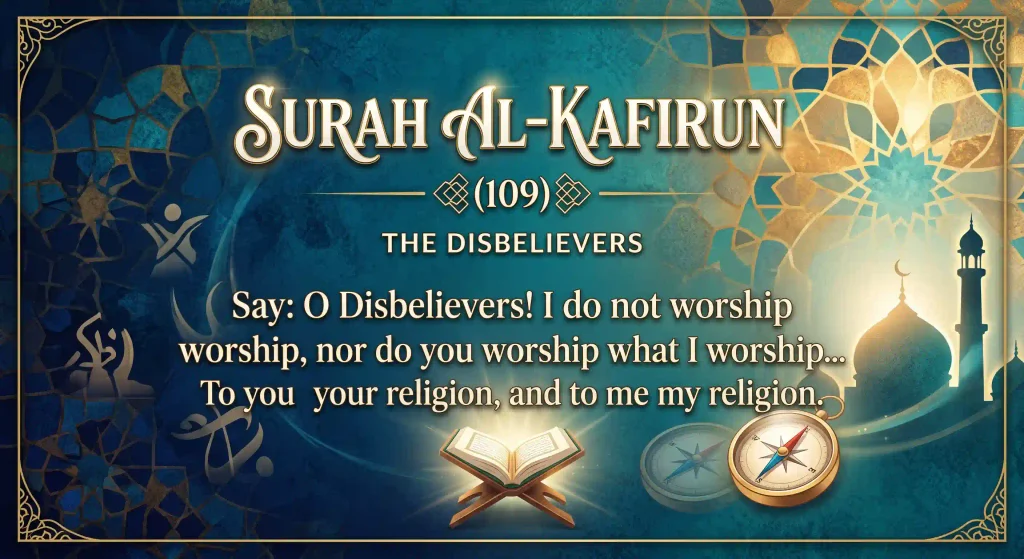
Surah Al-Kafirun (109) has six verses stating a clear separation in worship. It opens Qul ya ayyuhal-kafirun and ends lakum dinukum wa liya din, “For you is your religion, and for me is my religion.” It is the “+1” in the 3+1 Method.
بِسْمِ اللَّهِ الرَّحْمَٰنِ الرَّحِيمِ
Bismillahir-rahmanir-rahim
| Verse | Arabic | Roman English | English (Sahih International) | Urdu (draft) | Hindi (draft) |
|---|---|---|---|---|---|
| 1 | قُلْ يَا أَيُّهَا الْكَافِرُونَ | Qul ya ayyuhal-kafirun | Say, “O disbelievers, | کہہ دو: اے کافرو! | कहो: ऐ काफ़िरो! |
| 2 | لَا أَعْبُدُ مَا تَعْبُدُونَ | La a’budu ma ta’budun | I do not worship that which you worship. | میں اُن کی عبادت نہیں کرتا جن کی تم عبادت کرتے ہو۔ | मैं उनकी इबादत नहीं करता जिनकी तुम इबादत करते हो। |
| 3 | وَلَا أَنتُمْ عَابِدُونَ مَا أَعْبُدُ | Wa la antum ‘abiduna ma a’bud | Nor are you worshippers of what I worship. | اور نہ تم اس کی عبادت کرنے والے ہو جس کی میں عبادت کرتا ہوں۔ | और न तुम उसकी इबादत करने वाले हो जिसकी मैं इबादत करता हूँ। |
| 4 | وَلَا أَنَا عَابِدٌ مَّا عَبَدتُّمْ | Wa la ana ‘abidum-ma ‘abattum | Nor will I be a worshipper of what you worship. | اور نہ میں اُن کی عبادت کرنے والا ہوں جن کی تم نے عبادت کی۔ | और न मैं उनकी इबादत करने वाला हूँ जिनकी तुमने इबादत की। |
| 5 | وَلَا أَنتُمْ عَابِدُونَ مَا أَعْبُدُ | Wa la antum ‘abiduna ma a’bud | Nor will you be worshippers of what I worship. | اور نہ تم اس کی عبادت کرنے والے ہو جس کی میں عبادت کرتا ہوں۔ | और न तुम उसकी इबादत करने वाले हो जिसकी मैं इबादत करता हूँ। |
| 6 | لَكُمْ دِينُكُمْ وَلِيَ دِينِ | Lakum dinukum wa liya din | For you is your religion, and for me is my religion.” | تمہارے لیے تمہارا دین ہے اور میرے لیے میرا دین۔ | तुम्हारे लिए तुम्हारा दीन है और मेरे लिए मेरा दीन। |
Source: Quran 109:1-6. Deeper guide: Surah Al-Kafirun verse 6.
What does each word of Surah Al-Ikhlas mean?
Surah Al-Ikhlas is built from a few simple Arabic words. “Qul” means say, “ahad” means One, and “samad” means the one everyone turns to in need. The negatives “lam” and “wa lam” deny that Allah has offspring, a parent, or any equal.
| Arabic | Roman English | Meaning |
|---|---|---|
| قُلْ | qul | say |
| هُوَ | huwa | He |
| اللَّهُ | Allah | Allah |
| أَحَدٌ | ahad | One |
| الصَّمَدُ | as-samad | the Eternal Refuge |
| لَمْ يَلِدْ | lam yalid | He has not begotten |
| وَلَمْ يُولَدْ | wa lam yulad | and was not born |
| كُفُوًا | kufuwan | equal |
Which Qul is which?
Each of the 4 Quls has its own theme and its own reports. Al-Kafirun separates worship, Al-Ikhlas states Allah’s oneness, and Al-Falaq and An-Nas ask for protection. Use the table to see verse counts, themes and the sourced use of each surah.
| Surah | No. | Verses | Theme | Reported use (with source) |
|---|---|---|---|---|
| Al-Kafirun | 109 | 6 | Clear separation in worship | Before sleep (Abu Dawud 5055; Tirmidhi 3403) |
| Al-Ikhlas | 112 | 4 | Allah’s oneness | Bedtime, morning, evening (Bukhari 5017; Abu Dawud 5082) |
| Al-Falaq | 113 | 5 | Refuge from outer harm | Bedtime, morning, evening (Bukhari 5017; Abu Dawud 5082) |
| An-Nas | 114 | 6 | Refuge from the whisperer | Bedtime, morning, evening (Bukhari 5017; Abu Dawud 5082) |
When should you recite them?
Authentic reports give three moments: bedtime, morning and evening. At bedtime, the Prophet ﷺ recited Al-Ikhlas, Al-Falaq and An-Nas, blew into his cupped hands, and wiped his body, three times. Morning and evening carry a separate report with a count of three.
| Moment | What | Source | Grade |
|---|---|---|---|
| Bedtime | Ikhlas, Falaq, Nas; cup hands, blow, wipe body; three times | Sahih al-Bukhari 5017 | Sahih |
| Morning and evening | Ikhlas, Falaq, Nas; three times each | Sunan Abi Dawud 5082; Tirmidhi 3575 [VERIFY number] | Hasan |
| Just before sleep | Al-Kafirun, then sleep | Abu Dawud 5055; Tirmidhi 3403 | [VERIFY grade] |
| Fajr sunnah prayer | Al-Kafirun and Al-Ikhlas in the two rak’ahs | Sahih Muslim [VERIFY number] | [VERIFY] |
| Illness | Falaq and Nas, then blow over the body | Sahih al-Bukhari 5016 | Sahih |
For a full daily list, see our guide to morning and evening adhkar. Adhkar means words of remembrance said at set times. Al-Ikhlas also has a report comparing it to one third of the Quran (Sahih al-Bukhari [VERIFY number]). That report is about its weight in meaning. It does not say reciting it three times replaces the whole Quran.
What is the Night Shield routine?
The Night Shield is a short bedtime routine built from two reports. Cup your hands, recite Al-Ikhlas, Al-Falaq and An-Nas, blow lightly, and wipe your body, three times. Then recite Al-Kafirun last and sleep. Joining the two reports is a practical arrangement, not one hadith.
- Say Bismillah (in the name of Allah) and join your palms together.
- Recite Al-Ikhlas, Al-Falaq and An-Nas.
- Blow lightly into your palms, then wipe your head, face and the front of your body.
- Repeat the wiping routine two more times, three in all (Bukhari 5017).
- Recite Al-Kafirun last, then go to sleep. Pair it with the other before-sleep duas if you like.
Time it once at a calm pace so you know how long it takes.
How can you learn the 4 Quls in 4 nights?
Learn one surah per night. Night 1 is Al-Ikhlas, the shortest at four verses. Night 2 is Al-Falaq, night 3 is An-Nas, and night 4 is Al-Kafirun. On night 5 you recite the full 3+1 routine. Small steps beat one long session.
- Night 1: Al-Ikhlas. Say one line, repeat it, then the whole surah.
- Night 2: Al-Falaq, plus Night 1 once.
- Night 3: An-Nas, plus nights 1 and 2.
- Night 4: Al-Kafirun, then the full 3+1.
Save this: [Download the printable Qul Card] 🚀🚀🚀 ([QUL CARD PDF URL]) (Arabic with vowel marks, roman English, and the Night Shield steps on one page). Parents can use it with children. Our guide on teaching the Quran explains why the effort matters.
How do the Quls fit work, school and family life?
Tie the Quls to habits you already have. The reports name morning, evening and bedtime, so attach them to getting ready, finishing work and brushing your teeth. A fixed anchor makes the routine easy to keep, even when you are the only Muslim in the room.
- Morning: say the three while putting on your shoes or waiting for the kettle.
- Evening: say them on the commute home or before you open the laptop for the night.
- School run: practice one surah with your child in the car or at the table.
- Hard days: recitation sits beside, not instead of, rest, talking to someone and getting care. See our dua for anxiety.
Al-Falaq asks for refuge from envy. For more, read about protection from the evil eye. Keep the habit light and private. No one needs to see it.
What are common mistakes?
The most common mistakes are treating all four surahs as one unit, repeating reward claims without a source, and reading without understanding. Fix them by following the 3+1 table, checking each claim, and learning the English meaning alongside the sounds.
- Merging the reports. The reports name the surahs separately. Keep the sources visible.
- Repeating unsourced rewards. Some claims online, such as special rewards for reading Al-Falaq in Ramadan, lack a source we could verify. We do not repeat them. [VERIFY]
- Reading only in roman English. It is a first step. Add audio and learn the letters over time.
- Using recitation as a substitute for care. Seek medical help when you need it.
4 Qul Surah in English pdf
FAQ
What are the 4 Quls in English?
The 4 Quls are Surah Al-Kafirun (109), Al-Ikhlas (112), Al-Falaq (113) and An-Nas (114). In English they are often called The Disbelievers, The Sincerity, The Daybreak and Mankind. Each begins with “Qul,” meaning “say,” which is why people group them together.
Which Quls should I read before sleeping?
Read Al-Ikhlas, Al-Falaq and An-Nas, then cup your hands, blow lightly and wipe over your head, face and body, three times (Bukhari 5017). A separate report advises reading Al-Kafirun before sleep (Abu Dawud 5055), so many people finish with it.
How many times should I recite the 4 Quls?
The reports give three times for Al-Ikhlas, Al-Falaq and An-Nas in the morning and evening (Abu Dawud 5082), and three rounds at bedtime (Bukhari 5017). The Al-Kafirun report names no set count, so a single recitation before sleeping is a simple, safe choice.
Can I use roman English if I cannot read Arabic?
Yes, as a first step. Roman English helps you sound the words, but it cannot show every Arabic sound. Pair it with audio from a qualified reciter, then learn the letters over time. Ask a teacher to correct your pronunciation.
Are the 4 Quls for protection from the evil eye?
Al-Falaq and An-Nas are the two surahs of seeking refuge, and Muslims widely recite them for protection, including from envy. Recitation is worship and supplication to Allah, not a guarantee. It never replaces medical care, rest or practical safety steps.
How do I teach the 4 Quls to my child?
Start with one surah per night, beginning with Al-Ikhlas at four verses. Say one line, let your child repeat it, and use roman English only as a bridge. Add audio from a qualified reciter, keep each session short, and praise effort, not perfection.
Do all four Quls have the same virtue?
No. Each has its own reports. Al-Ikhlas has a report comparing it to one third of the Quran, Al-Falaq and An-Nas are the surahs of refuge, and Al-Kafirun has a report for before sleep. Avoid reward claims that have no source.
Next step
Further reading (external): Quran.com, Surah Al-Ikhlas and Sahih al-Bukhari 5017 on Sunnah.com.
Written by [SCHOLAR NAME], [CREDENTIALS]. Last reviewed: [DATE] by [REVIEWER NAME]. Quran translation: Sahih International. Hadith numbering: Sunnah.com.
