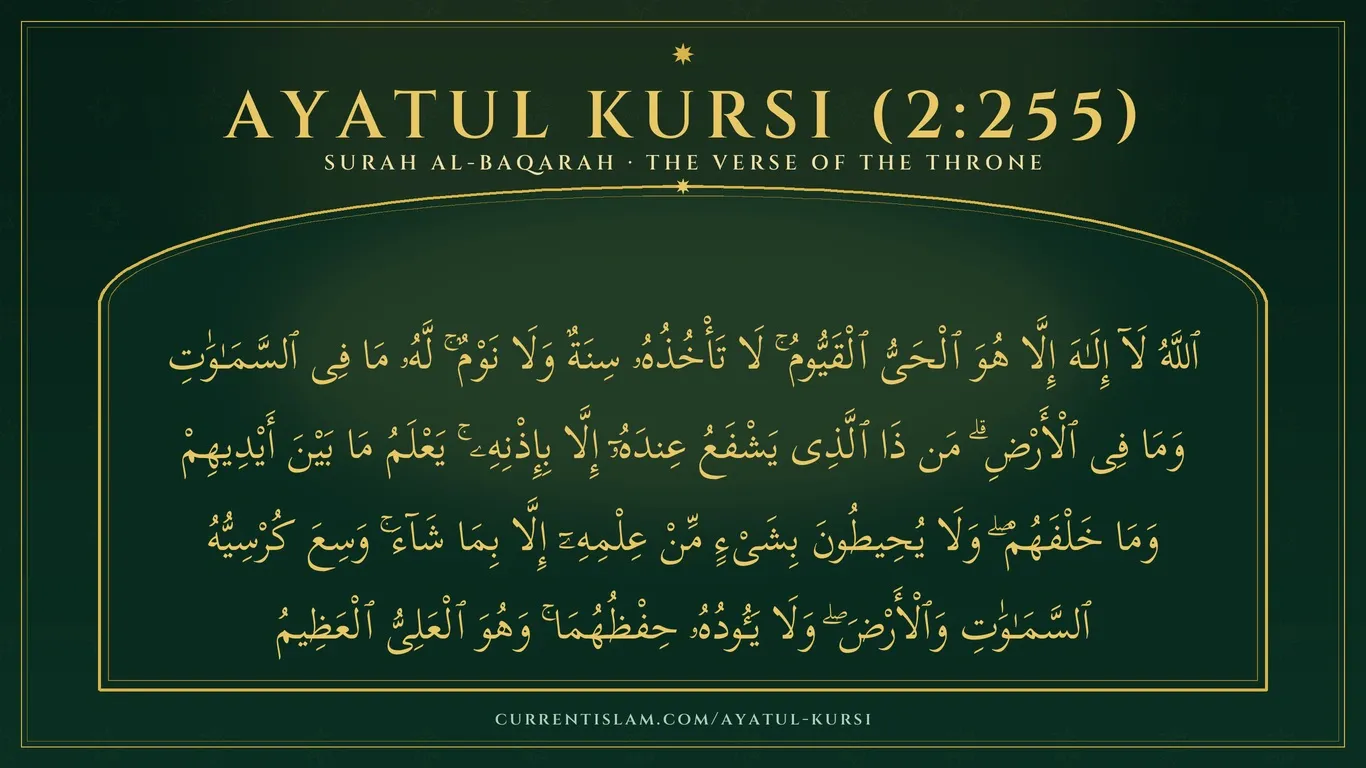
The greatest verse in the Quran, in full Arabic with English, Urdu and Hindi translation — and the two moments a day the Sunnah anchors it to.
Quick Answer
- Ayatul Kursi is Quran 2:255, the verse of Surah Al-Baqarah the Prophet ﷺ called the greatest in the Book of Allah (Sahih Muslim 810). Its full Arabic, transliteration, English (Khattab), Urdu (Jalandhari) and Hindi (al-Umari) are on this page to read and copy.
- Recite it at two anchored times — the Two Anchors: after every obligatory prayer, and when you get into bed at night.
- No verified source fixes a count of 7, 41, 100, 313 or 786 recitations. The hadith pattern is once after each prayer, and once in bed.
Contents
- What is Ayat al-Kursi?
- Ayat al-Kursi in Arabic — the complete text (2:255)
- What does Ayat al-Kursi mean, phrase by phrase?
- Why is Ayat al-Kursi called the greatest verse in the Quran?
- The Two Anchors — when should you recite Ayat al-Kursi?
- What about reciting it 7, 41, 100, 313 or 786 times?
- What are the verified benefits of Ayat al-Kursi?
- How do I start? The Two Anchors practice plan
- Common mistakes with Ayat al-Kursi
- Frequently asked questions
The house is finally quiet, the phone is face down, and your mind is still replaying the day. At that moment, and again at the end of every prayer, Muslims reach for the same fifty words. Ayatul Kursi is the 255th verse of Surah Al-Baqarah in the Holy Quran — the verse the Prophet ﷺ named the greatest in the Book of Allah. Below is its complete Arabic text, faithful English, Urdu and Hindi translations, what the words mean, and the two moments the Sunnah ties it to.
What is Ayat al-Kursi?
Ayatul Kursi is verse 255 of Surah Al-Baqarah, the longest chapter of the Quran. Its name means “the Verse of the Kursi” — the Seat of Allah, which the verse says encompasses the heavens and the earth. Muslims recite it after prayers and before sleep for protection.
Counted word by word over the Arabic text, the whole verse holds exactly 50 words. One short verse, carrying the Quran’s fullest description of who Allah is: His life, His knowledge, His ownership of everything, and His nearness to the one who calls on Him. It is a single verse out of 6,236 — if you want the full picture of the Book it sits in, see how long the Quran is in pages, words and reading time.
Ayat al-Kursi in Arabic — the complete text (2:255)
Here is the verse in full, exactly as it stands in Surah Al-Baqarah. Read it, copy it, keep it on your phone. It is also one of the verses gathered in the Manzil Dua, the protection collection recited in one sitting — but it stands on its own, and it is short enough to learn by heart.
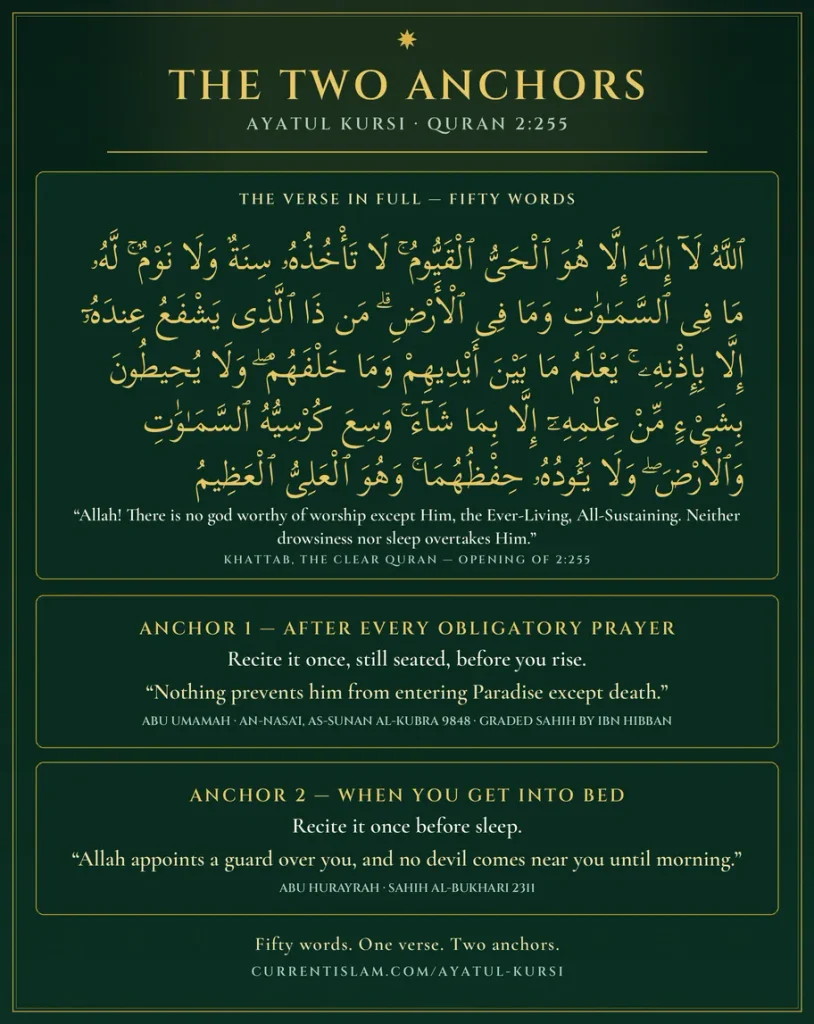
ٱللَّهُ لَآ إِلَـٰهَ إِلَّا هُوَ ٱلْحَىُّ ٱلْقَيُّومُ ۚ لَا تَأْخُذُهُۥ سِنَةٌ وَلَا نَوْمٌ ۚ لَّهُۥ مَا فِى ٱلسَّمَـٰوَٰتِ وَمَا فِى ٱلْأَرْضِ ۗ مَن ذَا ٱلَّذِى يَشْفَعُ عِندَهُۥٓ إِلَّا بِإِذْنِهِۦ ۚ يَعْلَمُ مَا بَيْنَ أَيْدِيهِمْ وَمَا خَلْفَهُمْ ۖ وَلَا يُحِيطُونَ بِشَىْءٍ مِّنْ عِلْمِهِۦٓ إِلَّا بِمَا شَآءَ ۚ وَسِعَ كُرْسِيُّهُ ٱلسَّمَـٰوَٰتِ وَٱلْأَرْضَ ۖ وَلَا يَـُٔودُهُۥ حِفْظُهُمَا ۚ وَهُوَ ٱلْعَلِىُّ ٱلْعَظِيمُ
Transliteration: Allahu la ilaha illa Huwa, al-Hayyul-Qayyum. La ta’khudhuhu sinatun wa la nawm. Lahu ma fis-samawati wa ma fil-ard. Man dhal-ladhi yashfa’u ‘indahu illa bi-idhnih. Ya’lamu ma bayna aydihim wa ma khalfahum, wa la yuhituna bi-shay’in min ‘ilmihi illa bima sha’. Wasi’a kursiyyuhus-samawati wal-ard, wa la ya’uduhu hifzuhuma, wa Huwal-‘Aliyyul-‘Azim.
English (Khattab, The Clear Quran): “Allah! There is no god worthy of worship except Him, the Ever-Living, All-Sustaining. Neither drowsiness nor sleep overtakes Him. To Him belongs whatever is in the heavens and whatever is on the earth. Who could possibly intercede with Him without His permission? He fully knows what is ahead of them and what is behind them, but no one can grasp any of His knowledge—except what He wills to reveal. His Seat encompasses the heavens and the earth, and the preservation of both does not tire Him. For He is the Most High, the Greatest.”
Urdu (Jalandhari):
“خدا (وہ معبود برحق ہے کہ) اس کے سوا کوئی عبادت کے لائق نہیں زندہ ہمیشہ رہنے والا اسے نہ اونگھ آتی ہے نہ نیند جو کچھ آسمانوں میں اور جو کچھ زمین میں ہیں سب اسی کا ہے کون ہے جو اس کی اجازت کے بغیر اس سے (کسی کی) سفارش کر سکے جو کچھ لوگوں کے روبرو ہو رہا ہے اور جو کچھ ان کے پیچھے ہوچکا ہے اسے سب معلوم ہے اور وہ اس کی معلومات میں سے کسی چیز پر دسترس حاصل نہیں کر سکتے ہاں جس قدر وہ چاہتا ہے (اسی قدر معلوم کرا دیتا ہے) اس کی بادشاہی (اور علم) آسمان اور زمین سب پر حاوی ہے اور اسے ان کی حفاظت کچھ بھی دشوار نہیں وہ بڑا عالی رتبہ اور جلیل القدر ہے”
Hindi (al-Umari): “अल्लाह (वह है कि) उसके सिवा कोई पूज्य नहीं। (वह) जीवित है, हर चीज़ को सँभालने (क़ायम रखने)¹ वाला है। न उसे कुछ ऊँघ पकड़ती है और न नींद। उसी का है जो कुछ आकाशों में और जो कुछ धरती में है। कौन है, जो उसके पास उसकी अनुमति के बिना अनुशंसा (सिफ़ारिश) करे? वह जानता है जो कुछ उनके सामने और जो कुछ उनके पीछे है। और वे उसके ज्ञान में से किसी चीज़ को (अपने ज्ञान से) नहीं घेर सकते, परंतु जितना वह चाहे। उसकी कुर्सी आकाशों और धरती को व्याप्त है और उन दोनों की रक्षा उसे नहीं थकाती। और वही सबसे ऊँचा, सबसे महान है।²”
Download the Ayatul Kursi PDF — Arabic · English · Urdu · Hindi
What does Ayat al-Kursi mean, phrase by phrase?
Ayat al-Kursi declares that Allah alone is God: the Ever-Living who sustains everything and never sleeps. All that the heavens and earth contain belongs to Him, nobody intercedes without His permission, His knowledge covers what lies ahead and behind, and guarding creation never tires Him.
| # | Arabic Phrase | Transliteration | English (Khattab, by phrase) |
|---|---|---|---|
| 1 | ٱللَّهُ لَآ إِلَـٰهَ إِلَّا هُوَ ٱلْحَىُّ ٱلْقَيُّومُ | Allahu la ilaha illa Huwa, al-Hayyul-Qayyum | Allah! There is no god worthy of worship except Him, the Ever-Living, All-Sustaining. |
| 2 | لَا تَأْخُذُهُۥ سِنَةٌ وَلَا نَوْمٌ | La ta’khudhuhu sinatun wa la nawm | Neither drowsiness nor sleep overtakes Him. |
| 3 | لَّهُۥ مَا فِى ٱلسَّمَـٰوَٰتِ وَمَا فِى ٱلْأَرْضِ | Lahu ma fis-samawati wa ma fil-ard | To Him belongs whatever is in the heavens and whatever is on the earth. |
| 4 | مَن ذَا ٱلَّذِى يَشْفَعُ عِندَهُۥٓ إِلَّا بِإِذْنِهِۦ | Man dhal-ladhi yashfa’u ‘indahu illa bi-idhnih | Who could possibly intercede with Him without His permission? |
| 5 | يَعْلَمُ مَا بَيْنَ أَيْدِيهِمْ وَمَا خَلْفَهُمْ | Ya’lamu ma bayna aydihim wa ma khalfahum | He fully knows what is ahead of them and what is behind them. |
| 6 | وَلَا يُحِيطُونَ بِشَىْءٍ مِّنْ عِلْمِهِۦٓ إِلَّا بِمَا شَآءَ | Wa la yuhituna bi-shay’in min ‘ilmihi illa bima sha’ | But no one can grasp any of His knowledge — except what He wills to reveal. |
| 7 | وَسِعَ كُرْسِيُّهُ ٱلسَّمَـٰوَٰتِ وَٱلْأَرْضَ | Wasi’a kursiyyuhus-samawati wal-ard | His Seat encompasses the heavens and the earth. |
| 8 | وَلَا يَـُٔودُهُۥ حِفْظُهُمَا | Wa la ya’uduhu hifzuhuma | And the preservation of both does not tire Him. |
| 9 | وَهُوَ ٱلْعَلِىُّ ٱلْعَظِيمُ | Wa Huwal-‘Aliyyul-‘Azim | For He is the Most High, the Greatest. |
Kursi is the word the verse is named after. Khattab translates it as “His Seat,” and in English the verse is just as often called the Throne Verse. Either way, the point of the sentence is scale: the Seat encompasses the heavens and the earth together, and holding both costs Allah no effort at all. Four of His names carry the verse: al-Hayy, the Ever-Living; al-Qayyum, the All-Sustaining; al-Aliyy, the Most High; and al-Azim, the Greatest. Nothing in the verse asks for anything. It simply tells you who is awake while you sleep.
Why is Ayat al-Kursi called the greatest verse in the Quran?
The Prophet ﷺ asked Ubayy ibn Ka’b which verse of the Quran was the greatest. Ubayy answered with this one: “Allah — there is no god but He, the Ever-Living, the All-Sustaining.” The Prophet ﷺ struck his chest in approval and prayed that knowledge would bring him joy.
That exchange is recorded in Sahih Muslim (810), in a chapter Muslim himself titled “The virtue of Surat al-Kahf and Ayat al-Kursi.” Ibn Kathir, in his commentary on this verse, writes that tremendous virtues have been associated with it, and points to the same report: the authentic hadith describes it as the greatest ayah in the Book of Allah. Why this verse, above 6,000 others? Read it once and the answer is in front of you. Other verses carry laws, stories and warnings. This one carries nothing but Allah Himself — His oneness, His life, His knowledge, His ownership — which is why the last three ayat of Surah Hashr, the other great passage of His names, is its natural companion read.
The Two Anchors — when should you recite Ayat al-Kursi?
The Sunnah anchors Ayat al-Kursi to two moments in the day. Recite it after every obligatory prayer, and recite it when you get into bed at night. A promise is attached to each anchor: Paradise after the prayers, and a guard from Allah through the night.
Anchor one: after the prayer. Abu Umamah reported that the Messenger of Allah ﷺ said: “Whoever recites Ayat al-Kursi at the end of every obligatory prayer, nothing prevents him from entering Paradise except death.” The report is in an-Nasa’i’s as-Sunan al-Kubra (9848), and Ibn Hibban graded it Sahih. It takes under a minute, said quietly where you prayed, before the day pulls you away. The same after-prayer moment carries the Mu’awwidhat — the short protection chapters ending with Surah Al-Falaq — which the Prophet ﷺ ordered ‘Uqba ibn ‘Amir to recite after every prayer (Mishkat al-Masabih 969).
Anchor two: the bed. Abu Hurayrah was guarding the Ramadan charity when a thief came three nights running. On the third night the thief bargained for his freedom with knowledge: recite Ayat al-Kursi when you go to bed, and Allah will appoint a guard over you, and no devil will come near you until morning. The Prophet ﷺ confirmed it the next day: “He told you the truth, though he is a liar — that was Satan.” The full account is in Sahih al-Bukhari (2311) — read it yourself at sunnah.com/bukhari:2311. For the same night watch, Fallahu Khairun Hafizan — the verse of Ya’qub handing his son over to Allah’s keeping — is the companion recitation many readers pair with it.
What about reciting it 7, 41, 100, 313 or 786 times?
No report opened for this article fixes a count of 7, 41, 100, 313 or 786 recitations of Ayat al-Kursi, and none promises wealth, a marriage or a stated number of angels in return. The pattern the sources actually give is once after each prayer, once in bed.
Counts travel fast online because a number feels like a method. But a promise needs a source, and the popular figures have none that survives checking. The largest, 786, is the abjad total attached to the bismillah — a letter-count, not a hadith count. The same care applies to a longer version of the after-prayer report, narrated from ‘Ali, which adds security for your house, your neighbour’s house and the dwellings around you. Al-Bayhaqi, who transmitted it, said plainly that its chain is weak (Mishkat al-Masabih 974) — so this page builds on the shorter, graded report instead, and leaves the weak addition named as weak.
What are the verified benefits of Ayat al-Kursi?
Three benefits rest on reports you can open and check yourself. The Prophet ﷺ confirmed this is the greatest verse in the Quran (Muslim 810). Recited in bed, it brings a guard from Allah and keeps Satan away until morning (Bukhari 2311). Recited after the prayers, Paradise follows death.
| Claim | Status | Source |
|---|---|---|
| It is the greatest verse in the Quran | Verified | Sahih Muslim 810 |
| Recited in bed: a guard from Allah, no devil near until morning | Verified | Sahih al-Bukhari 2311 |
| Recited after every obligatory prayer: nothing before Paradise except death | Verified report, graded Sahih by Ibn Hibban | an-Nasa’i, as-Sunan al-Kubra 9848 |
| Extended version adding security for your house and neighbours | Chain called weak by its own transmitter | Mishkat al-Masabih 974 (al-Bayhaqi) |
| Fixed counts — 7, 41, 100, 313, 786 — for wealth, marriage or set rewards | No source found in the collections opened | — |
There is also a quieter benefit the verse works on the heart directly. Tawakkul — reliance on Allah — is hard to hold at 2 a.m. when a worry will not switch off. The verse answers the worry with a fact: the One watching over you is never drowsy, never asleep, and never tired of guarding what He owns. That is not a medical claim and recitation does not replace care you need; it is the Quran’s own grounding for a believer lying awake. What the sources do not support is treating the verse as a charm that works without being recited — on that question, see what the Quran itself says about whether evil can come near it.
How do I start? The Two Anchors practice plan
Start tonight, with anchor two only. When you get into bed, read the verse once — from the Arabic if you can, from the transliteration while you learn, following the phrase table above. Pair it with Tasbeeh Fatima, the bedtime remembrance the Prophet ﷺ gave his daughter, and your night routine is complete in about two minutes. From tomorrow, add anchor one: once after each obligatory prayer, still seated, before you stand up. Five prayers plus bedtime gives you six anchors a day, and most people find the after-prayer one locks in first because the prayer itself is the reminder.
Learning it by heart is easier in pieces. The verse falls into nine phrases at its own pause marks; take one phrase a day and you hold the whole verse in under two weeks. Keep it inside your wider routine of morning and evening azkar rather than as a separate chore. And when you finish reciting, ask. The same surah, at verse 186, carries Allah’s promise to answer the one who calls on Him — read what Surah Baqarah ayat 186 says about that nearness, and let the verse you have just recited become the dua you make next.
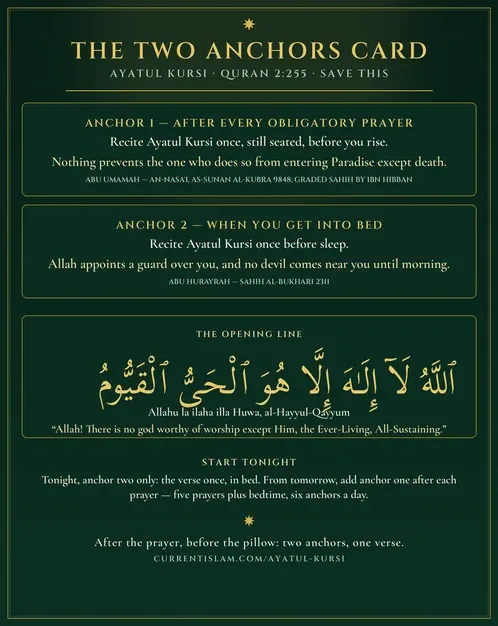
The Two Anchors Card — save this
> ANCHOR 1 — After every obligatory prayer. Recite Ayatul Kursi once, still seated, before you rise. Nothing prevents the one who does so from entering Paradise except death. (Abu Umamah — an-Nasa’i, as-Sunan al-Kubra 9848; graded Sahih by Ibn Hibban)
>
> ANCHOR 2 — When you get into bed. Recite Ayatul Kursi once before sleep. Allah appoints a guard over you, and no devil comes near you until morning. (Abu Hurayrah — Sahih al-Bukhari 2311)
>
> ٱللَّهُ لَآ إِلَـٰهَ إِلَّا هُوَ ٱلْحَىُّ ٱلْقَيُّومُ — Allahu la ilaha illa Huwa, al-Hayyul-Qayyum — “Allah! There is no god worthy of worship except Him, the Ever-Living, All-Sustaining.”
Common mistakes with Ayat al-Kursi
Four mistakes come up again and again. First, chasing a count — reciting a number a website invented, then feeling the recitation failed when the promised result does not arrive; the sources promise the anchors, not the counts. Second, treating the printed verse as a talisman: a framed copy on the wall is a reminder, but every verified report ties the protection to reciting it, not displaying it. Third, reading the transliteration for years without ever learning what the words mean — the phrase table on this page exists to close that gap. Fourth, sprinting out of the prayer: anchor one works because it is attached to the prayer itself, said in the minute after salam, not squeezed in later when it is usually forgotten.
Frequently asked questions
Ayatul Kursi is verse 255 of Surah Al-Baqarah, the second and longest chapter of the Quran. That is why you will see it written as Quran 2:255, and why searches for “ayat al kursi verse” and “ayat al kursi ayat number” all land on this single verse.
Fifty words exactly. We counted them one by one over the Arabic text of 2:255 as published on Quran.com: 58 written units, of which eight are pause marks standing alone, leaving fifty words. They fall into nine phrases at the verse’s own pause signs, listed in the table above.
Yes — this is one of the two anchored times. Abu Umamah reported that whoever recites it at the end of every obligatory prayer, nothing prevents him from entering Paradise except death. An-Nasa’i recorded it in as-Sunan al-Kubra (9848), and Ibn Hibban graded the report Sahih.
Allah appoints a guard over you, and no devil comes near you until morning. That is the teaching Abu Hurayrah received from the thief guarding the Ramadan charity — and the Prophet ﷺ confirmed it the next day: “He told you the truth, though he is a liar.” (Bukhari 2311)
Yes, start there. The full Arabic text above is free to copy to your phone, notes app or home screen, and the transliteration lets you recite tonight while you learn. Treat transliteration as a bridge: work through the nine phrases in the table until the Arabic itself becomes familiar.
No. The 4 Qul are four short chapters that open with “Qul” — Al-Kafirun, Al-Ikhlas, Al-Falaq and An-Nas — while Ayat al-Kursi is a single verse from Al-Baqarah. They are companions, not alternatives: the Qul chapters belong to the same night and after-prayer protection routine as the verse.
This page publishes the text, not audio: the complete Arabic, transliteration, English, Urdu and Hindi are here to read and copy. For listening while you learn, Quran.com carries recitation of 2:255. To keep it beside your bed, download the Ayatul Kursi PDF or print the Two Anchors Card.
Because of one word inside it: Kursi. Khattab translates it as the “Seat” of Allah, whose reach encompasses the heavens and the earth; in English the verse picked up the name Throne Verse from the same word. It is a name about scale — creation held, effortlessly, by its Maker.
Next step
- Say it tonight in bed — anchor two, once, from the transliteration if you need it.
- Add it after tomorrow’s prayers, and fold it into your morning and evening azkar.
- Go wider on protection: the Manzil Dua gathers this verse with the other protection passages in one sitting.
- Read next: Can Evil Come Near the Quran? — what actually guards a home.
Last reviewed: 8 November 2026 · Author: SHAHAB KHAN · Reviewed by: ATIF KHAN
