
Quick Answer
- The Prophet ﷺ said: “In this world, women and perfume have been made dear to me, and my comfort has been provided in prayer” (Sunan an-Nasa’i 3939, Hasan).
- He named musk the best of perfume (Sahih Muslim 2252), wore the best scent available, and never refused perfume given as a gift (Sahih al-Bukhari 2582).
- The limits are just as clear: no perfume after entering ihram, and a woman’s strong scent is not for people she passes in public (Sunan Abi Dawud 4173).
Contents
- What did the Prophet ﷺ say about fragrance?
- What was the Prophet’s favourite perfume?
- How did the Prophet ﷺ wear fragrance?
- When should a Muslim wear perfume?
- Why should you never refuse a gift of perfume?
- Why can men wear perfume openly but women are told to keep scent hidden?
- Is alcohol-based perfume allowed?
- The Sunnah Scent Card: start before this Friday
- Questions people ask
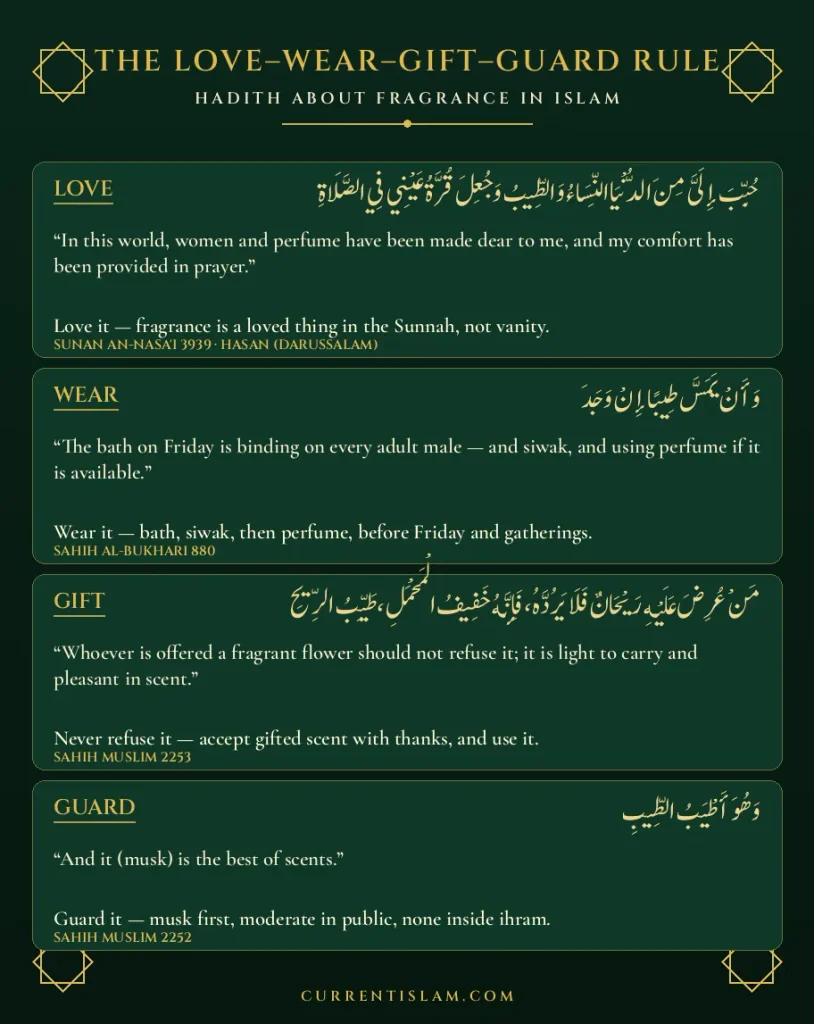
You notice it in the lift at work, on the train, in the row at prayer: the person next to you smells clean and pleasant, and the whole moment feels calmer. Is loving fragrance vanity? Is your spray too strong? If you are a woman, is wearing scent outside the house a sin you have been careless about? The Prophet ﷺ answered all of this, in words we can still check today. His teaching has four parts, and they hold together as one rule: the Love–Wear–Gift–Guard Rule. Love beautiful scent, wear it well, accept it graciously, and guard where it travels.
What did the Prophet ﷺ say about fragrance?
The Prophet ﷺ said that of this world, women and perfume were made dear to him, and his comfort was placed in prayer. Anas ibn Malik reported his words; they stand recorded in Sunan an-Nasa’i 3939, graded Hasan (sound), Darussalam edition.
حُبِّبَ إِلَىَّ مِنَ الدُّنْيَا النِّسَاءُ وَالطِّيبُ وَجُعِلَ قُرَّةُ عَيْنِي فِي الصَّلَاةِ
Hubbiba ilayya minad-dunya an-nisa’u wat-tib, wa ju’ilat qurratu ‘ayni fis-salah.
“In this world, women and perfume have been made dear to me, and my comfort has been provided in prayer.”
— Sunan an-Nasa’i 3939 · Grade: Hasan (Darussalam)
Urdu meaning:
انس رضی اللہ عنہ سے روایت ہے کہ رسول اللہ ﷺ نے فرمایا: دنیا کی چیزوں میں سے عورتیں اور خوشبو مجھے محبوب بنا دی گئی ہیں، اور میری آنکھوں کی ٹھنڈک نماز میں رکھی گئی ہے۔
| Arabic Word | Transliteration | Meaning |
|---|---|---|
| حُبِّبَ إِلَىَّ | hubbiba ilayya | was made dear to me |
| النِّسَاءُ | an-nisa’ | women (here, righteous companionship and family life) |
| الطِّيبُ | at-tib | perfume, beautiful fragrance |
| قُرَّةُ عَيْنِي | qurratu ‘ayni | the comfort (coolness) of my eyes |
| الصَّلَاةِ | as-salah | the prayer |
Notice the shape of the sentence. Two loved things belong to this world, and then the sentence lifts: his deepest comfort was not a worldly thing at all, but prayer, standing before Allah. Fragrance sits in the loved list honestly, without apology and without exaggeration. That balance is the Sunnah pattern for every physical pleasure: receive it gratefully, keep it in its place, and let worship stay first.
One accuracy point matters here, because this hadith is quoted everywhere. Many posters and posts add a word and say “three things were made dear to me.” The word “three” is not in the narration Anas reported. Hadith scholars, among them Ibn Hajar, rejected that addition, precisely because prayer is not a thing of this world and counting it as one distorts the meaning. Quote the hadith the way it was transmitted, and it needs no improvement.
What was the Prophet’s favourite perfume?
Musk. Abu Sa’id al-Khudri reported that the Prophet ﷺ spoke of a woman of the Children of Israel who filled a ring with musk, and said musk is the best of scents. The report is Sahih Muslim 2252. Muslim titled the chapter accordingly.
وَهُوَ أَطْيَبُ الطِّيبِ
Wa huwa atyabut-tib.
“And it (musk) is the best of scents.”
— Sahih Muslim 2252a · the Prophet’s ﷺ words inside the report of Abu Sa’id al-Khudri
Urdu meaning:
اور وہ (مشک) سب خوشبوؤں سے بہترین ہے۔
The Quran itself reaches for musk when it wants an image of the finest reward. Describing the sealed drink given to the righteous in Paradise, Allah says:
خِتَـٰمُهُۥ مِسْكٌ ۚ وَفِى ذَٰلِكَ فَلْيَتَنَافَسِ ٱلْمُتَنَـٰفِسُونَ
Khitamuhu misk; wa fi dhalika fal-yatanafasil-mutanafisun.
“whose last sip will smell like musk. So let whoever aspires to this strive ˹diligently˺.”
— Quran, Surah Al-Mutaffifin 83:26 · English: Dr. Mustafa Khattab, The Clear Quran · The drink itself is introduced in 83:25
Urdu (Jalandhari):
جس کی مہر مشک کی ہو گی تو (نعمتوں کے) شائقین کو چاہیے کہ اسی سے رغبت کریں
Shop blogs will tell you the Prophet’s ﷺ favourites were musk, oud and ambergris, ranked like a product line. The checked sources support one name at the top: musk, in his own words. Oud (aloeswood) enters the record as incense he fumigated with, as the next section shows, and ambergris enters as the scent Anas compared his fragrance to. Neither is called his favourite perfume in the Sahih collections. Let no one sell you a ranking the Prophet ﷺ never made.
How did the Prophet ﷺ wear fragrance?
He wore the best scent available, and wore it visibly. Aisha (may Allah be pleased with her) perfumed him with a perfume containing musk before ihram, and in another report used the best scent she could find until it shone on his head and beard.
“I used to perfume the Messenger of Allah (ﷺ) with a perfume containing musk before entering upon the state of Ihram and on the day of sacrifice (10th of Dhu’l-Hijja) and (at the conclusion of Ihram) before circumambulating the House (for Tawaf-i-Ifada).”
— Aisha · Sahih Muslim 1191 · Her practice is also in Sahih al-Bukhari 5922
Urdu meaning:
حضرت عائشہ رضی اللہ عنہا فرماتی ہیں کہ میں رسول اللہ ﷺ کو احرام باندھنے سے پہلے اور قربانی کے دن بیت اللہ کے طوافِ افاضہ سے پہلے ایسی خوشبو لگاتی تھی جس میں مشک شامل ہوتی تھی۔
Incense was part of the same habit. Nafi’ reported that when Ibn Umar fumigated himself, he used aloeswood on its own or with camphor, and he would say: this is how the Messenger of Allah ﷺ used to perfume himself with incense (Sahih Muslim 2254). So the Sunnah picture includes scent on the body and scent in the air of the home, both kept pleasant and both kept moderate.
And there is a report about the man himself that his companions never forgot. Anas said:
وَلاَ شَمِمْتُ مِسْكَةً وَلاَ عَنْبَرَةً أَطْيَبَ مِنْ رَائِحَةِ رَسُولِ اللَّهِ صلى الله عليه وسلم
Wa la shamimtu miskatan wa la ‘anbaratan atyaba min ra’ihati Rasulillah ﷺ.
“and I never smelt musk or ambergris and found its fragrance as sweet as the fragrance of Allah’s Messenger (ﷺ).”
— Anas ibn Malik · Sahih Muslim 2330b · Also in Sahih al-Bukhari 3561
Urdu meaning:
اور میں نے کبھی مشک یا عنبر نہیں سونگھا جو رسول اللہ ﷺ کی خوشبو سے زیادہ عمدہ ہو۔
We cannot copy that gift, and no one should pretend otherwise. What we copy is the care behind it: he was known by a beautiful presence that people were glad to be near.
When should a Muslim wear perfume?
First of all on Friday. Abu Sa’id al-Khudri testified that the Messenger of Allah ﷺ named three things for Jumu’ah (the Friday congregational prayer): the bath, cleaning the teeth with the siwak (a natural tooth-stick), and using perfume if it is available (Bukhari 880).
“The taking of a bath on Friday is compulsory for every male Muslim who has attained the age of puberty and (also) the cleaning of his teeth with Siwak, and the using of perfume if it is available.”
— Sahih al-Bukhari 880
Urdu meaning:
جمعہ کے دن غسل ہر بالغ مسلمان مرد پر لازم ہے، اور مسواک کرنا، اور اگر میسر ہو تو خوشبو لگانا (بھی اسی حکم میں شامل ہے)۔
Beyond Friday, Imam an-Nawawi gathered the recommended moments: the two Eids, gatherings of Muslims, and gatherings of remembrance (dhikr, remembering Allah) and knowledge. The pattern is easy to read. Perfume in the Sunnah is social before it is personal: it is how you honour the people who will sit beside you at the mosque, so that your presence is a pleasure and never a burden. If you are learning which surah to recite on Friday, add scent to the same preparation, as the last step before you leave.
The bath comes first in the hadith’s own order, and it deserves the same care as the scent that follows it. Our step-by-step ghusl guide walks through its method and its conditions in full, so the Friday routine stands on a sound foundation.
Why should you never refuse a gift of perfume?
Because a gift of scent is almost costless to receive and rude to send back. Abu Hurairah reported the Prophet’s ﷺ words: whoever is offered rayhan, a sweet-smelling plant and by extension a gift of fragrance, should not reject it (Sahih Muslim 2253).
مَنْ عُرِضَ عَلَيْهِ رَيْحَانٌ فَلَا يَرُدَّهُ، فَإِنَّهُ خَفِيفُ الْمَحْمَلِ، طَيِّبُ الرِّيحِ
Man ‘urida ‘alayhi rayhanun fa-la yaruddahu, fa-innahu khafiful-mahmal, tayyibur-rih.
“He who is presented with a flower should not reject it, for it is light to carry and pleasant in odour.”
— Sahih Muslim 2253
Urdu meaning:
جسے خوشبو پیش کی جائے وہ اسے رد نہ کرے، کیونکہ یہ اٹھانے میں ہلکی اور خوشبو میں عمدہ ہوتی ہے۔
His own practice matched his words. Anas said the Prophet ﷺ never refused a gift of perfume (Sahih al-Bukhari 2582, and again in the Book of Dress, 5929). A small bottle of attar (concentrated perfume oil) costs little, travels in a pocket, and says “I thought of you” without ceremony. In family group chats and office exchanges alike, scent is a gift that lands well every time. The companion rule is for the giver: offer the good stuff, in a small amount, without making the receiver feel a debt.
Why can men wear perfume openly but women are told to keep scent hidden?
Correct the question first, because the sources do. Islam does not ban women from fragrance: the Prophet’s ﷺ own household used it, and Aisha perfumed him with her hands. The restriction is narrower: a strong scent worn to pass groups of unrelated men in public.
أَيُّمَا امْرَأَةٍ اسْتَعْطَرَتْ فَمَرَّتْ عَلَى قَوْمٍ لِيَجِدُوا مِنْ رِيحِهَا فَهِيَ زَانِيَةٌ
Ayyuma imra’atin ista’tarat fa-marrat ‘ala qawmin li-yajidu min ri’iha fa-hiya zaniyah.
“Any woman who applies perfume and passes by people so that they may smell her fragrance is like an adulteress.”
— Abu Musa al-Ash’ari · Sunan an-Nasa’i 5126 · Also Sunan Abi Dawud 4173 and Jami’ at-Tirmidhi 2786 · Classed authentic by at-Tirmidhi, al-Hakim and al-Dhahabi
Urdu meaning:
جو عورت خوشبو لگا کر لوگوں کے پاس سے اس لیے گزرے کہ وہ اس کی خوشبو سونگھیں، تو وہ (اس حرکت میں) زانیہ کی مانند ہے۔
The wording is deliberately severe, and the commentators explain its target: a scent sent out ahead of a woman into a gathering stirs desire and draws every gaze, which is why the hadith names it with the ugliest word it can reach for. A related report adds the mosque door itself: a woman who has fumigated herself with incense should not join the Isha (night) prayer with the congregation (Sahih Muslim 444). The principle underneath is one this site returns to often, that purity is half of faith: outward cleanliness and inward restraint are one religion, not two.
What about the famous line that men’s fragrance is what shows scent and hides colour, while women’s is what shows colour and hides scent? It is reported by Abu Hurairah in Jami’ at-Tirmidhi 2787, and at-Tirmidhi called it Hasan. Here the grading genuinely splits: the Darussalam edition marks this chain Daif (weak), while al-Albani graded it Sahih. This article states the disagreement and builds no ruling on that line alone; the public-scent rule above stands on the stronger Abu Musa report.
So the working rule for a woman is simple. At home, with her husband or among women and close family, she wears what she loves, as the women of the Prophet’s ﷺ household did. Going out among unrelated men, she keeps scent unnoticeable, closer to clean than to perfumed, while deodorant and ordinary cleanliness remain basic courtesy, not adornment. And a husband should notice the other half: his Friday-and-gathering scent is a duty of manners his wife and his prayer row can testify to, one reason the hadith about prayer and this hadith belong together.
Is alcohol-based perfume allowed?
Qualified scholars have differed, and an article should not dress one opinion up as the only Islam. The shared ground is wide: drinking an intoxicant is forbidden by the Quran’s clear text, and perfume is worn on skin and cloth, not drunk. From that ground, two roads follow.
One group permits alcohol-based sprays for external use, reasoning that the prohibition targets intoxication and that prayer is invalidated by impurity on the body or clothes, not by a scent that has dried. Another group advises avoiding them wherever a good attar or alcohol-free spray exists, reasoning that caution around anything alcohol-based is safer for the heart and removes all doubt. Neither group calls the other group sinful for a spray of aftershave, and neither should you.
The practical Sunnah answer, whichever road your own teachers take, is the one this article has built from the start: keep a small alcohol-free attar for Friday, prayer and gatherings, where no question hangs over you at all, and follow your local scholars on the bottled sprays you already own. Anyone who tells you this question was settled by a single hadith is selling certainty the sources do not give.
The same care with sacred states applies on pilgrimage: scent is loved before performing Umrah according to the Sunnah, and left off completely once ihram begins.
That rhythm, loved then left for Allah’s sake, is part of the life-changing benefits of performing Umrah: the pilgrim learns that even a beloved Sunnah has a time to hold and a time to release.
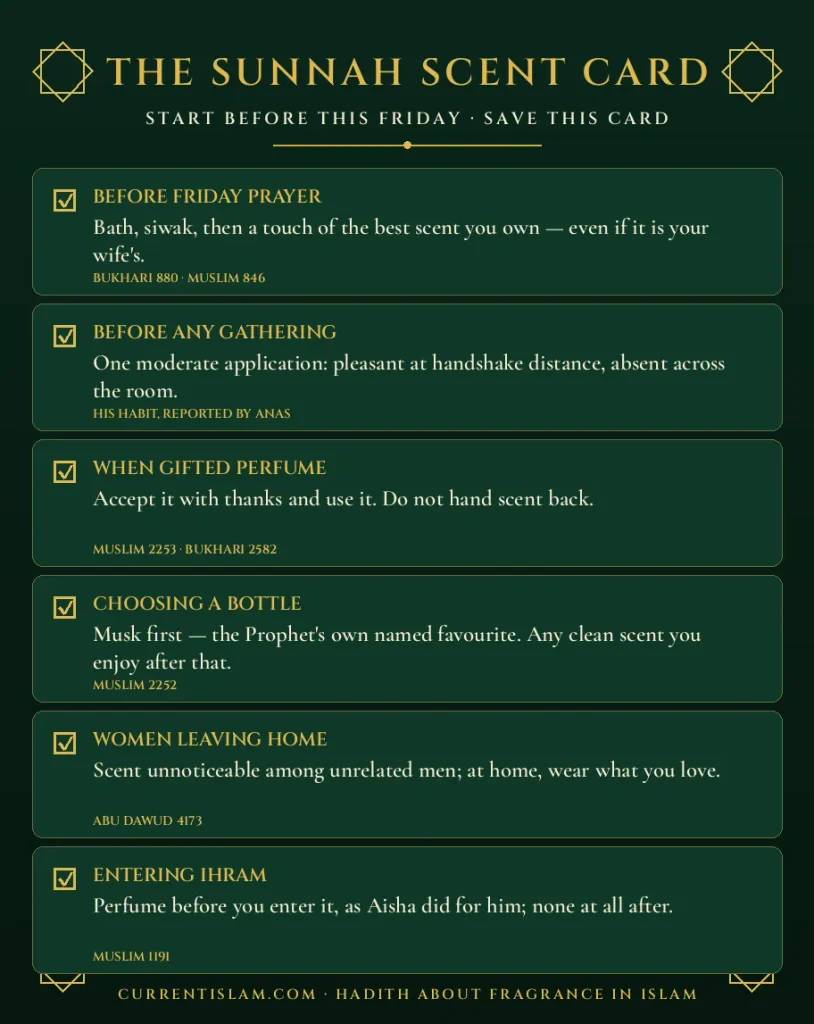
The Sunnah Scent Card: start before this Friday
Save this card. It is the whole article in one routine.
- Before Friday prayer: bath, siwak, then a touch of the best scent you own, even if it is your wife’s (Bukhari 880; Muslim 846).
- Before any gathering: one moderate application, on skin and beard or on clothing, checked once in the mirror and once by the door test: pleasant at handshake distance, absent across the room.
- When someone gifts you perfume: accept it with thanks and use it; do not hand scent back (Muslim 2253; Bukhari 2582).
- Choosing a bottle: musk first if you want the Prophet’s ﷺ own named favourite (Muslim 2252); any clean scent you enjoy after that.
- For women leaving home: scent stays unnoticeable among unrelated men; at home, wear what you love (Abu Dawud 4173, with the household practice of Aisha).
- Entering ihram: perfume before you enter it, as Aisha did for the Prophet ﷺ; none at all after (Muslim 1191), and finish with the dua after wudu as you get ready to leave.
| Situation | The Sunnah move | Source |
|---|---|---|
| Friday, before leaving | Bath, siwak, perfume if available | Bukhari 880 |
| Offered perfume | Accept it; it is light and pleasant | Muslim 2253 |
| Buying one scent only | Musk, the named best | Muslim 2252 |
| Woman going out in public | Scent unnoticeable to unrelated men | Abu Dawud 4173 |
| Starting Umrah or Hajj | Perfume before ihram, none inside it | Muslim 1191 |
Questions people ask
He said women and perfume were made dear to him in this world, while his comfort was placed in prayer, and Anas reported it in Sunan an-Nasa’i 3939, graded Hasan. He also named musk the best of perfume in Sahih Muslim 2252 and taught Muslims never to refuse gifted scent.
Musk is the only scent he called the best, in Sahih Muslim 2252, reported by Abu Sa’id al-Khudri. Claims ranking oud or ambergris as his favourites appear on shop blogs without a Sahih source; oud is verified as his incense, and ambergris as a comparison for his own beautiful fragrance.
No daily timetable is reported, so this article claims none. What is verified is a habit, not a schedule: Aisha applied the best available scent to him, saw it shining in his head and beard, and perfumed him around Hajj, while Friday carried its own explicit instruction in Bukhari 880.
Yes. The Prophet ﷺ loved perfume, wore the best scent available, perfumed himself before gatherings, and named Friday bathing, siwak and perfume together in Sahih al-Bukhari 880. Imam an-Nawawi extended the recommended moments to Eid, gatherings of Muslims, and sittings of remembrance and knowledge, male fragrance is worship-adjacent manners, not vanity.
They are not facing opposite rules. Women of the Prophet’s ﷺ household wore and applied fragrance, and a wife’s scent at home is inside the Sunnah. The restriction targets a strong scent carried past unrelated men in public, in the authentic report of Abu Musa in Abu Dawud 4173.
Yes, and the sources picture exactly that household. Aisha perfumed the Prophet ﷺ with her own hands and chose the best scent she could find for him, in reports in Sahih Muslim 1191 and Sahih al-Bukhari 5922. The public restriction in Abu Dawud 4173 begins at the door, not inside it.
Scholars of knowledge have differed, so beware any single-sentence answer. Many permit external use because perfume is not drunk and dried scent is not an impurity in prayer; others advise alcohol-free attar to remove all doubt. Keep an attar for prayer and Friday, and ask your own teachers about sprays.
Before ihram, yes: Aisha perfumed the Prophet ﷺ with musk-containing perfume immediately before he entered it, in Sahih Muslim 1191. After ihram begins, no perfume may be applied until the pilgrim exits that state. Our Umrah guide linked above gives the exact sequence, and the pilgrimage duas sit in one place.
Next step: read the Friday preparation in full with the surah to recite on Friday, then the pilgrim’s sequence in how to perform Umrah according to the Sunnah, and keep the purity foundation under both with purity is half of faith.
