You’ve felt it, haven’t you? That heavy, sluggish feeling when you are in a state of Janabat (major impurity). It’s not just physical uncleanliness; it feels like a spiritual barrier standing between you and your Creator. You want to pray, you want to touch the Quran, but you are “locked out.”
Ghusal is the key. It isn’t just a shower; it is a divine reset button. Whether it’s after intimacy (humbistari ke baad), menstruation, or just a wet dream, performing Ghusal correctly lifts that weight instantly. Let’s get it right, once and for all, so you never have to second-guess your purity again.
What is Ghusal?
Ghusal is the Islamic ritual bath required to lift the state of major impurity (Janabat). It involves washing the entire body with water so that not a single hair or millimeter of skin remains dry. Without it, Salah (prayer) is invalid.
1. The “Dua” for Ghusal (Gusal Karne Ki Dua)
This is the most common confusion. People search frantically for a “magical paragraph” to read while the water is running.
There is no specific long verbal Dua for Ghusal found in the Sunnah.
In fact, reciting Quranic verses or Allah’s name while naked in the bathroom is disliked (Makrooh).
The Real Method of Intention (Niyat)
The “Dua” is your specific intention in the heart.
- Arabic: نَوَيْتُ الْغُسْلَ لِرَفْعِ الْحَدَثِ الْأَكْبَرِ
- Transliteration: Nawaytul ghusla li raf’il hadathil akbar.
- English: I intend to perform Ghusal to remove major impurity.
- Urdu: میں نے پاکizgi حاصل کرنے کے لیے غسل کی نیت کی
Tip: “What is the dua for Ghusl?” Answer: The dua for Ghusl is the internal intention (Niyyah) to purify oneself. You say “Bismillah” before entering the bathroom, but inside, you remain silent and focus on the intention.
2. The 3 Faraiz of Ghusal (Mandatory Acts)
If you miss any of these, your Ghusal is invalid. You could stand under a waterfall for an hour, but if these three aren’t done, you are still impure.
A. Gargling (Kulli)
You must rinse your mouth thoroughly so water reaches the very back of the throat.
- Note: If you are fasting (Roza), do not gargle deep in the throat to avoid swallowing water. Just rinse the mouth.
B. Sniffing Water (Nose)
You must pull water up into the soft part of the nose (high enough that it stings slightly) and clean it out. The inside of the nose is considered part of the “outer body” in Fiqh.
C. Washing the Whole Body
Water must flow over every inch of the body.
- Hair: Water must reach the scalp (roots).
- Hidden Areas: Inside the navel, behind the ears, and underarms.
Scholar’s Note: Imam Abu Hanifa (RA) emphasizes that for men, if even a pin-head amount of skin is left dry, the Ghusal is incomplete.
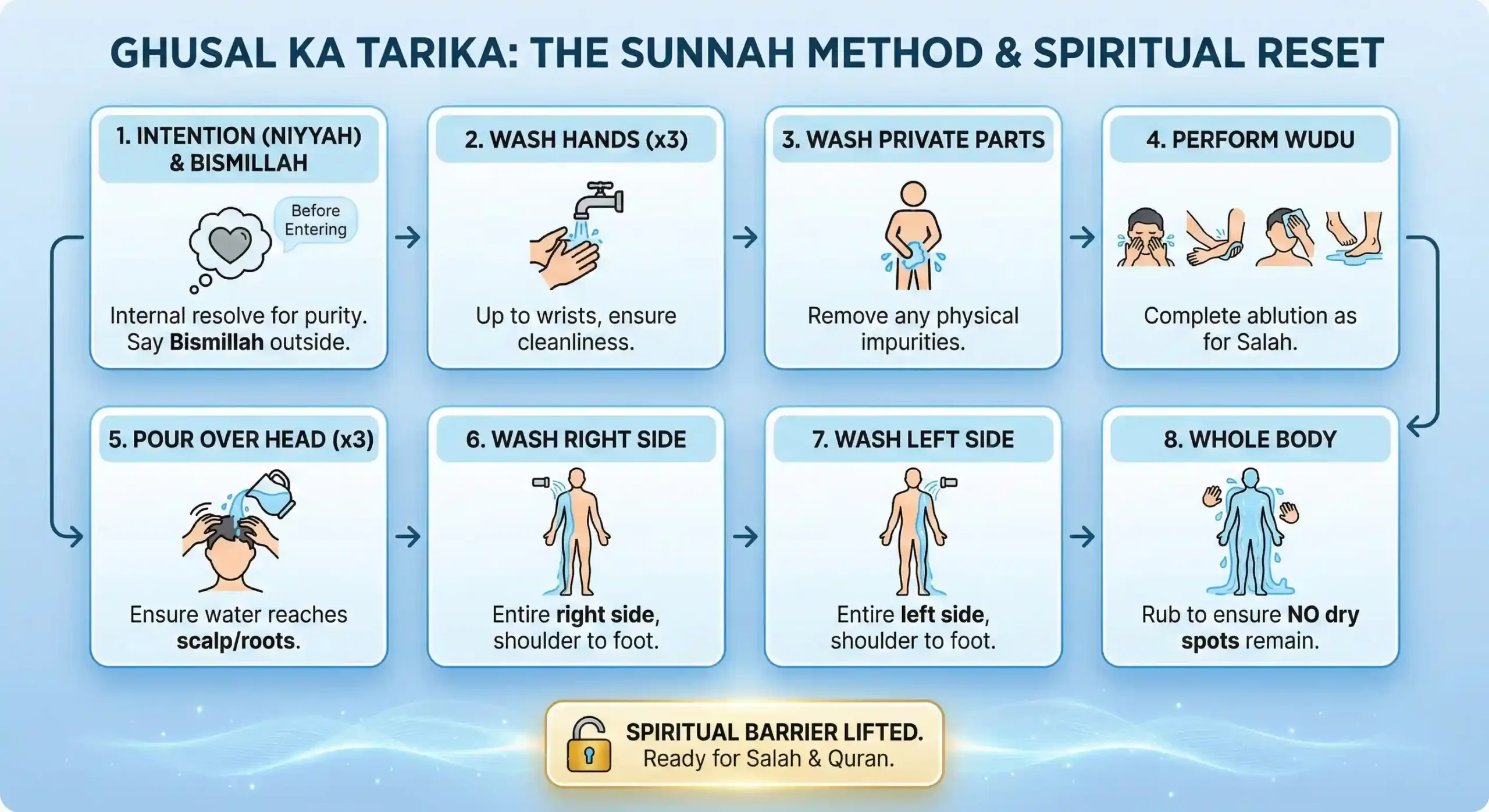
3. Ghusal Ka Tarika: Step-by-Step (The Sunnah Method)
This is the “Premium” method—the way the Prophet Muhammad (ﷺ) performed it. This combines the Faraiz (mandatory) with the Sunnah (rewardable) acts.
Step 1: The Intention (Niyat) Make the intention in your heart to purify yourself from Janabat. Say Bismillah before entering the shower area.
Step 2: Wash Hands Wash your hands up to the wrists three times. This ensures your tools (hands) are clean before touching the rest of the body.
Step 3: Wash Private Parts Wash your private areas specifically to remove any physical filth (Najasah), such as semen or blood.
Step 4: Perform Wudu (Ablution) Perform a complete Wudu exactly as you do for Salah.
- Variation: You can delay washing the feet until the very end if you are standing in a place where water gathers (to avoid splashing dirty water back on your feet).
Step 5: Pour Water Over Head Pour water over your head three times. Rub your hair with your fingers to ensure water reaches the roots.
Step 6: Wash the Right Side Pour water over your right shoulder and the entire right side of the body.
Step 7: Wash the Left Side Pour water over your left shoulder and the entire left side of the body.
Step 8: Whole Body Finally, let the water run over the entire body again, rubbing with your hands to ensure coverage.
The Complete Guide to Ghusal in Urdu, Faraiz & Sunnah (PDF)
4. Authentic Evidence
We don’t just guess; we look at the source. Here is the primary Hadith regarding the method of Ghusal.
Narrated by Aisha (Ummul Mu’minin): “Whenever the Prophet (ﷺ) took a bath after Janabat he started by washing his hands and then performed ablution like that for the prayer. After that he would put his fingers in water and move them through the roots of his hair, and then he would pour three handfuls of water over his head and then pour water all over his body.”
- Source: Sahih Al-Bukhari (248)
- Urdu: Sahih Bukhari, Hadith 248
5. Women’s Issues: Braids and Post-Intimacy
This is a frequent area of doubt (Waswasa).
Do women need to undo braids?
- The Ruling: If the water can reach the scalp (roots) without undoing the braids, she does not need to open them. The water does not need to soak the entire length of the braided hair, but the roots are mandatory.
- Humbistari ke baad: The rules for post-intimacy ghusal are the same for men and women.
People Also Ask:
No. For a valid Ghusal, water must touch the scalp and hair roots. However, women with tight braids do not need to undo them if water reaches the scalp.
No. If you performed the Sunnah method which includes Wudu, or if you washed the whole body, your Wudu is automatically done. You can go straight to prayer unless you break your Wudu (e.g., using the toilet) after the bath.
No. Soap and shampoo are for hygiene, not ritual purity. Pure water is the only requirement for the validity of Ghusal.
You do not need to repeat the whole bath. Just wash that specific dry spot immediately.
Your Next Step
Now that you have purified your body, the natural next step is to purify your connection with Allah through Salah.
Action: Don’t let this knowledge sit. If you are currently in a state of impurity, go perform this Sunnah method now. If you are clean, share this guide with a younger sibling or friend who might be too shy to ask about Janabat.
