Quick Answer
- Surah Luqman ayat 14-15 (Quran 31:14-15) are Allah’s command to honor your parents: gratitude is owed to Allah and to your parents in one sentence, and a mother’s bearing and weaning are named as the reason.
- Ayat 15 draws the one limit: if parents pressure you toward shirk (associating partners with Allah), do not obey them in that — yet still keep their company in this world courteously.
- No fixed wazifa count for these verses exists in the Quran or Sunnah. Read them, understand them, and act on them: that is their verified use.
Table of contents
- What is Surah Luqman ayat 14-15?
- The full Arabic, transliteration, and translations
- Why does gratitude to parents stand right after gratitude to Allah?
- What does “weakness upon weakness” mean?
- Two years of weaning, thirty months in total: how the verses fit together
- What if your parents pressure you toward shirk or sin?
- Is there a wazifa for Surah Luqman ayat 14-15?
- How do you live these two verses this week?
- Common mistakes with these verses
- FAQ
Your phone lights up. It is your mother, asking something small: a returned call, a visit, a postponed task. Or it is harder: a parent is asking you to drop a prayer, bend a rule, or follow the family into something Allah has forbidden. Both moments, the small neglect and the hard clash, are answered by the same two verses. Surah Luqman ayat 14-15 are the Quran’s complete statement on parents: total gratitude and one clear limit, without cruelty on either side.
What is Surah Luqman ayat 14-15?
Surah Luqman ayat 14-15 are two verses from Surah Luqman (chapter 31 of the Quran, revealed in Makkah, 34 verses in total) in which Allah commands every person to honor their parents, orders gratitude to Himself and to parents together, and sets one limit on obedience.
The verses name the mother’s hardship in bearing and weaning her child as the reason for the command, and ayat 15 completes the limit: parents are never obeyed in shirk (associating partners with Allah), yet their company in this world stays courteous. The verses sit inside the counsel of Luqman, the wise man Allah blessed with wisdom, to his son. Verse 13 carries his first warning, against shirk itself, in Innal Shirka Lazulmun Azim. Verses 14 and 15 follow in Allah’s own voice before the counsel resumes at verse 16, the mustard-seed teaching in Ya Bunayya Innaha. The order teaches by itself: protect your worship, honor your parents, and know that Allah sees even a deed the weight of a mustard seed.
The full Arabic, transliteration, and translations
Ayat 14 — the command and the reason
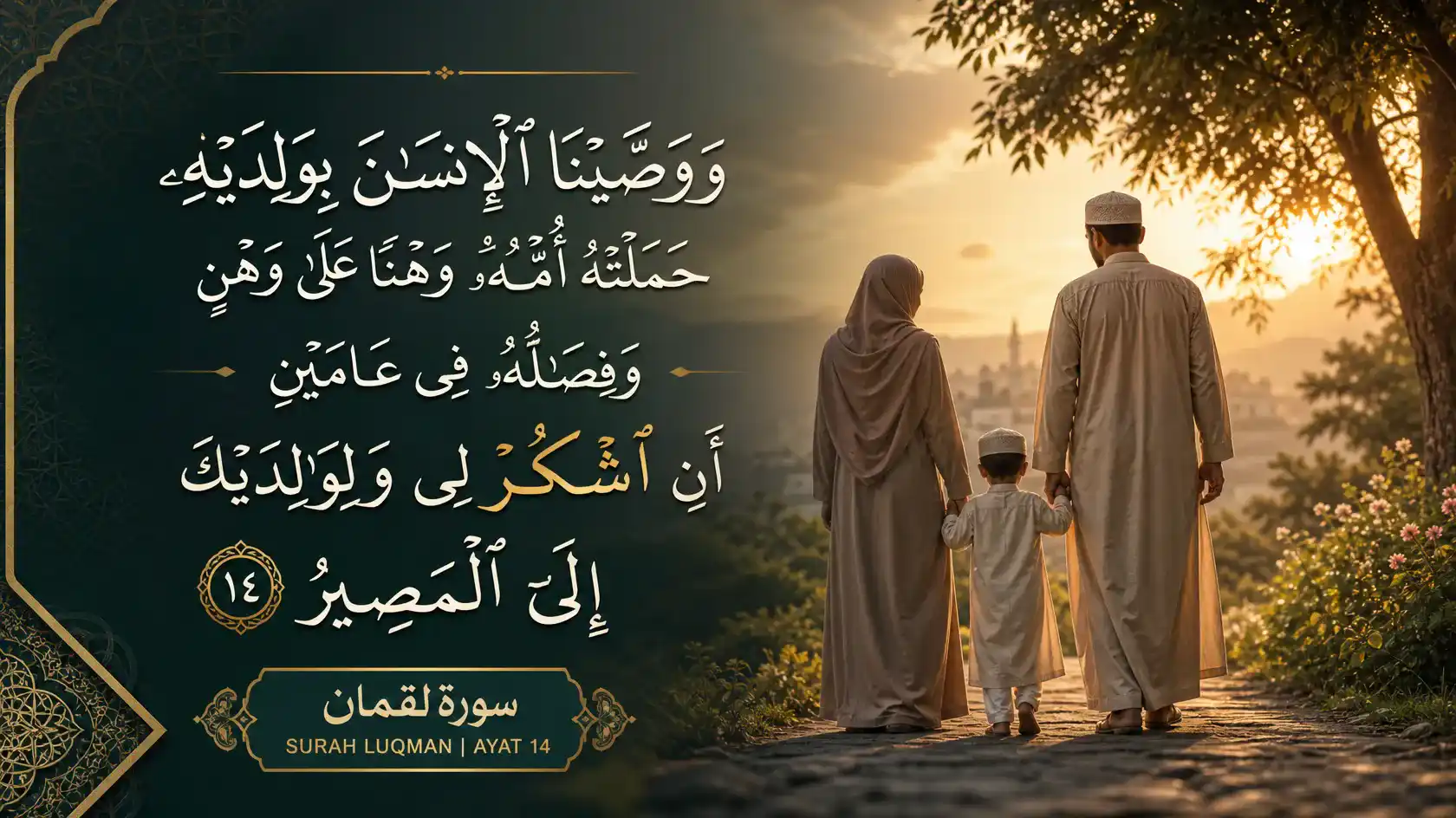
وَوَصَّيْنَا ٱلْإِنسَـٰنَ بِوَٰلِدَيْهِ حَمَلَتْهُ أُمُّهُۥ وَهْنًا عَلَىٰ وَهْنٍ وَفِصَـٰلُهُۥ فِى عَامَيْنِ أَنِ ٱشْكُرْ لِى وَلِوَٰلِدَيْكَ إِلَىَّ ٱلْمَصِيرُ
Wa wassaynal-insana biwalidayhi, hamalathu ummuhu wahnan ‘ala wahnin, wa fisaluhu fi ‘amayni, anish-kur li wa liwalidayka, ilayyal-masir.
English (Khattab, The Clear Quran): “And We have commanded people to ˹honour˺ their parents. Their mothers bore them through hardship upon hardship, and their weaning takes two years. So be grateful to Me and your parents. To Me is the final return.”
Urdu (Jalandhari):
اور ہم نے انسان کو جسے اُس کی ماں تکلیف پر تکلیف سہہ کر پیٹ میں اُٹھائے رکھتی ہے (پھر اس کو دودھ پلاتی ہے) اور( آخرکار) دو برس میں اس کا دودھ چھڑانا ہوتا ہے (اپنے نیز) اس کے ماں باپ کے بارے میں تاکید کی ہے کہ میرا بھی شکر کرتا رہ اور اپنے ماں باپ کا بھی (کہ تم کو) میری ہی طرف لوٹ کر آنا ہے
Hindi (al-Umari): और हमने इनसान को उसके माता-पिता के संबंध में ताकीद की है, उसकी माँ ने उसे कमज़ोरी पर कमज़ोरी के बावजूद उठाए रखा और उसका दूध छुड़ाना दो वर्ष में है, कि मेरा आभार प्रकट कर और अपने माता-पिता का। मेरी ही ओर लौटकर आना है।
Ayat 15 — the limit and the bond
وَإِن جَـٰهَدَاكَ عَلَىٰٓ أَن تُشْرِكَ بِى مَا لَيْسَ لَكَ بِهِۦ عِلْمٌ فَلَا تُطِعْهُمَا ۖ وَصَاحِبْهُمَا فِى ٱلدُّنْيَا مَعْرُوفًا ۖ وَٱتَّبِعْ سَبِيلَ مَنْ أَنَابَ إِلَىَّ ۚ ثُمَّ إِلَىَّ مَرْجِعُكُمْ فَأُنَبِّئُكُم بِمَا كُنتُمْ تَعْمَلُونَ
Wa in jahadaka ‘ala an tushrika bi ma laysa laka bihi ‘ilmun fala tuti’huma, wa sahibhumma fid-dunya ma’rufa, wattabi’ sabila man anaba ilayya, thumma ilayya marji’ukum fa-unabbi’ukum bima kuntum ta’malun.
English (Khattab, The Clear Quran): “But if they pressure you to associate with Me what you have no knowledge of, do not obey them. Still keep their company in this world courteously, and follow the way of those who turn to Me ˹in devotion˺. Then to Me you will ˹all˺ return, and then I will inform you of what you used to do.”
Urdu (Jalandhari):
اور اگر وہ تیرے درپے ہوں کہ تو میرے ساتھ کسی ایسی چیز کو شریک کرے جس کا تجھے کچھ بھی علم نہیں تو ان کا کہا نہ ماننا۔ ہاں دنیا (کے کاموں) میں ان کا اچھی طرح ساتھ دینا اور جو شخص میری طرف رجوع لائے اس کے رستے پر چلنا پھر تم کو میری طرف لوٹ کر آنا ہے۔ تو جو کام تم کرتے رہے میں سب سے تم کو آگاہ کروں گا
Hindi (al-Umari): और यदि वे दोनों तुझपर दबाव डालें कि तू मेरे साथ उस चीज़ को साझी ठहराए, जिसका तुझे कोई ज्ञान नहीं, तो उन दोनों की बात मत मान और दुनिया में उनके साथ सुचारु रूप से रह, तथा उसके मार्ग पर चल, जो मेरी ओर पलटता है। फिर मेरी ही ओर तुम्हें लौटकर आना है। तो मैं तुम्हें बताऊँगा, जो कुछ तुम किया करते थे।
| Arabic | Transliteration | Meaning |
|---|---|---|
| وَوَصَّيْنَا | wa wassayna | and We commanded / enjoined |
| ٱلْإِنسَـٰنَ | al-insana | the human being |
| بِوَٰلِدَيْهِ | biwalidayhi | concerning his parents |
| حَمَلَتْهُ | hamalathu | she bore him (in pregnancy) |
| أُمُّهُ | ummuhu | his mother |
| وَهْنًا | wahnan | in weakness / hardship |
| عَلَىٰ | ‘ala | upon |
| وَهْنٍ | wahnin | weakness |
| وَفِصَـٰلُهُ | wa fisaluhu | and his weaning |
| فِى | fi | in / within |
| عَامَيْنِ | ‘amayni | two years |
| أَنِ | ani | that (you should) |
| ٱشْكُرْ | ushkur | be grateful |
| لِى | li | to Me |
| وَلِوَٰلِدَيْكَ | wa liwalidayka | and to your parents |
| إِلَىَّ | ilayya | to Me |
| ٱلْمَصِيرُ | al-masir | is the final return |
| وَإِن | wa in | and if |
| جَـٰهَدَاكَ | jahadaka | they both strive against you / pressure you |
| عَلَىٰٓ | ‘ala | to (make you) |
| أَن | an | that |
| تُشْرِكَ | tushrika | you associate partners |
| بِى | bi | with Me |
| مَا | ma | what / that which |
| لَيْسَ | laysa | is not |
| لَكَ | laka | for you |
| بِهِ | bihi | of it |
| عِلْمٌ | ‘ilmun | any knowledge |
| فَلَا | fala | then do not |
| تُطِعْهُمَا | tuti’huma | obey the two of them |
| وَصَاحِبْهُمَا | wa sahibhumma | but accompany the two of them |
| فِى | fi | in |
| ٱلدُّنْيَا | ad-dunya | this world |
| مَعْرُوفًا | ma’rufa | courteously / with recognised kindness |
| وَٱتَّبِعْ | wattabi’ | and follow |
| سَبِيلَ | sabila | the way / path |
| مَنْ | man | of whoever |
| أَنَابَ | anaba | turns in devotion |
| إِلَىَّ | ilayya | to Me |
| ثُمَّ | thumma | then |
| إِلَىَّ | ilayya | to Me |
| مَرْجِعُكُمْ | marji’ukum | is your return |
| فَأُنَبِّئُكُم | fa-unabbi’ukum | and I will inform you |
| بِمَا | bima | of what |
| كُنتُمْ | kuntum | you used to |
| تَعْمَلُونَ | ta’malun | do |
Why does gratitude to parents stand right after gratitude to Allah?
It stands there because the Quran repeatedly pairs the two rights in one command: worship belongs to Allah alone, and the next duty named is kindness to parents. Your parents are the means through whom your life and upbringing reached you, so thanking them is gratitude made visible.
The same pairing opens Surah Al-Isra: “For your Lord has decreed that you worship none but Him. And honour your parents” (17:23, Khattab). Gratitude, shukr in Arabic, is not a feeling the verse leaves vague; it is a command with two addresses. The Prophet ﷺ gave it a shape when a man asked who most deserved his best companionship: “Your mother,” three times, then, “Your father” (Sahih al-Bukhari 5971). Jami’ at-Tirmidhi 1897, graded Hasan (sound) by Darussalam, adds “then the nearest relatives, then the nearest relatives.” Asked which deed Allah loves most, he ﷺ answered prayer at its time, then “to be good and dutiful to your parents” (Sahih al-Bukhari 527). Dutifulness to parents (birr al-walidain) ranks here immediately after the core acts of worship.
What does “weakness upon weakness” mean?
“Weakness upon weakness” (wahnan ‘ala wahnin) describes the mother’s body carrying a child: each stage of pregnancy adds strain to the strain already there, then birth and nursing continue it. Ibn Kathir records Mujahid explaining it as the hardship of bearing the child, and Qatadah as exhaustion upon exhaustion.
Ibn Kathir also records Ata al-Khurasani reading it as “weakness upon weakness.” The three explanations agree on the picture: nothing about your early years was cost-free, and your mother paid the cost in her own body before you could speak or thank anyone. The verse names that cost because memory is the engine of gratitude. A child who forgets treats a parent’s request as an interruption; a child who remembers hears it differently. Notice, too, that the verse never turns the mother’s hardship into a weapon, and never sets a measured debt to repay. It places the memory before the child and lets it work.
Two years of weaning, thirty months in total: how the verses fit together
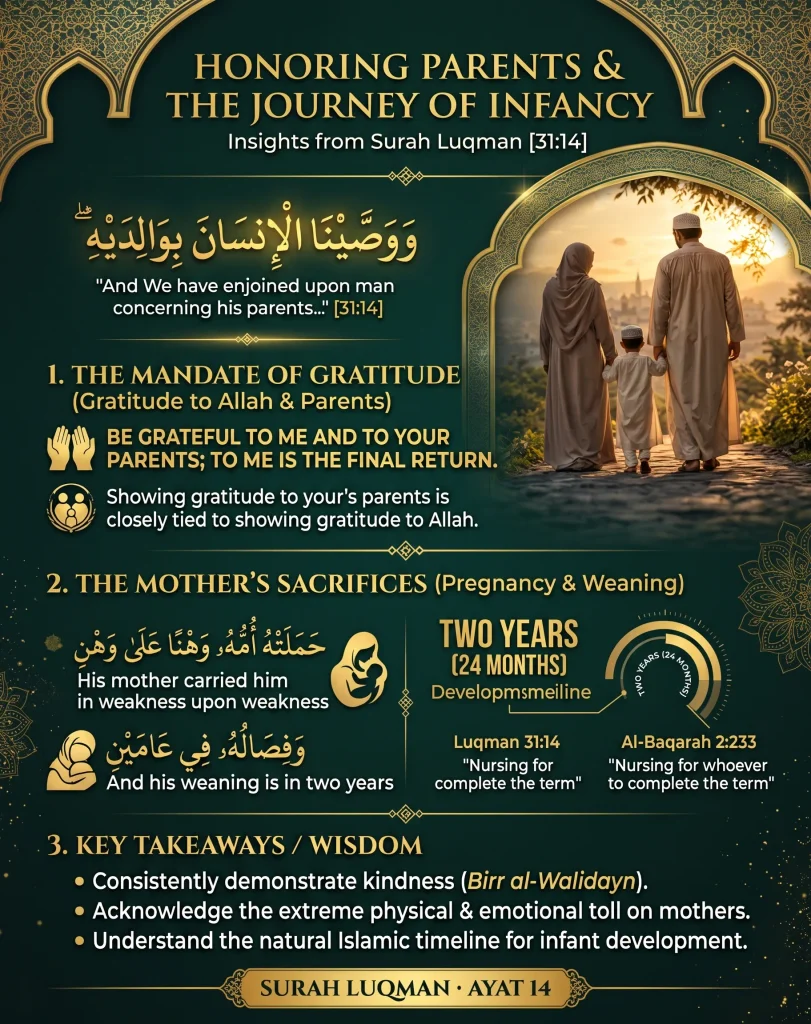
Ayat 14 gives the weaning period: two years. Surah Al-Ahqaf 46:15 gives the combined period of bearing and weaning: thirty months. Surah Al-Baqarah 2:233 gives two whole years of nursing for whoever wishes to complete it. Together they describe one early childhood.
The twin of this passage is Surah Ahqaf Ayat 15, which opens with the same words, then moves to the dua a believer makes at forty. Commentators drew a careful inference from the pair of numbers: if bearing and weaning together take thirty months (46:15) and weaning alone takes twenty-four months (31:14), the shortest bearing is six months. The inspected tafsir presentation attributes this reasoning to Ibn Abbas and notes that other scholars agreed with him. Treat it as a scholarly inference, not a medical ruling, and never a reason to judge any family’s feeding choices, which belong to parents and their doctors.
| Verse | What it measures | The number |
|---|---|---|
| Luqman 31:14 | Weaning of the child | Two years |
| Al-Ahqaf 46:15 | Bearing and weaning together | Thirty months |
| Al-Baqarah 2:233 | Nursing for whoever wishes to complete the term | Two whole years |
What if your parents pressure you toward shirk or sin?
Ayat 15 answers directly: if both parents pressure you to associate partners with Allah, do not obey them in that. Obedience to any person stops where disobedience to Allah begins. Yet the same verse commands courteous company in this world, so refusal never becomes coldness or cutting them off.
This is not a theoretical case. Ibn Kathir records, from At-Tabarani’s Al-‘Ishrah, the account of Sa’d ibn Abi Waqqas: a son who honored his mother, who swore when he became Muslim that she would not eat or drink until he left his religion, so people would shame him as his mother’s killer. He answered that even if she had a hundred souls leaving one by one, he would not abandon his religion, and told her to eat or not eat as she chose. She ate. His conduct is the verse’s pattern: no surrender on the faith, no cruelty in the refusal, the door of kindness kept open. Surah Al-Ankabut 29:8 carries the same ruling in near-identical words: a parent is obeyed in what is right, never in shirk or sin, and honored in every case.
In ordinary life the pressure is usually smaller than shirk, and the pattern scales down: a parent asks you to skip a prayer for a family event, join an interest-based loan, cut off a sibling, or lie on a form. The verse teaches a three-part reply. Refuse the specific act, clearly and once. Keep every other service running: the calls, the visits, the help with shopping, medicine, and paperwork. And follow “the way of those who turn to Me,” keeping company whose example steadies you.
Is there a wazifa for Surah Luqman ayat 14-15?
No. No verse and no hadith in the collections checked for this article assigns a repetition count, a number of days, or a promised result to reciting Luqman 31:14-15. Pages selling a count for these verses, such as thirty-three recitations for twenty-one days, give no source, because none is verified.
That honesty protects you twice. It protects your worship from invented conditions, since a practice the Prophet ﷺ never set cannot become a condition for your dua being answered. And it protects your parents from becoming a project with a deadline, as if twenty-one days of counting could replace years of ordinary kindness. What the sources give is stronger than a count: the verses themselves to recite as Quran, the mercy dua of 17:24, and the Prophet’s ﷺ ranking of dutifulness next to prayer. Recite ayat 14-15 for recitation, reflection, and action — and let the action be the point.
How do you live these two verses this week?
Use the framework this article names The Two Thanks, One Line. Two thanks are owed daily: to Allah, and to your parents. One line is never crossed: no obedience to anyone in shirk or sin. And one bond is never broken: courteous company, ma’ruf in the verse’s word.
Start tonight, in two minutes. Recite ayat 14-15 slowly, once, with the meaning. Then do the smallest concrete act the verses suggest: send the postponed message, or make the call. If a parent has passed away, the thanks continue as dua, and the Quran teaches the words in Rabbir Hamhuma Kama Rabbayani Sagheera (17:24): “My Lord! Be merciful to them as they raised me when I was young.” Pair it with the comprehensive Dua for Parents from 14:41. For the gratitude habit, Sulaiman’s thanks in Surah Naml Ayat 19 and the taught supplication in Rabbi A’inni Ala Zikrika train a tongue to thank Allah first, which is where ayat 14 begins.
Across an ordinary week, the verses fit the life you already have. At work, plan the shift swap that lets you visit a parent. On the commute, the call home costs only scrolling minutes. In the family group chat, answer your parents’ messages first and warmly. And if you are a parent yourself, Luqman is your model too: he advised his son gently, “O my dear son,” the spirit behind Islamic Parenting Tips.
The Two Thanks Card — save this
- Morning: one spoken thanks to Allah for one named favor.
- Daily: one concrete kindness to a parent — a call, a task, a bill, a visit, a dua.
- Weekly: one longer act — a meal together, an errand run, an old photograph sent with a note.
- Always: refuse sin, keep company courteously.
- 7-day tracker: Day 1 ☐ · Day 2 ☐ · Day 3 ☐ · Day 4 ☐ · Day 5 ☐ · Day 6 ☐ · Day 7 ☐ — mark each day both thanks were done.
Common mistakes with these verses
The first mistake is quoting ayat 14 to demand obedience while ignoring ayat 15, which limits that obedience. The second is the mirror image: quoting ayat 15 to justify cutting a difficult parent off entirely, when the verse commands continued courteous company in the same sentence as the refusal. The third is turning the verses into a wazifa, counting recitations for a promised change in a parent or a child, which no source supports. The fourth is treating the two-year weaning line as a test of other families instead of a measure of a mother’s service that should move her own child to gratitude. The fifth is waiting for a large occasion. The verses honor small, repeated, courteous acts, done while parents are alive, and as prayer after they are gone.
FAQ
In ayat 14 Allah commands gratitude to Himself and to parents, naming the mother’s hardship in bearing and weaning her child over two years. In ayat 15 He forbids obeying parents who pressure a child toward shirk, while commanding courteous company with them in worldly life.
Ayat 14-15 contain a command rather than a spoken dua: be grateful to Allah and to your parents. The Quran’s direct dua for parents is 17:24, “My Lord! Be merciful to them as they raised me when I was young,” and 14:41 asks forgiveness for parents and all believers.
No. You obey your parents in everything lawful, and the Prophet ﷺ ranked that dutifulness among the most beloved deeds. But no person is obeyed in disobedience to Allah. Ayat 15 settles the hardest case: refuse the sin, clearly and kindly, while continuing every lawful service and courteous company.
Because the verse itself gives the reason: the mother alone carries the pregnancy, hardship upon hardship, and the weaning years. The Prophet ﷺ matched this order when asked who most deserved good companionship, naming the mother three times before the father in Sahih al-Bukhari 5971, also reported in Tirmidhi 1897.
Ayat 14 says the child’s weaning takes two years, and Al-Baqarah 2:233 speaks of nursing for two whole years for whoever wishes to complete the term. Al-Ahqaf 46:15 counts bearing and weaning together as thirty months. Feeding decisions remain personal and medical; the verses honor the mother’s service.
No verified wazifa exists. Websites prescribing thirty-three recitations of ayat 14 with eleven Durood for twenty-one days cite no verse and no hadith for the count or the promised obedience. The Quran’s method is different: parents advise with wisdom, as Luqman did, and children respond with gratitude and kindness.
Yes, as Quran recitation and reflection, any day and any number of times. What you may not do is treat a self-chosen count as a Sunnah condition or a guaranteed mechanism. Pair recitation with the taught duas for parents and one concrete act of service daily.
Both open with the same command to honor parents and the same picture of a mother bearing her child in hardship. Luqman 31:14 counts weaning alone at two years and ends with gratitude and return. Ahqaf 46:15 counts bearing and weaning at thirty months, continuing into the dua at forty.
Next step: Read the twin passage next — Surah Ahqaf Ayat 15 for the dua at forty, then Rabbir Hamhuma Kama Rabbayani Sagheera for the mercy dua, and keep both beside your daily recitation this week.
