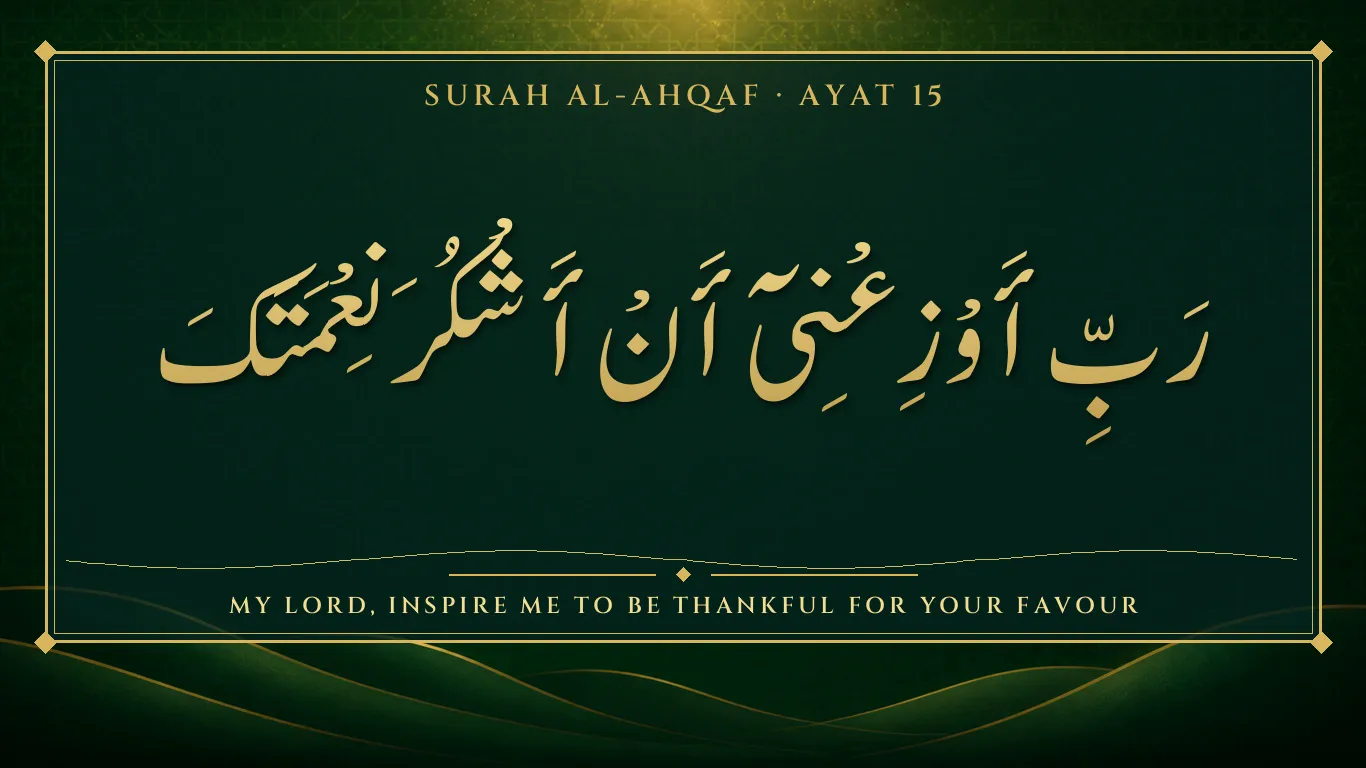
Quick Answer
- Surah Ahqaf ayat 15 commands kindness to parents, counts a mother’s bearing and weaning as thirty months, and ends with the Quran’s great dua at forty: gratitude for favours given to you and your parents, deeds that please Allah, righteous offspring, and repentance (Quran 46:15).
- The dua inside it — Rabbi awzi’ni an ashkura ni’matak — is the same opening Sulaiman prayed in Surah Naml (27:19), here spoken by an ordinary believer at middle age.
- No source gives this verse a fixed repetition count or a promised worldly benefit. Its own next verse carries the promise: Allah accepts the best of such people’s deeds and overlooks their misdeeds (46:16).
Table of Contents
- What Is Surah Ahqaf Ayat 15?
- Surah Ahqaf Ayat 15 in Arabic, Transliteration, English, Urdu and Hindi
- Word-by-Word Meaning of Wa Wassaynal Insana Biwalidaihi Ihsana
- Why Does the Verse Count a Mother’s Hardship in Months?
- Why Does the Same Dua Appear in Surah Naml?
- What Does the Dua at Forty Actually Ask For?
- What Are the Benefits of Surah Ahqaf Ayat 15?
- Is There a Wazifa or Fixed Count for This Verse?
- How Do You Practice the Forty-Year Turn?
- Where Does This Dua Fit in a Working Day?
- What Mistakes Do Readers Make With This Verse?
- Save This: The Forty Card
- FAQ
- Next Step
What Is Surah Ahqaf Ayat 15?
Surah Ahqaf ayat 15 is the Quran’s verse of the two generations: it commands every person to treat their parents with excellence, remembers what a mother carried to bring them here, and closes at age forty with a dua covering parents behind them and offspring ahead.
Most readers meet this verse at a particular season of life. The parents who once seemed permanent are aging and slowing down. Their own children are growing faster than expected. The verse speaks into that squeeze: backward with gratitude, forward with prayer, in one breath.
It also refuses vague gratitude. Before any dua is taught, it gives a number — thirty months of a mother’s bearing and weaning — count what she carried, then decide the thanks due.
Surah Ahqaf Ayat 15 in Arabic, Transliteration, English, Urdu and Hindi
وَوَصَّيْنَا ٱلْإِنسَـٰنَ بِوَٰلِدَيْهِ إِحْسَـٰنًا ۖ حَمَلَتْهُ أُمُّهُۥ كُرْهًا وَوَضَعَتْهُ كُرْهًا ۖ وَحَمْلُهُۥ وَفِصَـٰلُهُۥ ثَلَـٰثُونَ شَهْرًا ۚ حَتَّىٰٓ إِذَا بَلَغَ أَشُدَّهُۥ وَبَلَغَ أَرْبَعِينَ سَنَةً قَالَ رَبِّ أَوْزِعْنِىٓ أَنْ أَشْكُرَ نِعْمَتَكَ ٱلَّتِىٓ أَنْعَمْتَ عَلَىَّ وَعَلَىٰ وَٰلِدَىَّ وَأَنْ أَعْمَلَ صَـٰلِحًا تَرْضَىٰهُ وَأَصْلِحْ لِى فِى ذُرِّيَّتِىٓ ۖ إِنِّى تُبْتُ إِلَيْكَ وَإِنِّى مِنَ ٱلْمُسْلِمِينَ
Wa wassaynal-insana biwalidaihi ihsana. Hamalat-hu ummuhu kurhan wa wada’at-hu kurha. Wa hamluhu wa fisaluhu thalathuna shahra. Hatta idha balagha ashuddahu wa balagha arba’ina sanah, qala: Rabbi awzi’ni an ashkura ni’matakal-lati an’amta ‘alayya wa ‘ala walidayya, wa an a’mala salihan tardahu, wa aslih li fi dhurriyyati. Inni tubtu ilaika wa inni minal-muslimin.
“We have commanded people to honour their parents. Their mothers bore them in hardship and delivered them in hardship. Their ˹period of˺ bearing and weaning is thirty months. In time, when the child reaches their prime at the age of forty, they pray, “My Lord! Inspire me to ˹always˺ be thankful for Your favours which You blessed me and my parents with, and to do good deeds that please You. And instil righteousness in my offspring. I truly repent to You, and I truly submit ˹to Your Will˺.”” (Surah Al-Ahqaf 46:15, Dr. Mustafa Khattab, The Clear Quran, checked on Quran.com)
Urdu (Fateh Muhammad Jalandhari):
اور ہم نے انسان کو اپنے والدین کے ساتھ بھلائی کرنے کا حکم دیا۔ اس کی ماں نے اس کو تکلیف سے پیٹ میں رکھا اور تکلیف ہی سے جنا۔ اور اس کا پیٹ میں رہنا اور دودھ چھوڑنا ڈھائی برس میں ہوتا ہے۔ یہاں تک کہ جب خوب جوان ہوتا ہے اور چالیس برس کو پہنچ جاتا ہے تو کہتا ہے کہ اے میرے پروردگار مجھے توفیق دے کہ تو نے جو احسان مجھ پر اور میرے ماں باپ پر کئے ہیں ان کا شکر گزار ہوں اور یہ کہ نیک عمل کروں جن کو تو پسند کرے۔ اور میرے لئے میری اولاد میں صلاح (وتقویٰ) دے۔ میں تیری طرف رجوع کرتا ہوں اور میں فرمانبرداروں میں ہوں
Hindi (Maulana Azizul Haque al-Umari): “और हमने मनुष्य को अपने माता-पिता के साथ अच्छा व्यवहार करने की ताकीद दी। उसकी माँ ने उसे दुःख झेलकर गर्भ में रखा तथा दुःख झेलकर जन्म दिया और उसकी गर्भावस्था की अवधि और उसके दूध छोड़ने की अवधि तीस महीने है। यहाँ तक कि जब वह अपनी पूरी शक्ति को पहुँचा और चालीस वर्ष का हो गया, तो उसने कहा : ऐ मेरे पालनहार! मुझे सामर्थ्य प्रदान कर कि मैं तेरी उस अनुकंपा के लिए आभार प्रकट करूँ, जो तूने मुझपर और मेरे माता-पिता पर उपकार किए हैं। तथा यह कि मैं वह सत्कर्म करूँ, जिसे तू पसंद करता है तथा मेरे लिए मेरी संतान को सुधार दे। निःसंदेह मैंने तेरी ओर तौबा की तथा निःसंदेह मैं मुसलमानों (आज्ञाकारियों) में से हूँ।”
Surah Al-Ahqaf is the 46th chapter of the Quran, revealed in Makkah, with 35 verses, on page 504 of the Madinah mushaf, in Juz 26.
Word-by-Word Meaning of Wa Wassaynal Insana Biwalidaihi Ihsana
The verse runs 45 words. Its first four are the article’s phrase: wa wassaynal-insana biwalidaihi ihsana — “And We have enjoined on man, to his parents, kindness.”
| Arabic | Transliteration | Meaning |
|---|---|---|
| وَوَصَّيْنَا | Wa wassayna | And We have enjoined |
| ٱلْإِنسَـٰنَ | Al-insana | On man, the human being |
| بِوَٰلِدَيْهِ | Biwalidaihi | To his parents |
| إِحْسَـٰنًا | Ihsana | Kindness, excellence |
| حَمَلَتْهُ | Hamalat-hu | Carried him |
| أُمُّهُ | Ummuhu | His mother |
| كُرْهًا | Kurha | With hardship |
| وَوَضَعَتْهُ | Wa wada’at-hu | And gave birth to him |
| كُرْهًا | Kurha | With hardship |
| وَحَمْلُهُ | Wa hamluhu | And his bearing |
| وَفِصَـٰلُهُ | Wa fisaluhu | And his weaning |
| ثَلَـٰثُونَ | Thalathuna | Thirty |
| شَهْرًا | Shahra | Months |
| حَتَّىٰٓ | Hatta | Until |
| إِذَا | Idha | When |
| بَلَغَ | Balagha | He reaches |
| أَشُدَّهُ | Ashuddahu | His full strength, maturity |
| وَبَلَغَ | Wa balagha | And reaches |
| أَرْبَعِينَ | Arba’ina | Forty |
| سَنَةً | Sanah | Years |
| قَالَ | Qala | He says |
| رَبِّ | Rabbi | My Lord |
| أَوْزِعْنِى | Awzi’ni | Inspire me, grant me the power |
| أَنْ | An | That |
| أَشْكُرَ | Ashkura | I be grateful |
| نِعْمَتَكَ | Ni’mataka | Your favour |
| ٱلَّتِىٓ | Allati | Which |
| أَنْعَمْتَ | An’amta | You bestowed |
| عَلَىَّ | ‘Alayya | Upon me |
| وَعَلَىٰ | Wa ‘ala | And upon |
| وَٰلِدَىَّ | Walidayya | My parents |
| وَأَنْ | Wa an | And that |
| أَعْمَلَ | A’mala | I do |
| صَـٰلِحًا | Salihan | Righteous deeds |
| تَرْضَىٰهُ | Tardahu | That please You |
| وَأَصْلِحْ | Wa aslih | And make righteous |
| لِى | Li | For me |
| فِى | Fi | In, among |
| ذُرِّيَّتِى | Dhurriyyati | My offspring |
| إِنِّى | Inni | Indeed I |
| تُبْتُ | Tubtu | I repent, I turn back |
| إِلَيْكَ | Ilaika | To You |
| وَإِنِّى | Wa inni | And indeed I am |
| مِنَ | Mina | Among |
| ٱلْمُسْلِمِينَ | Al-muslimin | Those who submit |
Why Does the Verse Count a Mother’s Hardship in Months?
Because the Quran wants the debt measured, not felt in passing: a mother’s bearing and weaning together take thirty months, Luqman counts weaning alone at two years, and read together the two verses taught classical scholars that the shortest bearing is six months.
The word repeated in the verse is kurha — hardship. She carried him with hardship and delivered him with hardship; said twice, so it cannot be skimmed. Thirty months covers pregnancy plus nursing: “their weaning takes two years,” Allah says in Surah Luqman, ending that verse, “So be grateful to Me and your parents” (31:14, Khattab).
Read together, they yield a detail commentators draw out: thirty total, minus twenty-four of weaning, leaves six months as the shortest bearing. Counted months produce a different quality of thanks.
Why Does the Same Dua Appear in Surah Naml?
Because the Quran places one dua in two lives: Sulaiman speaks its opening at the height of power, grateful for blessings on himself and his parents, while an unnamed believer speaks it at forty, in an ordinary life, adding his children and his repentance to it.
The shared words are Rabbi awzi’ni an ashkura ni’matak — “My Lord, inspire me to be thankful for Your favour.” In Sulaiman’s dua for gratitude (27:19), the ending asks for the righteous servants’ company. Here the ending changes: righteousness in his offspring, repentance, and submission.
A prophet-king and an ordinary believer reach for the same first sentence — then each asks for what his own life most needs. The dua is a template, not a quotation to admire: keep its opening, and let your circumstances write the ending.
What Does the Dua at Forty Actually Ask For?
It asks for four things in a set order: gratitude for favours given to you and to your parents, deeds that please Allah rather than people, righteousness placed inside your offspring, and a repentant return that ends in plain submission to Him.
| Request in the dua | His words | What it covers |
|---|---|---|
| 1. Gratitude that looks back | “thankful for Your favours… blessed me and my parents with” | Blessings you received, including every one that reached you through your parents first |
| 2. Deeds that please Him | “to do good deeds that please You” | Gratitude proved by action, measured by Allah’s pleasure rather than by anyone’s applause |
| 3. Righteous offspring | “instil righteousness in my offspring” | The generation ahead: children prayed for before outcomes are visible |
| 4. A repentant return | “I truly repent to You, and I truly submit” | The honest ending: whatever the first forty held, the account is reopened with Allah |
Thanks looks backward; deeds fill the present; offspring carry the prayer forward; repentance closes the account — the practice below runs in these same four steps.
What Are the Benefits of Surah Ahqaf Ayat 15?
Its stated benefits stand in the text itself: Allah answers this kind of turning with acceptance and pardon in the very next verse, the Prophet ﷺ ranked a mother first for good companionship three times over, and a righteous child’s prayer outlives a parent’s death.
The next verse promises these people: “It is from these ˹people˺ that We will accept the good they did, and overlook their misdeeds — along with the residents of Paradise, ˹in fulfilment of˺ the true promise they have been given” (46:16, Khattab). Acceptance, pardon, Paradise — the verse’s own sequel.
Asked who deserved his best companionship, the Prophet ﷺ answered “Your mother” three times, then “Your father” (Sahih al-Bukhari 5971). And: “When a man dies, his acts come to an end, but three… a pious child, who prays for him” (Sahih Muslim 1631). For parents who have passed, the Quran gives Rabbir hamhuma kama rabbayani sagheera — “My Lord! Be merciful to them as they raised me when I was young” (17:24).
Is There a Wazifa or Fixed Count for This Verse?
No. No verse, hadith, or classical source checked for this article fixes a repetition count, a number of days, or a promised result for reciting Surah Ahqaf ayat 15 — not for children, not for parents, and not for turning forty itself.
Search results do attach numbers to it — so many times for righteous children, or for ease at forty. A wazifa (a fixed recitation practice) needs a basis in the sources; none opened here gives one. Adding a count and a guaranteed outcome quietly turns thanks into a transaction.
The Prophet ﷺ taught Mu’adh ibn Jabal a dua of thanks never to be left after any prayer: Allahumma a’inni ‘ala dhikrika wa shukrika wa husni ‘ibadatika — O Allah, help me to remember You, thank You, and worship You well (Sunan Abi Dawud 1522, graded sahih by al-Albani). The Allahumma a’inni ‘ala dhikrika wa shukrika page walks through that companion dua word by word. Gratitude in the Sunnah is scheduled after salah (the five daily prayers), not counted toward a purchase.
How Do You Practice the Forty-Year Turn?
Practice it as the Forty-Year Turn: once a day, at a prayer you already keep, run the verse’s four movements in order — thank back, act now, pray forward, return — and say the dua once, in Arabic or translation, whether you are forty or not.
Thank back. Name one favour that reached you through your parents: a meal, a school fee, a prayer of theirs you never heard. If your parents are living, let one named favour become one concrete kindness this week; the site’s dua for parents collection holds Ibrahim’s prayer for them (14:41).
Act now. Choose one deed today whose only audience is Allah’s pleasure. Keep it small and finishable before sleep: a call returned, an apology sent. Deeds are where gratitude stops being a mood.
Pray forward. Say the offspring line by name for your children, or for the children you hope for: “instil righteousness in my offspring.” Ibrahim prayed the twin request — Rabbi jalni muqimas salah, “My Lord, make me steadfast in prayer, and my offspring too” (14:40). Luqman’s counsel to his son — the Ya bunayya innaha verse (31:16) — and the site’s Islamic parenting tips carry it into daily practice.
Return. End with the verse’s ending: repentance, then submission without bargaining. Start tonight: after Isha, name one parental favour, pick tomorrow’s one deed, pray the offspring line by name, and say the full dua once before sleep.
Where Does This Dua Fit in a Working Day?
It fits at the hinges of an ordinary day: after a prayer, on the commute, in the pause before replying to the family chat. The believer who first speaks it in the Quran is mid-life and mid-duties, not on retreat — the dua was built for full calendars.
At work, it answers the promotion and the passed-over email with one sentence: favours are counted, deeds are offered, outcomes are left with Allah. At the school gate, the child in front of you is the offspring line, answered in real time.
Being the only Muslim in the room changes nothing: no announcement, no equipment — one quiet minute, four movements, one dua. Parents age and children grow at the same speed everywhere; the verse gives that squeeze a script.
What Mistakes Do Readers Make With This Verse?
The common mistakes are waiting for forty, reading the dua without its first half, skipping its parents, treating righteous children as a guaranteed product, and letting the verse stay a quotation instead of becoming a daily, counted act of gratitude.
Waiting for forty. The verse describes the believer at full maturity; it does not gate the dua behind a birthday. A twenty-year-old with living parents and a sixty-year-old with grown children both stand inside its sentences.
Separating the dua from the command. The dua is the verse’s second half; its first half is a command — excellence to parents — plus a counted hardship. Reciting the prayer while postponing the kindness reverses the verse’s order.
Expecting the offspring line to work like a formula. “Instil righteousness in my offspring” is a request to Allah, not a technique with a guaranteed result. It pairs prayer with upbringing; it never replaces upbringing or presence.
Save This: The Forty Card
Print this card or save it to your phone. Run it once a day, at a prayer you already keep — whatever your age.
- ☐ Thank back: I named one favour that reached me through my parents, and thanked Allah for it.
- ☐ One kindness: that favour became one concrete act for my parents this week — a call, a visit, a need met, a dua.
- ☐ Act now: I chose one deed today whose only audience is Allah’s pleasure, and I finished it.
- ☐ Pray forward: I said “instil righteousness in my offspring” by name for my children, present or hoped for.
- ☐ Return: I ended the day with the verse’s ending — repentance, then submission, no bargaining.
- ☐ No count attached: I said the dua once, with presence — not as a tally toward an outcome.
7-Day Two-Generation Tracker: each evening, write one line: a favour received through your parents on the left, a prayer said for your offspring on the right. Seven days of lines will show you the verse working in both directions.
FAQ
What is the dua in Surah Ahqaf ayat 15?
It runs: “My Lord! Inspire me to always be thankful for Your favours which You blessed me and my parents with, and to do good deeds that please You. And instil righteousness in my offspring. I truly repent to You, and I truly submit” (46:15, Khattab).
What does wa wassaynal insana biwalidaihi ihsana mean?
It is the verse’s opening: “And We have enjoined on man, to his parents, kindness.” Wassayna means We commanded with emphasis, al-insana is the human being, biwalidaihi means toward his two parents, and ihsana is excellence — not bare duty, but the best treatment a person can give.
Why does the verse mention thirty months?
The thirty months are the Quran’s count of a mother’s bearing plus weaning in this verse. Surah Luqman sets weaning alone at two years (31:14), and classical commentators reading both verses together derived six months as the shortest bearing. The count turns gratitude into something measured.
Why does the dua mention the age of forty?
Forty marks full maturity in the verse: the point where a person has received enough, and carried enough, to review life honestly. The dua is not restricted to that birthday. Younger and older readers pray it as their own; the verse simply sets the scene at life’s prime.
Can I recite this dua before turning forty?
Yes. Nothing in the verse or the sources checked limits it to people aged forty. The verse describes a believer at maturity praying it; it gives no age condition for reciting it. A teenager with living parents and a grandparent with grown children can both say it truthfully today.
Is there a wazifa of Surah Ahqaf ayat 15 for righteous children?
No verified wazifa exists. No source checked for this article sets a count, a number of days, or a guaranteed result for children. The verse itself teaches the request — “instil righteousness in my offspring” — as a dua to make sincerely, alongside real upbringing, presence, and example at home.
What is the benefit of reciting Surah Ahqaf ayat 15?
Its Quran-stated outcome stands in the next verse: for people who turn this way, Allah accepts the best of their deeds, overlooks their misdeeds, and places them with the residents of Paradise (46:16). Beyond that promise, the verse trains counted gratitude toward parents and steady prayer for offspring daily.
Which other verse carries the same dua?
Surah Naml ayat 19 carries the same opening: Sulaiman, hearing the ant, prayed “My Lord! Inspire me to be thankful for Your favours which You have blessed me and my parents with” (27:19). There it ends asking for righteous company; at forty it adds offspring and repentance.
Next Step
- Say the dua once today, after the next prayer, with one named parental favour in mind.
- Read the passage whole: Surah Al-Ahqaf, verses 15–16, in translation.
- For a parent who has passed away, continue with Rabbir hamhuma kama rabbayani sagheera.
- For the dua’s twin telling, read Sulaiman’s dua for gratitude in Surah Naml.
