Quick Answer
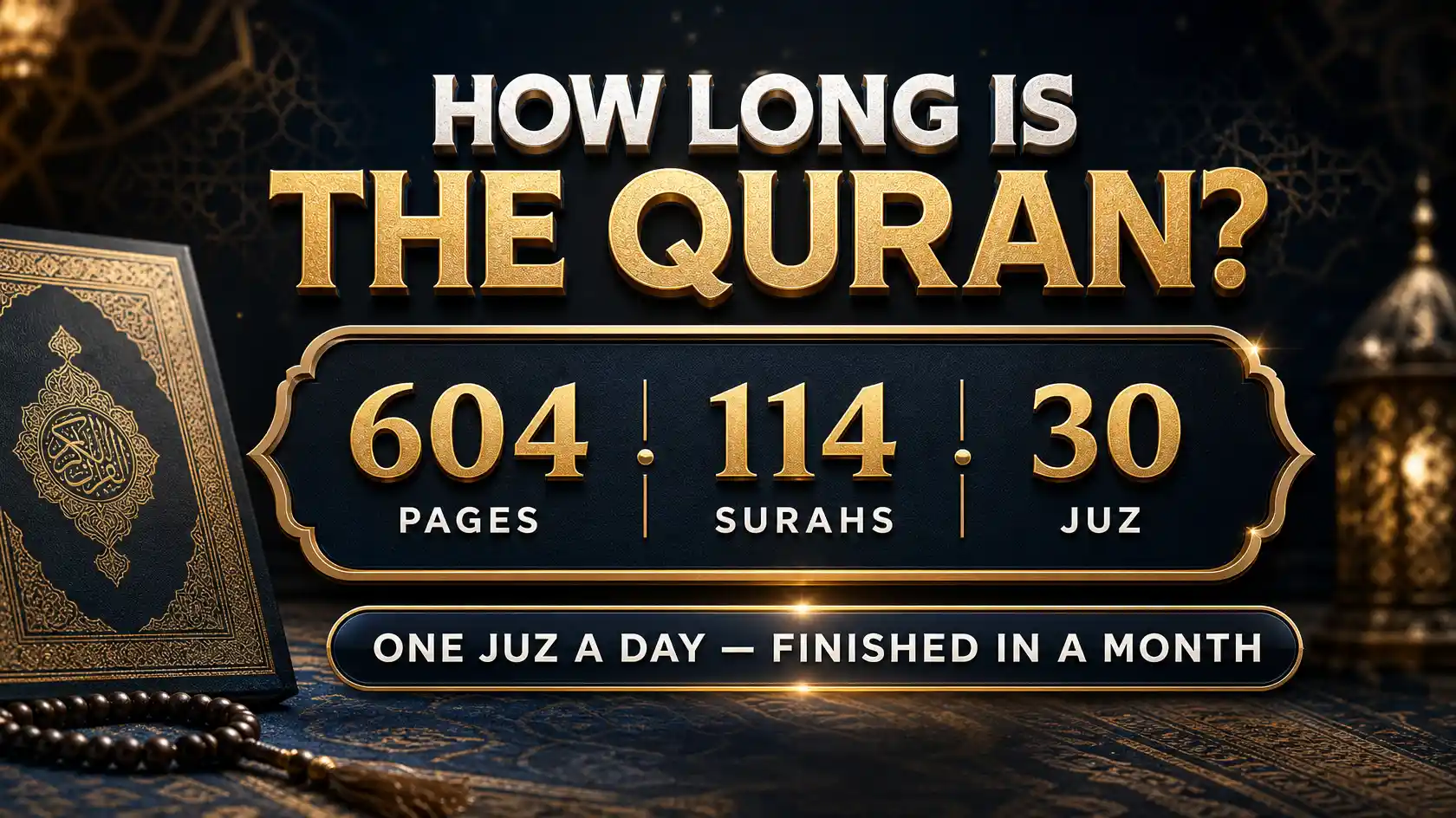
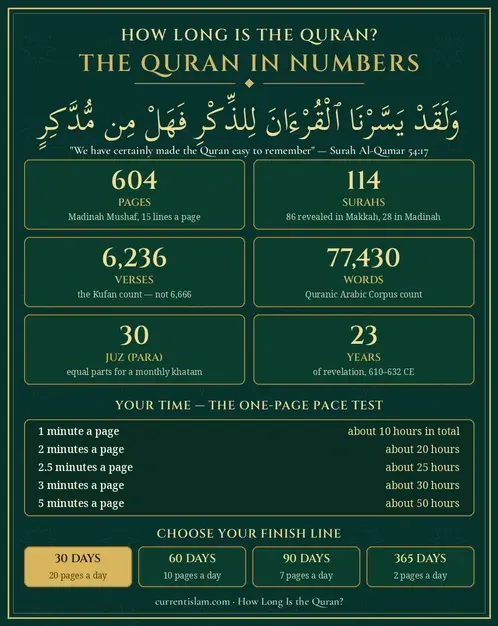
- 604 pages in the standard Madinah Mushaf — 114 surahs, 6,236 verses, about 77,430 Arabic words, divided into 30 juz (para).
- Reading time is yours to measure: at 2 minutes a page it is about 20 hours in total; at 3 minutes a page, about 30 hours.
- The friendly finish line: 20 pages a day — one juz — completes the whole Quran in about a month.
Someone hands you a Quran, and the first question is a measuring one: how long is this book? Behind it sit three quieter questions. Can I finish it? How long will it take me? Is it longer than the Bible my friend reads? This page answers all four lengths of the Quran — its pages, its words, your time, its years — with every number tied to a named source.
How long is the Quran? The 4 Lengths at a glance
The Quran is 604 pages long in the standard Madinah Mushaf, with 114 surahs, 6,236 verses and about 77,430 Arabic words. Recited aloud at a steady pace it takes roughly a day of reading in total, and it was revealed over about 23 years.
Most pages answer with one number and stop. The trouble is that “long” means four different things, and each has its own honest answer. Pages depend on the edition. Words depend on the counting. Time depends entirely on the reader. And its revelation span is measured in years, not pages. Keep the four separate and every figure below makes sense.
| Measure | The Number | What it Rests On |
|---|---|---|
| Pages | 604 | Madinah Mushaf, 15 lines a page |
| Surahs (chapters) | 114 | Agreed by all counting traditions |
| Verses (ayat) | 6,236 | Kufan count, Hafs mushaf |
| Words | 77,430 | Quranic Arabic Corpus count |
| Juz (para) | 30 | About 20 pages each |
| Hizb | 60 | Two per juz |
| Manazil | 7 | A one-week reading division |
| Longest surah | Al-Baqarah, 286 verses | Pages 2–49 of the Madinah Mushaf |
| Shortest surah | Al-Kawthar, 3 verses | A single page |
| Reading aloud | About 20–30 hours | Depends on your pace per page |
| Revelation | About 23 years | 610–632 CE |
How many pages are in the Quran?
The standard Arabic Quran, the Madinah Mushaf printed by the King Fahd Complex, has 604 pages of 15 lines each. Other prints differ: Indo-Pak copies run to roughly 850 pages, and English translations vary with layout, so 604 describes one named edition, not every copy.
A page count is a fact about paper, not about the Quran itself. The Madinah Mushaf is the reference point because its layout never changes: 15 lines a page, every page ending at a verse end, so page 300 holds the same verses everywhere. Pick up an Indo-Pak mushaf instead, in a larger script style, and the same words take roughly 850 pages. Add a translation or a large font and the book grows again. The words never changed; only the layout did.
How many verses and words are in the Quran?
By the standard Kufan count used in the Hafs mushaf, the Quran has 6,236 verses across 114 surahs. The Quranic Arabic Corpus, built at the University of Leeds on the verified Tanzil text, counts 77,430 Arabic words. The popular6,236 verses figure is not a standard count.
Verse counts differ slightly between the classical counting systems — Kufan, Basran, Shami and others — because scholars drew a few verse boundaries in different places, not because any word differs. The count in the mushaf most readers own is the Kufan 6,236, and our full breakdown of the total ayat in the Quran walks through each system. Word counts vary too: Arabic joins particles and pronouns to their neighbours, so counters must decide what counts as one word — which is why the Corpus figure is the one to quote. Letter totals quoted to the last digit shift with every method; none carries the agreement of the counts above.
How is the Quran divided into juz, hizb and manazil?
The Quran is divided into 30 juz, called para in South Asia, of about 20 pages each, so one juz a day finishes it in a month. Each juz splits into two hizb, giving 60, and a second division gives seven manazil for a weekly reading.
These divisions are reading tools, added to portion the book across a month, a week or a prayer schedule; they are not part of the revelation itself. Most readers meet the monthly division in Ramadan tarawih and khatam plans. The weekly one, the seven manazil, is older and less known — and not to be confused with Manzil Dua, the protective-verse booklet that borrows the word manzil but gathers verses from 14 surahs rather than marking a weekly portion. Our guide to how many surahs are in the Quran maps the 114 chapters themselves, Makki and Madani.
What are the longest and shortest parts of the Quran?
The longest surah is Al-Baqarah, with 286 verses spread over pages 2 to 49 of the Madinah Mushaf. The shortest is Al-Kawthar, with three verses on a single page. The longest single verse is the debt verse, Al-Baqarah 2:282, inside that longest surah.
The Quran opens small and grows. After Al-Fatiha’s seven verses on page 1 comes Surah Al-Baqarah, 48 pages on its own, holding the longest verse in the Quran, a single verse about recording a debt honestly. Near the back, whole surahs fit on one page. The chapters also fall into two families: 86 Makki surahs revealed before the Prophet’s ﷺ migration and 28 Madani after it, as the Quran.com index records. A Makki surah can carry world-famous verses: Surah Luqman ayat 14-15, on gratitude to parents, sits in a Makki chapter of just 34 verses.
How long does it take to read the Quran?
There is no single reading time, because pace decides it. At two minutes a page, 604 pages take about 20 hours; at three minutes a page, about 30 hours. Learners and anyone reading the translation alongside should expect longer, and that is fine.
Websites quote everything from 10 to 40 hours, without saying whose reading they timed. The working is simple: your total is your minutes per page multiplied by 604. A fluent reader reciting with tartil — measured, careful pronunciation — often lands near two to two and a half minutes a page. A learner may need five, and a reader pausing over the translation is doing something slower and different: study, not recitation. None of these speeds is wrong.
| Your Pace | Total Estimated Time |
|---|---|
| 1 minute a page | About 10 hours |
| 2 minutes a page | About 20 hours |
| 2.5 minutes a page | About 25 hours |
| 3 minutes a page | About 30 hours |
| 4 minutes a page | About 40 hours |
| 5 minutes a page | About 50 hours |
The One-Page Pace Test (save this): 1) Open your mushaf at any middle page. 2) Set a timer and read that page aloud at the pace you could keep for an hour. 3) Note the minutes. 4) Multiply by 604, then divide by 60 — that is your honest total in hours. 5) Divide 604 by your total days instead, and you have your daily pages.
The Prophet ﷺ set the rhythm himself (Sahih al-Bukhari 5054), in his words to Abdullah ibn Amr: Allah’s Messenger ﷺ said to me, “Recite the whole Qur’an in one month’s time.” I said, “But I have power (to do more than that).” Allah’s Messenger ﷺ said, “Then finish the recitation of the Qur’an in seven days, and do not finish it in less than this period.” A month is the starting rhythm, a week the floor in this narration — finishing is a practice of understanding, not a sprint.
How long does it take to listen to the Quran?
Listening takes as long as the recitation you choose. A full tartil recitation runs to roughly a day of audio in total, while faster reciters finish sooner and slow, careful recitations run longer. Check one juz in your app and multiply its time by thirty.
Listening follows the reciter’s pace, not yours, so its total is easy to predict: every complete audio set is divided by juz, so one part prices the whole. Note the length of juz 1 in your app and multiply by thirty. At about an hour a juz, the common tartil shape, a month of daily listening completes the Quran. Allah says of this book:
وَلَقَدْ يَسَّرْنَا ٱلْقُرْءَانَ لِلذِّكْرِ فَهَلْ مِن مُّدَّكِرٍ
Wa laqad yassarnal-qur’ana liz-zikri fa-hal min muddakir
“And We have certainly made the Quran easy to remember. So is there anyone who will be mindful?” (Surah Al-Qamar 54:17, Khattab)
Urdu (Jalandhari):
اور ہم نے قرآن کو سمجھنے کے لئے آسان کردیا ہے تو کوئی ہے کہ سوچے سمجھے؟
The verse comes four times in its surah; our page on Walaqad Yassarnal Quran traces each repetition. A book made easy to remember is a book meant to be finished — and finished again.
Is the Quran longer than the Bible?
In words, the King James Bible is about ten times longer than the Quran: roughly 783,137 words and 31,102 verses across 66 books, against about 77,430 words and 6,236 verses in one book. The comparison measures length only; the two scriptures differ in kind, not just size.
Here is the comparison plainly, with the edition named on the Bible side too, because Bible counts move with translation, as Quran page counts move with layout. In size alone the Quran is close to a single long novel, which surprises many readers. What the comparison cannot measure is density: a text recited daily and memorized whole by millions carries a presence that a word count does not capture.
| Feature | Quran | Bible (King James Version) |
|---|---|---|
| Words | About 77,430 (Arabic) | About 783,137 |
| Verses | 6,236 | 31,102 |
| Main divisions | 114 surahs, one book | 66 books, 1,189 chapters |
Your Khatam Finish-Line Chart
To finish the Quran in 30 days, read about 20 pages a day — one juz. In 60 days, about 10 pages a day; in 90 days, about 7; across a full year, 2 pages a day, which still completes all 604 pages with weeks to spare.
A khatam — one complete reading, Al-Fatiha to An-Nas — is simple division: 604 pages shared across your days. The chart does the division for the goals readers set most, priced at two and a half minutes a page. Anchor the pages to prayers and the habit holds itself: four pages after each of the five daily prayers is 20 pages a day, with no extra sitting.
| Finish In | Pages a Day | Minutes a Day |
|---|---|---|
| 7 days | 87 | About 3 hours 35 minutes |
| 30 days | 21 | About 50 minutes |
| 60 days | 11 | About 27 minutes |
| 90 days | 7 | About 17 minutes |
| 6 months | 4 | About 10 minutes |
| 1 year | 2 | About 5 minutes |
Start tonight with the smallest honest version: two pages after Isha, timed, with tomorrow’s pages marked. When two pages feels easy for a week, step up a row. When you reach page 604, begin again: the measure of this book is not speed, but return. Your next step: Surah Al-Fatiha, the seven verses on page 1 where every khatam begins.
Common mistakes when people quote the Quran’s length
Three figures cause most of the confusion. First, 6,236 verses: memorable and repeated, yet produced by no classical counting system — the mushaf in your hands numbers 6,236. Second, 604 pages treated as a property of the Quran rather than of one edition, which makes an 850-page home copy look like a different book. Third, one reading time quoted as if it belonged to everyone. Pages belong to editions, times belong to readers, and only the words, surahs and verses belong to the Quran itself. Quote each number with its owner attached.
FAQ
The Madinah Mushaf, the standard Arabic print issued by the King Fahd Complex and used in mosques worldwide, has 604 pages of 15 lines each. Other editions differ by layout: Indo-Pak prints run to roughly 850 pages, and translation editions vary, while the Arabic text itself stays exactly the same.
The Quranic Arabic Corpus, the University of Leeds project built on the verified Tanzil text, counts 77,430 Arabic words. Other careful counts land close by, between about 77,200 and 77,900, because Arabic joins some particles and pronouns to neighbouring words and counters draw the word boundary in slightly different places.
No. The verse total in the standard Hafs mushaf, following the Kufan counting system, is 6,236, and the other classical systems land within a few dozen of it. The 6,666 figure is widely repeated, but no counting system produces it and no printed mushaf numbers its verses that way.
At a tartil pace of about two minutes a page, the 604 pages take roughly 20 hours of recitation; at three minutes a page, roughly 30. The Prophet ﷺ guided Abdullah ibn Amr to a month, then seven days at the fastest, so one sitting is a measure, not a goal.
The Quran is divided into 30 juz of roughly equal length, about 20 pages each in the Madinah Mushaf; in South Asia a juz is called a para, so the whole book is 30 para. Each juz divides into two hizb, and a separate weekly division gives seven manazil.
The Quran was revealed to the Prophet Muhammad ﷺ over about 23 years, beginning in Ramadan of 610 CE in Makkah and ending shortly before his death in 632 CE in Madinah: roughly 13 years of Makki revelation and 10 years of Madani revelation, answering events and questions as they arose.
There is no fixed term, because memorization adds review to new learning. The maths sets the floor: at one new page a day, the 604 pages alone take about 20 months, before the growing daily review every memorizer carries. Steady students in structured programs commonly take a few years.
Because page counts belong to print editions, not to the text. Script style, font size, lines per page and commentary all stretch or shrink the book: the 15-line Madinah print has 604 pages, Indo-Pak prints roughly 850, and the words, surahs and verses inside are identical in every sound copy.
