No verse and no hadith gives Muslims a licence to lie for Islam — here is the rule, the only three exceptions, and what taqiyya really means.
Quick Answer
- No. Lying (kadhib) is haram, a major sin, and the first sign of the hypocrite. No source permits lying to non-Muslims, or deceiving anyone to spread Islam.
- Three doors only. The Prophet ﷺ allowed what people call lying in war stratagem, in reconciling two people, and in kind speech between spouses (Sahih Muslim 2605a) — and scholars prefer true, indirect words even there.
- One shield. Taqiyya is concealing your faith under coercion, when life or safety faces a real threat and your heart stays firm (Quran 3:28; 16:106). It is a concession for the persecuted, not a tool for dawah.
Contents
- Is lying haram in Islam?
- Can Muslims lie to non-Muslims, or lie to spread Islam?
- What does taqiyya mean in the Quran?
- When is lying permissible in Islam? The Three Doors
- Taqiyya, kitman and tawriya: what is the difference?
- Is taqiyya a Sunni or a Shia teaching?
- Claims about lying that do not survive the sources
- Before You Speak: the practice plan
- Questions people ask
Someone sends you a clip. A speaker claims Islam lets Muslims lie to non-Muslims whenever it helps the faith, and one Arabic word, taqiyya, is offered as proof. If you are the only Muslim in the room, every eye turns to you. Can Muslims lie for the sake of Islam? No. Lying, called kadhib in Arabic, is a forbidden major sin, and no verse or hadith gives a general licence to deceive anyone, Muslim or not, for dawah, which means inviting people to Islam, or for any other cause. What the sources give instead is far narrower: three named exceptions, and one shield for a believer under coercion. This article sets out the rule, the three doors, and the shield, from the texts themselves.
Is lying haram in Islam?
Yes. Lying is haram in Islam, and it is counted among the major sins. Allah commands, “O believers! Be mindful of Allah and be with the truthful” (Quran 9:119), and pairs false speech with idolatry in one verse: “shun the impurity of idolatry, and shun words of falsehood” (Quran 22:30).
The Prophet ﷺ described where each road ends. Truthfulness leads to righteousness, and a person keeps telling the truth until he is recorded with Allah as truthful, while lying leads to wickedness, and a person keeps lying until he is recorded with Allah as a liar (Sahih al-Bukhari 6094; Sahih Muslim 2607a). He ﷺ also named lying first among the signs of the hypocrite: “The signs of a hypocrite are three: whenever he speaks, he tells a lie; whenever he promises, he breaks it; and whenever he is entrusted, he betrays the trust” (Sahih al-Bukhari 33; Sahih Muslim 59). A habit, not a slip, is what these texts warn against. The verse that begins Innal Muslimina wal Muslimat lists truthful men and women among those Allah has promised forgiveness and a great reward.
Can Muslims lie to non-Muslims, or lie to spread Islam?
No. No Quran verse and no hadith permits lying to non-Muslims because they are non-Muslims, and none permits deceiving people to spread Islam. The claim takes a narrow concession for a believer facing coercion and strips away its conditions until it sounds like a general licence. It is not one.
The duty to keep promises and treaties is not limited to fellow Muslims, and the Quran counts inventing a lie against Allah among the gravest wrongs (Quran 39:32). A faith that commands a witness to stand firm for justice even against himself and his parents (Quran 4:135) does not quietly license deceit as a method of invitation. When a Muslim explains Islam to a neighbor, a colleague, or a family chat, honesty is not a tactic that can be suspended for a good result. It is the message behaving like itself.
What does taqiyya mean in the Quran?
Taqiyya means guarding yourself: concealing your faith, or saying what you are forced to say, when you face danger, while your heart stays firm in faith. Its Quran bases are two verses, 3:28, which permits a precaution against tyranny, and 16:106, which excuses the believer who is compelled under coercion.
The two verses, in full
Quran 3:28 — Surah Aal-e-Imran
لَّا يَتَّخِذِ ٱلْمُؤْمِنُونَ ٱلْكَـٰفِرِينَ أَوْلِيَآءَ مِن دُونِ ٱلْمُؤْمِنِينَ ۖ وَمَن يَفْعَلْ ذَٰلِكَ فَلَيْسَ مِنَ ٱللَّهِ فِى شَىْءٍ إِلَّآ أَن تَتَّقُوا۟ مِنْهُمْ تُقَىٰةً ۗ وَيُحَذِّرُكُمُ ٱللَّهُ نَفْسَهُۥ ۗ وَإِلَىٰ ٱللَّهِ ٱلْمَصِيرُ
La yattakhidhi al-mu’minuna al-kafirina awliya’a min duni al-mu’minin; wa man yaf’al dhalika fa-laysa mina Allahi fi shay’in illa an tattaqu minhum tuqah; wa yuhadhdhirukumu Allahu nafsah; wa ila Allahi al-masir.
“Believers should not take disbelievers as guardians instead of the believers—and whoever does so will have nothing to hope for from Allah—unless it is a precaution against their tyranny. And Allah warns you about Himself. And to Allah is the final return.” — Khattab, The Clear Quran
Two verses earlier, the same surah teaches the believer to say Qulillahumma Malikal Mulki, “Owner of all sovereignty.”
Urdu (Jalandhari):
مؤمنوں کو چاہئے کہ مؤمنوں کے سوا کافروں کو دوست نہ بنائیں اور جو ایسا کرے گا اس سے خدا کا کچھ (عہد) نہیں ہاں اگر اس طریق سے تم ان (کے شر) سے بچاؤ کی صورت پیدا کرو (تو مضائقہ نہیں) اور خدا تم کو اپنے (غضب) سے ڈراتا ہے اور خدا ہی کی طرف (تم کو) لوٹ کر جانا ہے
Quran 16:106 — Surah An-Nahl
مَن كَفَرَ بِٱللَّهِ مِنۢ بَعْدِ إِيمَـٰنِهِۦٓ إِلَّا مَنْ أُكْرِهَ وَقَلْبُهُۥ مُطْمَئِنٌّۢ بِٱلْإِيمَـٰنِ وَلَـٰكِن مَّن شَرَحَ بِٱلْكُفْرِ صَدْرًا فَعَلَيْهِمْ غَضَبٌ مِّنَ ٱللَّهِ وَلَهُمْ عَذَابٌ عَظِيمٌ
Man kafara bi-Allahi min ba’di imanihi illa man ukriha wa qalbuhu mutma’innun bi-al-imani wa lakin man sharaha bi-al-kufri sadran fa-‘alayhim ghadabun mina Allahi wa lahum ‘adhabun ‘azim.
“Whoever disbelieves in Allah after their belief—not those who are forced while their hearts are firm in faith, but those who embrace disbelief wholeheartedly—they will be condemned by Allah and suffer a tremendous punishment.” — Khattab, The Clear Quran
Urdu (Jalandhari):
جو شخص ایمان لانے کے بعد خدا کے ساتھ کفر کرے وہ نہیں جو (کفر پر زبردستی) مجبور کیا جائے اور اس کا دل ایمان کے ساتھ مطمئن ہو۔ بلکہ وہ جو (دل سے اور) دل کھول کر کفر کرے۔ تو ایسوں پر الله کا غضب ہے۔ اور ان کو بڑا سخت عذاب ہوگا
Word by word: the phrases the ruling turns on
| Arabic | Transliteration | What it means |
|---|---|---|
| تُقَىٰةً | tuqah | A precaution, a guarding of yourself against harm (3:28) |
| أَوْلِيَاءَ | awliya | Guardians, protectors, allies taken over others (3:28) |
| أُكْرِهَ | ukriha | He is forced, compelled against his will (16:106) |
| قَلْبُهُ مُطْمَئِنٌّ بِٱلْإِيمَانِ | qalbuhu mutma’innun bi-al-iman | His heart is at rest, firm, with faith (16:106) |
| شَرَحَ بِٱلْكُفْرِ صَدْرًا | sharaha bi-al-kufri sadran | He opens his chest to disbelief willingly (16:106) |
Read 3:28 in full and the shape is clear. The verse warns believers not to take disbelievers as guardians over other believers, then allows one narrow move: a precaution against tyranny. Commenting on this verse, al-Qurtubi, the Andalusian scholar of tafsir (Quran commentary), held the line tightly: “Taqiyya is not permissible except with fear of death or loss of limb or tremendous suffering.” Nothing about inviting people to Islam. Nothing about winning an argument.
The second verse, 16:106, concerns a believer who is tortured into uttering words of disbelief. Classical commentators connect it with Ammar ibn Yasir, a Companion who was persecuted in Makkah until he said what his persecutors demanded, while his heart remained firm. Ibn Kathir, in his commentary on this verse, records the ruling the scholars agreed on: a person forced into disbelief may comply to preserve his life, or refuse and stay steadfast, as Bilal did under torture, and remaining steadfast is the better course. A concession for the cornered is not a command, and it is never a strategy.
When is lying permissible in Islam? The Three Doors
Almost never. The Prophet ﷺ allowed what people call lying in only three cases: stratagem in war, words that reconcile two people, and kind speech between a husband and a wife. Ibn Shihab said he heard of no exemption in anything people call a lie besides these three.
Humaid ibn Abd al-Rahman reported that his mother, Umm Kulthum bint Uqbah, heard Allah’s Messenger ﷺ say: “A liar is not one who tries to bring reconciliation amongst people and speaks good (in order to avert dispute), or he conveys good.” Ibn Shihab said he did not hear that exemption was granted in anything what the people speak as lie but in three cases: in battle, for bringing reconciliation amongst persons, and the narration of the words of the husband to his wife, and the narration of the words of a wife to her husband. — Sahih Muslim 2605a
The same three cases are stated as a ruling by Asma bint Yazid: “It is not lawful to lie except in three cases: something the man tells his wife to please her, to lie during war, and to lie in order to bring peace between the people” (Jami at-Tirmidhi 1939; at-Tirmidhi graded the report Hasan in his own words on the Sunnah.com page). Abu Dawud records Umm Kulthum’s version with the grade Sahih (al-Albani) at Sunan Abi Dawud 4921.
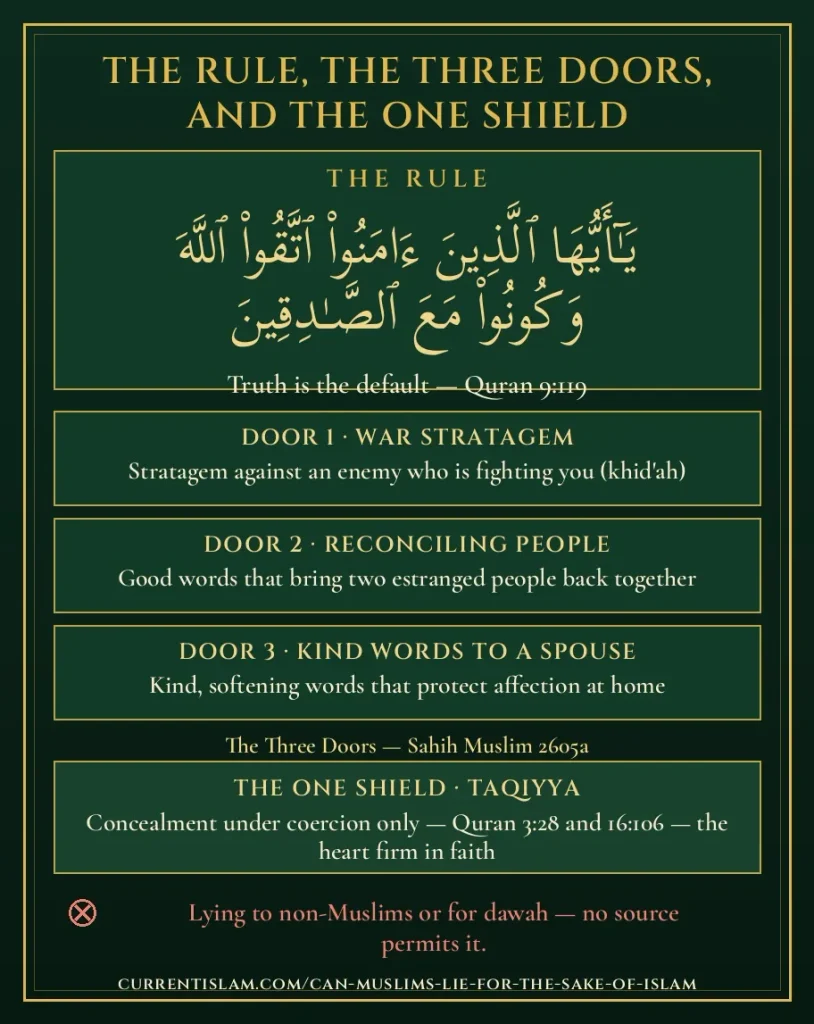
| The Three Doors | What is excused | What is never excused |
|---|---|---|
| War | Stratagem against an enemy who is fighting you (khid’ah) | Treachery, breaking a treaty or a promise (khiyanah) |
| Reconciliation | Good words that bring two estranged people back together | Lies that take a right, spread a dispute, or harm a third person |
| Spouses | Kind, softening words that protect affection at home | Lies about money, rights, or anything that cheats a spouse |
The first door is war. The Prophet ﷺ said, “War is deceit” (Sahih al-Bukhari 3029), meaning battlefield stratagem against an enemy who is fighting you. Scholars call this khid’ah, and they separate it sharply from khiyanah, treachery, which means breaking a covenant or a treaty. Treachery is prohibited without exception, so the war door never opens onto lying to partners, employers, or neighbors in daily life. The site’s own reading of Surah Tawbah ayat 5 shows how strictly the Quran frames wartime commands. The second door is reconciliation: telling each of two estranged people the good the other said, to bring them back together. It is the spirit of the dua Allahumma Allif Baina Qulubina, which asks Allah to unite hearts and remove rancor. The third is the home: warm words between spouses that protect affection. Kind words guard the mawaddah, the affection that Surah Ar-Room ayat 21 places between husband and wife.
Taqiyya, kitman and tawriya: what is the difference?
They are three different things, and mixing them is how the confusion starts. Taqiyya is concealing your faith under coercion. Kitman is concealment by silence, saying nothing and letting a matter stay hidden. Tawriya is speaking words that are true as you intend them, while the listener hears another sense.
| Term | What it is | Its limit |
|---|---|---|
| Taqiyya | Concealing faith, or saying what you are forced to say, under coercion | Real danger only; the heart stays firm; a concession, not a duty |
| Kitman | Concealment by silence; not volunteering what is yours to withhold | Never concealing testimony or a right owed to someone else |
| Tawriya | True words carrying a second sense that you intend | The words must stay true in the sense intended; no cheating anyone of a right |
| Ma’areed | Indirect speech, the wider habit behind tawriya | Al-Bukhari’s chapter title calls it “a safe way to avoid a lie” (6209) |
| Khid’ah | Battlefield stratagem in war | Never treachery (khiyanah) or a broken covenant |
A fourth term completes the set: ma’areed, indirect speech. Imam al-Bukhari gave a chapter of his Sahih the title “Al-Ma’arid is a safe way to avoid a lie” (Sahih al-Bukhari, Book of Good Manners, chapter 116, at hadith 6209). Where a true sentence with a less obvious meaning can protect someone, it comes before any outright falsehood, and it never licenses cheating a person out of a right. Silence, indirect words, then, and only in the three doors or under coercion, the concession itself: that order matters.
Is taqiyya a Sunni or a Shia teaching?
Both traditions know the principle, because both read these two verses, but they developed it differently. In Sunni scholarship, taqiyya stayed a narrow concession tied to compulsion and harm. In Shia scholarship, formed over centuries when Shia communities lived as a persecuted minority, it became a wider, central doctrine.
That difference is a matter of history and legal scope, not a test of anyone’s honesty. A Sunni and a Shia neighbor who both refuse to lie to you at work are not hiding opposite doctrines; both are following the default rule of their faith, which is truthfulness. What neither tradition teaches is a standing permission to deceive outsiders for the sake of the religion. On that point, the popular claim fails in both directions at once.
Claims about lying that do not survive the sources
No special day opens the door either. IslamWeb’s fatwa on lying names the April Fools custom directly: no day exists when a person may say whatever he wishes, and lying in jest is still lying. The same applies to the small social lie told to look impressive, the exaggerated story in the family chat, and the padded resume behind a dua for a job. None of these is war, reconciliation, a spouse’s kind word, or coercion. Each is simply kadhib, and the texts treat the habit as the danger, because a tongue trained on small lies stops noticing them. The Quran’s portrait of the slanderer in Surah Humazah belongs to the same family of tongue sins.
Before You Speak: the practice plan
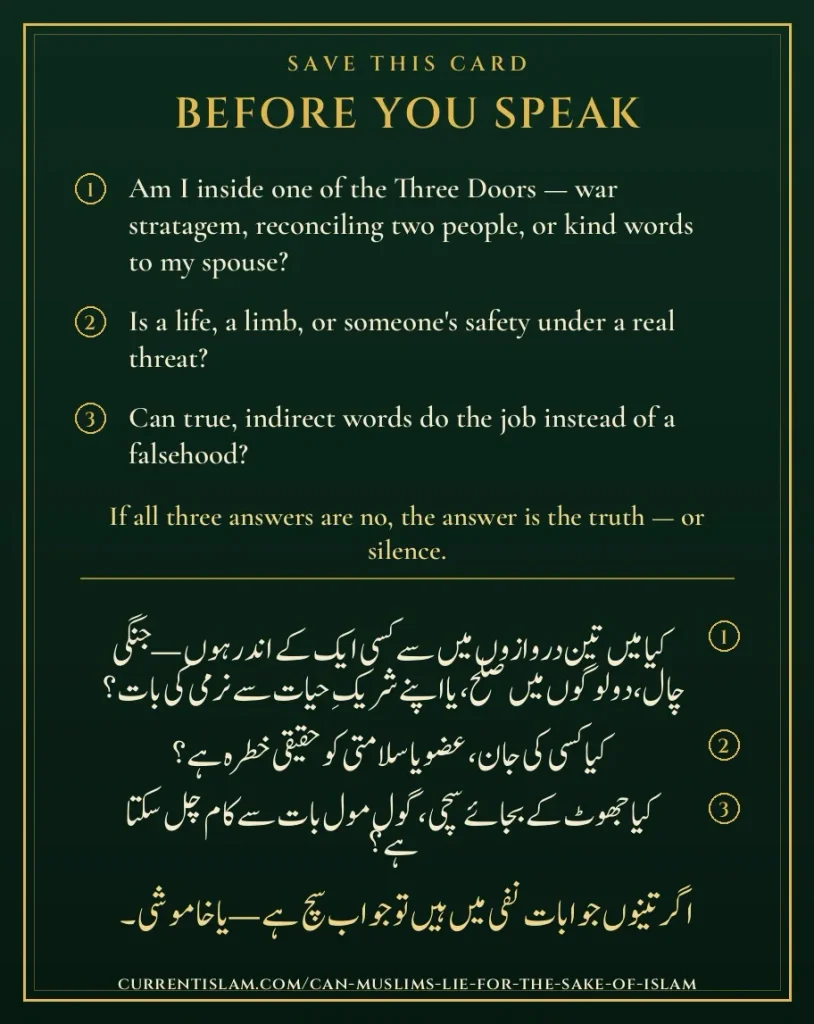
Start tonight, with one honest sentence where a soft lie would be easier: to your spouse, your parent, or the friend you have been avoiding. Then keep the decision card below where you can see it, on your phone or printed by your desk. At work or school, the plan sounds like this: answer plainly, decline to answer when a matter is private, and use indirect true words when a direct answer would expose someone to harm. It begins in small exchanges — the same ground as the greeting in Islam, where speech first meets the stranger. Being the only Muslim in the room does not require a performance. It requires the same thing every setting requires, a tongue that people learn they can trust. Pray for that tongue with the Quran’s own words: Rabbi Adkhilni Mudkhala Sidqin, “my Lord, let my entry be an entry of truth.”
The Before You Speak Card — save this
English
- Am I inside one of the Three Doors — war stratagem, reconciling two people, or kind words to my spouse?
- Is a life, a limb, or someone’s safety under a real threat?
- Can true, indirect words do the job instead of a falsehood?
If all three answers are no, the answer is the truth — or silence.
Urdu
- کیا میں تین دروازوں میں سے کسی ایک کے اندر ہوں — جنگی چال، دو لوگوں میں صلح، یا اپنے شریکِ حیات سے نرمی کی بات؟
- کیا کسی کی جان، عضو یا سلامتی کو حقیقی خطرہ ہے؟
- کیا جھوٹ کے بجائے سچی، گول مول بات سے کام چل سکتا ہے؟
اگر تینوں جوابات نفی میں ہیں تو جواب سچ ہے — یا خاموشی۔
Questions people ask
No. Islam gives no licence for small lies told to keep the peace or spare embarrassment. A white lie that reconciles two people, or softens speech between spouses, can fall inside the three doors. Any other white lie is still kadhib, and small lies train the tongue toward bigger ones.
No. Lying in jest is still lying, and the texts make no exception for jokes, pranks, or April Fools. IslamWeb’s ruling on lying states there is no special day when people may say whatever they wish. Humor is welcome in Islam, but a joke built on a falsehood is not.
People usually mean one of two things. Concealing faith under coercion is taqiyya. Speaking true words that carry a second, intended meaning is tawriya, called ma’areed, indirect speech. Neither is a general permission to lie, and scholars reach for indirect true words before any outright falsehood, even inside the exceptions.
This is the third door, and it is narrow. Kind, softening words between husband and wife that protect affection are excused, such as praising food or appearance beyond fact. Lies about money, rights, or anything that cheats a spouse are not excused, and they break the trust marriage runs on.
No. Parents are owed the truthful and gentle speech of all, and no door in the hadith opens toward them. Where a direct answer would cause harm, a believer may decline to answer, change the subject, or use true indirect words. A lie to a parent is still a lie.
Sometimes, and this is the shield, not a door. Where life, limb, or safety face a threat, the concession of 16:106 and the logic of protection can apply; scholars allow denying knowledge to shield a person from an oppressor. Embarrassment and awkward questions are not threats.
The Prophet ﷺ tied lying to two records: a person keeps lying until he is recorded with Allah as a liar, and lying is a sign of the hypocrite. The Quran pairs false speech with idolatry (22:30). No worldly penalty is set; the weight is moral and spiritual.
Stop the lie, regret it, and resolve not to return to it. Where it took a right, damaged a reputation, or cost money, put it right with that person if you can. Train the replacement: plain answers, silence when speech is not yours to give, indirect true words under pressure.
Next step
- Start with the rule itself: What is Islam? sets out the faith this ruling belongs to.
- Train the tongue daily: Greeting in Islam shows how much of a Muslim’s character is carried by ordinary speech.
- Guard the heart behind the tongue: Can Evil Come Near the Quran? explains how the Quran protects a home through recitation and practice.
- Check the claim at its source: Quran 3:28 on Quran.com and Sahih Muslim 2605.
Last reviewed: 8 November 2026 · Author: Shahab Khan · Reviewed by: Atif Khan
