You are sitting at your desk, or perhaps in a university study hall, when a colleague or friend asks, “So, what is Islam religion all about?” Instantly, your mind races. You feel the heavy weight of explanation fatigue. How do you accurately summarize a global faith of nearly two billion people in three minutes without sounding defensive or like a dry academic textbook?
When you search for answers to send them, you often hit a wall of dense encyclopedia entries, confusing political bias, or overwhelming theological jargon. Your friends want clarity. You crave an easy, authentic way to share the absolute truth of your faith.
This guide is your ultimate, shareable masterclass. We will strip away the noise and break down the pure foundational roots of Islam, bridging 7th-century Arabia with the modern digital Sunnah. Share this page with confidence.
What is Islam Religion? A Clear Definition
Islam is a major monotheistic global religion founded on the belief in one God, named Allah. The word “Islam” translates to submission to the will of God, and its followers, known as Muslims, live according to the revelations given to Prophet Muhammad (PBUH).
Here is why this matters for your daily routine. Islam is not an abstract philosophy reserved for Friday prayers. It is an active, practical framework for living. It governs everything from how you manage your finances to the way you treat your neighbors. In a modern era driven by anxiety, Islam offers a structured routine that continuously realigns your focus back to your Creator.
Is Islam a Country or a Place?
No, Islam is not a country. No, Islam is not a place. It is a universal religion practiced by diverse cultures across the globe. While its historical origins are rooted in the Middle East, the vast majority of Muslims today live in the Asia-Pacific region.
Many people confuse geographic culture with pure Islamic theology. But God’s dominion is not restricted by human borders. As the Quran beautifully reminds us, Allah is the Rabul mashriqain wa rabbul maghribain (Lord of the two Easts and the Lord of the two Wests). The faith transcends language, nationality, and race.
The Core Foundation: Tawhid (Oneness of God)
Tawhid is the absolute, uncompromising belief in the oneness of Allah. It dictates that God is entirely unique, eternal, self-sustaining, and has no partners, equals, or offspring. This monotheism is the bedrock of the entire Islamic faith.
Let’s break down the exact meaning of this concept. When a Muslim experiences overwhelming stress, they rely on Tawakkul (complete trust in God). This trust comes from knowing God is in absolute control. The purest definition of Allah is found in Surah Al-Ikhlas (Chapter 112).
Arabic Text:
قُلْ هُوَ اللَّهُ أَحَدٌ اللَّهُ الصَّمَدُ لَمْ يَلِدْ وَلَمْ يُولَدْ وَلَمْ يَكُن لَّهُ كُفُوًا أَحَدٌ
Transliteration: Qul huwal laahu ahad. Allah hus-samad. Lam yalid wa lam yoolad. Wa lam yakun lahu kufuwan ahad.
English Translation: Say, “He is Allah, [who is] One. Allah, the Eternal Refuge. He neither begets nor is born. Nor is there to Him any equivalent.”
Urdu Translation:
کہہ دیجئے کہ وہ اللہ ایک ہے۔ اللہ بے نیاز ہے۔ نہ اس کی کوئی اولاد ہے اور نہ وہ کسی کی اولاد ہے۔ اور اس کے برابر کا کوئی نہیں ہے۔
Hindi Translation: कह दो, “वह अल्लाह एक है। अल्लाह निरपेक्ष है। न उसने किसी को जना और न वह किसी से पैदा हुआ। और कोई भी उसके बराबर नहीं है।”
Describe the Five Pillars of Islam
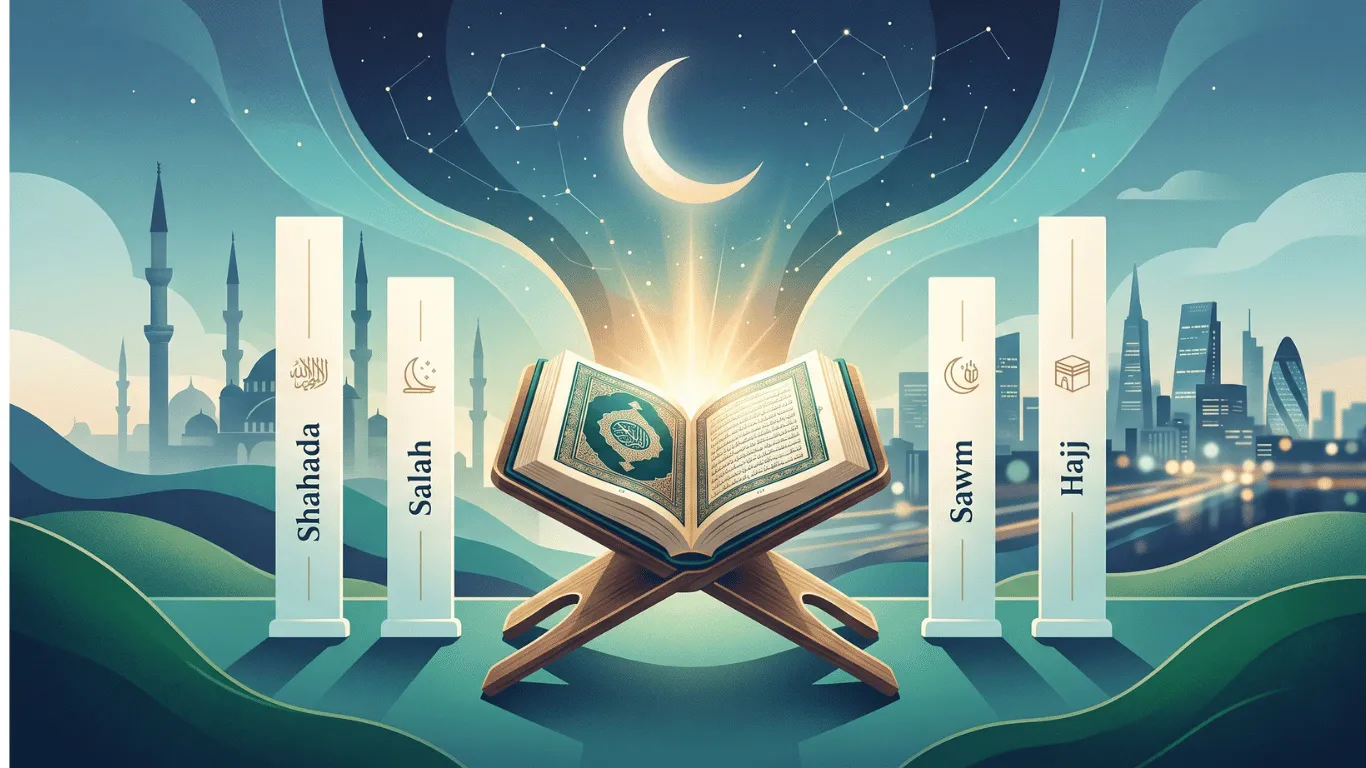
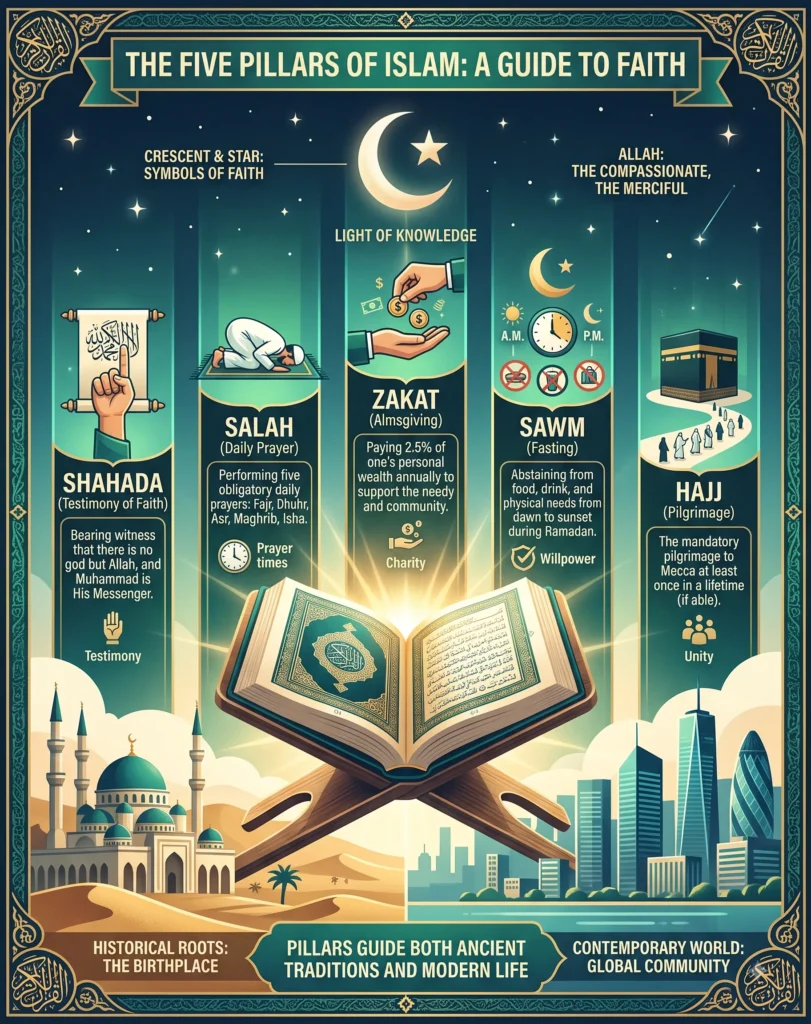
The Five Pillars of Islam are the obligatory acts of worship that form the foundation of a Muslim’s life. They consist of the declaration of faith (Shahada), five daily prayers (Salah), charitable giving (Zakat), fasting during Ramadan (Sawm), and the pilgrimage to Mecca (Hajj).
But how do we apply this in a hyper-connected, digital era? We call this the “Digital Sunnah.” You sync your smartwatch to adhan (prayer) times. You calculate your annual charity using automated Zakat apps. The pillars remain ancient, but the execution adapts to modern life, providing extreme spiritual grounding.
| Pillar | Arabic Term | The Modern Application (Digital Sunnah) | Core Spiritual Benefit |
| 1. Faith | Shahada | Verbally declaring God’s total oneness and Muhammad as His final messenger. | Eliminates modern anxieties by placing ultimate reliance (Tawakkul) on God alone. |
| 2. Prayer | Salah | Praying five times daily, often tracked via mobile phone prayer alerts. | Forces a mandatory digital detox; grounds the mind and pauses the workday hustle. |
| 3. Charity | Zakat | Calculating and distributing 2.5% of stagnant wealth annually online. | Purifies wealth, checks human greed, and builds financial equity in the community. |
| 4. Fasting | Sawm | Abstaining from food, drink, and bad habits from dawn until sunset. | Forges immense willpower (Sabr), physical discipline, and deep human empathy. |
| 5. Pilgrimage | Hajj | Traveling to Mecca at least once in a lifetime, stripping away all worldly status. | Unites millions of believers in absolute equality before God. |
The Quran, The Sunnah, and Authentic Guidance
The Quran is the central religious text of Islam, believed to be the verbatim word of God. The Sunnah refers to the teachings and lifestyle of Prophet Muhammad (PBUH), recorded in authenticated collections called Hadith. Together, they form Islamic law and daily guidance.
When Muslims read the Quran, they do not just skim it for information. The text requires presence and reflection. The Quran itself commands us in Surah al-muzzammil 73:4 to recite the words with measured, rhythmic recitation.
Furthermore, to understand the weight of the Five Pillars, we rely on the authentic words of the Prophet (PBUH), recorded meticulously by classical scholars. Here is the famous Hadith from Sahih al-Bukhari (Hadith 8):
Arabic Text:
بُنِيَ الإِسْلاَمُ عَلَى خَمْسٍ شَهَادَةِ أَنْ لاَ إِلَهَ إِلاَّ اللَّهُ وَأَنَّ مُحَمَّدًا رَسُولُ اللَّهِ، وَإِقَامِ الصَّلاَةِ، وَإِيتَاءِ الزَّكَاةِ، وَالْحَجِّ، وَصَوْمِ رَمَضَانَ
Transliteration: Buniya al-islam ‘ala khams: shahadati an la ilaha illallah wa anna Muhammadan rasulullah, wa iqamat as-salah, wa ita’ az-zakah, wa al-hajj, wa sawm Ramadan.
English Translation: Islam is based on five principles: To testify that none has the right to be worshipped but Allah and Muhammad is Allah’s Messenger; to offer the prayers dutifully; to pay Zakat; to perform Hajj; and to observe fast during the month of Ramadan.
Urdu Translation:
اسلام کی بنیاد پانچ چیزوں پر ہے: اس بات کی گواہی دینا کہ اللہ کے سوا کوئی معبود نہیں اور محمد (ﷺ) اللہ کے رسول ہیں، نماز قائم کرنا، زکوٰۃ دینا، حج کرنا، اور رمضان کے روزے رکھنا۔
Hindi Translation: इस्लाम की बुनियाद पांच चीजों पर है: इस बात की गवाही देना कि अल्लाह के सिवा कोई पूज्य नहीं और मुहम्मद (ﷺ) अल्लाह के रसूल हैं, नमाज़ क़ायम करना, ज़कात देना, हज करना, और रमज़ान के रोज़े रखना।
The History of Islam: 7th Century Origins
The history of Islam began in 7th century Arabia with revelations received by the Prophet Muhammad in Mecca around 610 CE. The Angel Gabriel delivered these messages from God, which were memorized, recorded, and eventually compiled into the Quran.
Understanding Asbab al-Nuzul (the historical reasons for revelation) is crucial. When Prophet Muhammad (PBUH) began preaching against the polytheistic idols of Mecca, he faced brutal persecution. The early Muslims endured social boycotts, torture, and exile. In 622 CE, they migrated to the city of Medina. This migration, known as the Hijrah, marks the beginning of the Islamic calendar. Within a few decades, Islam transformed a fractured tribal society into a unified civilization defined by justice, hygiene, and strict monotheism.
People Also Ask
Muslims believe Islam was not founded by a new person, but rather completed by Prophet Muhammad (PBUH). He was the final messenger in a long line of prophets, including Abraham, Moses, and Jesus, who all taught submission to one God.
No, Muslims do not worship Muhammad. He is strictly revered as a human being and the final Prophet of God. Worship is directed exclusively to Allah alone. Associating partners with God is the greatest sin in Islam.
Islam is the name of the religion itself, meaning “submission to God.” A Muslim is the person who practices the religion of Islam. You practice Islam; you are a Muslim.
Yes. Muslims believe Allah is the exact same Creator worshipped by Abraham, Moses, and Jesus. “Allah” is simply the Arabic word for “The God,” used by Arabic-speaking Christians and Jews as well.
Transform Your Daily Routine
Now that you have a clear, highly accurate understanding of the Islamic faith, it is time to turn knowledge into action. Whether you are actively studying the faith, seeking to optimize your daily prayers, or need a quick reference to share with inquisitive friends, we have built a resource for you.
Download our Free PDF Master-Guide: The Digital Sunnah: Everyday Duas and the 5 Pillars for Modern Life. Keep it on your phone for instant access to transliterations, authentic references, and micro-habits that connect your modern routine back to God.

3 thoughts on “What is Islam Religion?”