Quick Answer
- The Islamic greeting is As-Salamu Alaykum, peace be upon you — a prayer, not small talk, taught by the Prophet ﷺ and spread as an act of faith (Sahih Muslim 54a).
- Climb the Ladder: Alaykum alone is ten good deeds, adding Allah’s mercy makes twenty, adding His blessings makes thirty (Sunan Abi Dawud 5195).
- Reply one level better, or at least the same (Quran 4:86): Wa Alaykum As-Salam, and add a level when you can.
Contents
- What is the greeting in Islam?
- What is the 10–20–30 Salam Ladder?
- How do you reply to Assalamualaikum?
- How do you greet a man, a woman, or a group in Islam?
- What is the Islamic greeting in Arabic, word by word?
- How should you greet when entering a home in Islam?
- How do you greet the dead in a graveyard in Islam?
- What if a Salam is passed to you through someone else?
- Are Ahlan wa Sahlan, Ramadan and Eid greetings the same as Salam?
- Can you greet a non-Muslim with Salam?
- The Salam Decision Card: what do you say, every time?
- Questions people ask
You walk into a room, a shop, or a family gathering, and you want to open well. A mumbled word feels thin. Silence feels cold. The Islamic way of greeting solves that moment in one sentence.
The greeting in Islam is the Salam, the spoken prayer As-Salamu Alaykum, which means peace be upon you. A Muslim greeting is never small talk first. It is a prayer for the other person’s safety, and the Quran sets one rule for answering it: reply with something better, or at least the same (Quran 4:86). This guide gives you the full Salam, the Ladder, every reply, and the forms for a man, a woman, a group, a home, and a graveyard.
What is the greeting in Islam?
The greeting in Islam is As-Salamu Alaykum, peace be upon you. It is the Salam greeting the Prophet Muhammad ﷺ taught believers to spread widely, because it grows love between people (Sahih Muslim 54a). Every Islamic greeting in this guide begins with this one sentence.
One line carries its meaning: Salam Alaikum means you are praying that the person in front of you stays safe from every harm. For the full word-by-word meaning of Assalamualaikum wa Rahmatullahi wa Barakatuh, read our dedicated meaning guide.
When Allah created Adam, He told him to greet a group of angels and listen to their reply, because it would be his greeting and his offspring’s greeting. Adam said, As-Salamu Alaikum. The angels answered by adding Allah’s mercy (Sahih al-Bukhari 3326).
Spreading the Salam is faith, not manners alone: the Prophet ﷺ linked believing, loving one another, and spreading the Salam (Sahih Muslim 54a).
What is the 10–20–30 Salam Ladder?
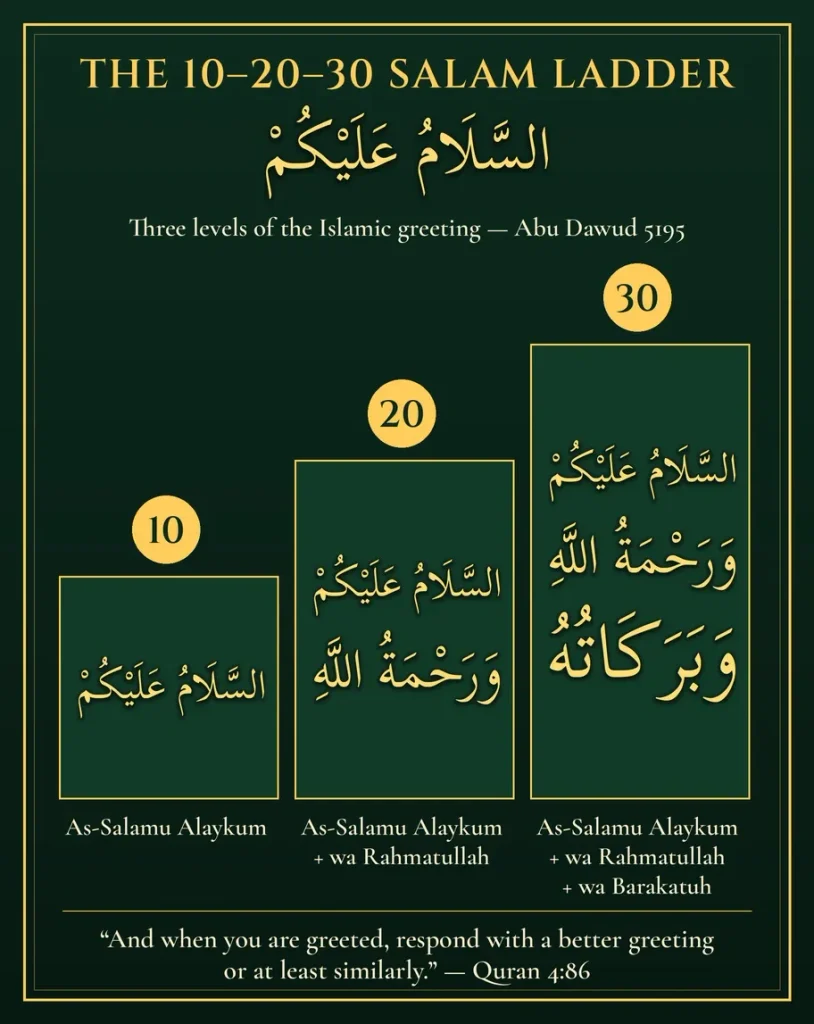
The 10–20–30 Salam Ladder has three levels. As-Salamu Alaykum earns ten good deeds. Adding wa Rahmatullah, and Allah’s mercy, earns twenty. Adding wa Barakatuh, and His blessings, earns thirty. A man greeted the Prophet ﷺ at each level, and he counted each reward aloud (Sunan Abi Dawud 5195, Sahih, al-Albani).
| Level | You Say (Arabic) | Transliteration | Good Deeds |
|---|---|---|---|
| 1 | السَّلَامُ عَلَيْكُمْ | As-Salamu Alaykum | 10 |
| 2 | السَّلَامُ عَلَيْكُمْ وَرَحْمَةُ اللَّهِ | As-Salamu Alaykum wa Rahmatullah | 20 |
| 3 | السَّلَامُ عَلَيْكُمْ وَرَحْمَةُ اللَّهِ وَبَرَكَاتُهُ | As-Salamu Alaykum wa Rahmatullahi wa Barakatuh | 30 |
Source: Sunan Abi Dawud 5195, graded Sahih by al-Albani.
Imran ibn Husayn reported the scene. One man greeted: Ten. A second added Allah’s mercy: Twenty. A third added His blessings: Thirty (Sunan Abi Dawud 5195).
Level one takes two seconds; level three takes four. No special place or fixed time is required. Climbing one level also gives the person answering you more to return.
How do you reply to Assalamualaikum?
Reply to Assalamualaikum with Wa Alaykum As-Salam, and peace be upon you too. The Quran’s rule: answer with a better greeting, or at least the same one (Quran 4:86). If someone adds Allah’s mercy, add His blessings. Never answer with less than you were given.
وَإِذَا حُيِّيتُم بِتَحِيَّةٍ فَحَيُّوا۟ بِأَحْسَنَ مِنْهَآ أَوْ رُدُّوهَآ ۗ إِنَّ ٱللَّهَ كَانَ عَلَىٰ كُلِّ شَىْءٍ حَسِيبًا
Wa idha huyyitum bi-tahiyyatin fa-hayyu bi-ahsana minha aw rudduha. Inna Allaha kana ala kulli shay’in hasiba.
“And when you are greeted, respond with a better greeting or at least similarly. Surely Allah is a ˹vigilant˺ Reckoner of all things.”
— Quran 4:86, The Clear Quran (Khattab)
Urdu (Jalandhari):
اور جب تم کو کوئی دعا دے تو (جواب میں) تم اس سے بہتر (کلمے) سے (اسے) دعا دو یا انہیں لفظوں سے دعا دو بےشک خدا ہر چیز کا حساب لینے والا ہے
The angels set this pattern with Adam, and Quran 4:86 makes it a lasting rule. Greeted at level one, answer at level two. Greeted at level two, answer at level three. Greeted in full, return it in full.
Two reply mistakes are common: answering a full greeting with a short one, and mumbling so the greeter cannot hear you. Say the reply clearly. And do not swap it for Jazakallahu Khairan, a prayer of thanks for a favour, not the answer to a Salam.
How do you greet a man, a woman, or a group in Islam?
Use Alayka for one man, Alayki for one woman, and Alaykum for a group. For who greets first, the Prophet ﷺ set a clear order: the young greet the old, a passerby greets the one sitting, and a small group greets a large group (Bukhari 6231).
| You are greeting | You say (Arabic) | Sounds like |
|---|---|---|
| One man | السَّلَامُ عَلَيْكَ | As-Salamu Alayka |
| One woman | السَّلَامُ عَلَيْكِ | As-Salamu Alayki |
| Two or more people, or a mixed group | السَّلَامُ عَلَيْكُمْ | As-Salamu Alaykum |
Arabic marks the change with one small sound: ka for a man, ki for a woman, kum for more than one person. Most people use Alaykum for everyone, which daily life accepts. The exact forms cost a minute to learn.
The starting order removes the awkward pause when two people wait for each other. In a corridor, on a school run, or joining a prayer row: if your place in the order says begin, begin warmly. At the mosque door, the dua before entering the mosque covers the doorway prayer first.
The same order helps when you visit someone ill. Open with the Salam, sit where you are invited, and keep the visit gentle. Our guide to the dua for the patient gives the prayer to say for them.
What is the Islamic greeting in Arabic, word by word?
The Islamic greeting in Arabic is As-Salamu Alaykum wa Rahmatullahi wa Barakatuh: peace be upon you, and Allah’s mercy, and His blessings. Each added phrase is a separate prayer, which is why the Ladder counts them separately. The table breaks it down word by word.
| Arabic | Transliteration | Meaning |
|---|---|---|
| السَّلَامُ | As-Salamu | peace, safety from every harm |
| عَلَيْكُمْ | Alaykum | upon you (plural) |
| وَرَحْمَةُ اللَّهِ | wa Rahmatullahi | and the mercy of Allah |
| وَبَرَكَاتُهُ | wa Barakatuh | and His blessings |
Say it slowly at first: As-Sa-LAA-mu A-LAY-kum. The long aa in Salam is part of the word. In texts, many write Salam Alaikum, but the full spoken form is As-Salamu Alaykum.
How should you greet when entering a home in Islam?
Before entering someone else’s home, ask permission and greet its people with Salam; the Quran makes both steps part of one entry (Quran 24:27). In your own home, greet your family the same way. If the house is empty, greet yourselves with a greeting from Allah, blessed and good (24:61).
يَـٰٓأَيُّهَا ٱلَّذِينَ ءَامَنُوا۟ لَا تَدْخُلُوا۟ بُيُوتًا غَيْرَ بُيُوتِكُمْ حَتَّىٰ تَسْتَأْنِسُوا۟ وَتُسَلِّمُوا۟ عَلَىٰٓ أَهْلِهَا ۚ ذَٰلِكُمْ خَيْرٌ لَّكُمْ لَعَلَّكُمْ تَذَكَّرُونَ
Ya ayyuhal-ladhina amanu la tadkhulu buyutan ghayra buyutikum hatta tastanisu wa tusallimu ala ahliha. Dhalikum khayrun lakum la’allakum tadhakkarun.
“O believers! Do not enter any house other than your own until you have asked for permission and greeted its occupants. This is best for you, so perhaps you will be mindful.”
— Quran 24:27, The Clear Quran (Khattab)
Urdu (Jalandhari):
مومنو! اپنے گھروں کے سوا دوسرے (لوگوں کے) گھروں میں گھر والوں سے اجازت لئے اور ان کو سلام کئے بغیر داخل نہ ہوا کرو۔ یہ تمہارے حق میں بہتر ہے (اور ہم) یہ نصیحت اس لئے کرتے ہیں کہ شاید تم یاد رکھو
The closing clause of Quran 24:61 covers the empty house:
فَإِذَا دَخَلْتُم بُيُوتًا فَسَلِّمُوا۟ عَلَىٰٓ أَنفُسِكُمْ تَحِيَّةً مِّنْ عِندِ ٱللَّهِ مُبَـٰرَكَةً طَيِّبَةً
Fa-idha dakhaltum buyutan fa-sallimu ala anfusikum, tahiyyatan min indillahi mubarakatan tayyibah.
“…when you enter houses, greet one another with a greeting from Allah, blessed and good.” (closing clause of Quran 24:61, Khattab wording for the clause)
Urdu (Jalandhari, for this clause):
اور جب گھروں میں جایا کرو تو اپنے (گھر والوں کو) سلام کیا کرو۔ (یہ) خدا کی طرف سے مبارک اور پاکیزہ تحفہ ہے۔
Permission protects privacy, and the Salam announces you with peace instead of surprise. Knock, wait to be admitted, then greet the household before any request or news. At your own doorway, pair it with the dua for entering home, the prayer said as you step inside.
How do you greet the dead in a graveyard in Islam?
Greet the dead in a graveyard with the words the Prophet ﷺ used at Al-Baqi: As-Salamu Alaykum, abode of a people who are believers (Sahih Muslim 974a). He then prayed for their forgiveness. The graveyard greeting is the same Salam, followed by prayer.
At Al-Baqi, the graveyard of Madinah, the Prophet ﷺ greeted its people and asked Allah to forgive them (Sahih Muslim 974a). Your visit follows the same two steps: greet first, then pray. Our dua for the departed gives one such prayer in full.
Keep the visit simple. Our full Kabristan ki Dua guide gives the complete graveyard supplication, so this page does not repeat it. The dead are greeted with peace, not passed by in silence, then remembered in prayer.
What if a Salam is passed to you through someone else?
If someone passes a Salam to you, reply to the person who sent it. Aisha received the angel Gabriel’s Salam through the Prophet ﷺ and answered, Wa alayhi As-Salam wa Rahmatullahi wa Barakatuh (Sahih al-Bukhari 3217). The reply travels back through the bearer, in full.
Aisha could not see Gabriel, yet she answered him directly, with the full reply (Sahih al-Bukhari 3217). A passed-on Salam is not a message to forward and forget. It is a greeting from a real person, and it earns a real reply.
The same rule fits modern life. A Salam sent by text or voice note is still a greeting with your name on it. Reply in full, reply promptly, and add one level if you can, as Quran 4:86 teaches.
Are Ahlan wa Sahlan, Ramadan and Eid greetings the same as Salam?
Ahlan wa Sahlan, Marhaban, and Sabah al-Khair are warm Arabic welcomes: you are among family, welcome, and good morning. They are cultural greetings, not the revealed Salam, and they do not replace it. Seasonal greetings work the same way, in Ramadan and at Eid.
Nothing here mocks those phrases; hosts across the Muslim world use them daily. Our Ahlan wa Sahlan guide explains their meaning in full. The honest point is order: a welcome phrase greets a guest, while the Salam is a prayer with a counted reward.
Mornings have their own warmth. Sabah al-Khair wishes someone a good morning, and many families answer Sabah an-Noor. Treat both as kind custom, and let the Salam stay first. The good morning dua page gathers the morning words and prayers.
Ramadan Mubarak and Ramadan Kareem both wish someone a blessed Ramadan. At Eid, Muslims say Taqabbalallahu Minna wa Minkum: may Allah accept it from us and from you. Enjoy each in its season; keep the Salam for every season.
Can you greet a non-Muslim with Salam?
Scholars differ on initiating the Salam to a non-Muslim, and this guide will not paste one view as the only ruling. Sahih Muslim 2164a sits in a chapter on greetings to the People of the Book, where some were twisting the words. Reply courteously; for initiating, follow your school.
The difference is genuine. One group of scholars reads the reports in Sahih Muslim’s Book of Greetings as a general rule against starting with the Salam. Another reads them in their setting, where a greeting was being twisted into a curse. Both cite real evidence, so your madhab (school of law) matters here.
What is not disputed is daily courtesy. Nothing here asks you to be cold to a neighbor, a colleague, or another parent at the school gate. General greetings and kindness to everyone are good character. Take the specific ruling from scholars you trust.
The Salam Decision Card: what do you say, every time?
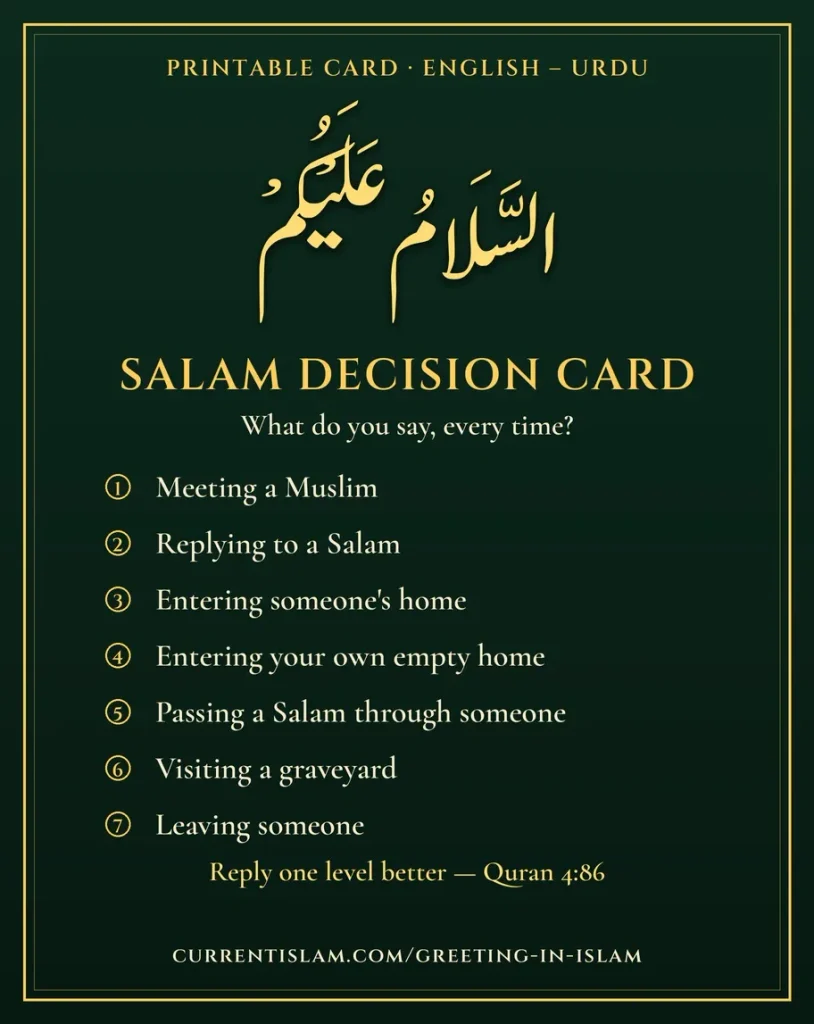
The Salam Decision Card gathers the whole guide onto one card: seven everyday situations, one correct opening for each, and the reply for each one too. Save it, print it, and keep it by the door until the replies become automatic.
The Salam Decision Card — save this
| Situation | What you say first |
|---|---|
| Meeting a Muslim, anywhere | As-Salamu Alaykum wa Rahmatullahi wa Barakatuh (level 3) |
| Replying to a Salam | Their level, plus one: see the reply table above |
| Entering someone’s home | Ask permission, then greet the household (Quran 24:27) |
| Entering your own empty home | As-Salamu Alaykum, greeting yourselves (Quran 24:61) |
| Passing a Salam through someone | Send the full Salam, and carry replies back in full |
| Visiting a graveyard | As-Salamu Alaykum, abode of a people who are believers (Muslim 974a) |
| Leaving someone | Salam, then Fi Amanillah for loved ones parting |
Start tonight, in three steps
- Use level 3 at the next three greetings: at home, at prayer, and on the phone.
- Reply one level better every time today, out loud and clearly.
- Teach one person the Ladder: a child, a parent, or a new Muslim friend.
When you part from someone you love, many add Fi Amanillah, I leave you in the care of Allah, after the farewell Salam.
When the parting is a journey, add the dua for travel before they leave, so the farewell carries a prayer as well as a greeting.
Questions people ask
Salam Alaikum means peace be upon you. It is a prayer that the person you meet stays safe from every harm, not a casual hello. This page keeps the meaning to one line. Our linked Assalamualaikum meaning guide gives the full word-by-word breakdown, Urdu meaning, and history of the phrase.
Reply Wa Alaykum As-Salam, and peace be upon you too. Then follow Quran 4:86: match the greeting you received, or answer one level better. If they added Allah’s mercy, you add His blessings. If they gave the full greeting, return the full greeting. Never answer a warm Salam with less.
The full Islamic greeting in Arabic is As-Salamu Alaykum wa Rahmatullahi wa Barakatuh: peace be upon you, and Allah’s mercy, and His blessings. It is the Ladder’s third level. The Prophet ﷺ counted ten good deeds for level one, twenty with mercy, thirty in full (Abu Dawud 5195).
Greet one woman with As-Salamu Alayki, using ki at the end. Greet one man with As-Salamu Alayka, and a group or a couple with As-Salamu Alaykum. The greeting itself, its reward, and the duty to reply stay the same. Only the ending changes to fit the person you are addressing.
Say the Salam even when the house is empty. Quran 24:61 teaches believers, when they enter houses, to greet themselves, meaning one another, with a greeting from Allah, blessed and good. Many families say As-Salamu Alaykum at their own door every single day, occupants or none.
Yes. A Salam sent by text, voice note, or chat is a real greeting, and the reply rule of Quran 4:86 still applies: answer in full, or one level better. Aisha replied in full to a Salam she received through the Prophet ﷺ (Bukhari 3217). Passed-on greetings earn passed-back replies.
At Eid, Muslims say Taqabbalallahu Minna wa Minkum: may Allah accept it from us and from you. It is a seasonal greeting exchanged alongside the Salam, not a replacement for it. The daily Salam stays the greeting for Eid morning and every other morning.
Both are used, and both wish someone a blessed Ramadan. Ramadan Mubarak is the more widely used of the two. Treat them as seasonal greetings that sit alongside the Salam. When you meet someone in Ramadan, open with As-Salamu Alaykum first, then add your Ramadan greeting with warmth.
Last reviewed: 8 November 2026 · Author: SHAHAB KHAN · Reviewed by: ATIF KHAN
