
You log into a morning meeting or step onto your college campus, and the ideological pressure is instant. A coworker invites you to a social event that fundamentally clashes with your Islamic values. A professor frames religious exclusivity as close-minded. The social anxiety builds rapidly. You want to remain respectful, but you feel the quiet exhaustion of constantly defending your Muslim identity in a secular society.
You need a definitive boundary.
Fourteen centuries ago, Allah revealed the exact framework to solve this modern psychological burden. It is not an apology. It is an unshakeable boundary wrapped in perfect linguistic grace: lakum deenukum waliya deen.
Here is why this single Quranic phrase is your strongest defense against religious imposter syndrome, and how building a daily spiritual habit around it will protect your faith.
What Does Lakum Deenukum Waliya Deen Mean?
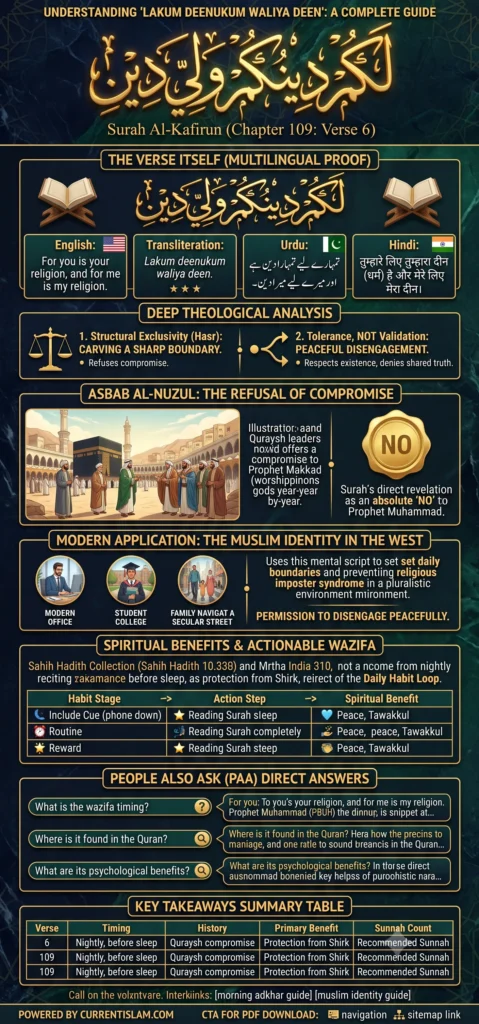
The best translation of lakum deenukum waliya deen is “For you is your religion, and for me is my religion.” Found in Surah Al-Kafirun (109:6), it establishes a definitive theological boundary, proving Muslims can practice peaceful civic coexistence without compromising the absolute purity of Islamic monotheism.
To understand the immense weight of this verse, we must look at the precise Arabic wording. In Quranic grammar, bringing the prepositional phrase “For you” (lakum) before the subject “religion” (deen) creates a rhetorical device called Hasr (structural exclusivity).
It does not simply mean “You have a religion and I have a religion.” It literally translates to: Your path belongs exclusively to you, and my path belongs exclusively to me.
Surah Al-Kafirun (Chapter 109: Verse 6)
- Arabic Text: لَكُمْ دِينُكُمْ وَلِيَ دِينِ
- Transliteration: Lakum deenukum waliya deen.
- English Translation: For you is your religion, and for me is my religion.
- Urdu Translation: تمہارے لیے تمہارا دین ہے اور میرے لیے میرا دین۔
- Hindi Translation: तुम्हारे लिए तुम्हारा दीन (धर्म) है और मेरे लिए मेरा दीन।
Why This Verse is Your Strongest Shield Against Anxiety
This verse eliminates social anxiety by removing the burden of ideological validation. It teaches believers that you do not need to agree with someone’s worldview to treat them with basic human dignity, creating a powerful psychological shield in pluralistic environments.
Many Muslims today struggle with the secular definition of “tolerance.” Modern society demands that tolerance means validating every lifestyle as equally true. This verse forcefully rejects that concept. It draws a sharp, uncompromising line that refuses the ideological gray area.
By internalizing this mindset, you experience a micro-transformation in your daily life. You stop over-explaining yourself. When pressured to compromise your daily prayers or dietary restrictions for the sake of “fitting in,” this verse gives you the exact mental script to respectfully disengage. You draw the line peacefully but firmly.
If you are struggling with the mental toll of these daily pressures, building a resilient mindset is critical. You can learn more about protecting your mental health in our complete Islamic guide to overcoming modern anxiety.
The Historical Context (Asbab al-Nuzul) and Classical Tafseer
This verse was revealed when the ruling Quraysh offered Prophet Muhammad (PBUH) a power-sharing compromise to worship their idols for a year. Allah revealed this Surah to permanently reject theological syncretism, making it the ultimate declaration of Tawhid.
According to classical scholars like Ibn Kathir, the Quraysh leaders approached the Prophet (PBUH) during a period of intense persecution in Makkah. They offered wealth, status, and a highly lucrative compromise: they would worship Allah for one year, if the Prophet worshipped their idols for one year.
This was a critical political test. Would the Prophet (PBUH) compromise the message of Tawhid (Oneness of God) for societal relief?
The revelation of Surah Al-Kafirun ended the negotiation instantly. Ibn Kathir explains that this chapter is an absolute disavowal of Shirk (polytheism). It pairs perfectly with another foundational Quranic principle found in Surah Al-Baqarah (2:256):
- Arabic Text: لَا إِكْرَاهَ فِي الدِّينِ
- Transliteration: La ikraha fid-deen.
- English Translation: “There is no compulsion in religion.”
Together, these verses build a perfect civic reality. We do not force our faith on you, but we will never dilute our faith to appease you.
The Nightly Sunnah: A Daily Spiritual Reset
Reciting Surah Al-Kafirun before sleeping is a highly recommended Sunnah of Prophet Muhammad (PBUH). It acts as a daily spiritual reset, serving as an explicit clearance from polytheism (Shirk) and realigning the believer’s heart with absolute reliance on Allah.
Faith wears down as we move through the world. The media we watch, the conversations we have, and the digital environments we consume constantly push us toward relying on things other than Allah. Implementing the recitation of Surah Al-Kafirun as a nightly wazifa (daily spiritual practice) cleanses the heart before sleep.
Sahih Hadith on Surah Al-Kafirun
- Arabic Text: اقْرَأْ (قُلْ يَا أَيُّهَا الْكَافِرُونَ) عِنْدَ مَنَامِكَ، فَإِنَّهَا بَرَاءَةٌ مِنَ الشِّرْكِ
- Transliteration: Iqra’ (Qul ya ayyuha al-kafirun) ‘inda manamika, fa innaha bara’atun min ash-shirk.
- English Translation: “Recite ‘Say: O disbelievers!’ when you go to sleep, for it is a clearance from polytheism.” (Sunan Abi Dawud 5055, graded Hasan)
- Urdu Translation: سوتے وقت ’قل یا ایھا الکافرون‘ پڑھا کرو کیونکہ یہ شرک سے براءت ہے۔
- Hindi Translation: सोते समय ‘कुल या अय्युहल काफ़िरून’ पढ़ा करो, क्योंकि यह शिर्क से मुक्ति है।
Pairing this practice with your regular morning and evening azkar creates an impenetrable spiritual fortress around your daily routine.
The Spiritual Habit Loop Breakdown
Building a lasting Islamic identity requires turning theological concepts into actionable habits. Here is how you can use the psychology of habit formation to integrate this Sunnah into your daily life.
People Also Ask:
The primary benefit of reciting Surah Al-Kafirun is protection from Shirk (polytheism). The Prophet Muhammad (PBUH) stated that reciting it before sleep acts as a clearance from associating partners with Allah. It also provides immense psychological strength, reinforcing a Muslim’s theological boundaries and personal faith.
The phrase “To you your religion and to me mine” is found in Surah Al-Kafirun, which is Chapter 109, Verse 6 of the Holy Quran. The exact Arabic transliteration is lakum deenukum waliya deen, serving as a definitive statement of religious exclusivity and peaceful civic disengagement.
Yes, reciting and internalizing this verse provides a mental framework to stop seeking validation from non-Muslim peers. It acts as a spiritual boundary. For targeted supplications regarding mental distress, we highly recommend learning the specific dua for anxiety and depression.
Next Steps for Your Daily Routine
Knowledge only becomes power when it is actively applied. Lakum deenukum waliya deen is far more than a historical quote; it is a vital tool for spiritual survival. It grants you the divine permission to be confidently, unapologetically Muslim, even when you are the only one in the room.
Do not let these habits slip through the cracks of a busy schedule. Make the conscious decision tonight to implement this short recitation before you sleep. Build your boundaries, trust in Allah, and watch your religious anxiety disappear.
