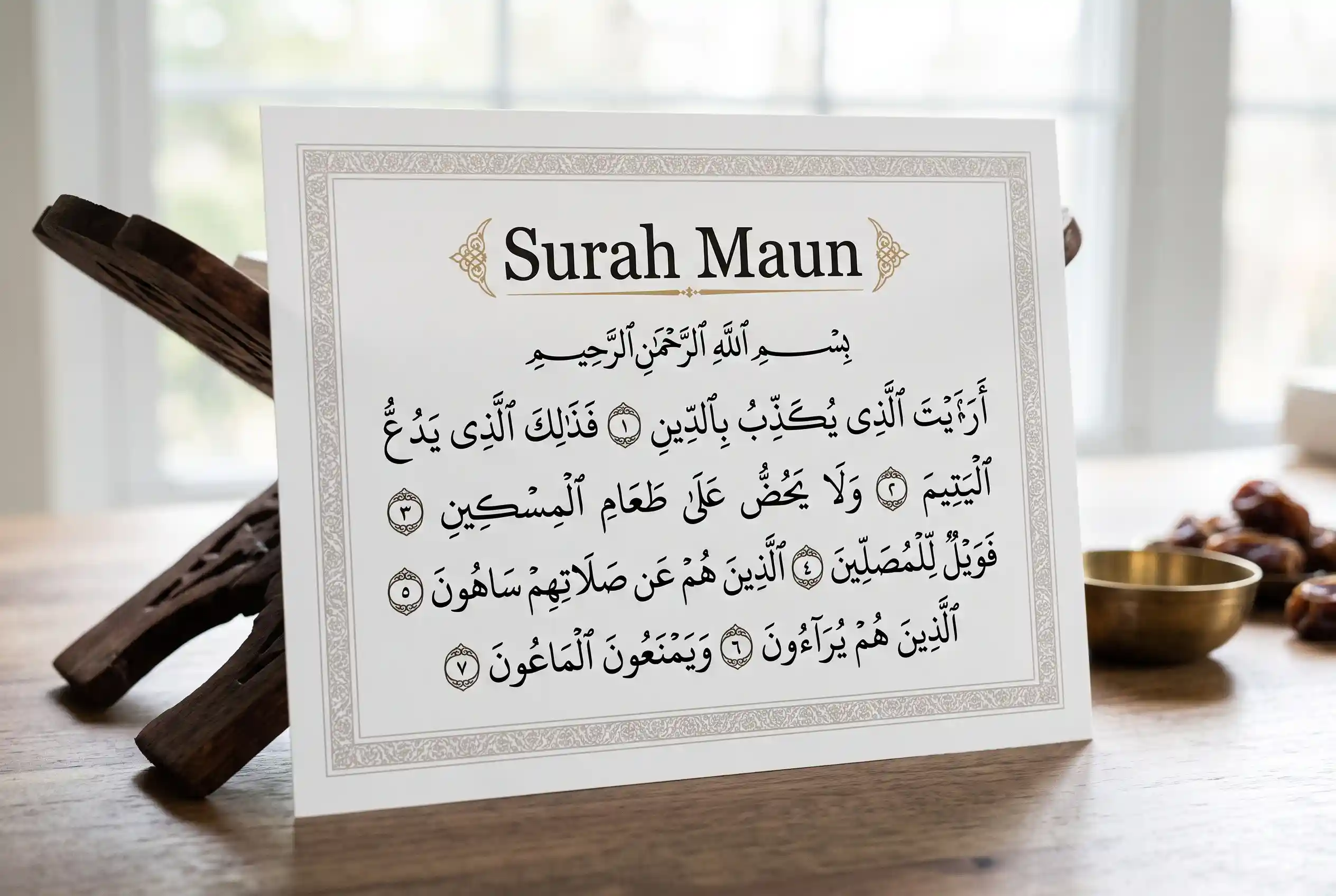
Surah Al-Ma’un (Arabic: سُورَةُ الْمَاعُونِ, meaning “The Small Kindnesses” or “Everyday Assistance”) is the 107th chapter of the Quran among the 114 Surahs in the Quran. Situated in the 30th Juz (Para Amma), this short chapter containing 7 ayats (verses) bridges the gap between ritual worship and social ethics. It establishes that true belief in the Day of Judgment is proven by how we treat orphans, the hungry, and our everyday neighbors.
Quick Answer: Surah Al-Ma’un at a Glance
- Core Facts: Chapter 107 of the Quran | 7 Verses (Ayats) | Located in Juz (Para) 30 | Early Meccan revelation (with Verses 4–7 viewed by several scholars as Medinan).
- Central Message: Outward prayer (Salah) is hollow if it does not soften the heart to care for orphans, feed the poor, and offer simple, everyday favors (Al-Ma’un) to people around you.
- Key Takeaway for Believers: Verse 5 condemns those who are careless of their prayer altogether (‘an salatihim), not sincere believers whose minds accidentally wander in prayer (fi salatihim).
Table of Contents
- Why Does Reciting Surah Maun Feel Like Autopilot?
- How Do You Read Surah Maun in Arabic, Transliteration, and Translation?
- What Does Every Word of Surah Maun Mean?
- Is Surah Maun a Meccan or Medinan Surah, and Which Para Is It In?
- Why Does Surah Maun Say “Woe to Those Who Pray”?
- What Are the Authentic Benefits of Surah Maun (And What About 7, 41, or 100 Times Wazifas)?
- How Can You Practice “The 2-Minute Ma’un Loop” in the US and UK Today?
- What Are Common Mistakes Muslims Make With Surah Maun?
- Frequently Asked Questions (FAQ)
You stand on your prayer mat after a long day at work or university. Tired and rushing to finish the units of Isha Namaz, your tongue automatically reaches for one of the shortest chapters you memorized as a child: Ara’aytalladhi yukadhdhibu bid-din. Within twenty seconds, you bow into Ruku’ (the bowing position), barely registering a single word you just spoke.
Worse, the one time you actually read the English translation, Verse 4 stops you cold: “So woe to those who pray.” If you struggle to pray on time between office meetings or your mind drifts toward tomorrow’s deadlines, a quiet guilt creeps in. You wonder if your distracted prayers are rejected—or worse, cursed.
Surah Al-Ma’un was not revealed to crush sincere, struggling believers with guilt. Instead, the Prophet Muhammad ﷺ taught us a faith where private worship fuels public mercy. When you understand the linguistic precision of these seven verses, the chapter transforms from a rushed childhood recitation into a gentle daily habit loop that heals both your prayer and your relationships.
[SCHOLAR ANECDOTE: Over the years, many young professionals and university students in cities like London and Chicago have reached out to scholars with the exact same fear. After reading the English translation of Verse 4 for the first time, they worry it is safer to stop praying altogether than to pray with a tired, distracted mind. Yet when we look at the original Arabic wording together, that heavy guilt turns into immediate relief.]
To read Surah Maun accurately, begin by seeking refuge and reciting Auzubillah and Bismillah, then recite its seven verses starting with Ara’aytalladhi yukadhdhibu bid-din and ending with Wa yamna’unal-ma’un. Below is the complete Uthmani Arabic script with full vowel markings (tashkeel), followed by a verse-by-verse phonetic transliteration and verified English, Urdu, and Hindi translations.
Full Arabic Text of Surah Al-Ma’un (Quran 107:1–7)
بِسْمِ اللَّهِ الرَّحْمَٰنِ الرَّحِيمِ
أَرَأَيْتَ الَّذِي يُكَذِّبُ بِالدِّينِ ﴿١﴾ فَذَٰلِكَ الَّذِي يَدُعُّ الْيَتِيمَ ﴿٢﴾ وَلَا يَحُضُّ عَلَىٰ طَعَامِ الْمِسْكِينِ ﴿٣﴾ فَوَيْلٌ لِّلْمُصَلِّينَ ﴿٤﴾ الَّذِينَ هُمْ عَن صَلَاتِهِمْ سَاهُونَ ﴿٥﴾ الَّذِينَ هُمْ يُرَاءُونَ ﴿٦﴾ وَيَمْنَعُونَ الْمَاعُونَ ﴿٧﴾
Complete Verse-by-Verse Breakdown (Arabic, Transliteration, English, Urdu & Hindi)
Ayah 1 (Quran 107:1)
- Transliteration: Ara’aytalladhi yukadhdhibu bid-din (often searched phonetically as araital lazi yukazzibu biddin)
- English (Saheeh International): Have you seen the one who denies the Recompense?
- Urdu (Fateh Muhammad Jalandhry): بھلا تم نے اس شخص کو دیکھا جو روزِ جزا کو جھٹلاتا ہے؟
- Hindi (Suhel Farooq Khan & Saifur Rahman Nadwi) : क्या तुमने उस व्यक्ति को देखा जो बदला दिए जाने (आख़िरत) को झुठलाता है?
Ayah 2 (Quran 107:2)
- Transliteration: Fadhalikalladhi yadu”ul-yatim
- English (Saheeh International): For that is the one who drives away the orphan
- Urdu: تو وہی تو ہے جو یتیم کو دھکے دیتا ہے
- Hindi: तो यही वह व्यक्ति है जो अनाथ को धक्के देता है,
Ayah 3 (Quran 107:3)
- Transliteration: Wa la yahuddu ‘ala ta’amil-miskin
- English (Saheeh International): And does not encourage the feeding of the poor.
- Urdu: اور مسکین کو کھانا کھلانے کی ترغیب نہیں دیتا
- Hindi: और मोहताज (ग़रीब) को खाना खिलाने के लिए प्रेरित नहीं करता।
Ayah 4 (Quran 107:4)
- Transliteration: Fa-waylun lil-musallin
- English (Saheeh International): So woe to those who pray
- Urdu: تو ایسے نمازیوں کی خرابی ہے
- Hindi: तो तबाही है उन नमाज़ पढ़ने वालों के लिए,
Ayah 5 (Quran 107:5)
- Transliteration: Alladhina hum ‘an salatihim sahun
- English (Saheeh International): [But] who are heedless of their prayer –
- Urdu: جو اپنی نماز سے غافل رہتے ہیں
- Hindi: जो अपनी नमाज़ से ग़ाफ़िल (लापरवाह) रहते हैं,
Ayah 6 (Quran 107:6)
- Transliteration: Alladhina hum yura’un
- English (Saheeh International): Those who make a show [of their deeds]
- Urdu: جو ریا کاری کرتے ہیں
- Hindi: जो दिखावा करते हैं,
Ayah 7 (Quran 107:7)
- Transliteration: Wa yamna’unal-ma’un
- English (Saheeh International): And withhold [simple] assistance.
- Urdu: اور برتنے کی چیزیں عاریتہً نہیں دیتے
- Hindi: और मामूली ज़रूरत की चीज़ें (पड़ोसियों को) देने से रोकते हैं।
(You can also listen to the verified audio recitation and compare scripts on Quran.com Chapter 107.)
Understanding the exact Arabic roots of Surah Maun transforms how you experience it in prayer. Instead of abstract concepts, the chapter uses vivid physical verbs—like shoving an orphan or withholding a cooking pot—to expose a heart that has forgotten the Reckoning described in Surah Al-Qariah.
Surah Maun is located in the 30th Para (Juz Amma) of the Quran, placed right after Surah Quraish (Li’ilafi Quraish). While most scholars classify it as a Meccan (Makki) surah, classical commentators like Ibn Abbas and Qatadah note that Verses 1–3 were revealed in Mecca, whereas Verses 4–7 address the hypocrites (Munafiqun) in Medina.
Historical Context (Asbab al-Nuzul) and Classical Tafsir
In Tafsir Ibn Kathir, the opening verses (107:1–3) address wealthy Meccan elites—historically identified by early commentators such as Ibn Jurayj and Muqatil as figures like Abu Jahl, Al-As ibn Wa’il, or Abu Sufyan prior to his acceptance of Islam. Much like the arrogant hoarders condemned in Surah Al-Humazah, these leaders prided themselves on tribal status in Mecca, yet harshly turned away fatherless children who asked for their rightful inheritance or a scrap of food.
Notice the phrasing in Verse 3: Allah says “ta’amil-miskin” (literally, “the food of the poor”), rather than “giving your food to the poor.” Classical scholars point out that the sustenance needed by the hungry is already their moral right, placed by Allah in the hands of the wealthy as a trust.
The second half of the chapter (107:4–7) shifts focus to religious hypocrisy. Whether applied to Meccan polytheists who clapped and whistled around the Kaaba or Medinan hypocrites who prayed only to gain social standing among Muslims, the diagnosis is identical. A person who mistreats the helpless (Verses 1–3) and a person who prays only for public applause while refusing small favors (Verses 4–7) share the same spiritual sickness: neither truly expects to stand before Allah in judgment.
Surah Maun says “Woe to those who pray” in Verse 4 to warn hypocrites who treat prayer as an empty public show while neglecting its timing, spirit, and moral duties. Because Verse 5 uses the Arabic preposition ‘an (away from) rather than fi (in), it does not condemn sincere believers whose minds accidentally wander during prayer.
The Preposition That Brought Relief to the Companions
In Tafsir Ibn Kathir and Tafsir al-Qurtubi, scholars record a profound linguistic insight reported by At-Tabari and Al-Bayhaqi (in Shu’ab al-Iman) from Masruq and Ata ibn Yasar: “Praise be to Allah who said ‘an salatihim (heedless away from their prayer) and did not say fi salatihim (forgetful inside their prayer).” [VERIFY: exact Bayhaqi reference number for editorial footnote].
Even the Prophet Muhammad ﷺ occasionally experienced human forgetfulness regarding the number of units in prayer to establish the legal ruling of Sujud as-Sahw (the prostration of forgetfulness), as recorded in Sahih al-Bukhari (1226) and Sahih Muslim (572). If you struggle to stay consistent or focused in your daily worship, the prophetic remedy is reciting Prophet Ibrahim’s dua for steadfastness in Salah (Rabbi-j’alni muqimas-salati) rather than giving up in despair.
As recorded in Sahih Muslim (622), the Prophet ﷺ described the prayer of the hypocrite: he sits watching the sun until it is just about to set between the horns of Satan, then stands up and pecks out four units hurriedly, remembering Allah in them only a little.
The authentic benefits of Surah Maun come from understanding, reciting, and acting upon its seven verses: it purifies the heart from Riya’ (showing off), motivates care for orphans, and revives neighborly generosity. Conversely, viral claims promising specific material rewards for reciting Surah Maun 7, 41, or 100 times as a wazifa (prescribed litany) have no basis in authentic Hadith.
Authentic Virtues vs. Cultural Wazifa Claims
- The Reward of Every Quranic Letter: In Jami` at-Tirmidhi (2910, graded Hasan Sahih), the Prophet ﷺ taught that whoever recites a single letter from the Book of Allah receives a good deed multiplied by ten. Reciting Surah Maun among your regular short ayats and surahs of the Quran earns immense reward.
- Closeness to the Prophet ﷺ Through Orphan Care: Surah Maun opens by defending the orphan. In Sahih al-Bukhari 5304 on Sunnah.com, the Prophet ﷺ held up his index and middle fingers and said: “I and the one who looks after an orphan will be like this in Paradise.”
- Protection From Spiritual Hypocrisy (Riya’): Regular reflection on Verses 4–7 acts as a spiritual mirror, reminding you of the foundational Hadith Innamal A’malu Bin-Niyyat (Actions are judged by intentions) so you catch subtle pride before it corrupts your worship.
- Addressing the 7x, 41x, and 100x Wazifa Trend: Many websites claim that reading Surah Maun 41 or 100 times cures poverty or resolves financial hardship. No authentic (Sahih) or sound (Hasan) Hadith establishes a fixed repetition count for Surah Al-Ma’un. If you are facing financial distress or seeking provision, rely on verified prophetic supplications like the authentic Dua for Rizq and debt relief while practicing Surah Maun’s actual command: feeding the hungry and helping your neighbor.
Important Health & Well-Being Note: Spiritual practices, Quranic recitation, and Dua bring deep emotional peace and complement professional medical, psychological, or financial care—they never replace qualified clinical treatment or practical action.
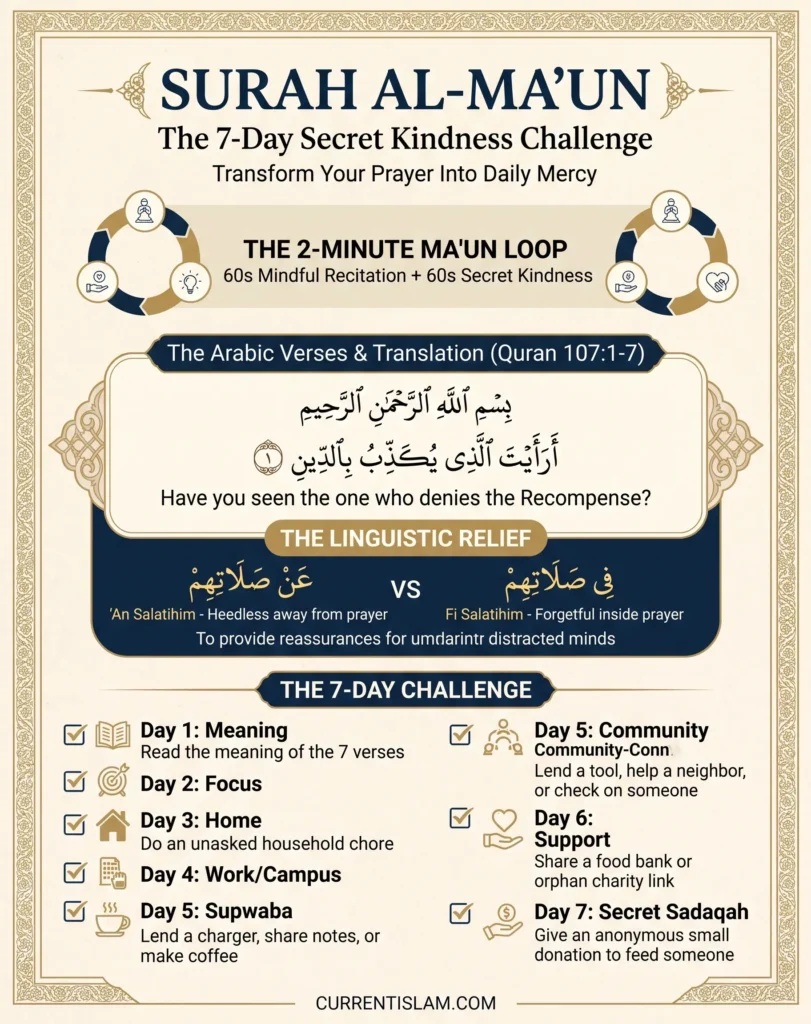
You can practice Surah Maun today by using The 2-Minute Ma’un Loop: pair every recitation of Surah Maun in your daily prayer with one immediate, zero-cost act of assistance (Al-Ma’un) at home, work, or school. This simple habit links your prayer mat directly to your daily character in under two minutes.
What Was Al-Ma’un Then vs. Now?
In Tafsir Ibn Kathir, Ibn Mas’ud, Ibn Abbas, and Ali ibn Abi Talib (may Allah be pleased with them) explained that Al-Ma’un refers to both obligatory Zakat and the small household items neighbors borrow from one another—like a cooking pot, a bucket, an axe, salt, or water. Notice why withholding a borrowed pot is so shameful: the item comes right back to you. Refusing a favor that costs you nothing violates the spirit of Hal Jaza’ul Ihsan Illal Ihsan (Is the reward for goodness anything but goodness?).
In a modern Western setting—whether you are commuting in London, studying in Chicago, or working in an office in New York—here is how 7th-century Al-Ma’un translates into everyday life:
The “Start Tonight” Practice Plan
- When: Tonight during Maghrib (sunset) or Isha (night) prayer.
- How Often: Once daily for the next 7 days.
- How Long: 2 minutes total (60 seconds in prayer, 60 seconds in action).
- The Recitation (60 Seconds): In the first or second unit (Rak’ah) of your prayer, recite Surah Al-Ma’un slowly after Surah Al-Fatiha. When you reach Alladhina hum ‘an salatihim sahun, consciously bring your focus back to Allah.
- The Secret Kindness (60 Seconds): Immediately after completing your authentic adhkar and dua after Salah, perform one hidden Ma’un act that nobody praises you for—wash the dishes left in the sink by a tired spouse or roommate, send a $5/£5 anonymous micro-donation to an orphan fund, or text a struggling classmate the notes they missed.
The most common mistakes with Surah Maun include mispronouncing heavy Arabic letters, giving up on prayer out of fear of Verse 4, and reducing Al-Ma’un to grand charity while ignoring basic manners at home. Avoiding these errors unlocks both accurate recitation and authentic spiritual growth.
- Pronunciation Trap in Verse 2 (Yadu”u): Many readers drop the Shaddah (doubled consonant emphasis) on the letter ‘Ayn in yadu”ul-yatim, pronouncing it lightly as yadu-ul-yatim. Ensure you hold the deep throat letter ‘Ayn firmly before moving to al-yatim.
- Confusing Ha (ح) and Haa (ه) in Verse 3 (Yahuddu): Pronounce yahuddu with a sharp, breathy Ha from the middle of the throat, followed by a heavy Dad (ض).
- Stopping at Verse 4 (Fa-waylun lil-musallin): In recitation etiquette (Waqf wa Ibtida’), avoid stopping at the end of Verse 4 and walking away, as the meaning (“So woe to those who pray”) is incomplete without Verse 5 (“Who are heedless of their prayer”).
- Public Charity vs. Private Rudeness: Donating to a mosque fundraiser in public (where people see your name) while snapping at your family or refusing to help a coworker with a 30-second task directly contradicts Verses 6 and 7.
1. What is the main message of Surah Maun?
Surah Maun teaches that authentic faith in the Day of Judgment cannot be separated from how you treat vulnerable people. It warns that outward religious rituals like prayer become spiritually hollow when accompanied by cruelty toward orphans, apathy toward the hungry, showing off (Riya’), and withholding small everyday favors.
2. Which Para (Juz) is Surah Maun in?
Surah Maun is located in the 30th Para (also known as Juz Amma), the final section of the Quran. It is the 107th chapter in the traditional Quranic order, placed immediately after Surah Quraish (Chapter 106) and right before Surah Al-Kausar (Chapter 108).
3. Why does Surah Maun say woe to those who pray?
Verse 4 says “Woe to those who pray” to condemn religious hypocrites who treat prayer as a public performance rather than an act of devotion to Allah. Verse 5 immediately clarifies that this warning applies to those who are neglectful of their prayers—delaying them habitually and ignoring their moral lessons.
4. Does getting distracted in prayer mean I am cursed by Surah Maun?
No, unintentional mental wandering during prayer does not place you under the warning of Surah Maun. Classical scholars like Ibn Kathir explain that the Arabic phrase ‘an salatihim targets those who are unmindful of prayer altogether, whereas sincere believers who get distracted in prayer (fi salatihim) are pardoned when they strive to refocus.
5. What does the word Al-Ma’un mean in the Quran?
In classical Arabic and Tafsir, Al-Ma’un refers to small, everyday kindnesses and household items that neighbors lend to one another—such as cooking pots, buckets, tools, water, or salt. Several early scholars also noted it encompasses obligatory charity (Zakat) and any basic assistance that costs little to share.
6. Is there an authentic hadith for reading Surah Maun 7, 41, or 100 times?
No, there is no authentic (Sahih) or sound (Hasan) Hadith from the Prophet Muhammad ﷺ prescribing the recitation of Surah Maun 7, 41, or 100 times for specific worldly wishes. While reciting any chapter of the Quran brings ten rewards per letter, the true prophetic way to honor Surah Maun is acting on its call to kindness.
7. Who was Surah Maun revealed about?
According to classical Tafsir authorities including Ibn Kathir, the opening verses were revealed in Mecca regarding arrogant Quraysh leaders—such as Abu Jahl or Al-As ibn Wa’il—who harshly repelled orphans. The closing verses also apply to the hypocrites (Munafiqun) who prayed only to be seen by others while withholding neighborly help.
Next Steps in Your Journey
- Continue Through Juz Amma: Read the next chapter in sequence with our guide to Surah Al-Kausar meaning and translation, or review the preceding chapter, Surah Al-Feel (Alam Tara Kaifa).
- Strengthen Your Daily Prayer: Memorize Subhanakallahumma (Sana in Namaz) and learn the Prophetic dua for steadfastness in Salah.
- Purify Your Intentions: Protect your good deeds from ostentation (Riya’) by reflecting on the Hadith on intentions (Innamal A’malu Bin-Niyyat).
Last reviewed: October 2026 | Reviewed for Arabic and theological accuracy by [ATIF KHAN, Credentials.]
