We check our screens hundreds of times a day, terrified of missing a notification, a message, or a breaking news alert. But what happens when the ultimate notification strikes? A sound so deafening and sudden that it shatters the mountains and scatters humanity like mindless moths. This is the reality of Al-Qari’ah.
Let’s look at the heart of Surah Qariah, a Makki revelation that serves as a profound spiritual reset, demanding we ask ourselves one critical question: Are my daily actions actually heavy, or just empty volume?
What is Surah Al-Qari’ah? (The Striking Calamity)
Surah Al-Qari’ah is the 101st chapter of the Quran. Revealed in Makkah, it vividly describes the terrifying suddenness of the Day of Judgment, reminding humanity that our ultimate destination depends entirely on the spiritual weight and sincerity of our deeds.
The Linguistic Shock (Verses 1-3)
Arabic:
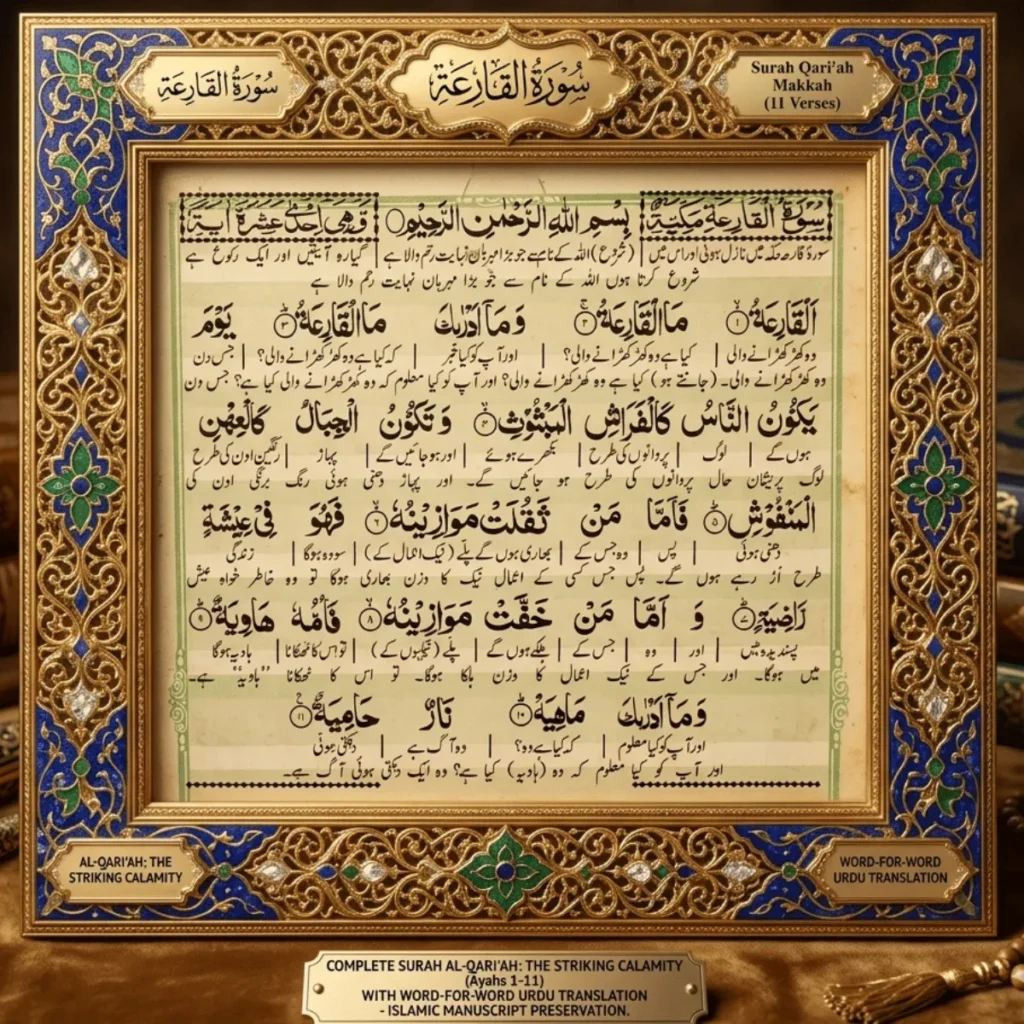
ٱلْقَارِعَةُ ١ مَا ٱلْقَارِعَةُ ٢ وَمَآ أَدْرَىٰكَ مَا ٱلْقَارِعَةُ ٣
Transliteration: Al-qari’ah. Mal-qari’ah. Wa maa adraaka mal-qari’ah.
English: The Striking Calamity. What is the Striking Calamity? And what can make you know what is the Striking Calamity?
Urdu:
وہ کھڑکھڑانے والی۔ کیا ہے وہ کھڑکھڑانے والی؟ اور آپ کو کیا خبر کہ کیا ہے وہ کھڑکھڑانے والی؟
Here is why this matters for you right now. The root word Qara’a (قَرَعَ) doesn’t just mean a loud noise. It means to strike something with immense, violent force—like a hammer hitting an anvil or a sudden alarm bell that makes your heart skip a beat.
Classical mufassirun, including Ibn Kathir, note that Allah uses repetition here not for poetic effect, but to create a profound “pattern interrupt.” The rhetorical question, “What can make you know?” emphasizes that human intellect simply cannot comprehend the sheer terror and magnitude of this impending Day.
The Day the World Breaks: Moths and Wool
On the Day of Judgment, the Quran states that human beings will scatter in mass panic like swarming moths, and the earth’s massive, immovable mountains will be crushed and blown away like fluffed, dyed wool.
The Upheaval of the Natural Order (Verses 4-5)
Arabic:
يَوْمَ يَكُونُ ٱلنَّاسُ كَٱلْفَرَاشِ ٱلْمَبْثُوثِ ٤ وَتَكُونُ ٱلْجِبَالُ كَٱلْعِهْنِ ٱلْمَنفُوشِ ٥
Transliteration: Yawma yakoonun-naasu kal-farashil-mabthooth. Wa takoonul-jibalu kal-‘ihnil-manfoosh.
English: It is the Day when people will be like moths, dispersed. And the mountains will be like wool, fluffed up.
Urdu:
جس دن لوگ ہوں گے پریشان حال پروانوں کی طرح بکھرے ہوئے۔ اور پہاڑ دھنی ہوئی رنگ برنگی اون کی طرح اڑ رہے ہوں گے۔
We spend our lives building skyscrapers, bank accounts, and digital empires, assuming the world beneath our feet is stable. Surah Qariah shatters this illusion.
Notice the brilliant, contrasting imagery. Humans, who pride themselves on intellect and power, will be reduced to Al-Farash (moths)—creatures that blindly and chaotically throw themselves into the fire. Meanwhile, the mountains, the ultimate symbols of earthly permanence, will become Al-‘Ihn—weightless, dyed wool drifting in the wind. If the mountains cannot survive the strike of the Qari’ah, how will our fragile egos survive?
The Spiritual Habit Loop: Weight vs. Volume
Allah does not judge the sheer number of your actions, but rather their spiritual weight. A heavy scale requires immense sincerity and consistency, while a light scale results from empty, distracted habits devoid of true faith.
The Scales of Absolute Justice (Verses 6-9)
Arabic:
فَأَمَّا مَن ثَقُلَتْ مَوَٰزِينُهُۥ ٦ فَهُوَ فِى عِيشَةٍۢ رَّاضِيَةٍۢ ٧ وَأَمَّا مَنْ خَفَّتْ مَوَٰزِينُهُۥ ٨ فَأُمُّهُۥ هَاوِيَةٌۭ ٩
Transliteration: Fa-ammaa man thaqulat mawaazeenh. Fahuwa fee ‘ishatir-raadiyah. Wa ammaa man khaffat mawaazeenuh. Fa-ummuhu haawiyah.
English: Then as for one whose scales are heavy, He will be in a pleasant life. But as for one whose scales are light, His refuge will be an abyss.
Urdu:
پس جس کے اعمال نیک کا وزن بھاری ہوگا۔ تو وہ خاطر خواہ عیش پسندیدہ میں ہوگا۔ اور جس کے نیک اعمال کا وزن ہلکا ہوگا۔ تو اس کا ٹھکانا ہاویہ ہے۔
This is the core paradigm shift of the Surah. It’s not about how many actions you checked off a list today; it’s about how heavily they sit on the Mawazin (Scales). A single, deeply sincere action done strictly for the sake of Allah can outweigh a mountain of mindless, distracted rituals.
To ensure our daily actions actually hold weight, we must constantly purify our intentions. If you feel your daily routines are becoming empty, taking a moment to seek profound forgiveness to cleanse your scales is the perfect spiritual reset.
Conversely, when you do perform a good deed, its weight is only secured if Allah accepts it. This is why scholars recommend making it a habit to recite the prophetic supplication for accepted deeds after every major act of worship.
The Abyss: Understanding Hawiyah
Hawiyah is a bottomless pit in Hellfire reserved for those whose bad deeds outweigh their good. The Quran chillingly refers to it as a “mother” because the sinner will fall headfirst into its fiery embrace just as a child returns to its mother.
The Final Reality (Verses 10-11)
Arabic:
وَمَآ أَدْرَىٰكَ مَا هِيَهْ ١٠ نَارٌ حَامِيَةٌۢ ١١
Transliteration: Wa maa adraaka ma hiyah. Naarun hamiyah.
English: And what can make you know what that is? It is a Fire, fiercely burning.
Urdu:
اور آپ کو کیا معلوم کہ وہ ہاویہ کیا ہے؟ وہ ایک دہکتی ہوئی آگ ہے۔
The use of the word Umm (Mother) in verse 9 is one of the most terrifying linguistic devices in the Quran. A mother is normally a place of refuge and comfort when a child falls. But for the one whose scales are light, their only “embrace” in the Hereafter will be the crushing depths of the Hellfire.
How hot is this fire? Imam An-Nawawi and Ibn Kathir frequently reference the famous Hadith in Sahih Bukhari where the Prophet Muhammad (ﷺ) stated: “Your (ordinary) fire is one of 70 parts of the (Hell) Fire.” The Surah ends abruptly. There is no long conclusion, just the stark reality of the Narun Hamiyah (fiercely burning fire). It leaves the reader in a state of awe, exactly as the sudden strike of the Qari’ah will leave humanity.
People Also Ask:
Al-Qari’ah translates to “The Striking Calamity.” It refers to the Day of Judgment, specifically highlighting the sudden, deafening sound that will strike fear into the hearts of humanity and signal the end of the world.
Reciting Surah Qariah acts as a powerful spiritual reminder. It cures the heart of complacency (Ghaflah), builds Taqwa (God-consciousness), and reminds believers to focus on the sincerity and weight of their deeds rather than worldly distractions.
In verse 9, Hell (Hawiyah) is called a “mother” as a terrifying metaphor. Just as a child falls into the open arms of its mother for refuge, the sinner whose good deeds are too light will have no refuge except falling headfirst into the embrace of the Hellfire.
