You just finished praying, fasting, or giving a large portion of your wealth to charity. You feel a sense of accomplishment. But right at that moment, a heavy question hits your heart: How do you actually know Allah accepted it?
This was the exact anxiety felt by two of the greatest Prophets in history while building the holiest site on earth. Let’s look at the heart of the issue and discover the ultimate Quranic formula for securing divine acceptance.
What is the Meaning of Rabbana Taqabbal Minna?
Rabbana taqabbal minna means “Our Lord, accept this from us.” It is a powerful Quranic supplication made by Prophet Ibrahim and Ismail while building the Kaaba. Muslims recite this dua to ask Allah to accept their good deeds and worship.
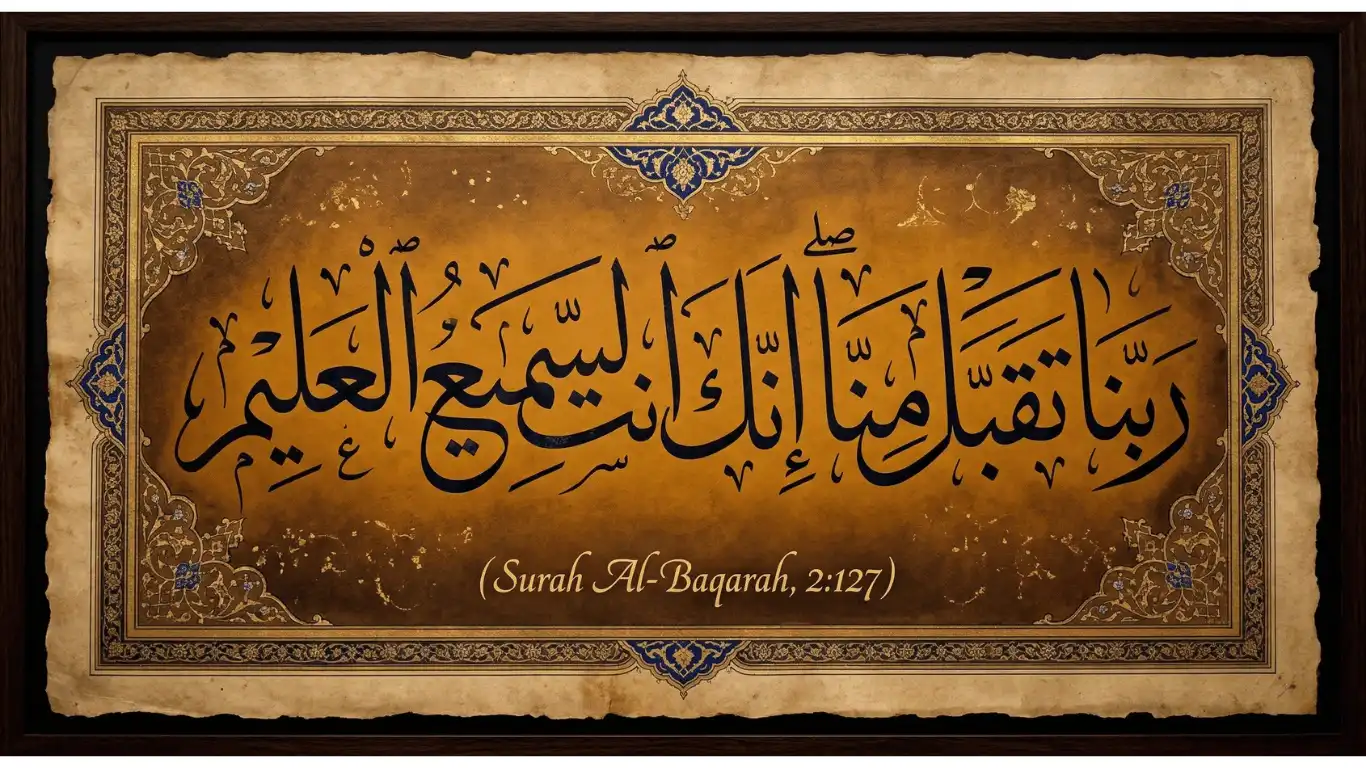
This profound moment is captured in Surah Al-Baqarah (2:127). Here is the foundational proof from the Quran:
The Multilingual Quadrant:
- Arabic: رَبَّنَا تَقَبَّلْ مِنَّا ۖ إِنَّكَ أَنتَ السَّمِيعُ الْعَلِيمُ
- Transliteration: Rabbana taqabbal minna innaka antas-samee’ul-‘aleem.
- English (Saheeh International): “Our Lord, accept [this] from us. Indeed You are the Hearing, the Knowing.”
- Urdu (Fateh Muhammad Jalandhari): “اے پروردگار ہم سے (یہ خدمت) قبول فرما۔ بےشک تو سننے والا اور جاننے والا ہے۔”
Word-by-Word Translation and Tafseer
Understanding the exact word-by-word meaning of this dua helps build absolute focus during your prayers. “Rabbana” calls upon our Creator, “Taqabbal” asks for gracious acceptance, and invoking Allah as the All-Hearing and All-Knowing purifies our hidden intentions.
Here is the breakdown of the vocabulary:
- Rabbana (رَبَّنَا): Our Lord, the Sustainer and Nurturer.
- Taqabbal (تَقَبَّلْ): Accept gracefully. This is not just taking something; it implies being pleased with the offering.
- Minna (مِنَّا): From us.
- Innaka (إِنَّكَ): Indeed, You.
- Anta (أَنتَ): Are You.
- As-Samee’ (السَّمِيعُ): The All-Hearing.
- Al-‘Aleem (الْعَلِيمُ): The All-Knowing.
The Scholarship Depth: Ibn Kathir’s Commentary
When we turn to classical scholarship, the context of this dua is deeply moving. Imam Ibn Kathir highlights a profound point in his Tafsir: Prophet Ibrahim (AS) and Prophet Ismail (AS) were executing a direct command from Allah to build the Kaaba. Yet, as they laid the heavy stones, they were weeping and trembling with the fear that their monumental effort might not be accepted.
They did not rely on the greatness of their deed; they relied on the mercy of Allah to accept it. This teaches us that true sincerity requires a balance of hope and humility.
The “Spiritual Habit Loop”: A Modern Strategy
The Spiritual Habit Loop involves pairing every good deed with an immediate prayer for divine acceptance. Instead of just finishing a religious task and moving on to your phone, tying this specific dua to the end of your actions locks in your sincerity.
Here’s why this matters for you in our modern, hyper-distracted world. Often, our good deeds become mechanical. We rush through our prayers to check notifications. By implementing the Spiritual Habit Loop, you create a cognitive anchor.
- The Trigger: Finishing a good deed (praying, reading Quran, helping a neighbor).
- The Action: Pausing immediately before moving or speaking.
- The Reward: Reciting Rabbana taqabbal minna, securing the feeling that your effort was handed directly to Allah.
Before you can worry about acceptance, you must first ensure your foundational acts of worship are solid. If you struggle with maintaining your daily prayers, you must first integrate the dua for establishing regular Salah into your routine, and then seal that prayer with the plea for acceptance.
Benefits and Wazifa of Rabbana Taqabbal Minna
Reciting this dua daily protects your heart from showing off and ensures your hard work is actually recorded. The best wazifa is to recite it three times after every obligatory prayer and immediately after completing any charitable act.
Beyond the immediate spiritual peace, consistent recitation offers distinct benefits:
- Protection from Riya (Showing Off): Reminding yourself that Allah is Al-‘Aleem (The All-Knowing) purifies your intention, keeping your deeds for Allah alone.
- Cultivating Humility: It prevents arrogance. You recognize that even your best efforts are flawed and need Allah’s grace to be accepted.
- Amplifying Reward: Deeds accepted by Allah are multiplied immensely on the Day of Judgment.
And of course, we are human. We will inevitably make mistakes or fall short in our worship. When our deeds are flawed, we should immediately follow up with the dua for seeking forgiveness when we wrong ourselves to wipe the slate clean.
People Also Ask:
You should read this dua immediately after completing any act of worship. It is highly recommended to recite it after finishing your daily Salah, giving Zakat or Sadaqah, completing a fast, or finishing a reading of the Quran.
The primary benefit is securing divine acceptance for your efforts. It purifies your intentions, protects your heart from arrogance, and follows the exact sunnah of Prophet Ibrahim and Ismail when they built the Kaaba.
Yes, you can make dua in English, especially outside of formal Salah. Saying “Our Lord, accept this from us” is perfectly valid, though reciting the original Arabic carries the specific barakah (blessing) of the Quranic words.
