
Maybe you found this dua the way most people do: late at night, phone in hand, after another month of waiting. Or a relative sent it in the family chat with the words “recite this.” The hope underneath is simple, and heavy. You want a child. Or you want the ache of feeling left alone to lift. The Quran keeps a seven-word dua for exactly that moment. It belongs to the prophet Zakariya, who was old, whose wife could not conceive, and who still asked: Rabbi la tazarni fardan wa anta khairul wariseen (Quran 21:89). This page gives you the dua, its meaning, Allah’s answer, and how to pray it tonight — plus an honest word about the counts promised online.
Quick Answer
The dua:
رَبِّ لَا تَذَرْنِى فَرْدًا وَأَنتَ خَيْرُ ٱلْوَٰرِثِينَ
— Rabbi la tazarni fardan wa anta khairul wariseen
— “My Lord! Do not leave me childless, though You are the Best of Successors.” (Quran 21:89, Surah Al-Anbiya)
Who said it: the prophet Zakariya, asking Allah for an heir in his old age. Allah answered in the very next verse with a son, Yahya (21:90).
How often: no fixed count exists in the Quran or the Sunnah. Pray it with understanding, as often as your heart returns to it.
Start here:
New to duas from the Quran? Go to the dua itself
Returning to practice and rebuilding a routine? Go to how to pray it
Sent this link and just curious? Go to what happened when he prayed it
Contents
The dua in full: Arabic, transliteration, translation
What does Rabbi la tazarni fardan mean, word by word?
Was he asking for a child, or asking not to be left alone?
What happened when Zakariya prayed it?
Three prophets, one surah, three answered calls
How do you pray it? The Ask-and-Entrust Pattern
How many times should you recite it?
A second dua from the Sunnah to pray alongside it
Mistakes that quietly spoil this dua
Questions people ask
Rabbi La Tazarni Fardan Wa Anta Khairul Wariseen: The Dua in Full (Surah Anbiya, Ayat 89)
Here is the verse as it stands in the Quran. The dua itself is the second half of the verse: seven words, counted from the Arabic. The first four words are the narrator’s frame — “And Zakariya, when he called to his Lord” — and then his own voice begins.
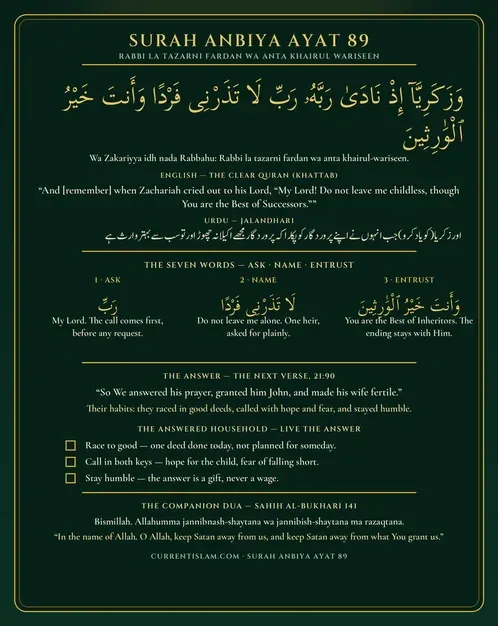
وَزَكَرِيَّآ إِذْ نَادَىٰ رَبَّهُۥ رَبِّ لَا تَذَرْنِى فَرْدًا وَأَنتَ خَيْرُ ٱلْوَٰرِثِينَ
Wa zakariyya idh nada rabbahu: Rabbi la tazarni fardan wa anta khairul wariseen.
“And ˹remember˺ when Zachariah cried out to his Lord, ‘My Lord! Do not leave me childless, though You are the Best of Successors.'” — The Clear Quran (Khattab)
اور زکریا (کو یاد کرو) جب انہوں نے اپنے پروردگار کو پکارا کہ پروردگار مجھے اکیلا نہ چھوڑ اور تو سب سے بہتر وارث ہے
तथा ज़करिया को (याद करो), जब उन्होंने अपने पालनहार को पुकारा : ऐ मेरे पालनहार! मुझे अकेला मत छोड़ और तू सब वारिसों से बेहतर है।
Source: Quran 21:89, Surah Al-Anbiya (The Prophets), the 17th juz. English: Khattab, The Clear Quran. Urdu: Jalandhari. Hindi: al-Umari.
What Does Rabbi La Tazarni Fardan Mean, Word by Word?
It means: “My Lord, do not leave me alone, while You are the best of inheritors.” Zakariya addresses Allah as his own Lord, asks not to be left single and without an heir, and closes by praising Allah as the One who remains and inherits all things after everyone passes.
| Arabic (عربي) | Transliteration | Meaning in English |
|---|---|---|
| رَبِّ | Rabbi | My Lord |
| لَا | la | do not |
| تَذَرْنِى | tazarni | leave me |
| فَرْدًا | fardan | alone, single, without an heir |
| وَأَنتَ | wa anta | while You |
| خَيْرُ | khairu | the Best |
| ٱلْوَٰرِثِينَ | al-wariseen | of those who inherit, of the Successors |
Two words carry the whole weight. Fardan is not just “lonely.” It is being left as one, with nobody after you. And the ending does something unusual: Zakariya asks for an heir while saying, in one breath, that Allah is the best of inheritors. The request and the surrender sit in one sentence. Hold on to that shape.
Was He Asking for a Child, or Asking Not to Be Left Alone?
He was asking for a child — an heir who would stand among the people after him. Ibn Kathir explains “leave me not single” as “with no child and no heir to stand among the people after me.” The loneliness here is the loneliness of a line ending.
Zakariya was an old man. His wife had never been able to have a child. He had spent his life guarding Maryam, the mother of Isa, in her prayer chamber. When he thought about who would carry the message after him, he saw nobody. Ibn Kathir also notes how he made this call: in secret, hiding it from his people. It was a quiet sentence between a man and his Lord.
The Quran tells his story three times. In Aal-e-Imran, his hope wakes up at Maryam’s out-of-season provision, and he prays Zakariya’s dua for a righteous offspring. In Surah Maryam, you hear his longer prayer in Surah Maryam, where he names his brittle bones and white hair. Here in Al-Anbiya, the same prayer is pressed down to seven words. If your situation is different — unmarried, or alone in a house full of people — pray these words for the aloneness you carry. Then ask Allah in your own words for what you need. The verse’s own occasion is still a child and an heir.
What Happened When Zakariya Prayed It?
The next verse is the answer, and it opens with three words: “So We answered.” Allah gave Zakariya a son, Yahya, and made his wife able to conceive. Read it in full: Allah describes the household before He describes the gift.
فَٱسْتَجَبْنَا لَهُۥ وَوَهَبْنَا لَهُۥ يَحْيَىٰ وَأَصْلَحْنَا لَهُۥ زَوْجَهُۥٓ ۚ إِنَّهُمْ كَانُوا۟ يُسَـٰرِعُونَ فِى ٱلْخَيْرَٰتِ وَيَدْعُونَنَا رَغَبًا وَرَهَبًا ۖ وَكَانُوا۟ لَنَا خَـٰشِعِينَ
“So We answered his prayer, granted him John, and made his wife fertile. Indeed, they used to race in doing good, and call upon Us with hope and fear, totally humbling themselves before Us.” — The Clear Quran (Khattab), Quran 21:90
تو ہم نے ان کی پکار سن لی۔ اور ان کو یحییٰ بخشے اور ان کی بیوی کو اُن کے (حسن معاشرت کے) قابل بنادیا۔ یہ لوگ لپک لپک کر نیکیاں کرتے اور ہمیں امید سے پکارتے اور ہمارے آگے عاجزی کیا کرتے تھے
Notice what the answer verse spends its words on. The gift takes one short clause. The rest of the verse — most of its nineteen words — describes habits: this family raced to do good, they called on Allah with hope and with fear held together, and they stayed humble before Him. Ibn Kathir records Ibn Abbas, Mujahid and Sa’id bin Jubayr on the wife: “She was barren and never had a child, then she gave birth.” The miracle is real. But the Quran frames it inside a life that was already turned toward Allah. That framing is a gift to you: habits are something you can begin tonight, while you wait for the part only Allah can give.
Three Prophets, One Surah, Three Answered Calls
Zakariya’s dua does not stand alone in Surah Al-Anbiya. The surah gathers the calls of prophet after prophet, and a pattern repeats. Ayyub called out from inside his illness. Yunus called out from inside the darkness. Zakariya called out from inside his old age. Each call is followed by the same door opening.
| Prophet | His Call (Dua) | The Answer Begins |
|---|---|---|
| Ayyub (21:83) |
أَنِّى مَسَّنِىَ ٱلضُّرُّ وَأَنتَ أَرْحَمُ ٱلرَّٰحِمِينَ
“Harm has touched me, and You are the Most Merciful of the merciful” | “So We answered him” (21:84) |
| Yunus (21:87) |
لَّآ إِلَـٰهَ إِلَّآ أَنتَ سُبْحَـٰنَكَ إِنِّى كُنتُ مِنَ ٱلظَّـٰلِمِينَ
“There is no god but You; glory be to You; I was among the wrongdoers” | “So We answered him” (21:88) |
| Zakariya (21:89) |
رَبِّ لَا تَذَرْنِى فَرْدًا وَأَنتَ خَيْرُ ٱلْوَٰرِثِينَ
“My Lord, do not leave me childless” | “So We answered his prayer” (21:90) |
Look at what the three calls share. None of them bargains. None sets a deadline or a count. Each names the trouble truthfully, then says something true about Allah — His mercy, His oneness, His lasting inheritance. If illness is your trouble, the surah’s first call belongs to you too: read Ayyub’s dua in illness. And when the trouble is a mistake of your own, the dua of Yunus is the same surah teaching the same shape of prayer.
How Do You Pray It? The Ask-and-Entrust Pattern
Zakariya’s seven words have a shape, and the shape is the method. Call it the Ask-and-Entrust Pattern. First, ask plainly: “My Lord” — no long introduction, no performed emotion. Second, name the fear honestly: “do not leave me alone.” He did not dress it up. Third, entrust the ending: “while You are the Best of Inheritors.” Before any answer arrived, he praised Allah as the One who remains after everyone. Ibn Kathir calls that closing phrase “a supplication and form of praise befitting the topic.” Ask, name it, entrust it. The same three moves work for any dua you make in your own words.
Now the practical side. There is no required time for this dua, so anchor it to prayers you already keep. Say it in sujud (prostration, when you are closest to your Lord). Say it after a salah (one of the five daily prayers), or in the last part of the night when the house is quiet — the same secrecy Zakariya chose. Praying it for pregnancy, or alongside fertility treatment, fits the same anchors: pick one salah a day and make it yours. Many readers keep it in the same sitting as Ayatul Kursi after each prayer. If you want a wider daily rhythm of Quranic prayer, the 40 Rabbana duas walk through the Quran’s own supplications one day at a time.
The Answered Household Checklist — built from the three habits Allah names in 21:90. Tick one row a day.
☐ Race to one good: one act of good done quickly today, before the day talks you out of it
☐ Call with hope and fear: the 7-word dua said slowly once, hope and honesty together
☐ Stay humble: one sujud where you ask for nothing — you only thank
Start tonight: after Isha, sit for one minute. Say the dua once, slowly, in Arabic if you can and in your own language after it. Then name your need in your own words. Then stop, and entrust the ending out loud: “You are the Best of Inheritors.”
How Many Times Should You Recite It? The Honest Answer
No number. Neither the Quran nor any hadith assigns a count to this dua — not 100, not 313, not 786. Those numbers travel unsourced from blog to blog. Repeat the dua as often as your heart wants; do not believe a count was prescribed when it was not.
This matters because the counts rarely travel alone. They arrive holding hands with promises: recite it this many times and a baby boy is guaranteed; do it for seven days and a marriage proposal, a job, or money will follow. Zakariya’s dua is a dua for an heir. Nothing in the verse or its tafsir turns it into a procedure for a son rather than a daughter, a wedding, or a salary. A child of either sex is a gift, and the sex of a child is Allah’s decision alone — worth sitting with, if family pressure is part of your pain. Pray the dua for what it is. For work and provision, the Quran gives Musa his own words at Madyan, kept in our dua for a job guide.
One more honest word, said gently. Dua sits alongside means; it does not replace them. If you and your spouse have been trying for a child for a year or more, seeing a doctor is not a failure of faith. Zakariya’s story includes a wife whose condition Allah changed; understanding yours is part of taking the means He created. Pray this dua with a full heart and keep your appointments. The two were never in competition.
A Second Dua From the Sunnah to Pray Alongside It
The Prophet ﷺ taught a short dua that touches the same hope from the other side: protection for a child before that child exists. Narrated by Ibn Abbas, it is the dua said before intimacy between husband and wife.
بِسْمِ اللَّهِ اللَّهُمَّ جَنِّبْنَا الشَّيْطَانَ وَجَنِّبِ الشَّيْطَانَ مَا رَزَقْتَنَا
Bismillah. Allahumma jannibna ash-shaytan, wa jannibi ash-shaytana ma razaqtana.
“In the name of Allah. O Allah! Protect us from Satan and also protect what you bestow upon us (i.e. the coming offspring) from Satan.” The Prophet ﷺ said that if a child is then destined for the couple, “Satan will never be able to harm that offspring.” — Sahih al-Bukhari 141
Zakariya’s dua asks for the child. This dua guards the child. Prayed together, they cover the longing and the protection — both fully sourced. And when the child comes, the Quran gives parents their next sentence — the comfort of our eyes, the dua of Surah Al-Furqan (25:74) for spouses and offspring.
Mistakes That Quietly Spoil This Dua
The first is chasing a count instead of a conversation — racing through 313 repetitions while the mind is elsewhere, when one slow, understood sentence is the thing itself. The second is bargaining: treating the dua as a transaction with a delivery date, then reading a delay as rejection. Zakariya waited years, and the answer verse praises the waiting household’s habits, not its impatience. The third is skipping the ending. People quote the request and drop the praise, but “You are the Best of Inheritors” is where the peace lives. Say the whole sentence. The fourth is performing patience for people while hiding your pain from Allah. Zakariya hid his dua from his people, not his pain from his Lord. Bring the pain to Allah honestly.
Questions People Ask
It is in Surah Al-Anbiya, the twenty-first chapter of the Quran, at verse eighty-nine, in the seventeenth juz. The verse opens by naming Zakariya and his call to his Lord, and the dua itself is the verse’s second half, seven words long.
Allah answered in the very next verse: “So We answered his prayer, granted him John, and made his wife fertile.” The son was Yahya. The same verse then praises the household’s habits — racing to good deeds, calling with hope and fear, and staying humble.
As often as you like, and no fixed number exists. No verse or authentic hadith prescribes one hundred, three hundred and thirteen, or any other count for this dua. Repeat it slowly with understanding, inside your normal prayers and quiet moments, without chasing a total.
No source presents it that way. It is Zakariya’s dua for an heir and righteous offspring, and Allah answered with a son in his story. No verse or hadith guarantees any supplicant a boy rather than a girl; a child’s sex is Allah’s decision alone.
Yes. Nothing restricts this dua to the time before conception, and its words — asking Allah not to leave you alone and praising Him as the Best of Inheritors — fit pregnancy well. Pair it with the Prophet’s ﷺ taught duas and keep your medical care in place.
Yes, you can pray it. Its original occasion was Zakariya’s wish for an heir, so if your need is different — companionship, marriage, relief from loneliness — say this dua as the Quran teaches it, then ask Allah for your own need in your own words too.
Jalandhari translates the verse:
“اور زکریا (کو یاد کرو) جب انہوں نے اپنے پروردگار کو پکارا کہ پروردگار مجھے اکیلا نہ چھوڑ اور تو سب سے بہتر وارث ہے”
— “My Lord, do not leave me alone, and You are the best of all inheritors.”
Both are Zakariya’s words. In Aal-e-Imran 3:38 he asks directly: “My Lord, grant me from Yourself a good offspring; indeed, You are the Hearer of supplication.” In Al-Anbiya 21:89 the same request is shorter and ends in surrender, praising Allah as the Best of Inheritors.
Next step
Want the companion dua from the same chamber? Read Zakariya’s dua at 3:38 — Rabbi habli min ladunka
Praying for a righteous son like Ibrahim did? Read Rabbi habli minas saliheen (37:100)
Building a daily dua habit? Start the 40 Rabbana duas, one a day
Send this to someone who is waiting and praying — they may need the honest version more than another promised count.
