
How many times have you opened your phone intending to read something beneficial, only to realize forty-five minutes later that you’ve been mindlessly scrolling through a blur of notifications and videos?
We live in an era of information overload, yet we are starved for actual focus. We consume thousands of words a day, but how much of it actually stays in our hearts? Long before smartphones and shattered attention spans, Allah provided the ultimate “focus reset” button for the human mind.
Let’s look at the heart of the issue and see how a simple, ancient phrase can transform your modern learning journey.
What Does Rabbi Zidni Ilma Mean?
“Rabbi Zidni Ilma” translates precisely to ‘My Lord, increase me in knowledge.’ Found in Surah Ta-Ha, Verse 114, this profound Quranic dua is a direct plea to Allah for intellectual growth, spiritual focus, and the lifelong retention of truly beneficial information.
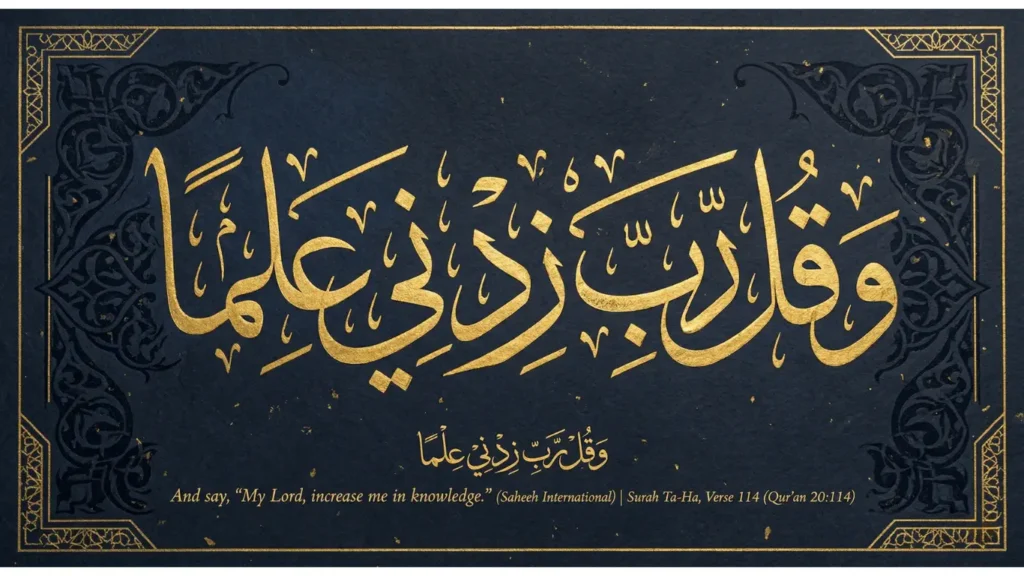
The Primary Source: Surah Ta-Ha, Verse 114
- Arabic: وَقُل رَّبِّ زِدْنِي عِلْمًا
- Transliteration: Wa qul Rabbi zidni ilma.
- English: “And say, ‘My Lord, increase me in knowledge.'” (Saheeh International)
- Urdu: اور کہو کہ اے میرے پروردگار مجھے اور زیادہ علم دے۔ (Fateh Muhammad Jalandhari)
Word-by-Word Breakdown
- Rabbi (رَبِّ): “My Lord.” It invokes Allah’s attribute as the Nurturer and Sustainer. You are asking the One who grows a seed into a tree to grow your intellect.
- Zidni (زِدْنِي): “Increase me.” An active request for continuous, never-ending growth.
- Ilma (عِلْمًا): “Knowledge.” Because it is written in an indefinite grammatical form, it encompasses all types of beneficial knowledge—both worldly skills and spiritual wisdom.
The Tafseer: Why Was This Dua Revealed?
This beautiful dua was revealed when Angel Jibreel brought the Quran. Fearing he might forget the verses, Prophet Muhammad would rush his recitation. Allah revealed this specific verse to teach him complete reliance on divine retention rather than human anxiety.
Classical scholar Imam Ibn Kathir explains in his Tafseer that Allah was instructing His Messenger to be patient. Instead of rushing to memorize through sheer human effort, the Prophet (ﷺ) was told to ask Allah for the capacity to absorb and retain the revelation.
Here is why this matters for you today: If the most knowledgeable human being to ever live was commanded to ask for an increase in knowledge, we must recognize our own profound limitations. It is the ultimate antidote to intellectual arrogance.
The “Digital Sunnah” Strategy: Fixing Modern Brain Fog
In today’s world of endless notifications, our natural attention spans are entirely shattered. Reciting ‘Rabbi Zidni Ilma’ before opening a book or laptop acts as a spiritual anchor, instantly shifting your brain from passive digital consumption to active, intentional learning.
We often treat studying or reading as a purely mechanical task. But in the Islamic tradition, acquiring Ilm (knowledge) is a deeply spiritual act.
Imam Malik famously advised his student, Imam Ash-Shafi’i, saying, “I see that Allah has placed light in your heart, so do not extinguish it with the darkness of disobedience.” This teaches us a critical prerequisite: a distracted, cluttered heart cannot easily hold the light of knowledge. Before you sit down to study or work, it is highly recommended to reset your spiritual state by clearing the heart through sincere Istighfar. Once the spiritual blocks are removed, the dua for knowledge can truly take root.
The Profound Benefits of Ilm Mein Izafa Ki Dua
Regularly reciting this dua completely transforms your daily study habits into acts of worship. It expands your actual comprehension, protects your mind from useless information, and ensures the knowledge you gain actively improves your character and benefits your future life.
Consider the immense reward associated with this pursuit.
The Hadith on the Path of Knowledge
- Arabic: مَنْ سَلَكَ طَرِيقًا يَلْتَمِسُ فِيهِ عِلْمًا سَهَّلَ اللَّهُ لَهُ بِهِ طَرِيقًا إِلَى الْجَنَّةِ
- Transliteration: Man salaka tariqan yaltamisu fihi ‘ilman sahhala Allahu lahu bihi tariqan ila al-jannah.
- English: “Whoever travels a path seeking knowledge, Allah will make easy for him a path to Paradise.” (Sahih Muslim, 2699)
- Urdu: جو شخص علم کی تلاش میں کسی راستے پر چلتا ہے، اللہ اس کے لیے جنت کا راستہ آسان کر دیتا ہے۔
We do not seek knowledge just to pass exams or get promotions. The ultimate goal of increasing our intellect is to recognize our Creator, serve our communities, and prepare for our inevitable return. True knowledge grounds us, constantly reminding us to prepare for the reality ahead, much like understanding the heavy reality of the Hereafter in Surah Al-Qariah.
People Also Ask:
The most powerful dua for studying is “Rabbi Zidni Ilma” (My Lord, increase me in knowledge). Recite it before opening your books or taking an exam to seek Allah’s help in focus, understanding, and memory retention.
Yes, you can absolutely recite Rabbi Zidni Ilma without Wudu. Because it is a dua (supplication) meant for daily remembrance and seeking help, you can say it at any time, whether you are at your desk, commuting, or preparing to read.
There is no fixed number of times you must recite Rabbi Zidni Ilma in the Sunnah. The focus should be on the sincerity and consistency of the request. Reciting it once with full focus and intention is better than repeating it mindlessly.
Your Next Step
Knowledge is only as valuable as the action it inspires. Start implementing the “Digital Sunnah” today. Before you open your next browser tab, before you start your next study session, pause for three seconds and say: Rabbi Zidni Ilma. Want more practical, modern applications of the Sunnah? Join our weekly newsletter below, where we send one clear, actionable Islamic habit directly to your inbox every Friday to help you navigate the modern world with faith and focus.

1 thought on “ilm Mein Izafa Ki Dua Rabbi Zidni ilma”