
We spend decades building homes, advancing careers, and securing our futures, yet the one absolute certainty of human existence is the one we plan for the least. The profound Quranic declaration, Kullu Nafsin Zaikatul Maut, is not meant to paralyze us with fear. Rather, it is the ultimate “Reality Anchor.” It is a Divine reminder designed to snap us out of worldly illusions and realign our daily habits with our eternal destination. Let’s look at the heart of this profound reality.
What Does Kullu Nafsin Zaikatul Maut Mean?
Kullu Nafsin Zaikatul Maut translates to “Every soul will taste death.” It is a universal decree from Allah that every living, conscious being will transition from this temporary physical world (Dunya) to the eternal realm by experiencing the phenomenon of physical death.
This phrase appears exactly three times in the Holy Quran (Surah Aal-e-Imran 3:185, Surah Al-Anbiya 21:35, and Surah Al-Ankabut 29:57).
Word-by-Word Breakdown and Pronunciation
Understanding the exact linguistic root unlocks the true depth of the verse.
- Kullu (كُلُّ): Meaning “Every” or “All.” There are no exceptions.
- Nafsin (نَفْسٍ): The “Soul” or conscious self.
- Zaikatu (ذَائِقَةُ): From the root Zawq, meaning “to taste.” This implies the soul does not cease to exist; rather, it experiences the flavor of death before moving on.
- Al-Maut (الْمَوْتِ): The cessation of biological life; physical death.
Pronunciation Guide: Kul-lu naf-sin zaa-i-qa-tul mawt.
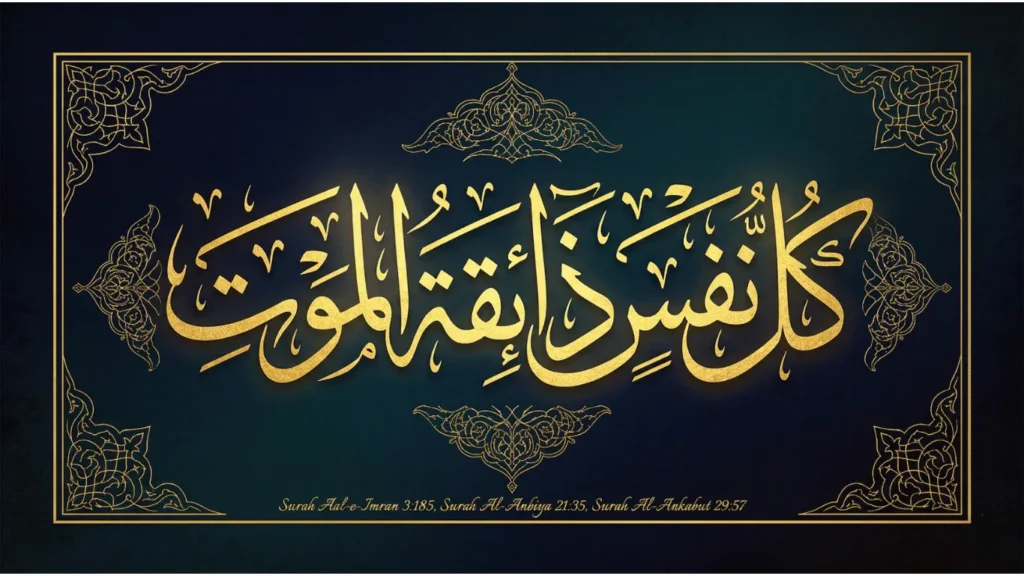
The 3 Quranic Contexts of “Kullu Nafsin Zaikatul Maut” (Every Soul Will Taste Death)
The profound phrase “Kullu Nafsin Zaikatul Maut” appearing in the Holy Quran is often misunderstood simply as a reminder of mortality. However, Allah (SWT) presents this reality in three distinct contexts to guide the believer’s mindset regarding life, accountability, and trials.
Below is a breakdown of these three contexts, including Arabic text, transliteration, and English and Urdu translations.
1. The Context of Ultimate Justice (Surah Aal-e-Imran 3:185)
In this Ayat, the core message is accountability. Death is presented not as an end, but as the gateway to ultimate justice. It serves as a reminder that all worldly inequities and imbalances will be perfectly resolved on the Day of Judgement.
Revelation Script & Translations
Arabic:
كُلُّ نَفْسٍ ذَآئِقَةُ ٱلْمَوْتِ ۗ وَإِنَّمَا تُوَفَّوْنَ أُجُورَكُمْ يَوْمَ ٱلْقِيَٰمَةِ
Transliteration:
Kullu nafsin zaa’iqatul mawt; wa innamaa tuwaffawna ujoorakum Yawmal Qiyaamah.
English (Saheeh International):
“Every soul will taste death, and you will only be given your [full] compensation on the Day of Resurrection.”
Urdu (Fateh Muhammad Jalandhari):
ہر جان موت کا مزہ چکھنے والی ہے اور تم کو قیامت کے دن تمہارے اعمال کا پورا پورا بدلہ دیا جائے گا۔
2. The Context of the Ultimate Test (Surah Al-Anbiya 21:35)
In Surah Al-Anbiya, mortality is used to frame our earthly existence. This life is defined as a continuous examination. Allah reminds us that both hardship (evil) and prosperity (good) are not random events, but specific trials of our faith, patience, and gratitude.
Revelation Script & Translations
Arabic:
كُلُّ نَفْسٍ ذَآئِقَةُ ٱلْمَوْتِ ۗ وَنَبْلُوكُم بِٱلشَّرِّ وَٱلْخَيْرِ فِتْنَةً
Transliteration:
Kullu nafsin zaa’iqatul mawt; wa nablookum bishsharri walkhayri fitnah.
English (Saheeh International):
“Every soul will taste death. And We test you with evil and with good as trial.”
Urdu (Fateh Muhammad Jalandhari):
ہر جان موت کا مزہ چکھنے والی ہے۔ اور ہم تم کو برائی اور بھلائی میں آزمائش کے لئے مبتلا کرتے ہیں۔
3. The Context of Unwavering Courage (Surah Al-Ankabut 29:57)
This Ayat was revealed during a time of intense persecution against Muslims. In this context, the reminder of death is meant to remove fear. By establishing that death is guaranteed for all, it empowers believers with the courage to remain steadfast in their faith. Compressing one’s faith to preserve a temporary life is futile when the return to Allah is inevitable.
Revelation Script & Translations
Arabic:
كُلُّ نَفْسٍ ذَآئِقَةُ ٱلْمَوْتِ ۖ ثُمَّ إِلَيْنَا تُرْجَعُونَ
Transliteration:
Kullu nafsin zaa’iqatul mawt; thumma ilaynaa turja’oon.
English (Saheeh International):
“Every soul will taste death. Then to Us will you be returned.”
Urdu (Fateh Muhammad Jalandhari):
ہر جان موت کا مزہ چکھنے والی ہے۔ پھر تم ہماری ہی طرف لوٹ کر آؤ گے۔
Classical Tafsir Meets Modern Reality
To grasp the magnitude of Kullu Nafsin, we must look at how classical scholars interpreted it and apply that wisdom to our highly distracted modern lives.
Imam Ibn Kathir, in his renowned Tafsir, highlights that these verses are meant to comfort the believer and diminish the value of temporary worldly gains. He emphasizes that no one, regardless of wealth, status, or fortification, can escape this decree. Similarly, Imam An-Nawawi taught that the constant remembrance of death is the ultimate destroyer of worldly desires, naturally pushing a believer toward sincere repentance (Tawbah).
The Reality Anchor Framework
Today, we face a crisis of attention. Social media algorithms, endless entertainment, and material pursuits create a “Digital Dunya” that makes us functionally immortal in our own minds. We delay prayer, withhold charity, and hold grudges assuming we have decades left.
Applying Kullu Nafsin Zaikatul Maut acts as a Reality Anchor. It is the spiritual habit of asking yourself daily: “If I were to taste death tonight, would I be satisfied with my browser history, my missed prayers, and how I treated my family today?” Recognizing the fragility of life does not cause despair; it forces extreme clarity and purpose.
Spiritual Benefits, Wazifa, and Deliverance from Distress
Reciting and reflecting upon this reality carries immense spiritual weight. It softens the heart, cures arrogance, and brings immediate perspective during times of worldly anxiety or financial loss.
There is no specific prescribed “Wazifa” of repeating Kullu Nafsin Zaikatul Maut a set number of times for worldly gain, as the verse is a statement of reality rather than a supplication. However, scholars recommend reading it to break the ego during moments of excessive pride.
When the anxiety of our eventual passing feels overwhelming, turning to the Ever-Living Creator is our greatest relief. You can find profound comfort in calling upon His eternal mercy through the supplication Ya Hayyu Ya Qayyum Birahmatika Astaghees, which grounds the heart when facing immense distress.
Furthermore, the distractions of this world often act like an illusion, pulling our focus away from the reality of the grave. To break these worldly illusions and protect your spiritual focus, you must rely on the Quran. The profound truth revealed in Surah Taha Ayat 69 Wa Alqi Ma Fi Yaminika Talqaf Ma Sanaoo serves as a reminder of how Divine truth permanently nullifies the falsehoods and magic of this temporary life.
People Also Ask:
The exact phrase “every soul shall taste death” appears in three different Surahs in the Quran: Surah Aal-e-Imran (Chapter 3, Verse 185), Surah Al-Anbiya (Chapter 21, Verse 35), and Surah Al-Ankabut (Chapter 29, Verse 57).
The use of the word “taste” indicates that the soul itself does not die or vanish. Instead, the eternal soul temporarily experiences the transition of physical death before entering the realm of Barzakh (the barrier between this world and the hereafter).
You can overcome the fear of death by shifting your perspective. Understand that death is a return to a merciful Creator. Focus on daily good deeds, maintaining a state of purity, and making constant Dua for a good ending (Husn al-Khatimah).
Allah tests us to reveal our true character and faith. Because death is inevitable, the focus of life is not to simply exist, but to determine our rank and station in the eternal hereafter based on how we handled our worldly trials.
