When you wake up in New York at 6 AM before your conference call, or step onto the London Underground at 7:30 AM GMT feeling overwhelmed by notifications, this 4-verse chapter becomes your 90-second weapon against digital anxiety. Prophet Muhammad (PBUH) said reciting Surah Al-Ikhlas equals one-third of the Quran [Sahih Bukhari 6:61:502]. Here’s exactly how to memorize it with English transliteration, use phone reminders for consistency, and transform your tech habits into spiritual practice.
What Is Surah Al-Ikhlas (Chapter 112)?
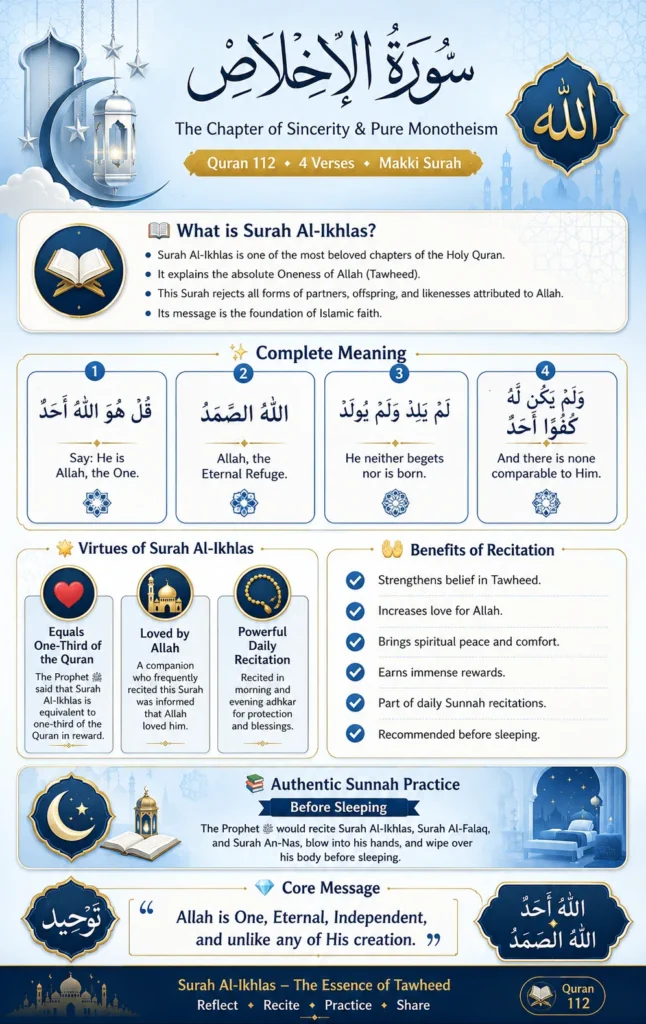
Surah Al-Ikhlas (الأخلاص) is the 112th chapter of the Quran with 4 verses, classified as Meccan (revealed in Makkah before migration to Madinah). It defines Allah’s absolute oneness (Tawheed) and is also called Surat At-Tawheed (The Chapter of Monotheism). For Western Muslims struggling with Arabic memorization, this surah is the perfect starting point—short, profound, and recited daily in obligatory prayers.
Full Surah Al-Ikhlas: Arabic + Transliteration + English + Urdu
Verse 1
Arabic:
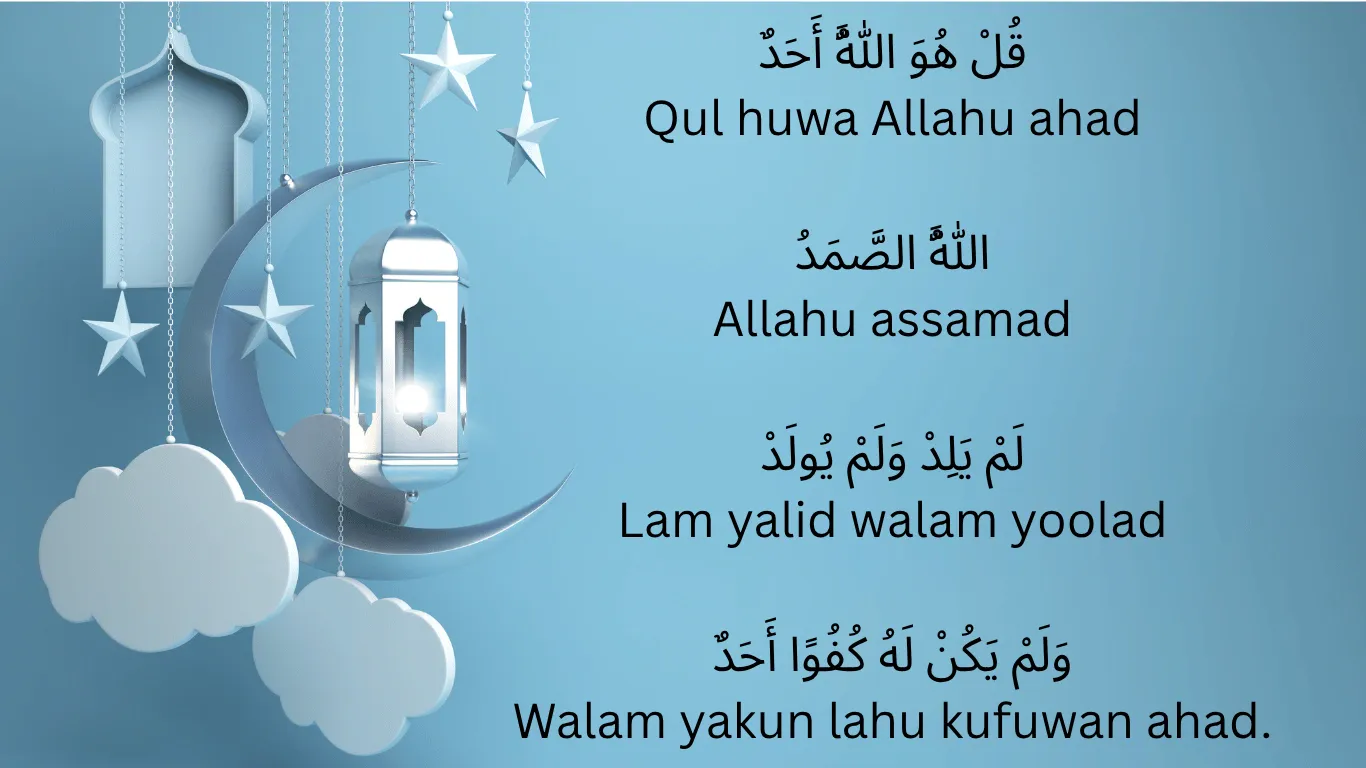
قُلْ هُوَ اللَّهُ أَحَدٌ
Transliteration: Qul huwa Allahu ahad
English: “Say, ‘He is Allah, [who is] One'”
Urdu:
“کہو وہ اللہ ایک ہے”
Verse 2
Arabic:
اللَّهُ الصَّمَدُ
Transliteration: Allahu assamad
English: “Allah, the Eternal Refuge”
Urdu: “
اللہ بے نیاز ہے”
Verse 3
Arabic:
لَمْ يَلِدْ وَلَمْ يُولَدْ
Transliteration: Lam yalid walam yoolad
English: “He neither begets nor is born”
Urdu:
“وہ نہ کسی کو جنا اور نہ اسے جنا گیا”
Verse 4
Arabic:
وَلَمْ يَكُنْ لَهُ كُفُوًا أَحَدٌ
Transliteration: Walam yakun lahu kufuwan ahad
English: “Nor is there to Him any equivalent”
Urdu:
“اور کوئی اس کا ہمسر نہیں”
Bismillah: Arabic:
بِسْمِ اللَّهِ الرَّحْمَنِ الرَّحِيمِ
Transliteration: Bismillaahir Rahmaanir Raheem
English: “In the name of Allah, the Entirely Merciful, the Especially Merciful”
Urdu:
“اللہ کے نام سے جو نہایت مہربان، بے انتہا محبت کرنے والا ہے”
Word-by-Word Arabic Meaning (For Memorization)
Understanding Arabic roots helps Western Muslims memorize transliteration faster:
| Arabic Word | Transliteration | Root Meaning | English |
|---|---|---|---|
| قُلْ | Qul | Say (command) | “Say” |
| هُوَ | Huwa | He | “He” |
| اللَّهُ | Allahu | Allah | “Allah” |
| أَحَدٌ | Ahad | One/Indivisible | “One” |
| الصَّمَدُ | Assamad | Eternal Refuge | “Eternal Refuge” |
| لَمْ | Lam | Not (negation) | “Neither” |
| يَلِدْ | Yalid | Begets | “Begets” |
| يُولَدْ | Yoolad | Is born | “Is born” |
| كُفُوًا | Kufuwan | Equivalent | “Equivalent” |
Ibn Kathir explains: “Ahad” means Allah is singular in being, attributes, and actions—no division, no partner, no equal [Tafseer Ibn Kathir, Surah 112].
Top 5 Benefits of Reciting Surah Al-Ikhlas
1. Equivalent to One-Third of the Quran
Hadith: “By Him in Whose Hand my soul is, it is equivalent to one-third of the Quran” [Sahih Bukhari 6:61:502].
Why it matters: Reciting 3 times = full Quran reward. Perfect for busy NYC/London schedules.
2. Grants Paradise Through Love
Hadith: A man said, “I love Surah Al-Ikhlas.” Prophet (PBUH) replied: “Your love of it has granted you paradise” [Sahih Muslim 4:2.2].
Why it matters: Emotional connection > mechanical recitation.
3. House in Paradise (10 Times Daily)
Hadith: “Whoever reads it 10 times, Allah builds him a dwelling in Paradise” [Tirmidhi 5:432].
Why it matters: Set phone reminder at 7 AM EST (NYC) or 9 AM GMT (London).
4. Forgiveness of 50 Years of Sins (200 Times Daily)
Hadith: “Whoever reads it 200 times daily, Allah erases sins of 50 years” [Narrated by Anas].
Why it matters: Break into 3 sessions: morning (commute), afternoon (office), evening (home).
5. Allah Loves You (Spiritual Connection)
Hadith: Prophet (PBUH) said about someone who loved reciting it: “Inform him that Allah loves him” [Sahih Bukhari].
Why it matters: In secular societies, this reassures identity and purpose.
The Digital Sunnah: How to Use Phone Reminders for Surah Ikhlas
Here’s why this matters for you in 2026. You don’t need more time—you need smart habit stacking.
Step 1: Set 3 Phone Reminders
- 7:00 AM EST (NYC/Miami) or 9:00 AM GMT (London/Manchester): “Recite Surah Ikhlas 10x”
- 12:30 PM PST (LA/San Francisco): “Midday break—Surah Ikhlas 5x”
- 8:00 PM EST: “Before sleep—Surah Ikhlas + Al-Falaq + An-Naas”
Step 2: Use Quran Apps for Transliteration Practice
- Quran.com: Listen to Mishary Alafasy while reading transliteration
- Muslim Pro: Audio + text sync for memorization
- Ayat: Daily verse reminders with Arabic + English
Step 3: 90-Second Digital Break Routine
- Close email/phone (10 sec)
- Recite Surah Ikhlas slowly with transliteration (60 sec)
- Reflect on “Ahad” = Allah is unique, not like my stress (20 sec)
This becomes important when you look at your morning routine in New York or London. Tech usually drains you—now it anchors you.
Protection Duas: Surah Al-Falaq + An-Naas (Morning & Evening)
Prophet Muhammad (PBUH) recommended reciting Surah Al-Ikhlas + Al-Falaq + An-Naas (3x) for protection [Sunnah practice].
Morning (Before Work/Commute—7 AM EST / 9 AM GMT)
Surah Al-Falaq 113:1–5:
Arabic: قُلْ أَعُوذُ بِرَبِّ الْفَلَقِ…
Transliteration: Qul a’eedhu bi Rabbil-falaq…
English: “Say, ‘I seek refuge in the Lord of the dawn…'”
Urdu: “کہو میں صبح کے رب کی پناہ مانگتا ہوں…”
Evening (Before Sleep—8 PM EST / 10 PM GMT)
Surah An-Naas 114:1–6:
Arabic: قُلْ أَعُوذُ بِرَبِّ النَّاسِ…
Transliteration: Qul a’eedhu bi Rabbin-naas…
English: “Say, ‘I seek refuge in the Lord of mankind…'”
Urdu: “کہو میں انسانوں کے رب کی پناہ مانگتا ہوں…”
Combine with Al-Ikhlas for complete sunnah protection routine.
Quran Verse for Remembrance: Surah Al-Baqarah 2:151–152
Arabic: فَاذْكُرُونِي أَذْكُرْكُمْ وَشْكُرُوا لِي وَلَا تَكْفُرُونِ
Transliteration: Faz kuruni az kurkum washkuruli wa la takfuroon
English: “So remember me; I will remember you. And be grateful to me and do not deny me.”
Urdu: “پس مجھے یاد رکھو میں تمہیں یاد رکھوں گا اور میری شکرگزار ہو اور نہیں کفر کرو”
This connects Surah Ikhlas to daily remembrance (dhikr)—essential for Western Muslims in secular work environments.
Practical Application: Office, School, Commute in US/UK
Now let’s connect this to daily life at your office or school:
- NYC Office (10 AM EST): Before meeting, close laptop → 3x Surah Ikhlas → clarity returns
- London Commute (8 AM GMT): Underground noise → phone on silent → 5x Surah Ikhlas → anxiety drops
- LA School (11 AM PST): Before exam → 10x Surah Ikhlas → confidence builds
- Manchester Evening (7 PM GMT): After work → 3x Ikhlas + Falaq + Naas → protection for family
Here’s why this matters: You’re not adding burden—you’re replacing scroll-time with sacred-time.
Download Your Free Dua Guide (PDF)
Ready to memorize Surah Al-Ikhlas with confidence? Download our free PDF guide with:
- ✅ Full Arabic text with proper tashdid (diacritical marks)
- ✅ English transliteration (large font for memorization)
- ✅ US/UK English translation + Urdu translation
- ✅ Phone reminder template (EST/PST/GMT)
- ✅ Audio QR codes for Mishary Alafasy recitation
[Download Free Dua Guide Now] ← Your 90-second digital sunnah starts today.
Related Articles for Western Muslims
- Learn how many chapters exist in the Quran: How Many Surahs in Quran
🚀🚀🚀🚀🚀
- Read Surah Ikhlas in Urdu for diaspora families: Surah Ikhlas Translation in Urdu
By substituting scroll-time with sacred-time, you transform technology from distraction into devotion. Surah Al-Ikhlas isn’t just verses—it’s your digital sunnah anchor in 2026.
