
There are questions in marriage that couples are often too afraid to ask due to cultural stigma. However, in Islam, seeking knowledge to ensure one’s actions remain within the boundaries of Halal (permissible) is highly encouraged.
To answer the exact question directly: Yes, according to the majority of Islamic scholars, oral stimulation and kissing are permissible forms of foreplay.
Because this specific act does not fall under the explicit prohibitions of Islamic law, scholars classify it under the general permissibility of spouses enjoying one another. However, this permissibility is tied to strict conditions regarding hygiene and mutual respect. To understand exactly why scholars rule this way, we must look at the foundational rules of marriage.
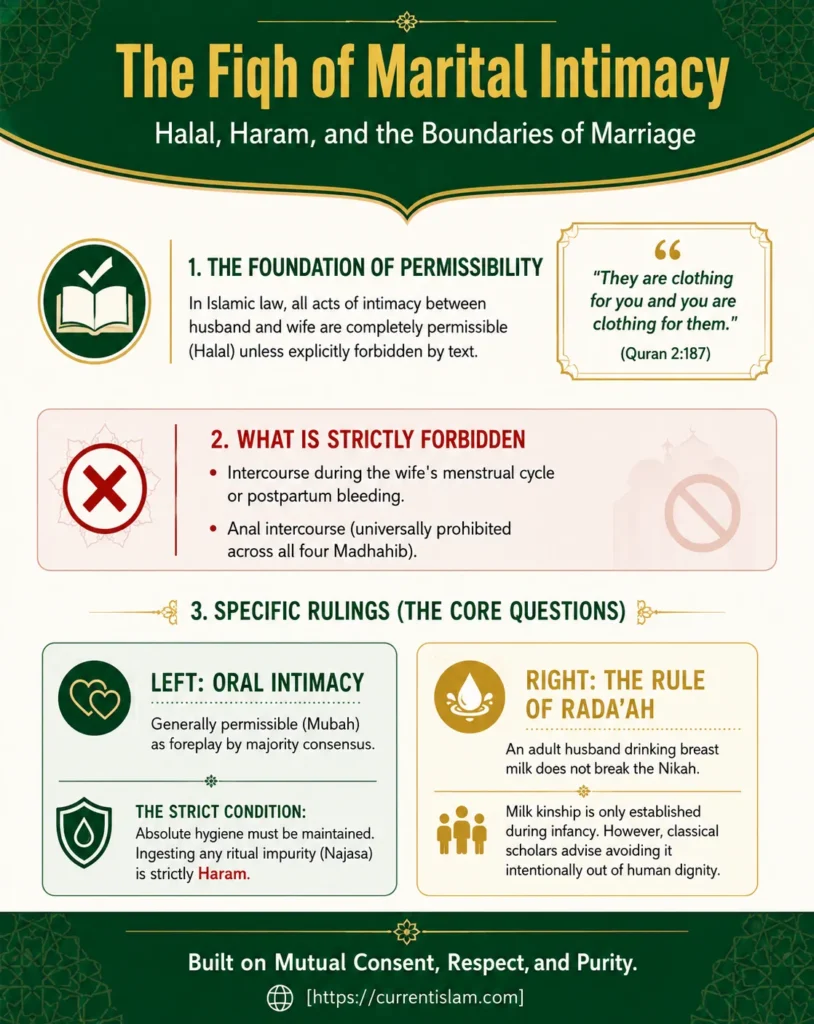
The Fiqh of Marital Intimacy: Halal, Haram, and Adab
When examining the rules of intimacy, it is critical to separate cultural taboos from actual Islamic jurisprudence (Fiqh). In Islamic law, the golden rule regarding non-ritual acts between a husband and wife is Al-Asl fi al-Ashya al-Ibahah—meaning the default state of all things is permissibility unless explicitly forbidden by the Quran or authentic Hadith.
The Quran establishes a standard of ultimate physical and emotional closeness in Surah Al-Baqarah (2:187):
“They are clothing for you and you are clothing for them.”
Scholars interpret “clothing” as a metaphor for protection, comfort, and the complete removal of physical boundaries between spouses.
The Absolute Prohibitions (Strictly Haram)
To understand what is Halal, we must clearly define the boundaries. There are only two explicit prohibitions regarding physical intimacy between spouses:
- Intercourse During Menstruation: The Quran explicitly forbids actual intercourse during a woman’s menstrual cycle. However, physical closeness, touching, and sleeping in the same bed remain completely permissible.
- Anal Intercourse: Multiple authentic Hadiths strictly forbid this act, describing it as a major sin across all four schools of thought due to physical harm and contradiction of human dignity.
The Non-Negotiable Condition: Avoiding Najasa
While kissing and oral foreplay are widely considered Mubah (permissible), there is one absolute jurisprudential condition: the strict avoidance of Najasa (ritual impurity).
Urine, menstrual blood, and madhi (pre-seminal fluid) are ritually impure. It is strictly Haram to ingest any impurities in Islam. Therefore, any form of oral intimacy is entirely contingent upon absolute hygiene and cleanliness.
(Note on Adab: While the majority view it as permissible, some classical Hanafi scholars classified the act as Makruh (disliked) purely out of etiquette, reasoning that the mouth is noble and used for reciting the Quran. However, it is not classified as a sin or Haram).
Can husband drink milk of wife in islam
A common anxiety among couples is whether a husband accidentally or intentionally drinking his wife’s breast milk invalidates the Nikah (marriage) by establishing milk kinship (Rada’ah).
The unanimous consensus of all four major schools of thought is that the marriage remains 100% valid.
In Islamic Fiqh, milk kinship is only established if a child is breastfed during infancy (specifically within the first two lunar years of life). Because the husband is an adult, consuming breast milk does not change the marital relationship or make him a “foster son.”
However, scholars differentiate between accidental and intentional consumption during intimacy:
- Accidental Consumption: If swallowed accidentally during foreplay, there is absolutely no sin, and no expiation (Kaffarah) is required.
- Intentional Consumption: The Hanafi school, along with other classical jurists, rules that it is Makruh (strongly disliked) or Haram to intentionally consume it. The reasoning is based on human dignity (Karamah). Human milk is a substance divinely designed specifically for the nourishment of infants, and consuming it unnecessarily as an adult contradicts that purpose.
