Have you ever faced an opponent, a daunting task, or a systemic problem so large that your own resources felt entirely insignificant? Thousands of years ago, a single letter crossed a desert to a sun-worshipping empire of immense wealth. It wasn’t backed by threats of immediate violence, nor did it boast of the sender’s massive army. It opened with absolute humility—and it changed the course of history.
Here is why a single verse from that letter remains one of the most powerful formulas for success, diplomacy, and spiritual grounding today.
What Does Innahu Min Sulaiman Wa Innahu Bismillah Mean?
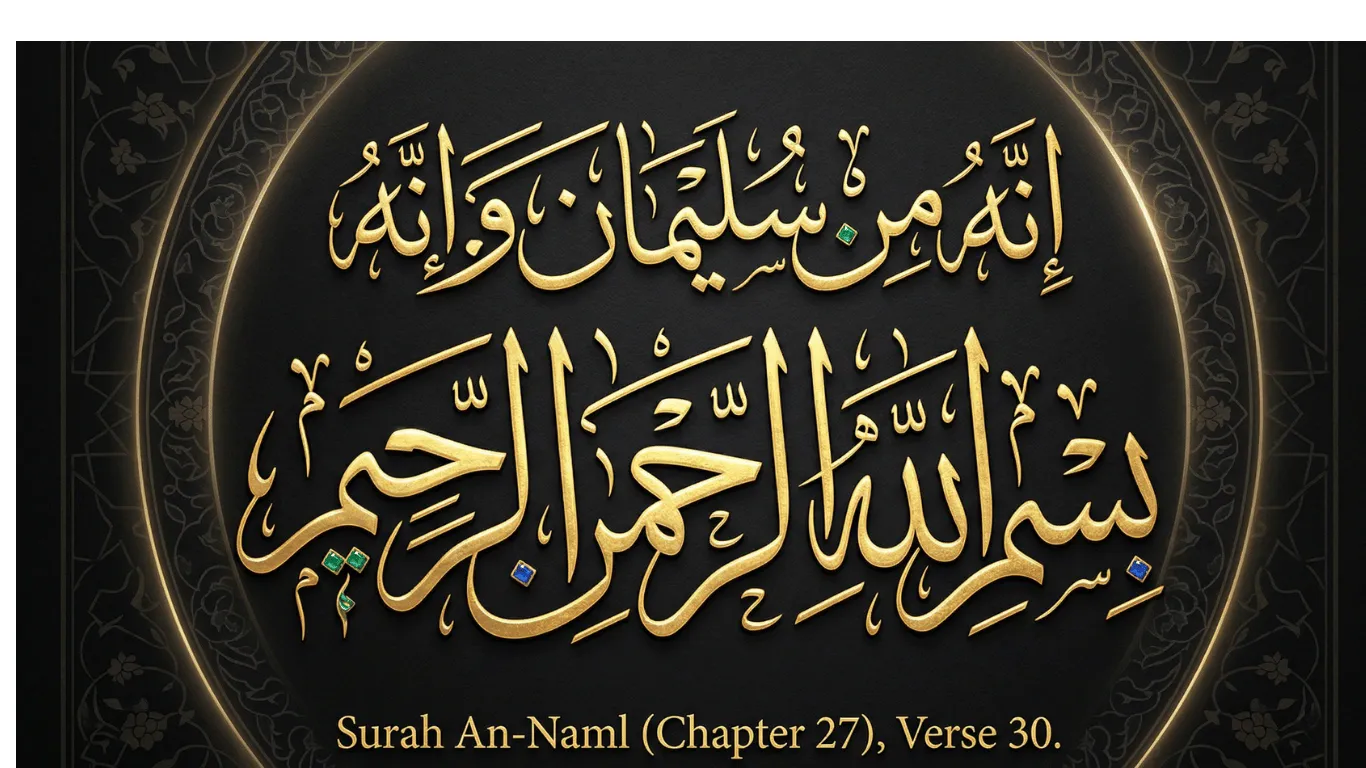
Innahu min Sulaiman wa innahu bismillah refers to verse 30 of Surah An-Naml. It translates to: “Indeed, it is from Solomon, and indeed, it reads: In the name of Allah, the Entirely Merciful, the Especially Merciful.” It demonstrates beginning important matters with God’s name.
To truly grasp the weight of this verse, we must look at the primary sources across four dimensions.
The Multilingual Quadrant: Surah An-Naml 27:30
- Arabic: إِنَّهُ مِن سُلَيْمَانَ وَإِنَّهُ بِسْمِ اللَّهِ الرَّحْمَٰنِ الرَّحِيمِ
- Transliteration: Innahu min Sulaymana wa innahu bismillahi r-rahmani r-rahim.
- English (Saheeh International): “Indeed, it is from Solomon, and indeed, it reads: ‘In the name of Allah, the Entirely Merciful, the Especially Merciful.'”
- Urdu (Fateh Muhammad Jalandhari): “بیشک وہ خط سلیمان کی طرف سے ہے اور بیشک وہ اللہ کے نام سے شروع ہے جو نہایت مہربان رحم والا ہے۔”
Word-by-Word Translation of Surah An-Naml 27:30
Understanding Surah An-Naml verse 30 word by word helps reveal its deep diplomatic and spiritual meaning. Here is the exact breakdown of the Arabic vocabulary used by Prophet Solomon.
| Arabic | Transliteration | English Meaning | Urdu Meaning |
| إِنَّهُ | Innahu | Indeed, it | بیشک وہ |
| مِن | min | [is] from | سے |
| سُلَيْمَانَ | Sulaymana | Solomon, | سلیمان |
| وَإِنَّهُ | wa-innahu | and indeed, it [reads]: | اور بیشک وہ |
| بِسْمِ | bismi | In the name | نام سے |
| اللَّهِ | Allahi | [of] Allah, | اللہ کے |
| الرَّحْمَٰنِ | ar-Rahmani | the Entirely Merciful, | نہایت مہربان |
| الرَّحِيمِ | ar-Rahimi | the Especially Merciful. | رحم والا |
Historical Context (Asbab al-Nuzul) and Classical Tafseer
The historical context of this verse centers on Prophet Solomon sending a letter via a Hoopoe bird to Bilqis, the Queen of Sheba. Classical Tafseer highlights Solomon’s humility and reliance on Allah despite ruling a massive, unmatched kingdom.
When the Hoopoe (Hudhud) informed Sulaiman (AS) about a prosperous kingdom ruled by a woman whose people worshipped the sun, he did not react with immediate warfare. Instead, he drafted a concise letter.
According to the Tafseer of Ibn Kathir, Bilqis was deeply impressed by the noble nature of the letter. Ibn Kathir notes that scholars agree this is a clear Sunnah: every important document or undertaking should begin with Bismillah.
Sulaiman (AS) was a king who commanded men, jinn, and animals. Yet, he stripped away all royal titles. He simply wrote his name, followed immediately by the name of the Creator. If you want to explore the deeper geopolitical dynamics of this event, you can read more historical insights on Surah An-Naml to grasp the full diplomatic exchange between the two empires.
The 7x Wazifa of Innahu Min Sulaiman: Benefits and Method
The 7x wazifa of Innahu Min Sulaiman is traditionally recited for success, removing difficult obstacles, and gaining spiritual protection. Reciting it seven times daily with focused intention is a widely accepted practice for opening closed doors in matters of business or personal disputes.
Here’s why this matters for you: sometimes, we face “kingdoms” of our own—a difficult boss, a massive financial hurdle, or an overwhelming life transition.
Step-by-Step Method for the Wazifa
- Perform fresh Wudu (ablution).
- Recite Durood Shareef (Salawat) 3 times.
- Recite Innahu min Sulaymana wa innahu bismillahi r-rahmani r-rahim exactly 7 times.
- Recite Durood Shareef 3 times again.
- Make your specific Dua to Allah.
Important Note: The mechanics of the Wazifa are secondary to the state of your heart. When performing this, your mind must be entirely focused on placing complete trust in Allah’s plan, just as Solomon did when sending his letter into the unknown.
The “Digital Sunnah”: A Modern Strategy for Muslims
The modern application of this verse teaches the “Digital Sunnah.” Just as Solomon began his royal decree with Bismillah, Muslims today should begin emails, texts, and digital content with the name of Allah to invite divine blessings.
Let’s look at the heart of the issue. We send dozens of emails, WhatsApp messages, and professional documents every day. How many of them start with the remembrance of Allah?
Prophet Sulaiman (AS) used the most advanced communication method of his time (a specialized scout bird) to send a message. But the technology didn’t distract him from the spiritual foundation of the message itself. By adopting this “Digital Sunnah” and starting our daily correspondences with Bismillah, we transform mundane tasks into acts of worship.
Unlike the fleeting wealth of the Queen of Sheba’s physical empire, our digital and physical actions hold eternal weight. This verse is a profound reminder of understanding the weight of our deeds when standing before our Creator. True authority does not come from our job titles; it comes from aligning our actions with the Rahman and Rahim.
People Also Ask”:
Prophet Sulaiman wrote Bismillah to establish that his authority and his invitation to the Queen of Sheba were not based on his own ego or desire for conquest, but were strictly under the command and mercy of Allah.
While technically a Quranic verse recounting a historical letter, Innahu Min Sulaiman is frequently used by Muslims as a Dua or Wazifa to seek success, resolve conflicts peacefully, and invoke Allah’s mercy before major tasks.
Reading Surah An-Naml provides immense spiritual benefits, including strengthening one’s belief in the unseen, learning the etiquette of leadership through the stories of prophets, and understanding that true power belongs solely to Allah.
Join the Conversation
How do you plan to implement the “Digital Sunnah” in your daily life? Let us know, and be sure to share this Tafseer with someone who might be facing a difficult obstacle today. May Allah grant us the wisdom of Sulaiman (AS).

1 thought on “Innahu Min Sulaiman Wa Innahu Bismillahirrahmanirrahim”