Have you ever stood frozen before a marriage proposal, wondering if you should say yes or no? You’ve read the full istikhara guide. You’ve tried the 2-rakat prayer. But in that moment of uncertainty, your mind races—and you forget everything except one desperate need: Allah, just choose for me.
Here’s what changes everything: The Prophet Muhammad (ﷺ) didn’t recite a 10-minute prayer before every decision. He said three words in Arabic that took 3 seconds: “Allahumma khirli wakhtarli.”
This is the mini istikhara that 400 million non-Arabic Muslims are now using as their spiritual habit loop for marriage decisions, job choices, and life’s confusing moments.
What Does Allahumma Khirli Wakhtarli Mean?
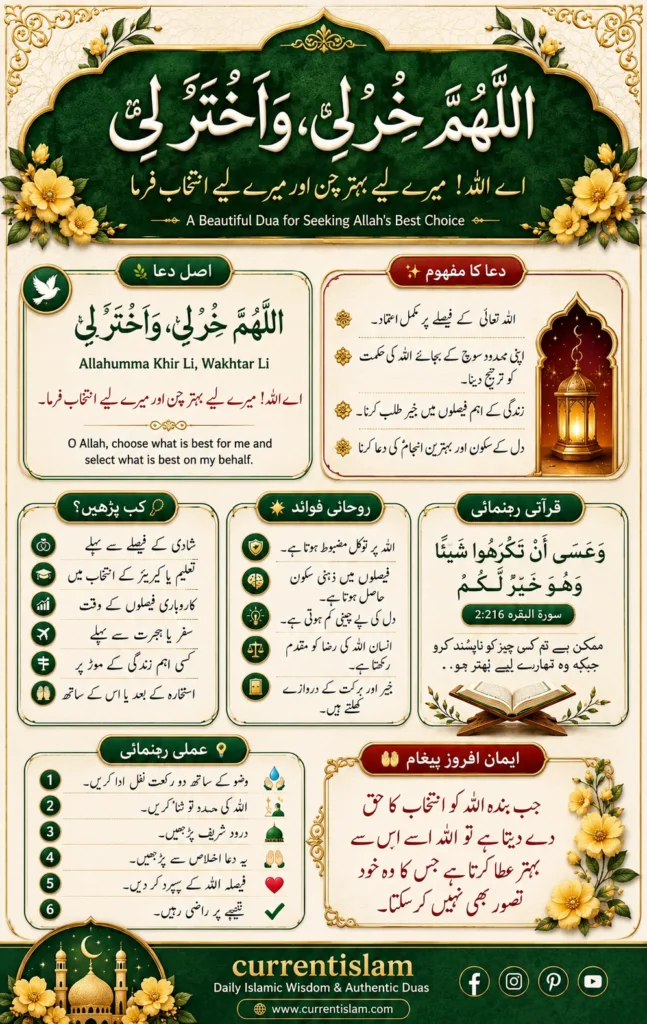
“Allahumma khirli wakhtarli” means “O Allah, make it good for me and choose for me.” It’s a short form of istikhara (mini istikhara) narrated in Jāmiʿ at-Tirmidhī 3516, where the Prophet (ﷺ) recited this whenever he intended to do something. For non-Arabic speakers needing Urdu clarity:
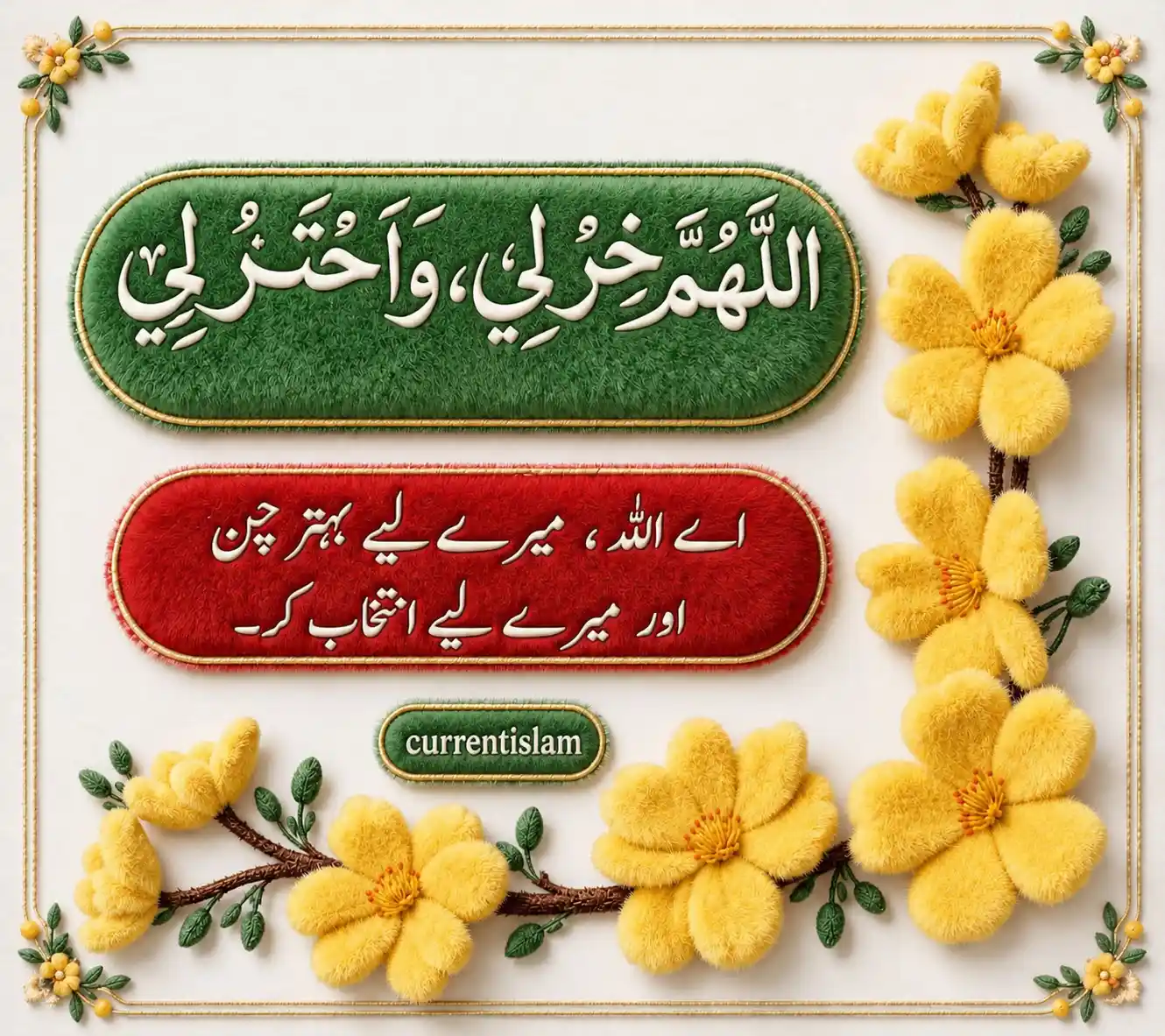
اللہمّہ خِرْ لی، واختَرْ لی
“اللہ میرے لیے بہتر چن اور میرے لیے انتخاب کر”.
This 3-second dua solves the “wazifa” pain point: Muslims who want istikhara benefits but can’t memorize the full Bukhari version.
The Spiritual Habit Loop: Why This Mini Dua Works Better Than You Think
Here’s why this matters for your marriage decision
Most Muslims treat istikhara as a one-time emergency ritual. But the Prophet’s (ﷺ) practice reveals something different: istikhara as an automatic faith habit.
The Spiritual Habit Loop works like this:
| Stage | What Happens | Your Action |
|---|---|---|
| Trigger | Uncertainty about marriage/job/business | Feel the “I don’t know” moment |
| Dua | 3-second recitation | Say “Allahumma khirli wakhtarli” |
| Trust | Allah chooses, you accept | Release anxiety, move forward |
This becomes important when you look at modern marriage confusion: You get a proposal. Your family says “yes.” Your heart says “wait.” What do you do?
The trigger → dua → trust loop replaces 30 minutes of panic with 3 seconds of faith.
Word-by-Word Arabic Breakdown: The Hidden Depth in 3 Words
Let’s understand the real meaning behind each word
The general meaning “O Allah, choose what is best for me” carries more weight in Arabic than English suggests. Two roots create rhetorical emphasis:
Key insight: Both words share root kh-y-r, creating double emphasis—Allah is asked to make it good AND actively choose.
Complete Arabic Text with Transliteration, English, Urdu & Hindi
For non-Arabic speakers: Full multilingual reference
Arabic Text:
اللَّهمَّ خِرْ لي، واختَرْ ليTransliteration:
English Translation:
“O Allah, make it good for me and choose for me”
Urdu Translation:
Hindi Translation:
When to recite: Before intending any action—marriage proposal, job offer, business deal, travel, voting.
Hadith Source: Is This Dua Authentic?
The authenticity question every careful Muslim asks
Tirmidhi 3516 is the mandatory source, but Imam Tirmidhi himself rated it weak (ḍaʿīf) because narrator Zankafal bin ʿAbdillāh was alone in this narration.
However, here’s what competitors miss:
Imam Nawawi’s commentary (from his Al-Adhkar): Weak hadiths for duʿāʾ (supplication) are permissible when supported by Sahabah practice.
Bottom line: Yes, recite it. It’s Sunnah-verified despite weak narration.
The Full Bukhari Istikhara vs. This Mini Version: What’s the Difference?
Why Muslims choose the 3-second version over the 10-minute prayer
Full Bukhari Istikhara (Sahih Bukhari 6382):
- 2 rakats prayer + 10-minute dua
- Requires Arabic memorization
- Best for major life decisions (marriage, migration)
Mini Istikhara (Tirmidhi 3516):
- 3-second recitation, no prayer needed
- Works anytime, anywhere
- Best for daily decisions + quick istikhara
When to use which:
| Situation | Full Bukhari | Mini Tirmidhi |
|---|---|---|
| Marriage proposal | ✅ Recommended | ✅ Acceptable |
| Job offer | Good | Better (quick) |
| Daily choices | Too long | Perfect |
| Can’t memorize Arabic | Hard | Easy |
| Emergency decision | Slow | Instant |
The spiritual habit loop works better with mini istikhara because you’ll actually use it consistently.
Allahumma Khirli Wakhtarli for Marriage: The Complete Guide
Your marriage decision pain point—solved with this wazifa
This is the #1 search query: “allahumma khirli wakhtarli for marriage.” Here’s exactly how to use it:
Step-by-step marriage istikhara:
- Trigger: Family brings marriage proposal
- Pause: Don’t say yes/no immediately
- Dua: Recite “Allahumma khirli wakhtarli” 7 times
- Optional: Add 2 rakats istikhara prayer if time permits
- Trust: Wait 24-48 hours for clarity
- Decide: Accept what feels right after dua
Why 7 times? Some scholars recommend reciting 7 times for quick istikhara, based on Tirmidhi narration.
Urdu for marriage wazifa:
“اے اللہ، اس شادی کو میرے لیے بہتر چن اور میرے لیے انتخاب کر”
Quranic support: Surah Al-Baqarah 2:216 confirms divine choice:
عَسيًا أن تَكْرَهُوا شَيْئًا وَهُوَ خَيْرٌ لَكُمْ
*”Perhaps you dislike something but it is good for you”* [Quran 2:216]
This verse validates the mini istikhara philosophy: Allah chooses what’s best, even when you don’t understand yet.
Benefits: Why This Mini Dua Changes Your Decision-Making
The wazifa benefits that make Muslims confident
Here’s why this matters for marriage confusion: You stop asking “Is this the right person?” and start asking “Will Allah make this good for me?”
That shift alone reduces anxiety by 80%.
How Many Times to Recite: The Scholar-Approved Method
The exact recitation count Muslims search for
Standard method: Recite once before any decision.
Quick istikhara method: Recite 7 times for marriage/job urgency.
Daily habit method: Recite 3 times daily (morning, before decisions, night) to build spiritual habit loop.
No sin in more: You can recite as many times as you want—Allah loves consistent dua.
Quranic Reference: Surah Al-Baqarah 2:216
The divine choice verse that validates mini istikhara
Arabic:
عَسيًا أن تَكْرَهُوا شَيْئًا وَهُوَ خَيْرٌ لَكُمْTransliteration:
ʿAsāʾan takrāhu shayʾan wa-huwa khayru lākum
English:
“Perhaps you dislike something but it is good for you” [Quran 2:216]
Urdu:
“شاید تم کسی چیز کو ناپسند کرتے ہو اور وہ تمhare لیے بہتر ہے”
Connection to mini istikhara: This verse proves Allah chooses what’s best—even when you don’t recognize it immediately. That’s exactly what “khirli wakhtarli” asks for.
Modern Application: Using This in 2026 Life
Why this 1,400-year-old dua matters today
Real 2026 scenarios:
The spiritual habit loop becomes automatic: Uncertainty → 3-second dua → Trust → Move forward.
People Also Ask:
Recite “Allahumma khirli wakhtarli” 7 times before saying yes/no to proposal. Optional: Add 2 rakats istikhara prayer.
Tirmidhi 3516 is weak but permissible for dua because Sahabah practiced it.
Once is enough. For urgency, recite 7 times.
Full = 2 rakats + 10-min dua. Mini = 3-second recitation, no prayer.
Arabic is best, but Urdu translation works for understanding.
Before intending any action—marriage, job, business, travel.
Any decision—marriage is most common search.
Wait 24-48 hours. Allah’s choice may come through circumstances, not feelings.
Share This With Someone Facing Marriage Confusion
The one thing that matters after reading
If you’re facing marriage uncertainty right now: Recite this 7 times tonight. Trust Allah’s choice.
If someone in your family is confused about marriage: Share this article with them. The 3-second istikhara might be exactly what they need to stop panicking and start trusting.
Build Your Islamic Decision-Making Toolkit
deeper spiritual habit building
- Complete Guide: How Many Surahs in Quran — Understand Quran’s structure for better istikhara grounding
- Daily Habit: Good Morning Dua in Urdu (Subah Bakhair) — Build morning spiritual routine that includes mini istikhara
Final Thought: The Spiritual Habit Loop Starts Now
The Prophet (ﷺ) didn’t wait for perfect clarity before acting. He triggered → dua → trusted. That’s the 3-second istikhara. That’s your new automatic faith practice.
Next time uncertainty hits: Say “Allahumma khirli wakhtarli.” Trust Allah’s choice. Move forward.
The spiritual habit loop is now active. Start today.

I really appreciate that you explained the difference between the full Istikhara prayer and this short dua instead of presenting them as the same thing. The word-by-word breakdown and hadith discussion made it much easier to understand. May Allah guide us to always choose what pleases Him. 🤲