Have you ever felt a sudden heaviness in your chest, a quiet, lingering sorrow that no conversation seems to fix? For generations, Muslims have turned not just to silence, but to the rhythmic, tear-filled melodies of Naat to find their emotional anchor. The words of “Ho Karam Sarkar” are far more than beautiful poetry. They serve as a desperately needed exhale for the anxious heart, a bridge connecting our temporary worldly grief to the eternal comfort of prophetic guidance.
Here is why this matters. When words fail us, reciting the praises of the Prophet Muhammad (PBUH) gives our pain a voice and our hope a direction. Let’s explore the profound meaning, exact lyrics, and the psychological comfort embedded in this timeless recitation.
Why Ho Karam Sarkar Resonates in the Modern Heart
Ho Karam Sarkar” remains a globally cherished Naat because it directly addresses human vulnerability. By asking for the Prophet’s (PBUH) intercession during times of immense sorrow, the reciter acknowledges their own limitations, replacing feelings of modern anxiety and isolation with deep spiritual reliance and hope.
When we experience overwhelming stress, the human mind naturally creates a continuous loop of worry. We constantly replay our problems. The recitation of a beautifully structured Naat interrupts this negative cycle. It acts as a behavioral and emotional reset. By engaging in auditory zikr—listening to or reciting rhythmic, meaningful words—we shift our cognitive focus from our own perceived failures to the boundless mercy associated with the Prophet (PBUH). This isn’t just tradition; it is a profound method of emotional regulation, offering a stable anchor when the world feels unpredictable.
Ho Karam Sarkar Naat Lyrics: Complete Text and Transliteration
Finding the exact, accurate lyrics to “Ho Karam Sarkar” is essential for proper recitation and spiritual connection. Below, you will find the flawless Urdu script, the easy-to-read Roman English transliteration, and a deeply emotional English translation to help you internalize the meaning of every single verse.
Ho Karam Sarkar Naat Lyrics in Urdu Text
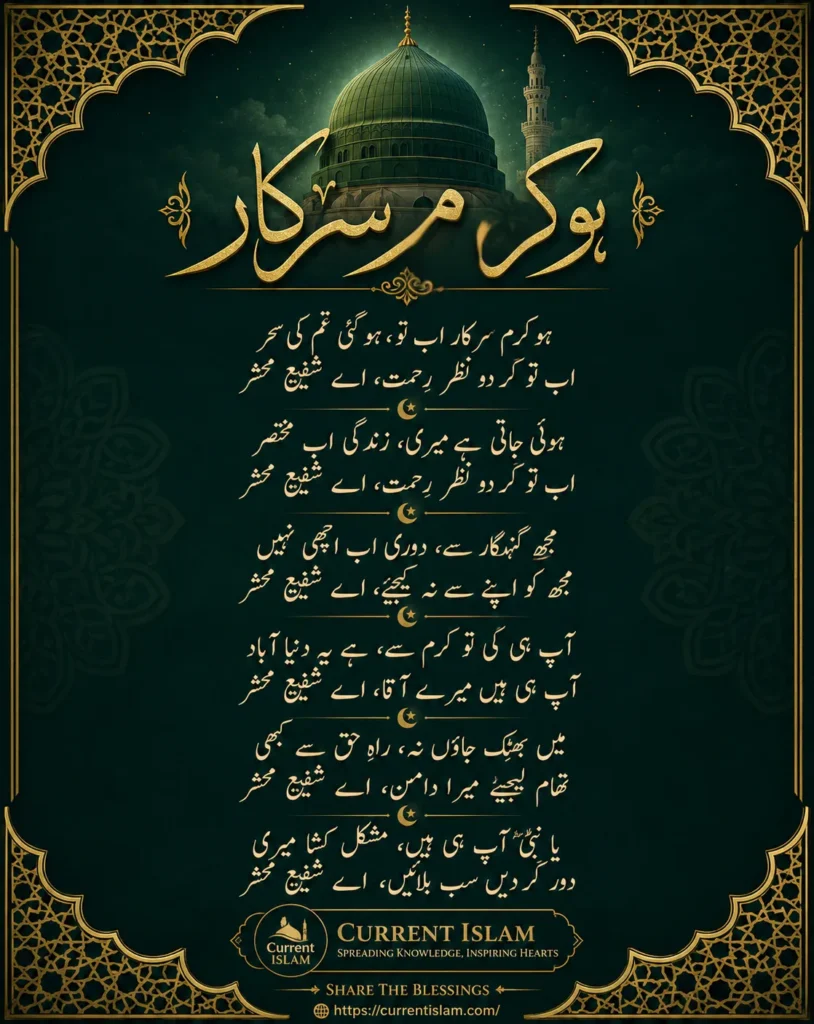
ہو کرم سرکار اب تو، ہو گئی غم کی سحر اب تو کر دو نظرِ رحمت، اے شفیعِ محشر
ہوئی جاتی ہے میری، زندگی اب مختصر اب تو کر دو نظرِ رحمت، اے شفیعِ محشر
مجھ گنہگار سے، دوری اب اچھی نہیں مجھ کو اپنے سے نہ کیجیے، اے شفیعِ محشر
آپ ہی کی تو کرم سے، ہے یہ دنیا آباد آپ ہی ہیں میرے آقا، اے شفیعِ محشر
میں بھٹک جاؤں نہ، راہِ حق سے کبھی تھام لیجیے میرا دامن، اے شفیعِ محشر
یا نبیؐ آپ ہی ہیں، مشکل کشا میری دور کر دیں سب بلائیں، اے شفیعِ محشر
Ho Karam Sarkar Naat Lyrics Roman English
Ho karam sarkar ab to, ho gai gham ki sahar Ab to kar do nazr-e-rehmat, Ae Shafe-e-Mehshar
Hui jaati hai meri, zindagi ab mukhtasar Ab to kar do nazr-e-rehmat, Ae Shafe-e-Mehshar
Mujh gunahgar se, doori ab achi nahi Mujh ko apne se na kijiye, Ae Shafe-e-Mehshar
Aap hi ki to karam se, hai yeh duniya aabad Aap hi hain mere aqa, Ae Shafe-e-Mehshar
Main bhatak jaun na, raah-e-haq se kabhi Thaam lijiye mera daaman, Ae Shafe-e-Mehshar
Ya Nabi aap hi hain, mushkil kusha meri Door kar dein sab balayein, Ae Shafe-e-Mehshar
English Translation and Spiritual Meaning
- “Bestow your favor, O Master, for the dawn of sorrow has arrived.” The reciter admits they are at their breaking point. The “dawn of sorrow” represents those moments when anxiety is at its peak.
- “Now, cast a glance of mercy, O Intercessor of the Day of Judgment.” This is the core plea. Shafe-e-Mehshar refers to the Prophet’s exclusive role in interceding for his Ummah when they need it most.
- “My life is rapidly becoming shorter.” A powerful reflection on mortality. It brings the reader back to reality, reminding us that time is running out to seek forgiveness and spiritual purity.
- “Hold onto my hem, lest I stray from the path of truth.” This becomes important when you look at the distractions of modern life. It is a request for behavioral guidance, asking the Prophet’s teachings to act as a safeguard against losing one’s moral compass.
Auditory Zikr Against Anxiety
The “Spiritual Habit Loop” is the practice of replacing negative thought patterns with the rhythmic recitation of Islamic poetry and Durood. Listening to “Ho Karam Sarkar” serves as an auditory trigger that calms the nervous system and redirects the mind toward divine mercy.
Let’s understand the real meaning behind our emotional reactions to Naat. We live in an era characterized by sensory overload and persistent digital distractions, which naturally elevate our stress hormones. When you intentionally play or recite “Ho Karam Sarkar,” you are engaging in a highly effective coping mechanism.
The repetition of the plea “Ab to kar do nazr-e-rehmat” (Now, cast a glance of mercy) acts as a grounding technique. It allows the reciter to verbally release their burdens. This classical Islamic practice of praising the Prophet (PBUH) through poetry provides a safe, structured environment for emotional expression. By embedding this auditory zikr into your daily routine, you create a spiritual habit loop that consistently buffers against daily anxieties, reinforcing the pursuit of Islamic mindfulness.
Quranic and Prophetic Foundations of Naat
Reciting Naat is deeply rooted in Islamic tradition. The Quran directly commands believers to send blessings upon the Prophet (PBUH), and authentic Hadith confirm that expressing love for him through poetry and praise elevates a believer’s spiritual status and secures his intercession.
To ensure our practices are firmly grounded, we must look to the foundational texts of Islam. The tradition of classical Islamic poetry traditions dates back to the time of the Prophet (PBUH) himself, notably through his companion Hassan ibn Thabit (R.A.), who used his poetic mastery to defend and praise the Messenger of Allah.
The Divine Command for Salawat (Surah Al-Ahzab 33:56)
Arabic Verse:
إِنَّ ٱللَّهَ وَمَلَٰٓئِكَتَهُۥ يُصَلُّونَ عَلَى ٱلنَّبِىِّ ۚ يَٰٓأَيُّهَا ٱلَّذِينَ ءَامَنُوا۟ صَلُّوا۟ عَلَيْهِ وَسَلِّمُوا۟ تَسْلِيمًا
Transliteration: Inna Allaha wa mala’ikatahu yusalloona ‘ala an-nabi, ya ayyuha allatheena amanoo salloo ‘alayhi wasallimoo tasleema.
English Translation: “Indeed, Allah confers blessing upon the Prophet, and His angels [ask Him to do so]. O you who have believed, ask [Allah to confer] blessing upon him and ask [Allah to grant him] peace.” (Quran 33:56)
Urdu Translation:
بیشک اللہ اور اس کے فرشتے نبی پر درود بھیجتے ہیں، اے ایمان والو! تم بھی ان پر درود اور خوب سلام بھیجو۔
Reliable Commentary (Tafseer):
Scholars of Tafseer note that this is a profoundly unique divine command. While Allah commands us to perform acts like prayer and fasting, He does not do these things Himself. However, Allah Himself sends blessings upon the Prophet (PBUH) before commanding the believers to do the same. This highlights the immense spiritual magnitude and exalted status of engaging in Salawat (sending blessings).
Clear Modern Relevance:
Whenever we recite a beautifully structured Naat like “Ho Karam Sarkar,” we are actively fulfilling this exact Quranic injunction. Here’s why this matters: it provides a practical, melodic way to integrate the command of sending blessings into our daily routines, ensuring our tongues remain moist with a practice deeply beloved by the Creator.
The Promise of Intercession (Jami` at-Tirmidhi)
Arabic Hadith:
أَوْلَى النَّاسِ بِي يَوْمَ الْقِيَامَةِ أَكْثَرُهُمْ عَلَيَّ صَلَاةً
Transliteration: Awla an-nasi bi yawm al-qiyamati aktharuhum ‘alayya salatan.
English Translation: “The closest people to me on the Day of Resurrection will be those who send the most blessings upon me.” (Jami` at-Tirmidhi)
Urdu Translation:
قیامت کے دن لوگوں میں سے میرے سب سے زیادہ قریب وہ شخص ہوگا جو مجھ پر سب سے زیادہ درود بھیجتا ہوگا۔
Reliable Commentary:
Imam Tirmidhi grades this Hadith as sound (Hasan). It establishes a direct, undeniable correlation between the frequency of praising the Prophet (PBUH) and a believer’s proximity to him in the Hereafter. It highlights that sending blessings is not just a worldly act of devotion, but a strategic spiritual investment for the Day of Judgment.
Clear Modern Relevance:
This Hadith validates the very core message of “Ho Karam Sarkar.” When the poet cries out “Ae Shafe-e-Mehshar” (O Intercessor of the Day of Judgment), it is not an empty wish or mere poetry. It is a profound, active hope grounded entirely in this prophetic promise, offering immense comfort to believers navigating the trials of modern life.
People Also Ask:
“Ho Karam Sarkar” translates to “Bestow your favor, O Master” or “Show your mercy, O Leader.” It is an emotional plea directed toward the Prophet Muhammad (PBUH), asking for his spiritual guidance, mercy, and intercession during times of extreme hardship.
While many have recited this beautiful Naat, Awais Raza Qadri is globally recognized for his incredibly emotional and powerful rendition. His specific style has helped popularize the Naat across South Asia and the diaspora.
“Shafe-e-Mehshar” is an Arabic and Urdu title that means “The Intercessor of the Day of Gathering (Judgment Day).” It is a title given exclusively to Prophet Muhammad (PBUH), reflecting the Islamic belief that he will intercede on behalf of humanity before Allah.
Gham ki sahar” translates to “the dawn of sorrow.” It is a poetic metaphor used to describe a period in life where sadness and difficulties have completely overshadowed a person, making them desperate for the spiritual light and mercy of the Prophet (PBUH).
Yes, reciting Naat is a highly rewarded spiritual practice. Because the core of any Naat is sending peace and blessings upon the Prophet Muhammad (PBUH), it falls directly under the Quranic command to engage in Salawat and Durood, making it a powerful act of devotion.
Elevate Your Daily Spiritual Routine
Understanding the profound meaning behind the words we recite is the first step toward transforming our hearts. To truly benefit from the spiritual habit loop, consistency is key.
- Subscribe to our “Weekly Spiritual Refinement” Newsletter to receive curated insights on the psychology of Islamic spirituality, beautiful Naat explanations, and practical tips for finding peace in a chaotic world directly in your inbox.
- Free Download: Claim your beautifully designed PDF containing the Arabic, Urdu, and English texts of “Ho Karam Sarkar,” paired with a tracker for your daily Durood habits. Keep it on your device as a constant, calming reminder of sending blessings upon the Prophet.
