Have you ever found yourself quietly humming a melody that instantly settles your mind and brings peace to your heart? For generations, millions across the globe have found that exact comfort in the profound words of Hasbi Rabbi Jallallah. More than just a beautiful recitation, these words are a psychological anchor, a historical testament, and a direct line to divine reliance.
Here’s why this matters. To truly grasp the impact of these verses, we must look beyond the rhythm and understand the powerful declarations of faith and historical resilience woven into every line.
What Does Hasbi Rabbi Jallallah Mean?
Hasbi Rabbi Jallallah translates to “My Lord is sufficient for me; Glory be to Allah.” This powerful phrase is a core declaration of Islamic faith, emphasizing absolute reliance on the Creator while purifying the heart from worldly anxieties and spiritual distractions.
Let’s understand the real meaning of the core refrain. It is a masterful distillation of Islamic theology into a few easily recited syllables.
- Hasbi Rabbi Jallallah: A declaration of Tawakkul (reliance on God). It trains the mind to let go of the illusion of control and trust the Divine.
- Ma fi Qalbi Ghairullah: “There is nothing in my heart except Allah.” This represents the behavioral shift required to detach from materialism, ego, and fear.
- Noor-e-Muhammad Sallallah: “The Light of Muhammad, peace and blessings be upon him.” Acknowledging the Prophet as the ultimate guide to this divine truth.
- La ilaha illallah: The foundational Tawheed and Kalima, meaning “There is no god but Allah.”
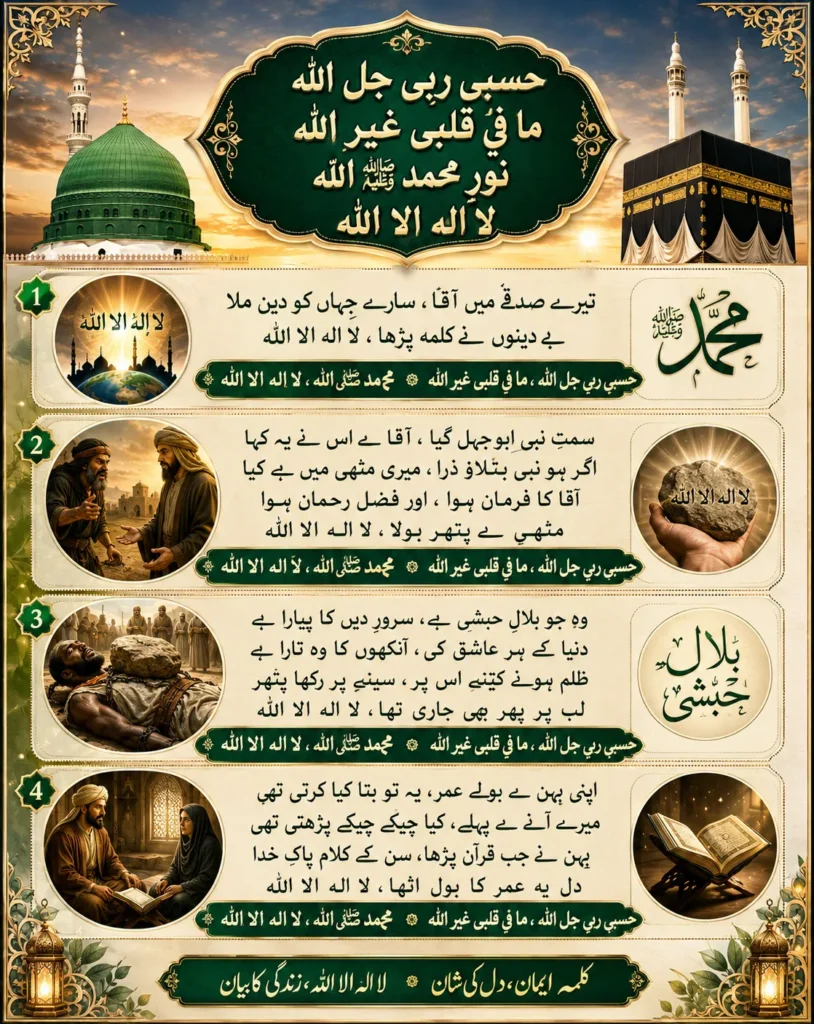
Complete Urdu Naat Lyrics, Transliteration, and Translation
Finding accurate Urdu Naat lyrics alongside proper transliteration is often a challenge for non-native speakers. Below is the complete, line-by-line breakdown to help you memorize, recite, and understand the depth of this beautiful poem.
The Chorus
Urdu:
حسبی ربی جل اللہ، ما فی قلبی غیر اللہ
Transliteration: Hasbi Rabbi jallallah, Ma fi qalbi ghairullah.
English: My Lord is sufficient for me, Glory be to Allah. There is nothing in my heart except Allah.
Stanza 1: The Miracle of the Pebbles
Urdu:
سمتِ نبی ابو جہل گیا، آقا سے اس نے یہ کہا اگر ہو نبی بتلاؤ ذرا، میری مٹھی میں ہے کیا
Transliteration: Simt-e-Nabi Abu Jahl gaya, Aqa se usne yeh kaha Agar ho Nabi batlao zara, Meri mutthi mein hai kya.
English: Abu Jahl went towards the Prophet, and said to the Master: If you are a Prophet, tell me, what is in my closed fist?
Urdu:
آقا کا فرمان ہوا، اور فضلِ رحمان ہوا مٹھی سے پتھر بولا، لا الہ الا اللہ
Transliteration: Aqa ka farman hua, aur fazl-e-Rahman hua, Mutthi se patthar bola, La ilaha illallah.
English: The Master commanded, and the grace of the Merciful occurred, From the fist, the stone spoke: There is no god but Allah.
Stanza 2: The Resilience of Hazrat Bilal
Urdu:
وہ جو بلالِ حبشی ہے، سرورِ دیں کا پیارا ہے دنیا کے ہر عاشق کی، آنکھوں کا وہ تارا ہے
Transliteration: Woh jo Bilal-e-Habshi hai, Sarwar-e-deen ka pyara hai, Dunya ke har ashiq ki, Aankhon ka woh tara hai.
English: He who is Bilal of Abyssinia, the beloved of the Master of Religion, Of every lover in the world, he is the star of their eyes.
Urdu:
ظلم ہوئے کتنے اس پر، سینے پر رکھا پتھر لب پر پھر بھی جاری تھا، لا الہ الا اللہ
Transliteration: Zulm hue kitne us par, Seene par rakha patthar, Lab par phir bhi jari tha, La ilaha illallah.
English: How much cruelty was inflicted upon him, a boulder placed on his chest, Yet on his lips remained: There is no god but Allah.
Stanza 3: The Transformation of Hazrat Umar
Urdu:
اپنی بہن سے بولے عمر، یہ تو بتا کیا کرتی تھی میرے آنے سے پہلے، کیا چپکے چپکے پڑھتی تھی
Transliteration: Apni behen se bole Umar, Yeh to bata kya karti thi, Mere aane se pehle, Kya chupke chupke parhti thi.
English: Umar said to his sister, Tell me, what were you doing? Before my arrival, what were you secretly reading?
Urdu:
بہن نے جب قرآن پڑھا، سن کے کلامِ پاکِ خدا دل یہ عمر کا بول اٹھا، لا الہ الا اللہ
Transliteration: Behen ne jab Quran parha, Sun ke kalam-e-pak-e-Khuda, Dil yeh Umar ka bol utha, La ilaha illallah.
English: When his sister read the Quran, hearing the pure word of God, The heart of Umar cried out: There is no god but Allah.
Stories of the Sahaba: The Historical Context
This specific Naat is a profound example of Seerah in Islamic poetry. It does not just offer praise; it serves as a lyrical history lesson, documenting the psychological and physical endurance of the early Muslims.
The Psychological Shift of Umar ibn al-Khattab The stanza detailing Hazrat Umar’s conversion highlights a profound internal transformation. Initially filled with anger, Umar’s cognitive state was completely altered by the auditory and spiritual resonance of the Quran.
Quranic Reference: Surah Ta-Ha (20:1-5)
﴾طه ﴿١﴾ مَا أَنزَلْنَا عَلَيْكَ الْقُرْآنَ لِتَشْقَىٰ ﴿٢﴾ إِلَّا تَذْكِرَةً لِّمَن يَخْشَىٰ ﴿٣
Transliteration: Ta-Ha. Ma anzalna ‘alaykal-qur’ana litashqa. Illa tazkiratal-limay-yakhsha.
English Translation:
“Ta, Ha. We have not sent down to you the Qur’an that you be distressed. But only as a reminder for those who fear [Allah].”
Urdu Translation:
طہٰ۔ ہم نے تم پر یہ قرآن اس لیے نازل نہیں کیا کہ تم مشقت میں پڑ جاؤ۔ بلکہ یہ تو اس شخص کے لیے نصیحت ہے جو (خدا سے) ڈرتا ہے۔
Core Lessons and Context
- 💡 Clear Modern Relevance: This historical event demonstrates how divine words act as a psychological intervention, turning hostility into profound tranquility and leadership.
- 🤍 Respectful Interpretation: Umar’s story reminds us that no heart is too hard to be softened by the truth, and true strength lies in submitting to divine guidance.
The Endurance of Bilal ibn Rabah The verses recalling the torture of Hazrat Bilal (RA) show the triumph of spiritual resilience over physical suffering. The boulder on his chest was heavy, but his behavioral conditioning—anchored in the concept of Ahad (The One)—rendered the physical pain secondary to his spiritual conviction.
Psychological Calm: Why This Islamic Zikr Matters Today
Islamic Zikr and Nasheeds are not merely cultural art forms; they are proven methods for emotional regulation. The rhythmic repetition of divine names lowers stress and brings the mind back to the present moment, away from the anxieties of the future.
Quranic Reference: Surah Ar-Ra’d (13:28)
الَّذِينَ آمَنُوا وَتَطْمَئِنُّ قُلُوبُهُم بِذِكْرِ اللَّهِ ۗ أَلَا بِذِكْرِ اللَّهِ تَطْمَئِنُّ الْقُلُوبُ
Transliteration: Allatheena amanoo watatma-innu quloobuhum bithikri Allahi; ala bithikri Allahi tatma-innu alquloob.
English Translation:
“Those who have believed and whose hearts have rest in the remembrance of Allah. Unquestionably, by the remembrance of Allah hearts are assured.”
Urdu Translation:
جو لوگ ایمان لائے اور ان کے دل اللہ کے ذکر سے اطمینان پاتے ہیں۔ سن لو! اللہ کے ذکر ہی سے دلوں کو اطمینان نصیب ہوتا ہے۔
Core Lessons and Context
- 💡 Clear Modern Relevance: In an era of digital overload and constant stress, repeating a phrase like Hasbi Rabbi Jallallah serves as a powerful grounding technique.
- 🤍 Respectful Interpretation: God designed the human heart to seek peace, and this verse confirms that ultimate peace is only achieved when the mind aligns with its Creator through continuous remembrance.
Now let’s connect this to daily life. Make reciting this phrase a conscious habit during your commute, while walking, or when feeling overwhelmed. The integration of this Zikr aligns your behavioral responses with the peaceful rhythm of faith.
People Also Ask:
The exact origin of the traditional Urdu verses is deeply rooted in oral South Asian Islamic traditions. While the core Arabic refrain is a universal Zikr passed down through generations, the Urdu stanzas regarding the Stories of the Sahaba have been adapted and refined by various classic Sufi poets and scholars over time.
Reciting this phrase instills a deep sense of Tawakkul (trust in God). It spiritually protects the reciter from despair, reduces psychological anxiety by shifting focus away from worldly problems, and purifies the heart by affirming the oneness of Allah.
It functions as both. The melodic recitation of the historical stories makes it a Naat (poetry in praise of the Prophet PBUH and his companions), while the repetitive Arabic chorus is an established Zikr used to remember Allah and ground the soul.
