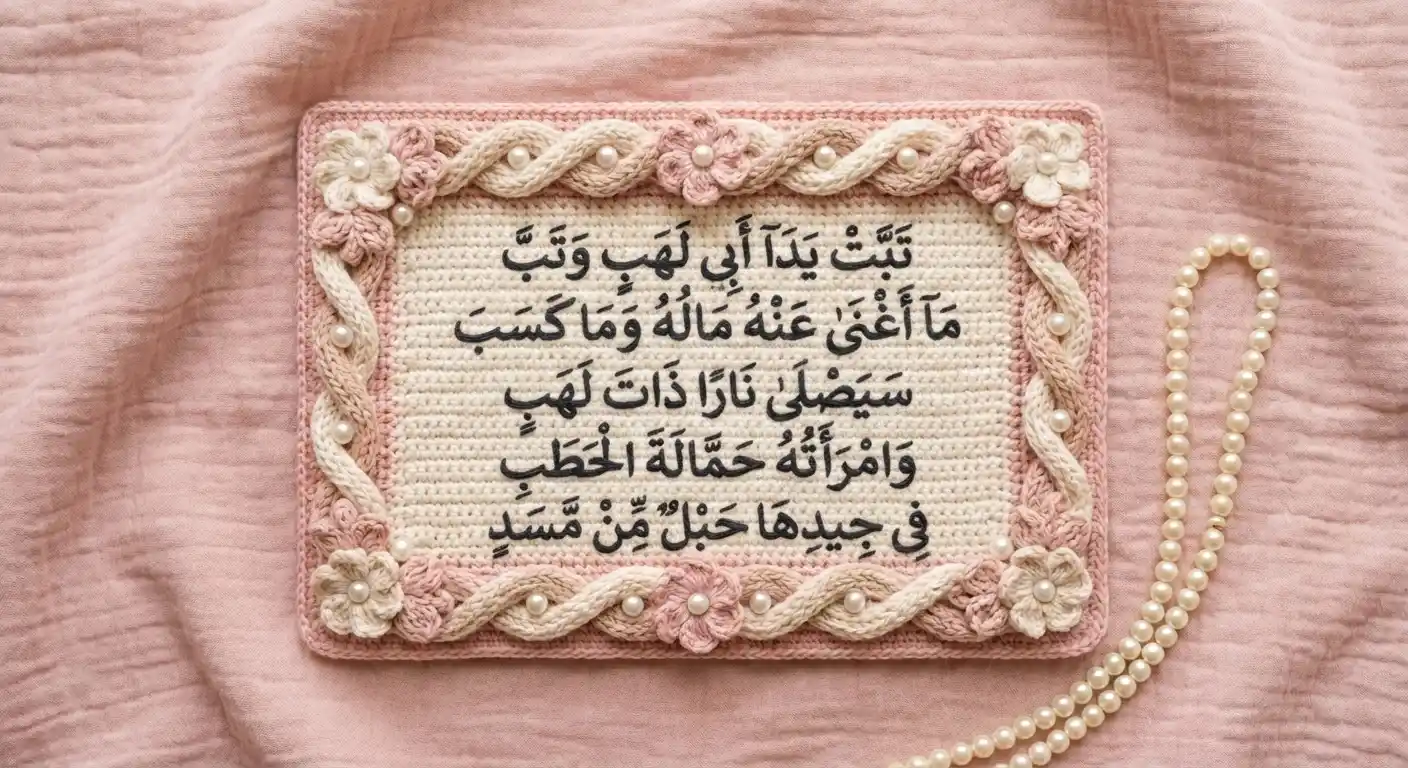
Have you ever felt betrayed by the very people who were supposed to protect you? It is a painful reality that even the holiest people faced: family toxicity. Surah Al-Masad isn’t just a historical curse on an enemy; it is Allah’s timeless promise that He defends the believers against wealth, status, and even their own bloodline when those things turn against the Truth. If you are struggling with “bad nazar” (evil eye) or arrogance from others, this Surah is your spiritual shield.
1. What is Surah Al-Masad (Surah Lahab)?
Surah Al-Masad, also known as Surah Lahab, is the 111th chapter of the Quran with 5 verses. It was revealed in Makkah to condemn Abu Lahab, an uncle of Prophet Muhammad (PBUH), and his wife for their severe opposition to Islam. It serves as a warning against arrogance and reliance on worldly wealth.
2. Surah Al-Masad: Arabic, Transliteration, English & Urdu
You can read Surah Al-Masad in Arabic, English, and Urdu below. It begins with “Tabbat yada Abi Lahab” which translates to “May the hands of Abu Lahab be ruined.”
سورہ المسد (لہب) – اردو ترجمہ
بامحاورہ ترجمہ: فتح محمد جالندھری
خلاصہ: یہ سورہ غرور اور اسلام دشمنی کے انجام کو بیان کرتی ہے۔
Here is the transliteration and English translation of Surah Al-Lahab (also known as Surah Al-Masad), the 111th chapter of the Quran.
Surah Al-Lahab (The Flame)
Bismillāhi r-raḥmāni r-raḥīm (In the name of Allah, the Entirely Merciful, the Especially Merciful)
1. Tabbat yadā abī Lahabin wa tabb
May the hands of Abu Lahab be ruined, and ruined is he.
2. Mā aghnā ʿanhu māluhu wa mā kasab
His wealth will not avail him or that which he gained.
3. Sayaṣlā nāran dhāta lahab
He will [enter to] burn in a Fire of [blazing] flame.
4. Wa mraʾatuhu ḥammālata l-ḥaṭab
And his wife [as well]—the carrier of firewood.
5. Fī jīdihā ḥablun min masad
Around her neck is a rope of [twisted] fiber.
3. Word-by-Word Analysis & Tafseer
The phrase “Tabbat Yada” means “perish the hands,” symbolizing the total loss of power. “Al-Masad” refers to a twisted rope of palm fiber, representing the punishment awaiting Abu Lahab’s wife for spreading thorns and slander against the Prophet.
- Tabbat (تَبَّتْ): Perished, ruined, or broken. It implies a loss that cannot be recovered.
- Waatab (وَتَبَّ): And he is doomed. The first part refers to his actions (hands), the second to his person.
- Hammalat al-hatab (حَمَّالَةَ الْحَطَبِ): “The carrier of firewood.” Ibn Kathir explains this metaphorically: she used to carry slander and gossip to ignite “fires” between people, just as wood ignites fire.
The Lesson for 2026:
Wealth and connections (networking) are the gods of the modern era. This Surah shatters that illusion. Abu Lahab was the “elite” of Makkah, yet his status could not save him.
2. Why is it called “Tabat Surah”?
“Tabat Surah” is a common nickname for Surah Al-Masad, taken directly from the very first word of the chapter, “Tabbat,” which means “Perish” or “Ruined.” It is frequently used by students and beginners to easily identify the Surah by its sound.
4. The Story of Surah Lahab (For Kids & Beginners)
The story of Surah Lahab begins at Mount Safa. When Prophet Muhammad (PBUH) gathered his family to warn them of judgment, his uncle Abu Lahab shouted, “May you be ruined! Did you gather us for this?” Allah immediately revealed this Surah to defend His Prophet.
Tell this to your children:
Imagine someone bullying you just because you told the truth. That is what happened to our Prophet (PBUH). His own uncle threw stones at him and told people not to listen to him. His aunt (Umm Jamil) would place thorns on the path where the Prophet walked. But did the Prophet fight back with insults? No. Allah fought for him by revealing this Surah. It teaches us that when we are bullied for doing good, Allah is on our side.
5. Benefits and Wazifa (41 Times & 100 Times)
While the Sunnah is to recite Surah Al-Masad for reflection and during prayers, many spiritual practitioners suggest reciting it for protection against enemies and removing the effects of jealousy (hasad).
- Protection from Zalim (Oppressors):Scholars and spiritual practitioners often recommend reciting this Surah when dealing with an unjust enemy who is relentless.
- The Method (Based on Tajrubat/Experience): Reciting it 41 times continuously (with Durood Shareef before and after) is often done with the intention of stopping the harm of an oppressor.
- Spiritual Detox (100 Times):Some recite it 100 times to break the “knots” of black magic or severe jealousy, focusing on the verse min masad (twisted rope).
- Note: Always prioritize the 5 daily prayers (Salah) and the morning/evening Adhkar (Sunnah supplications) over specific numbers, as the greatest protection is Taqwa (God-consciousness).
6. People Also Ask:
It is called Surah Al-Masad because the final verse mentions a rope of “Masad” (twisted palm fiber) around the neck of Abu Lahab’s wife, symbolizing her punishment in the afterlife.
Yes, absolutely. It is a part of the Quran and can be recited in any compulsory or voluntary prayer.
Yes, it contains a divine curse upon Abu Lahab and his wife. However, for us, reciting it is an act of worship and a reminder of the consequences of arrogance.
The main message is that family lineage and money have no value in the eyes of Allah if a person opposes the Truth. Only faith and good deeds matter.
