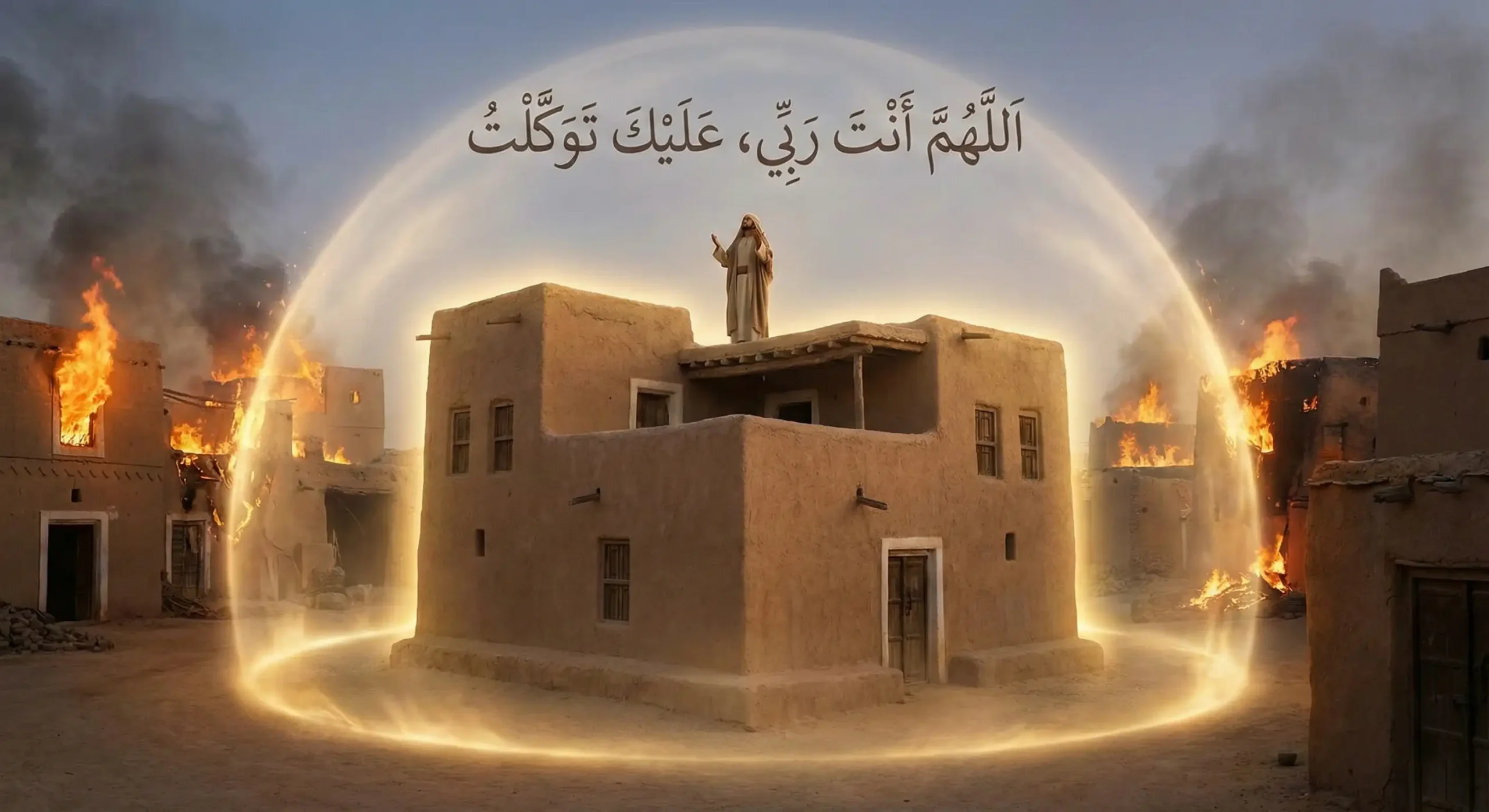
Imagine standing in front of your home, watching the entire neighborhood engulfed in flames, yet feeling absolute, unshakeable peace that your home is safe. This isn’t just optimism; it is the certainty of Tawakkul (Reliance).
This was the state of the great Companion, Abu Darda (RA). When told his house had burned down, he simply replied, “No, it has not.” Why? Because of a specific supplication he had made that morning.
In a world full of unpredictable calamities—from physical accidents to the silent fires of anxiety—the Dua of Abu Darda remains the believer’s ultimate shield.
What is the Dua of Abu Darda?
The Dua of Abu Darda is a comprehensive Islamic supplication recited in the morning and evening for protection against sudden calamities, fire, theft, and loss. It is based on a narration where Abu Darda (RA) expressed absolute confidence that his property was safe due to these specific words taught by the Prophet (ﷺ).
The Story Behind the Supplication
The fame of this Dua comes from a dramatic historical event recorded in books like Ibn al-Sunni. A man rushed to Abu Darda (RA) shouting, “O Abu Darda, your house has burned down!” The fire was massive, consuming the entire area.
Abu Darda (RA) remained calm and replied, “It has not burned. Allah would not do that, because of words I heard from the Messenger of Allah (ﷺ). Whoever says them at the beginning of the day, no calamity will befall him until evening, and whoever says them in the evening, no calamity will befall him until morning.”
When they checked the neighborhood, the fire had destroyed everything surrounding his home but had stopped exactly at his boundary walls.
The Dua: Arabic, English, and Urdu
To ensure this protection is accessible to everyone, here is the complete Dua broken down by language.
1. The Full Arabic Text
اللَّهُمَّ أَنْتَ رَبِّي، لاَ إِلَهَ إِلاَّ أَنْتَ، عَلَيْكَ تَوَكَّلْتُ، وَأَنْتَ رَبُّ الْعَرْشِ الْعَظِيمِ، مَا شَاءَ اللهُ كَانَ، وَمَا لَمْ يَشَأْ لَمْ يَكُنْ، وَلاَ حَوْلَ وَلاَ قُوَّةَ إِلاَّ بِاللهِ الْعَلِيِّ الْعَظِيمِ، أَعْلَمُ أَنَّ اللهَ عَلَى كُلِّ شَيْءٍ قَدِيرٌ، وَأَنَّ اللهَ قَدْ أَحَاطَ بِكُلِّ شَيْءٍ عِلْمًا، اللَّهُمَّ إِنِّي أَعُوذُ بِكَ مِنْ شَرِّ نَفْسِي، وَمِنْ شَرِّ كُلِّ دَابَّةٍ أَنْتَ آخِذٌ بِنَاصِيَتِهَا، إِنَّ رَبِّي عَلَى صِرَاطٍ مُسْتَقِيمٍ
2. Transliteration (For Easy Reading)
Allahumma anta Rabbi, la ilaha illa anta, ‘alayka tawakkaltu, wa anta Rabbul ‘Arshil ‘Azim. Ma sha’ Allahu kana, wa ma lam yasha’ lam yakun, wa la hawla wa la quwwata illa billahil ‘Aliyyil ‘Azim. A’lamu annAllaha ‘ala kulli shay’in qadir, wa annAllaha qad ahata bikulli shay’in ‘ilma. Allahumma inni a’udhu bika min sharri nafsi, wa min sharri kulli dabbatin anta akhidhun bi nasiyatiha, inna Rabbi ‘ala siratim mustaqim.
3. English Translation (Meaning)
“O Allah, You are my Lord, there is no god but You. Upon You I rely, and You are the Lord of the Mighty Throne. What Allah wills comes to pass, and what He does not will does not occur. There is no power and no strength except with Allah, the Most High, the Most Great. I know that Allah has power over all things and that Allah encompasses all things in knowledge. O Allah, I seek refuge with You from the evil of my own self and from the evil of every living creature whose forelock You hold. Verily, my Lord is on a Straight Path.”
4. Urdu Translation (اردو ترجمہ)
اے اللہ! تو ہی میرا رب ہے، تیرے سوا کوئی معبود نہیں، میں نے تیرے ہی اوپر بھروسہ کیا، اور تو عرشِ عظیم کا مالک ہے۔ جو اللہ نے چاہا وہ ہو گیا، اور جو اس نے نہیں چاہا وہ نہیں ہوا۔ گناہوں سے بچنے کی طاقت اور نیکی کرنے کی قوت اللہ کے بغیر ممکن نہیں جو کہ بہت بلند اور عظمت والا ہے۔ میں جانتا ہوں کہ اللہ ہر چیز پر قادر ہے، اور اللہ کا علم ہر چیز کو گھیرے ہوئے ہے۔ اے اللہ! میں تیری پناہ مانگتا ہوں اپنے نفس کے شر سے، اور ہر اس جانور کے شر سے جس کی پیشانی تیرے قبضے میں ہے، بیشک میرا رب سیدھے راستے پر ہے۔
Word-by-Word Deep Analysis
This Dua isn’t just a magic spell; it is a mental realignment. Let’s break down why it works.
| Phrase | Spiritual Meaning |
| Ma sha’ Allahu kana | Acceptance of Destiny: You acknowledge that if the fire burns, it is His will. If it stops, it is His will. This removes the fear of “chance” or “bad luck.” |
| La hawla wa la quwwata | The Transfer of Power: You are admitting, “I cannot save my house.” You transfer the burden of protection from your weak self to the All-Powerful. |
| Anta akhidhun bi nasiyatiha | Total Control: “Holding the forelock” is an ancient idiom for complete dominance. The fire, the thief, or the oppressor is on a leash held by Allah. They cannot bite unless He loosens the leash. |
Is the Dua of Abu Darda Authentic? (Scholarly Note)
While the specific story of the fire is classified as “Da’if” (Weak) by scholars like Al-Albani due to the narrator Al-Aghlab bin Tamim, the text of the Dua itself is sound. Its meanings are fully supported by the Quran and other authentic Hadith, making it permissible and beneficial to recite.
It is crucial to have integrity in our worship.
- The Consensus: Scholars agree that weak hadith can be acted upon for Fada’il al-A’mal (virtuous deeds), especially when the meaning contradicts no Islamic principle.
- The Recommendation: Recite this with the intention of praising Allah and seeking His general protection, rather than believing firmly that it is a guaranteed contract specific to fire, as the chain of narration is not Sahih (rigorously authentic).
The “Anxiety Antidote”: A master plan for 2026
We often worry about physical fires, but what about the “fires” in our minds? The burnout, the panic attacks, the fear of the future?
Here is a new way to use this Dua: The Control-Release Method.
- Trigger: When you feel anxiety rising about a future event (a job interview, a medical test, travel).
- Recite: Ma sha’ Allahu kana, wa ma lam yasha’ lam yakun. (What He wills happens, what He doesn’t will, won’t).
- Release: Visualize the outcome you are afraid of. Now, visualize Allah “holding its forelock.” Realize that the scary outcome literally cannot exist unless Allah allows it for your growth.
- Result: You stop fighting reality and start trusting the Writer of your story.
The Complete Masnoon Dua for Protection
🛡️ The Wazifa of Abu Darda: A Daily Practice for Protection
Best for: Protection of House, Business, Family, and Relief from Anxiety.
Many people search for a specific Wazifa (Spiritual Practice) to protect their property and loved ones. Based on the narration of Abu Darda (RA), scholars and spiritual teachers recommend the following method to lock the doors of calamity before they even open.
The Method (Tarika):
- Timing is Key:
- Morning: Recite immediately after the Fajr Prayer. This provides a “safety shield” until sunset.
- Evening: Recite immediately after the Maghrib Prayer. This provides protection through the dangers of the night.
- The Routine:
- Step 1: Begin with Durood Shareef (e.g., Sallallahu Alayhi Wasallam or Durood-e-Ibrahim) 3 times.
- Step 2: Recite the Dua of Abu Darda (Arabic text above) with full concentration 1 time (or 3 times for extra focus).
- Step 3: Visualize your home, children, and assets being surrounded by the light of Allah’s name.
- Step 4: End with Durood Shareef 3 times.
Common Questions
The best times to recite this Dua are in the early morning (after Fajr prayer) and in the early evening (after Asr or Maghrib prayer) as part of your daily Azkar.
Yes, the Dua seeks refuge from “every living creature,” which includes humans who intend harm, such as thieves or oppressors. It places your property under Allah’s direct supervision.
If you cannot read Arabic, it is permissible to recite the meaning in English or Urdu to ask Allah for protection. However, making an effort to learn the original Arabic is highly rewarded.
Your Next Step
Don’t just read this and close the tab. Right now, take a screenshot of the “Transliteration” section above. Set a reminder on your phone for tomorrow morning after Fajr labeled: “Secure the Fortress.” Try reciting it for 3 days and notice the shift in your peace of mind.
