Facing seemingly impossible odds—whether it is years of unexplained infertility, a stagnant career, or deep-rooted family trauma—drains your soul. For college students facing academic mountains, working professionals battling burnout, or diaspora parents in the West and Asian countries carrying heavy cultural expectations, watching time slip away while a prayer remains unanswered creates suffocating anxiety. You feel forgotten. The exact remedy for this spiritual fatigue lies in the raw vulnerability demonstrated by Prophet Zakariyya. Surah Maryam ayat 4 provides the perfect architectural blueprint for how to ask Allah for a miracle when biology, logic, and time are entirely against you.
What is the Exact Meaning of Surah Maryam Ayat 4?
Surah Maryam ayat 4 means that Prophet Zakariyya confessed his extreme physical weakness and advanced age to Allah, followed by a profound declaration of unwavering hope. It guarantees that true supplication requires admitting utter powerlessness while trusting entirely in God’s past mercy.
Arabic Text:
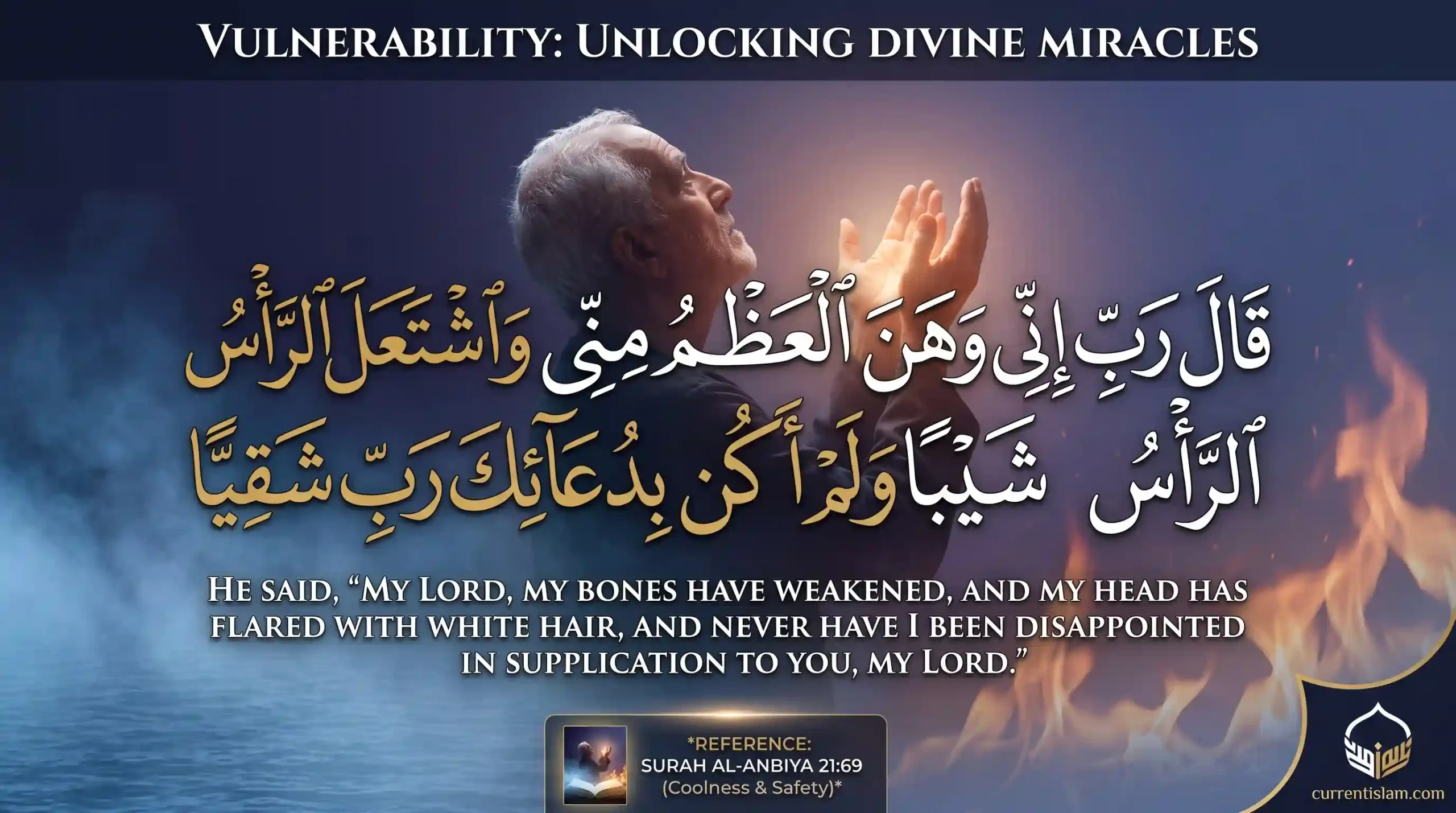
قَالَ رَبِّ إِنِّي وَهَنَ الْعَظْمُ مِنِّي وَاشْتَعَلَ الرَّأْسُ شَيْبًا وَلَمْ أَكُن بِدُعَائِكَ رَبِّ شَقِيًّا
Transliteration:
Qala rabbi innee wahana alAAathmu minnee washtaAAala arra/su shayban walam akun biduAAa-ika rabbi shaqiyya.
English Translation:
“He said, ‘My Lord, indeed my bones have weakened, and my head has filled with white, and never have I been in my supplication to You, my Lord, disappointed.'”
Urdu Translation:
اس نے کہا اے میرے رب! میری ہڈیاں کمزور ہو گئی ہیں اور سر بڑھاپے کی وجہ سے بھڑک اٹھا ہے (سفید ہو گیا ہے)، اور اے میرے رب! میں تجھے پکار کر کبھی محروم نہیں رہا۔
Hindi Translation:
उसने कहा, “ऐ मेरे रब! मेरी हड्डियाँ कमज़ोर हो गई हैं और सिर बुढ़ापे के कारण भड़क उठा है (सफ़ेद हो गया है), और ऐ मेरे रब! मैं तुझे पुकार कर कभी वंचित नहीं रहा।”
The Linguistic Breakdown of Qala Rabbi Inni Wa Hanal Azmu Minni
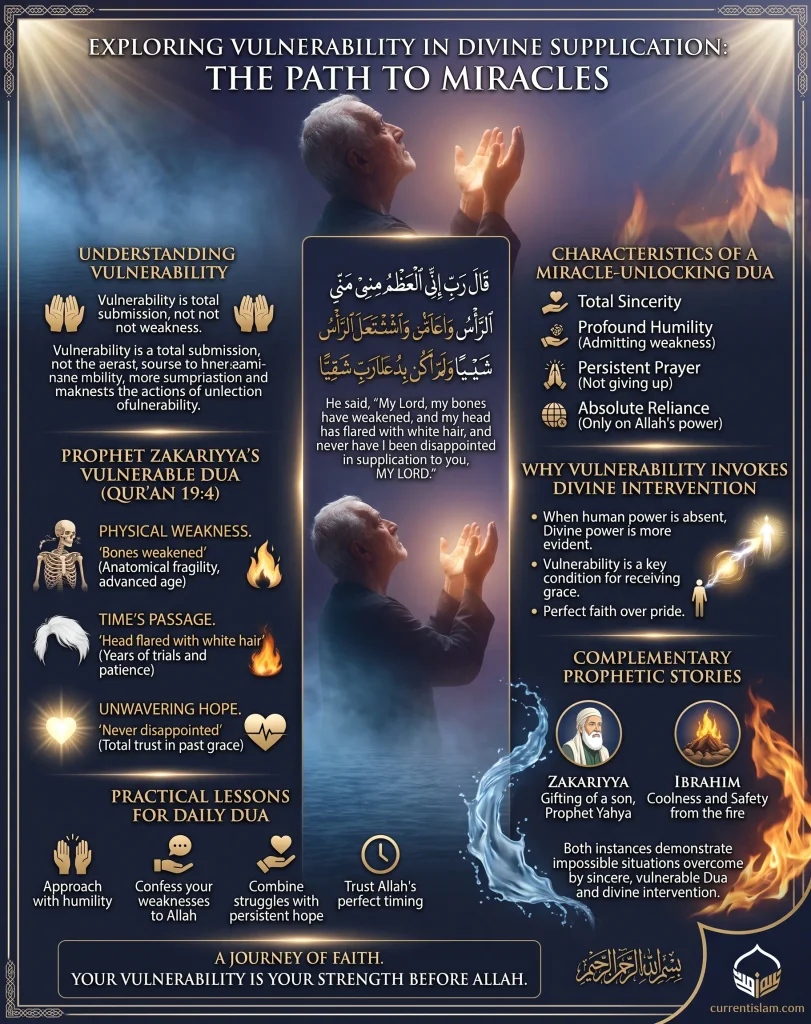
The phrase “qala rabbi inni wa hanal azmu minni” translates to “My Lord, my bones have weakened.” It uses profound Arabic metaphors, comparing white hair to a rapidly spreading wildfire, emphasizing total structural decay and complete vulnerability before Allah.
Classical Tafseer, including the works of Ibn Kathir, highlights the specific anatomical and environmental wording used by Prophet Zakariyya. He does not simply complain about being tired. He explicitly mentions his bones (al-azm). Bones are the foundational scaffolding of the human body. By declaring that his bones are weak, he is presenting his ultimate physical bankruptcy to God.
Here is why this matters for your daily routine. We are often taught to “stay strong” and project confidence. Islam flips this narrative during Dua. The fastest way to invite Divine strength is to display absolute human frailty. Zakariyya pairs this with the word ishta’ala, which translates to a fire flaring up. He describes his aging as a spark that rapidly consumed the dark hair on his head. He embraces his limitations rather than hiding them.
Shielding Yourself Against Hopelessness
You apply this spiritual habit loop by openly admitting your limitations to Allah, reflecting on how He answered your past prayers, and maintaining absolute optimism (Husn al-Dhann). This shifts your mindset from despair to active, faithful anticipation of God’s timing.
For many converts and families across Asian countries, the pressure to produce heirs or secure financial stability creates immense emotional weight. Zakariyya asked for a child when his wife was barren and he was nearing a century in age. Yet, he concluded his prayer with the concept of Husn al-Dhann (a good opinion of Allah): “And never have I been in my supplication to You, my Lord, disappointed.”
He based his future hope on God’s past track record. If you are making dua for righteous children, you must pair this mindset of vulnerability with specific supplications like Rabbi habli min ladunka zurriyatan tayyibatan.
To elevate your spiritual state further, focus on the purity of your intentions. Just as the Ahl al-Bayt were purified in Ayat e tatheer, purifying your heart from doubt allows your prayers to ascend rapidly. Even when facing immense global or historical uncertainties, such as the prophecies detailed in the Ghazwa-e-Hind Hadith, the believer’s strongest weapon remains their unwavering Dua, profound Sabr (patience), and reliance on the Divine plan.
Data Visualization: The 3 Pillars of Miraculous Dua
| Concept | Quranic Phrase | Modern Application |
| Utter Vulnerability | Wahana alAAathmu minnee (My bones have weakened) | Stop pretending you have everything under control. Confess your exact stress and burnout to Allah. |
| Brutal Honesty | WashtaAAala arra/su shayban (My head flared with white hair) | Bring your physical and material limitations directly to God. Do not hide your biological or financial reality. |
| Radical Optimism | Walam akun biduAAa-ika rabbi shaqiyya (Never have I been disappointed) | Use your past answered prayers as fuel. Trust that the One who provided for you yesterday will provide tomorrow. |
Authentic Hadith Affirming the Power of Dua in Hard Times
The Prophet Muhammad (PBUH) confirmed that Allah always responds to prayers unless the believer grows impatient. Authentic Hadiths support Surah Maryam ayat 4 by proving that maintaining hope, just as Zakariyya did, guarantees a Divine response in the best timing.
Prophet Zakariyya did not let years of silence stop him from asking. This exact sentiment is mirrored in the Sunnah. When your Dua feels delayed, it is actively being processed by the Creator of time itself.
Arabic Text:
يُسْتَجَابُ لِلْعَبْدِ مَا لَمْ يَدْعُ بِإِثْمٍ أَوْ قَطِيعَةِ رَحِمٍ مَا لَمْ يَسْتَعْجِلْ
Transliteration:
Yustajabu lil-‘abdi ma lam yad’u bi-ithmin aw qati’ati rahimin ma lam yasta’jil.
English Translation:
“The supplication of the servant is granted as long as he does not supplicate for a sin or for severing the ties of blood, and as long as he does not become hasty.” (Sahih Muslim 2735)
Urdu Translation:
بندے کی دعا ہمیشہ قبول ہوتی ہے جب تک کہ وہ کسی گناہ یا قطع رحمی کی دعا نہ کرے، اور جب تک وہ جلد بازی نہ کرے۔
Hindi Translation:
बंदे की दुआ हमेशा क़ुबूल होती है जब तक कि वह किसी गुनाह या रिश्ते तोड़ने की दुआ न करे, और जब तक वह जल्दबाज़ी न करे।
People Also Ask
The main message of Surah Maryam ayat 4 is that a believer must approach Allah with complete humility, acknowledging their physical and worldly limitations, while maintaining absolute certainty that Allah will answer their prayers based on His infinite mercy.
You recite it with precise Tajweed: Qa-la rab-bi in-nee wa-ha-nal az-mu min-nee wash-ta-a-lal ra-su shay-ban wa-lam a-kun bi-du-a-i-ka rab-bi sha-qiy-ya. Ensure the letter ‘Ayn in alAAathmu is pronounced deeply from the throat.
Yes, reciting Surah Maryam ayat 4 is highly beneficial for those struggling with fertility, marriage delays, or seemingly impossible goals. Recite it daily after your obligatory prayers with deep Tawakkul, asking Allah to grant you the same miraculous response He granted Prophet Zakariyya.
Are you looking for more actionable Quranic insights to build a peaceful, loving home? Read our complete guide to Surah room ayat 21 to discover the exact blueprint for finding tranquility in your marriage.
