Have you ever walked past a hospital, seen a car accident, or scrolled past a heartbreaking news story and felt a sudden, cold grip of fear? It’s that quiet voice asking, “What if that was me?”
In a world obsessed with what we don’t have—better phones, bigger houses, perfect lifestyles—we rarely pause to realize the catastrophe we were just saved from. We look at others to compare our wealth, but we forget to look at others to measure our safety.
This isn’t just a prayer; it is a Spiritual Vaccine. It is a promise from the Prophet Muhammad (ﷺ) that shifts your mindset from anxiety to gratitude in seconds, while literally rewriting your destiny to keep you safe.
What is the Dua for Seeing Someone Afflicted?
Voice Answer: The dua for seeing someone afflicted is a specific supplication taught by Prophet Muhammad (ﷺ) that, when recited, guarantees God’s protection from that specific trial or illness for the rest of your life.
This is the fortress. When you see someone suffering from a physical illness, a calamity, or a deep spiritual trial, recite this immediately.
The Full Text
Arabic:
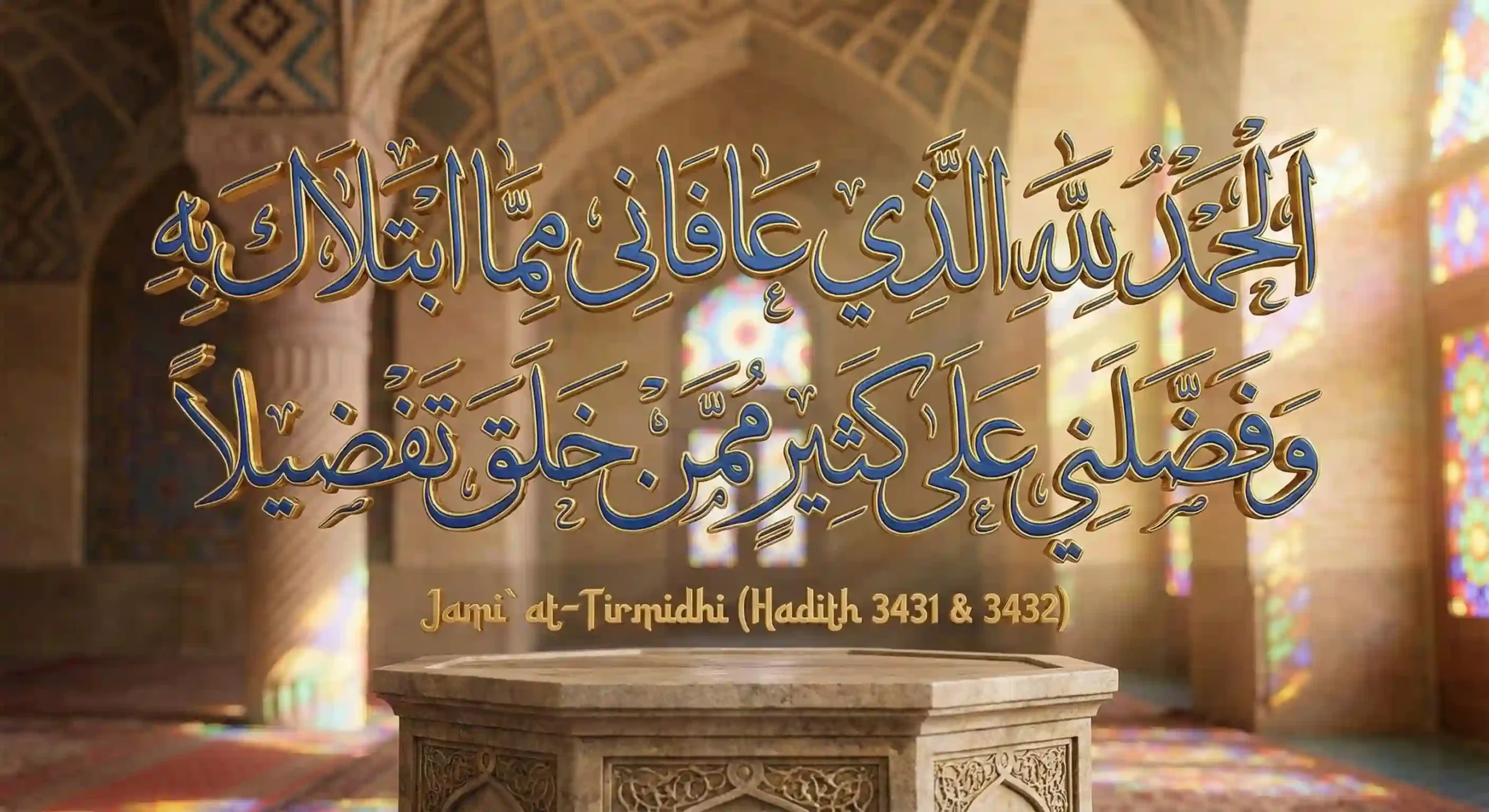
الْحَمْدُ لِلَّهِ الَّذِي عَافَانِي مِمَّا ابْتَلاَكَ بِهِ وَفَضَّلَنِي عَلَى كَثِيرٍ مِمَّنْ خَلَقَ تَفْضِيلاً
Transliteration: Al-hamdu lillaahil-ladhee ‘aafaanee mimmab-talaaka bihi wa faddalanee ‘alaa katheerin mimman khalaqa tafdeela.
English Translation (Saheeh International Context): “Praise be to Allah who has spared me from what He has afflicted you with, and preferred me greatly above much of what He has created.”
Urdu Translation (Fateh Muhammad Jalandhari Style): “Sab taareef Allah ke liye hai jisne mujhe us (musibat) se bachaya jis mein tujhe mubtala kiya, aur mujhe apni bohot si makhlooq par fazeelat di.”
Word-by-Word Breakdown
Understanding the Arabic roots adds depth to your intent (Niyyah).
| Arabic Word | Transliteration | English Meaning | Urdu Meaning |
| الْحَمْدُ لِلَّهِ | Al-hamdu lillah | Praise be to Allah | Allah ka shukar hai |
| الَّذِي | Alladhee | The One Who | Wo Zaat jisne |
| عَافَانِي | ‘Aafaani | Saved/Cured/Protected me | Mujhe afiyat di/bachaya |
| مِمَّا | Mimma | From what | Us cheez se |
| ابْتَلاَكَ بِهِ | Ibtalaka bihi | He afflicted you with | Tujhe mubtala kiya |
| وَفَضَّلَنِي | Wa faddalani | And preferred me | Aur mujhe fazeelat di |
| عَلَى كَثِيرٍ | ‘Ala katheerin | Over many | Bohot se logon par |
| مِمَّنْ خَلَقَ | Mimman khalaqa | Of those He created | Jinhein usne paida kiya |
| تَفْضِيلاً | Tafdeela | With a marked preference | Bohot zyada fazeelat |
Export to Sheets
Alhamdulillah Hillazi Aafani’ is Your Lifetime Shield Against Calamity (PDF)
Authentic Sources and Hadith References
This dua is recorded in Jami` at-Tirmidhi (Hadith 3431 & 3432) and Sunan Ibn Majah (Hadith 3892). It is classified as Hasan (good) by scholars regarding its chain of narration.
The Hadith: The Messenger of Allah (ﷺ) said: “Whoever sees an afflicted person and says [the above Dua], he shall not be struck by that affliction.” (Jami` at-Tirmidhi 3431)
Scholarship Note: Scholars like Imam Al-Nawawi in Al-Adhkar emphasize that this applies to both worldly tribulations (sickness, poverty) and religious tribulations (sin, misguidance). However, he notes a crucial condition regarding how you say it, which we will cover in the Etiquette section.
The “Perspective Pivot” (New for 2026)
The Perspective Pivot is a mindfulness technique where you use this dua to instantly shift your focus from envy of what others have, to deep gratitude for the suffering you have been spared from.
Here is the heart of the matter. We live in an age of “Instagram Envy.” You scroll and see people who are richer, fitter, or happier than you. This creates a spiritual void.
This Dua offers a counter-strategy: The Perspective Pivot.
Instead of looking up at those who have more, the Prophet (ﷺ) taught us to look down at those who have less or are suffering.
- The Problem: You feel depressed because you drive an old car.
- The Pivot: You see a breakdown on the highway or a serious accident. You recite the dua.
- The Result: Your frustration turns into relief. You realize your “old car” is actually a vessel of safety (Aafiyah).
This isn’t just religious practice; it’s cognitive reframing. It stops the cycle of ingratitude dead in its tracks.
The Vital Etiquette: Silence is Golden
You must recite this dua silently to yourself. It is forbidden to say it loud enough for the afflicted person to hear, as this would cause them pain and break the rules of Islamic brotherhood.
This is where many people get it wrong. The purpose of this Dua is gratitude to Allah, not arrogance over the victim.
The Rule of Whispering: Imam At-Tirmidhi mentions regarding this Hadith that one should say it “to himself” (Sirran).
- If they hear you: It sounds like you are gloating or bragging that you are better than them. This is a sin.
- If you whisper: It remains a private transaction between you and Allah. You get the protection; they keep their dignity.
The only exception? If the affliction is a sin (like someone openly committing a crime), some scholars suggest saying it aloud might serve as a deterrent, but in 2026, silence and safety are almost always the wiser path.
Common Questions:
Yes, Islamic scholars agree that “affliction” (Bala) in the Hadith covers physical diseases, disabilities, and chronic illnesses. Reciting it with conviction serves as a preventative spiritual measure.
Yes, you can. The dua acknowledges Allah’s favor upon you. Seeing suffering in any human being is a reminder of Allah’s power and your own fragility, regardless of the other person’s faith.
Most scholars suggest that the dua is primarily for witnessing something in person (“Direct Witnessing”). However, reciting it upon seeing tragic news is still a virtuous act of Dhikr (remembrance) and gratitude, even if the specific guarantee of the Hadith implies physical presence.
Is this dua for bad character too? Absolutely. If you see someone who is rude, cruel, or lost in sin, reciting this dua protects your heart from becoming like them. It protects your character just as it protects your body.
