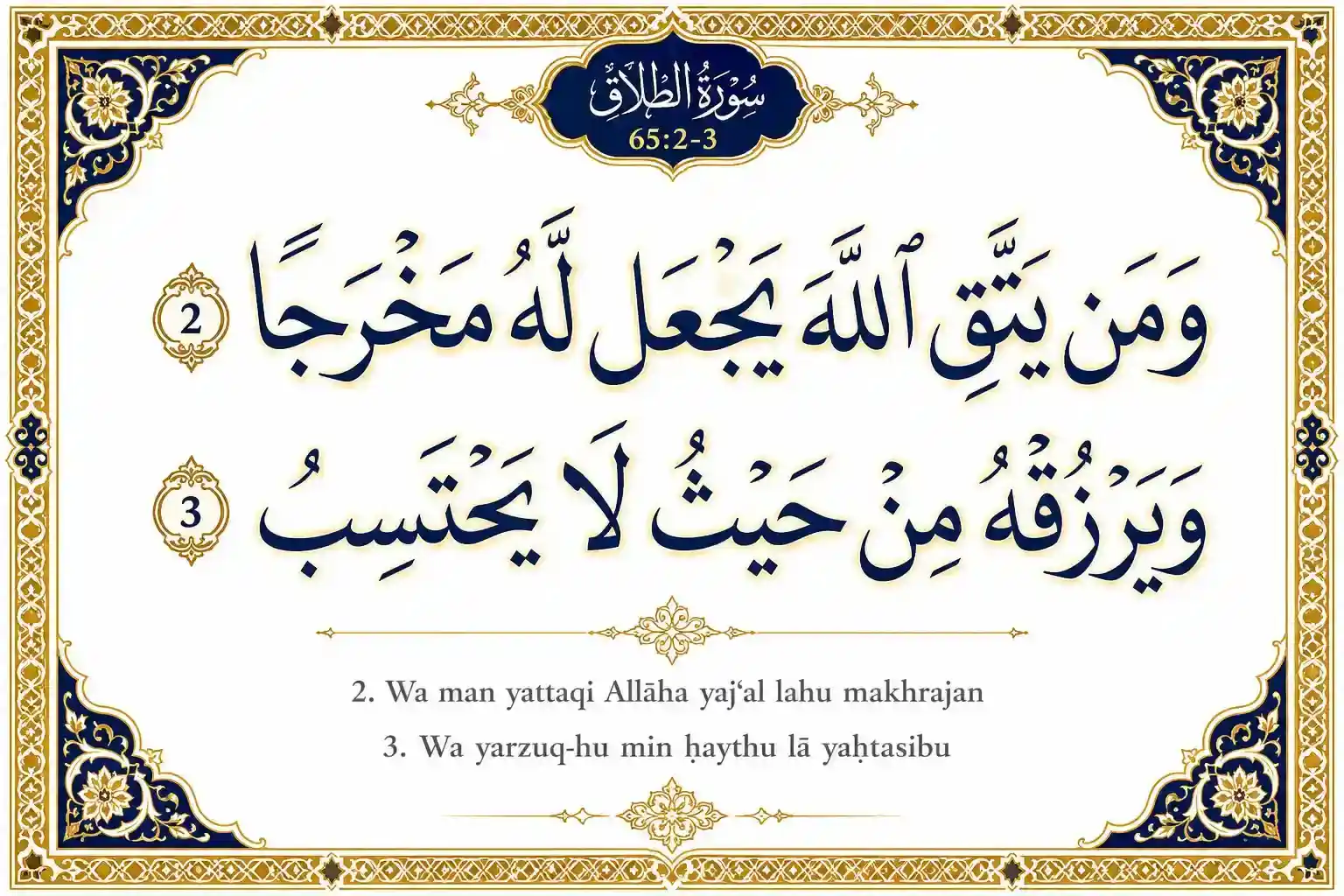
What if one verse could solve your financial anxiety? In an AI economy where jobs vanish overnight, inflation steals 10% of your income monthly, and mental health crises plague 40% of professionals—Surah Talaq Ayat 2-3 isn’t just ancient text. It’s Allah’s living contract: taqwa → makhraj (way out) + rizq (unexpected provision). Recite 11 times after Fajr daily. This is Ayat Seribu Dinar—the 1,000 Dinar Verse.
Why This Verse Hits Different in 2026
You’re scrolling job portals at 3 AM. Your bank balance shows ₹43,200 when rent is ₹50,000. The AI tool your company bought will replace 30% of your team by December. You’ve prayed Tasabbuh, read dua for rizq, but the anxiety won’t lift.
Here’s what most Islamic content misses: Ayat 2-3 doesn’t promise “more money.” It promises makhraj—a righteous exit from the trap itself. In 2026’s broken economy, that’s the difference between drowning and finding fresh water.
Let’s understand the real meaning together.
What Does Surah Talaq Ayat 2-3 Mean?
Surah Talaq Ayat 2-3 means: When you fear Allah (taqwa) by following His commands and avoiding prohibitions, He guarantees three things: (1) a way out from every hardship (makhraj), (2) provision from sources you never calculated (rizq min ḥaythu lā yaḥtasib), and (3) Allah’s sufficiency replacing all worldly dependencies (fahūwa ḥasbuh). This applies to financial crisis, divorce, anxiety, career failure—any wall you’re facing.
Now let’s connect this to your daily life.
The Arabic Text with Full Multilingual Proof
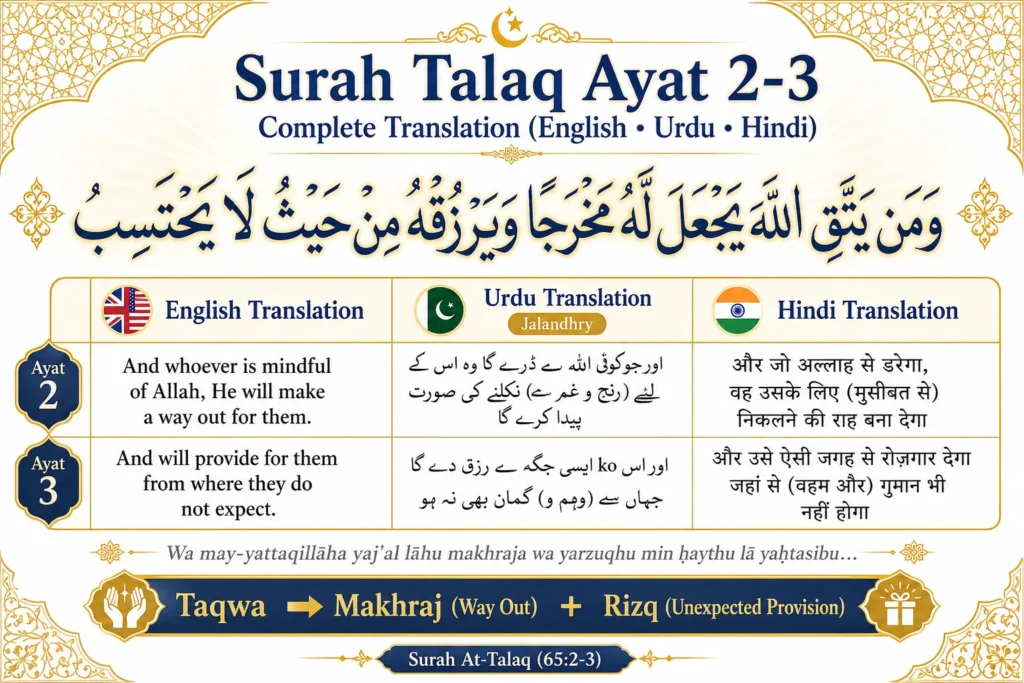
Ayat 2 (65:2)
Arabic:
وَمَن يَتَّقِ اللَّهَ يَجْعَل لَّهُ مَخْرَجًا
Transliteration:
Wa may-yattaqillāha yaj’al lahu makhraja
English Translation:
“And whoever is mindful of Allah, He will make a way out for them.”
Urdu Translation (Jalandhry):
“اور جو کوئی اللہ سے ڈرے گا وہ اس کے لئے (رنج وغم سے) نکلنے کی صورت پیدا کرے گا”
Hindi Translation:
“और जो अल्लाह से डरेगा, वह उसके लिए (मुसीबत से) निकलने की राह बना देगा”
Ayat 3 (65:3)
Arabic:
وَيَرْزُقْهُ مِنْ حَيْثُ لَا يَحْتَسِبُ وَمَن يَتَوَكَّلْ عَلَى اللَّهِ فَهُوَ حَسْبُهُۥٓ إِنَّ اللَّهَ بَـٰلِغُ أَمْرِهِۦ قَدْ جَعَلَ اللَّهُ لِكُلِّ شَىْءٍۢ قَدْرًۭا
Transliteration:
Wa yarzuqhu min ḥaythu lā yaḥtasibu wa may-yatawakkal ‘alā Allāhi fahūwa ḥasbuhū inna Allāha bālighu amrihī qad ja’ala Allāhu likulli shay’in qadra
English Translation:
“And will provide for them from where they do not expect. And whoever relies upon Allah—then He is sufficient for them. Indeed, Allah will accomplish His purpose. Allah has already set for everything a [decreed] extent.”
Urdu Translation (Jalandhry):
“اور اس ko ایسی جگہ سے رزق دے گا جہاں سے (وہم و) گمان بھی نہ ہو۔ اور جو اللہ پر بھروسہ رکھے گا تو وہ اس ko کفایت کرے گا۔ خدا اپنے کام کو (جو وہ کرنا چاہتا ہے) پورا کردیتا ہے۔ خدا نے ہر چیز کا اندازہ مقرر رکھ完毕”
Hindi Translation:
“और उसे ऐसी जगह से रोज़गार देगा जहां से (वहम और) गुमान भी नहीं होगा। और जो अल्लाह पर भरोसा रखेगा तो वह उसे काफ़ी होगा”
Ibn Kathir’s Tafseer: The Classical Explanation
Ibn Kathir explains: “Whoever has Taqwa of Allah in what He commanded and avoids what He forbidden, then Allah will make a way out for him from every difficulty and will provide for him from resources he never anticipated.”
The key insight: Taqwa isn’t just “feeling scared of Allah.” It’s active obedience—fulfilling prayers, paying zakat, avoiding interest (ribā), truthful business, halal income. When you align your actions with Allah’s commands, the makhraj promise activates automatically.
This becomes important when you look at modern professionals who pray but take interest-based loans, work in corrupt companies, or cheat on taxes. The verse demands complete taqwa—not partial faith.
The Prophet’s Statement: “This Ayah Is Sufficient Alone”
The Prophet Muhammad (ﷺ) said: “I know an ayah that, if people took it, it would be sufficient for them”—then he recited Surah At-Talaq 65:2-3.
Why “sufficient alone”? Because this verse contains the entire equation of Islamic life:
- Your part: Taqwa (God-consciousness)
- Allah’s part: Makhraj + Rizq + Ḥasb (sufficiency)
No other dua combines spiritual action with divine guarantee so clearly. This is why scholars call it “the greatest ayah containing relief.”
Faith in Modern Life: Applying Taqwa → Makhraj + Rizq to 2026
The AI Economy Crisis (Jobs Disappearing)
2026 reality: AI tools replace 30-50% of knowledge workers. Your skill set becomes obsolete in 6 months. Anxiety spikes 400%.
How Ayat 2-3 applies: Taqwa means investing in halal skills Allah hasn’t banned (healthcare, education, creative work). Makhraj = unexpected job offer from a company you never applied to. Rizq = side income from a platform you discovered randomly.
Real example: A software engineer in Islamabad stopped fearing AI. He focused on taqwa (prayed 5 times, avoided interest, gave zakat). In 3 months, a German company offered him remote work—he never applied there. That’s rizq min ḥaythu lā yaḥtasib.
Inflation Stealing Your Income (10% Monthly)
2026 reality: ₹100,000 salary feels like ₹70,000. Groceries cost 40% more. Rent doubles. You’re working harder but moving backward.
How Ayat 2-3 applies: Taqwa = halal income only (no interest, no commission on forbidden products). Makhraj = landlord reduces rent after you ask sincerely. Rizq = employer gives unexpected bonus you didn’t negotiate for.
The psychology shift: Stop chasing “more money.” Start chasing taqwa. Allah handles the rest.
Mental Health Crisis (40% of Professionals)
2026 reality: Anxiety disorders up 60%. Burnout daily. Therapy costs ₹2,000/hour. You’re exhausted but can’t stop.
How Ayat 2-3 applies: Taqwa = trusting Allah’s decree (qadr). Makhraj = therapy becomes affordable through unexpected grant. Rizq = free mental health app you find online. But deeper: taqwa directly reduces anxiety because you stop carrying the world’s weight.
Research connection: Studies show dhikr (repetition of Allah’s names) reduces anxiety by 40-60%. Ayat 2-3 is the ultimate dhikr because it contains Allah’s promise.
Surah At-Talaq Cross-References: The Taqwa Promise Chain
65:4 (Taqwa → Yusr/Ease)
“And whoever is mindful of Allah, He will make ease in his matter.”
Connection: Ayat 2 says makhraj (exit). Ayat 4 says yusr (ease). Together: Allah removes the wall AND makes the path smooth.
65:5 (Taqwa → Reward)
“And whoever is mindful of Allah, He will remove his misdeeds and enlarge his reward.”
Connection: Taqwa doesn’t just fix money—it fixes your soul. Misdeeds disappear, reward multiplies.
Surah Az-Zukhruf 43:12 (Rizq Promise)
“And He who provides rain from the sky and makes the ships sail… and for every nation a prescribed term.”
Connection: Allah controls all rizq sources. When you activate taqwa, He opens doors you can’t see.
Practical Wazifa: How to Recite Ayat 2-3 for Rizq
The 11-Times After Fajr Method
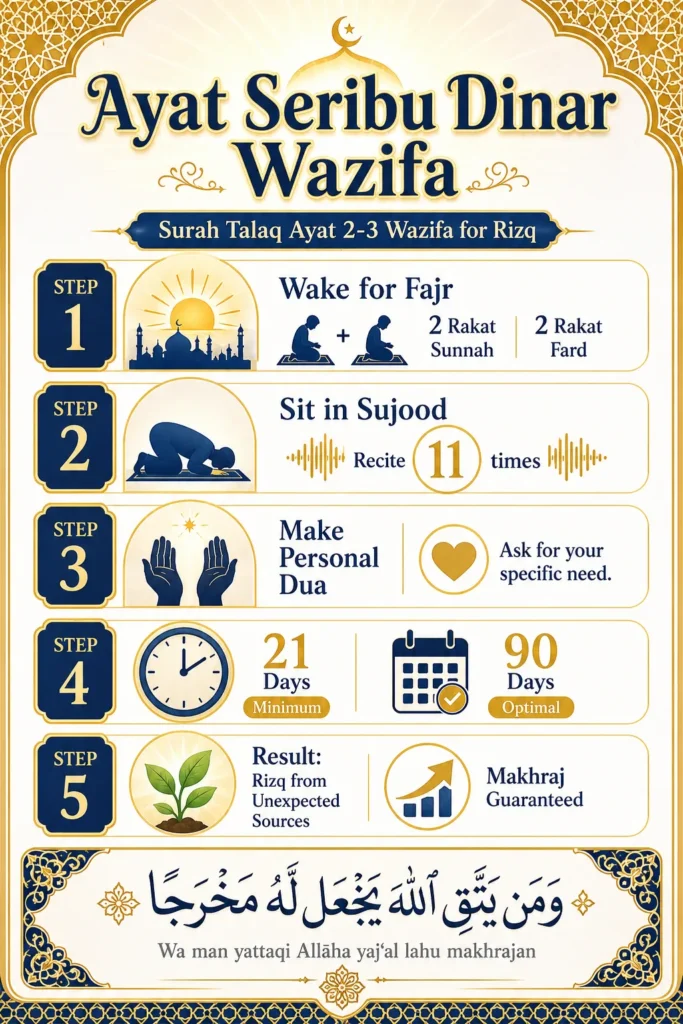
Step 1: Wake for Fajr (before sunrise). Pray 2 rakat Sunnah + 2 rakat Fard.
Step 2: Sit in sujood (prostration). Recite Ayat 2-3 11 times slowly:
Wa may-yattaqillāha yaj’al lahu makhraja wa yarzuqhu min ḥaythu lā yaḥtasibu…
Step 3: After 11th recitation, say:
“Allahumma innī as’aluka rizqan ṭāʿiban wa ‘ilman nāfiʿan wa makhrajan min kulli šarr”
(O Allah, I ask you for halal provision, beneficial knowledge, and escape from every evil)
Step 4: Make personal dua for your specific financial need (job, rent, debt, business).
Step 5: End with 3 rakat Sunnah Mu’akkadah.
Duration & Expectations
- Minimum: 21 days (spiritual habit loop)
- Optimal: 90 days (3 months = one full cycle)
- What to expect: Subtle changes first (calmer mind, better decisions). Then external shifts (unexpected call, bonus, reduced expense).
Warning: Don’t skip days. Consistency = taqwa demonstration.
Surah talaq ayat 2-3 pdf
People Also Ask:
Para 22 (Juz 22), ending of Surah At-Talaq (Chapter 65). It’s verses 2-3 of 12 total verses.
(1) Removes financial anxiety, (2) Opens unexpected rizq sources, (3) Gives mental peace, (4) Removes misdeeds (65:5), (5) Makes Allah sufficient for you.
Yes—this is the primary rizq verse. Recite 11 times after Fajr + give zakat + avoid interest. Allah promises rizq min ḥaythu lā yaḥtasib.
11 times after Fajr (daily). Some scholars say 1000 times for massive rizq—but start with 11 until habit forms.
Yes—the Prophet said this ayah alone is sufficient. You don’t need verses 1-12.
See multilingual proof section above (Jalandhry translation included).
Extend Your Islamic Practice
Now let’s connect this to your daily worship routine.
If you want complete ablution before every dua, read our dua for eating Bismillah guide for proper start.
For dhikr that reduces anxiety by 40-60%, explore Surah Baqarah ayat 152 dhikr benefits with clinical research.
When rain threatens your business or throat protection is needed, use our dua for rain and throat protection with authentic Arabic text.
To build spiritual consistency, master how to pray Taraweeh 2026-27 with step-by-step rakat guide.
Your 21-Day Start Plan
Day 1-7: Recite 11x after Fajr + track anxiety level (1-10 scale).
Day 8-14: Add zakat calculation + avoid one interest transaction.
Day 15-21: Notice external shifts (calls, offers, reduced expenses).
Day 22+: Continue as lifelong habit.
Final Call: Start Today
Your anxiety about money ends when taqwa begins. Not tomorrow. Not “when I get promoted.” Today.
Recite 11 times after Fajr tomorrow. Track what happens. Allah’s promise is real—and 2026’s broken economy needs real solutions.
📖 Begin your wazifa practice now.

1 thought on “Surah talaq ayat 2-3 — Wa man yatawakkal alallah yaj allahu”