Have you ever woken up feeling a heaviness you can’t explain? Or felt that despite your best efforts, an invisible wall—envy, bad luck, or anxiety—is blocking your progress?
You aren’t alone. In a world full of hidden negativity, we often feel vulnerable.
This is exactly why Surah Al-Falaq was revealed. It isn’t just a set of verses; it is a direct line to the Creator, asking Him to split the darkness of your life and bring forth the light of a new dawn. Whether you are battling the Evil Eye (Nazar), seeking safety from magic (Sihr), or just need peace of mind, this guide covers the deep spiritual power of the “Daybreak.”
1. What is Surah Al-Falaq? (Meaning & Background)
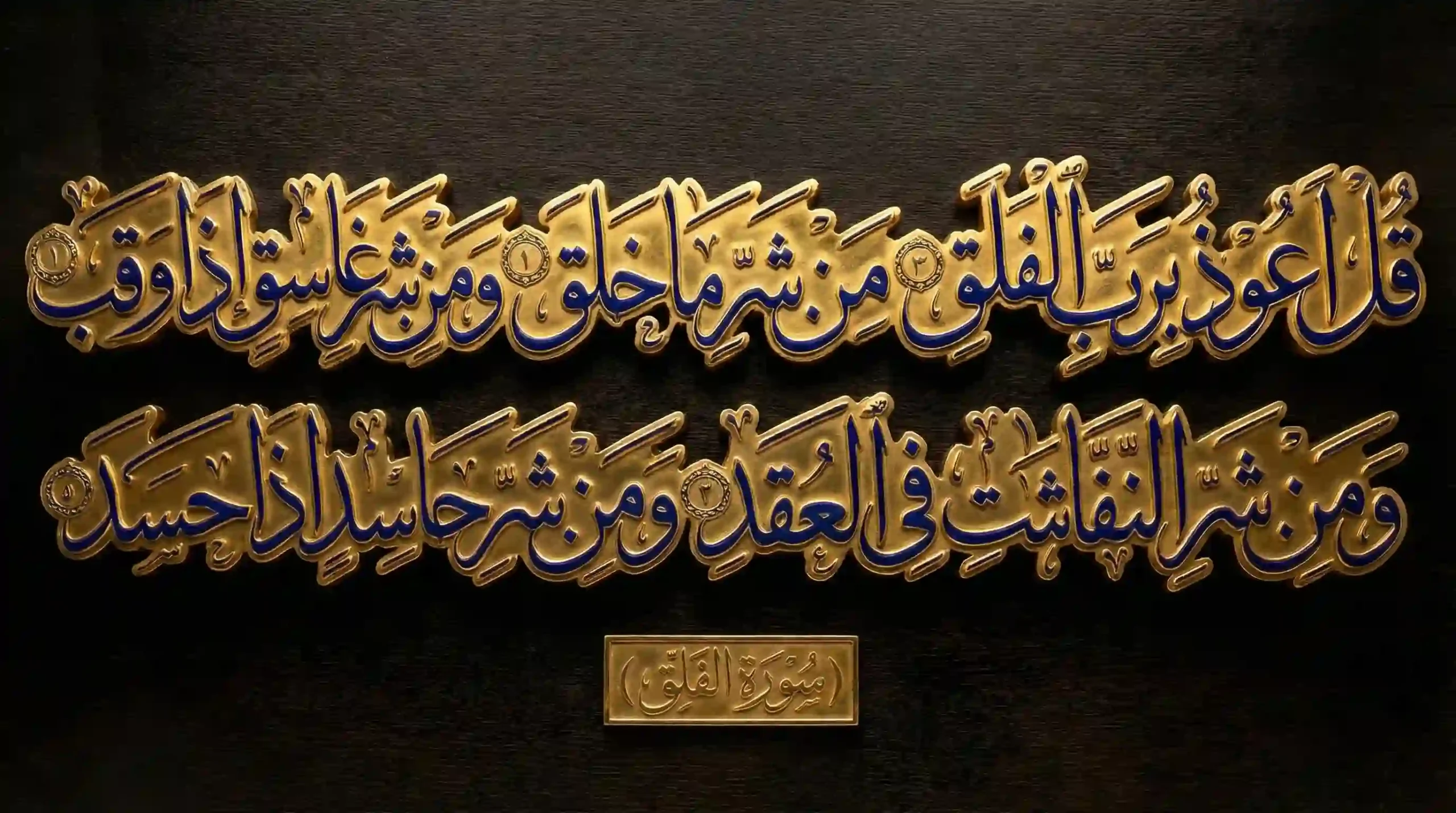
Surah Al-Falaq is the 113th chapter of the Quran, commonly known as “The Daybreak.” It is one of the two “Mu’awwidhatayn” (Verses of Refuge) used specifically for protection against external evils like black magic, jealousy, and the darkness of night. It was revealed in Madinah to cure the Prophet (PBUH) from a spell.
The Historical Context (Asbab al-Nuzul)
Imagine the strongest man you know suddenly feeling weak and confused. Even the Prophet Muhammad (Peace Be Upon Him) was tested. A man named Labid ibn al-A’sam cast a spell using the Prophet’s hair and a comb, tying knots to bind his energy.
Allah revealed Surah Al-Falaq and Surah An-Nas as the cure. As the Prophet recited each verse, a knot untied, and he felt the weight lift instantly.
Citation: Tafsir Ibn Kathir notes this event, highlighting that the Quran is the ultimate cure (Shifa).
2. Surah Al-Falaq: Word-by-Word (Arabic, English & Urdu)
The correct way to recite Surah Al-Falaq involves understanding its five verses in depth. Below is the complete transliteration, English translation (Saheeh International), and Urdu translation (Fateh Muhammad Jalandhari) to help you connect with the meaning.
| Verse | Arabic Text | Transliteration | English (Saheeh Intl) | Urdu (Jalandhari) |
| 1 | قُلْ أَعُوذُ بِرَبِّ الْفَلَقِ | Qul a’oozhu bi rabbil-falaq | Say, “I seek refuge in the Lord of daybreak…” | کہو کہ میں صبح کے مالک کی پناہ مانگتا ہوں |
| 2 | مِن شَرِّ مَا خَلَقَ | Min sharri ma khalaq | “…From the evil of that which He created…” | ہر چیز کی برائی سے جو اس نے پیدا کی |
| 3 | وَمِن شَرِّ غَاسِقٍ إِذَا وَقَبَ | Wa min sharri ghasiqin iza waqab | “…And from the evil of darkness when it settles…” | اور اندھیری رات کی برائی سے جب وہ چھا جائے |
| 4 | وَمِن شَرِّ النَّفَّاثَاتِ فِي الْعُقَدِ | Wa min sharrin-naffaa-thaati fil ‘uqad | “…And from the evil of the blowers in knots…” | اور گنڈوں پر (پڑھ پڑھ کر) پھونکنے والیوں کی برائی سے |
| 5 | وَمِن شَرِّ حَاسِدٍ إِذَا حَسَدَ | Wa min sharri haasidin iza hasad | “…And from the evil of an envier when he envies.” | اور حسد کرنے والے کی برائی سے جب وہ حسد کرے |
3. The 4 Major Benefits of Reciting Surah Falaq
The primary benefits of Surah Falaq include divine protection from black magic (Sihr), safeguarding against the Evil Eye (Nazar), and shielding oneself from the jealousy of others. Reciting it daily ensures that Allah becomes your fortress against physical and spiritual harm that is hidden from human eyes.
Here is the breakdown of why this Surah is essential for your daily routine:
- Destroys Jealousy (Hasad): Envy is dangerous; it can ruin health and wealth. Verse 5 specifically targets this energy.
- Breaks Black Magic: Just as it cured the Prophet (PBUH), it remains the most potent weapon against sorcery today.
- Protection from Nightmares: The “darkness” mentioned in Verse 3 refers to the terrors of the night.
- General Safety: Verse 2 covers everything Allah created—from viruses to accidents.
Prophetic Habit: The Prophet (PBUH) said: “Recite Surah Al-Ikhlas and Al-Mu’awwidhatayn (Al-Falaq and An-Nas) three times at dawn and dusk. It will suffice you in all respects.” (Sunan Abu Dawood 5082)
4. Understanding the Wazifa: 100x, 313x, and 1000x
Reciting Surah Falaq 100, 313, or 1000 times is a form of intensive spiritual focus (Wazifa) practiced by some for severe distress or breaking strong magic. While the Sunnah is to recite it 3 times, increasing the number is permitted as general worship (Dhikr) to ask Allah for urgent help.
If you are going through a particularly heavy time, here is how people utilize these numbers for focus (with the intention of Dua):
- The 3x Sunnah Method (Best for Daily Use):
- When: After Fajr and Maghrib.
- How: Recite Ikhlas, Falaq, and Nas 3 times each.
- Result: A complete shield for 12 hours.
- The 100x / 313x Method (For Anxiety & Distress):
- Many spiritual practitioners suggest reciting Surah Falaq 100 times or 313 times (the number of Sahaba at Badr) when you feel overwhelmed by enemies or blocked pathways.
- Note: Ensure you start and end with Durood Shareef.
- The 1000x Method (For Severe Spiritual Attacks):
- This is often prescribed by Raqis (healers) for breaking stubborn black magic. It requires immense patience and reliance on Allah, not the number itself.
5. Common Questions
To treat the Evil Eye, cup your hands, recite Surah Al-Falaq, Al-Nas, and Al-Ikhlas, blow into your hands, and wipe them over your face and body. Repeat this three times. This was the practice of the Prophet (PBUH) before sleep.
Yes, women can recite Surah Falaq during menstruation for protection (Adhkar). Most scholars agree that reciting it from memory as a supplication (Dua) or protection is permissible, even if not touching the Mushaf.
“Blowers in knots” refers to practitioners of sorcery or witchcraft. In ancient times, they would tie knots in cords and blow curses into them to bind a person’s life. This verse asks Allah to nullify their influence.
6. The “Daybreak Protocol”
Let’s stop treating this Surah as just something we “have to read.” Let’s make it a tool for modern mental resilience.
The Protocol:
- Trigger: When you open your eyes in the morning (Daybreak).
- Action: Before you check your phone notifications (which bring anxiety/darkness), recite Qul a’oozhu bi rabbil-falaq.
- Mindset: Visualize the sun rising and burning away the “knots” in your stomach—the stress about work, the fear of judgment, the envy of peers.
- Result: You enter the day not defensively, but with the confidence that the Lord of the Dawn has your back.
