Have you ever felt an unexplainable pull toward Makkah and Madinah, an ache in your heart when you see the white garments of Ihram? For decades, millions of Muslims have found the exact words for this yearning in a single, masterful piece of poetry. Written by Yousuf Qadeeri and immortalized by the legendary Qari Waheed Zafar Qasmi, this kalam is more than just a hymn; it is an anthem for the spiritually homesick.
If you are looking for the complete zahe muqaddar naat lyrics, their translations, and the profound Islamic scholarship hidden within its verses, you are in the exact right place. Let’s understand the real meaning of these beautiful words and how they connect to our daily faith.
What Does Zahe Muqaddar Mean?
“Zahe Muqaddar” translates to “What a glorious destiny” or “How incredibly fortunate is my fate.” This Naat expresses the profound spiritual ecstasy of a believer who has received the divine invitation to visit the holy cities of Makkah and Madinah. It captures the physical journey of pilgrimage and the internal journey of the soul.
Here is why this matters: visiting the sacred lands is not viewed as a human accomplishment in Islamic tradition, but as a divine summons. The poetry brilliantly captures this transition from an ordinary life to a sacred journey.
Zahe Muqaddar Naat Lyrics in Roman English
For our global readers who want to recite this beautiful kalam but may struggle with the classical script, here is the complete zahe muqaddar naat lyrics roman english transliteration.
Zahe muqaddar, huzoor-e-Haq se, salaam aaya, payaam aaya
Jhukao nazrein, bichao palkein, adab ka aala maqaam aaya
Yeh kaun sar se kafan lapete, chala hai ulfat ke raaste par
Farishtey hairat se tak rahe hain, yeh kaun zee-ehtiraam aaya
Fiza mein Labbaik ki sadayein, za-farsh ta arsh goonjti hain
Har ek qurbaan ho raha hai, zabaan pe yeh kis ka naam aaya
Yeh raah-e-Haq hai, sambhal ke chalna, yahan hai manzil qadam qadam par
Puhanchana dar par to kehna Aaqa, salaam lijiye ghulam aaya
Yeh kehna Aaqa bohat se aashiq, tadapte se chorr aaya hoon main
Bulawe ke muntazir hain lekin, na subh aaya, na shaam aaya
Dua jo nikli thi dil se aakhir, palat ke maqbool ho ke aayi
Woh jazba jis mein tadap thi sachi, woh jazba aakhir ko kaam aaya
Khuda tera hafiz-o-nigehbaan, o raah-e-Batha ke jaane wale
Naveed-e-sad imbisat ban kar, payaam-e-Dar-us-Salaam aaya
Zahe muqaddar, huzoor-e-Haq se, salaam aaya, payaam aaya
Jhukao nazrein, bichao palkein, adab ka aala maqaam aaya
Zahe Muqaddar Naat Lyrics in Urdu Text
For those who wish to read the poetry in its original, elegant script, here is the complete zahe muqaddar naat lyrics in urdu text.
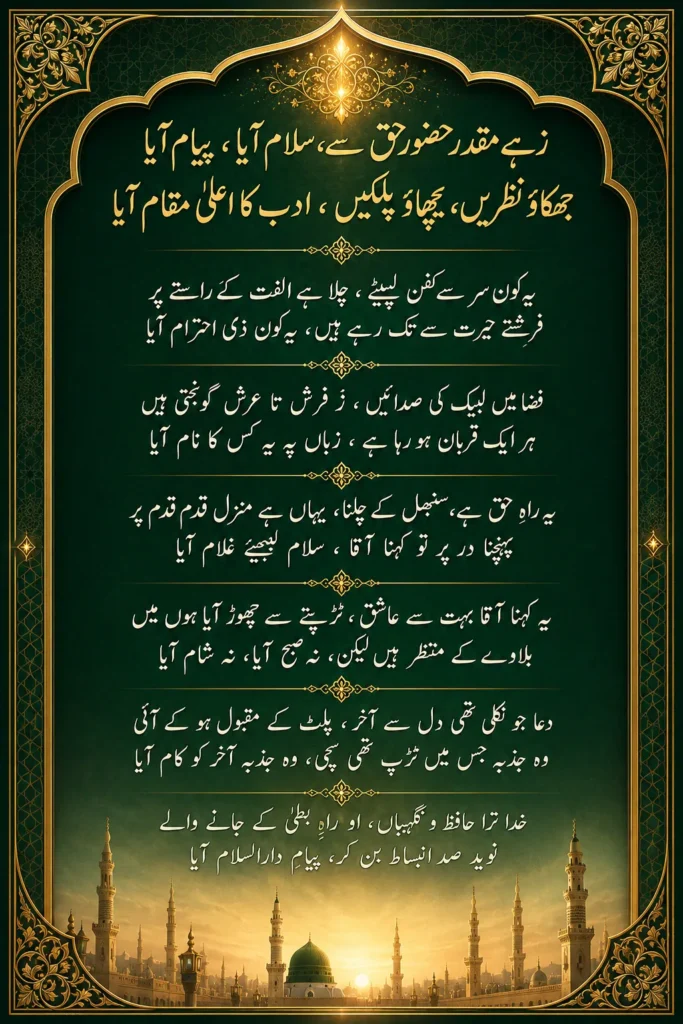
زہے مقدر حضورِ حق سے، سلام آیا ، پیام آیا
جھکاؤ نظریں، بچھاؤ پلکیں ، ادب کا اعلیٰ مقام آیا
یہ کون سر سےکفن لپیٹے، چلا ہے الفت کے راستے پر
فرشتے حیرت سے تک رہے ہیں، یہ کون ذی احترام آیا
فضا میں لبیک کی صدائیں ، زَ فرش تا عرش گونجتی ہیں
ہر ایک قربان ہو رہا ہے ، زباں پہ یہ کس کا نام آیا
یہ راہِ حق ہے، سنبھل کے چلنا، یہاں ہے منزل قدم قدم پر
پہنچنا در پر تو کہنا آقا ، سلام لیجیے غلام آیا
یہ کہنا آقا بہت سے عاشق، تڑپتے سے چھوڑ آیا ہوں میں
بلاوے کے منتظر ہیں لیکن، نہ صبح آیا، نہ شام آیا
دعا جو نکلی تھی دل سے آخر، پلٹ کے مقبول ہو کے آئی
وہ جذبہ جس میں تڑپ تھی سچی، وہ جذبہ آخر کو کام آیا
خدا ترا حافظ و نگہباں، او راہِ بطحٰی کے جانے والے
نویدِ صد انبساط بن کر، پیامِ دارالسلام آیا
English Translation and Word-by-Word Meaning
To truly appreciate the zahe muqaddar naat english translation, we must break down the verses. The poet uses high-register Urdu and Persian vocabulary to convey the gravity of the pilgrimage.
Verse 1:
What a glorious destiny, from the Divine Presence, a greeting and a message has arrived.
Lower your gazes, spread your eyelashes (in respect), the highest station of reverence has arrived.
Verse 2:
Who is this, wrapped in a shroud from head to toe, walking upon the path of devotion?
The angels are watching in astonishment, asking: who is this highly respected soul that has arrived?
Verse 3:
In the atmosphere, the echoes of “Labbaik” (Here I am, O God) resound from the earth to the heavens.
Everyone is sacrificing themselves; whose magnificent name has come upon their tongues?
Verse 4:
This is the path of truth, walk carefully, for here every single step is a destination itself.
When you reach the door (of the Prophet), say: O Master, accept the greetings of this servant who has arrived.
Essential Vocabulary Guide
To help our younger readers and those studying the [understanding classical Urdu Naats] tradition, here is a breakdown of the key terms used in this masterpiece:
| Urdu Word | Roman Transliteration | Contextual English Meaning |
| زہے مقدر | Zahe Muqaddar | How incredibly fortunate / What a glorious destiny |
| حضورِ حق | Huzoor-e-Haq | The Divine Presence (Allah) |
| ادب | Adab | Deep spiritual etiquette and profound respect |
| کفن | Kafan | Burial shroud (metaphorically referring to the Ihram) |
| الفت | Ulfat | Pure, selfless devotion and love |
| فرش تا عرش | Farsh ta Arsh | From the earth below to the divine throne above |
| بطحٰی | Batha | An ancient, classical name for the valley of Makkah |
The Divine Summons: Quranic and Hadith References
This poetic masterpiece is deeply rooted in Islamic theology. Every verse corresponds directly to the Quranic framework of Hajj, Umrah, and the etiquette of visiting the Prophet Muhammad ﷺ.
Here is the foundational Islamic proof that supports the very first line of the Naat—that the journey is a direct divine invitation.
The Divine Call to Pilgrimage (Surah Al-Hajj 22:27)
The opening line of the Zahe Muqaddar Naat directly mirrors the spiritual reality established in the Quran. When Prophet Ibrahim (AS) completed the Kaaba, Allah commanded him to announce the pilgrimage to all of humanity.
Arabic Verse:
وَأَذِّن فِى ٱلنَّاسِ بِٱلْحَجِّ يَأْتُوكَ رِجَالًا وَعَلَىٰ كُلِّ ضَامِرٍ يَأْتِينَ مِن كُلِّ فَجٍّ عَمِيقٍ
- Transliteration: Wa adhdhin fin-nasi bil-Hajji ya’tuka rijalan wa ‘ala kulli daamirin ya’teena min kulli fajjin ‘ameeq.
- English Translation: “And proclaim to the people the Hajj [pilgrimage]; they will come to you on foot and on every lean camel; they will come from every distant pass.”
- Urdu Translation: اور لوگوں میں حج کی منادی کر دے، وہ تیرے پاس پیدل آئیں گے اور ہر دبلے اونٹ پر جو ہر دور دراز راستے سے آئیں گے۔
Modern Relevance & Connection to the Naat: This verse confirms the deep theological meaning behind the Naat’s opening. You do not simply wake up and decide to go to Makkah; you respond to a divine call that was made thousands of years ago. When the “payaam” (message) finally arrives from the Divine Presence, your destiny shifts entirely. This is why the poet exclaims “Zahe Muqaddar” (What a glorious destiny)—because earning this invitation is the ultimate spiritual privilege.
The Etiquette of the Prophet’s Mosque (Surah Al-Hujurat 49:2)
The second line of the Naat introduces the crucial concept of Adab (spiritual etiquette). This is directly rooted in the Quranic command regarding how believers must conduct themselves in the physical and spiritual presence of the Prophet Muhammad ﷺ.
Arabic Verse:
يَا أَيُّهَا الَّذِينَ آمَنُوا لَا تَرْفَعُوا أَصْوَاتَكُمْ فَوْقَ صَوْتِ النَّبِيِّ
- Transliteration: Ya ayyuhal-ladheena amanu la tarfa’u aswatakum fawqa sawtin-nabiyyi…
- English Translation: “O you who have believed, do not raise your voices above the voice of the Prophet…”
- Urdu Translation: اے ایمان والو! اپنی آوازیں نبی کی آواز سے بلند نہ کرو…
Modern Relevance & Connection to the Naat: This strict Quranic injunction is beautifully summarized by the poet into a single, emotional phrase: “Jhukao nazrein, bichao palkein” (Lower your gazes, spread your eyelashes). It teaches the modern Muslim a timeless lesson: the highest form of love is profound respect (Adab). When visiting Madinah—or even when reciting Salawat from afar—lowering one’s worldly ego and maintaining absolute reverence is the key to spiritual acceptance.
Faith in Modern Life: A Relevance Framework
Let’s connect this classical poetry to our modern daily routines. Why does a poem written decades ago still make people weep today in cars, homes, and offices around the world?
It is because it activates what we can call The Spiritual Habit Loop.
In our hyper-connected, noisy lives, our hearts become cluttered. We chase worldly success, but often feel an underlying emptiness. When a believer listens to “Zahe Muqaddar,” it disrupts the worldly noise. It reminds the listener of their ultimate destination. The “tadap” (yearning) mentioned in the poem is actually a sign of a spiritually alive heart.
The Symbolism of the Shroud (Ihram)
One of the most striking lines is: “Yeh kaun sar se kafan lapete…” (Who is this wrapped in a shroud…).
The Ihram consists of two unstitched white towels. The poet deliberately calls it a “kafan” (burial shroud). This becomes important when you look at modern materialism. We are judged by the brands we wear and the cars we drive. But when you put on the Ihram, you are wearing the exact same garment you will be buried in. The CEO and the laborer stand shoulder-to-shoulder, completely equal before God. The angels look on in astonishment because a human being, driven by pure love, has voluntarily stripped away their worldly ego before physical death has even arrived.
The Ambassador of the Broken-Hearted
Furthermore, the poem assigns a duty to the traveler: “Yeh kehna Aaqa bohat se aashiq, tadapte se chorr aaya hoon main…” (Tell the Master, I have left many longing lovers behind…).
This creates a communal bond. If you cannot afford to go on Umrah or Hajj right now, this Naat validates your pain. Your pure intention, your tears, and your longing are recognized. As the poet notes, sincere yearning (tadap thi sachi) never goes to waste in the court of Allah.
People Also Ask:
The Naat “Zahe Muqaddar” was written by the esteemed classical Urdu poet Yousuf Qadeeri. His poetry is renowned for its deep spiritual resonance, focus on Adab (etiquette), and intense love for the Prophet Muhammad ﷺ.
While many have recited it, the definitive and most famous rendition is by Qari Waheed Zafar Qasmi. His classical training, impeccable pronunciation (Tajweed), and deeply emotional voice made this Naat a global household name in the 1980s and 1990s.
Jhukao nazrein” literally means “lower your gazes.” In the context of this Naat, it refers to the strict spiritual etiquette required when visiting the Prophet’s ﷺ mosque in Madinah. It signifies humility, respect, and the lowering of one’s worldly ego.
“Labbaik” is an Arabic word meaning “Here I am at your service.” It is the central chant of the Hajj and Umrah pilgrimage (the Talbiyah). The Naat describes how this chant echoes from the earth all the way to the divine throne.
Listening to or reciting zahe muqaddar naat lyrics is not merely an exercise in enjoying poetry; it is a profound spiritual check-in. It asks us if we are ready to respond to the divine call, leave our egos behind, and walk the path of devotion. May we all be blessed with this glorious destiny, and until then, may our sincere yearning keep our hearts alive and deeply connected to the [spiritual etiquette of Hajj] and the love of the Prophet ﷺ.

1 thought on “Zahe muqaddar naat lyrics : urdu text, translation & deep meaning”