Waking up overwhelmed with anxiety about the future and regrets from the past is a heavy, silent burden. The sheer weight of daily responsibilities in a modern, hyper-connected society leaves you feeling paralyzed. You plan your day down to the minute, yet everything often feels entirely out of your control.
The ultimate remedy is understanding the profound reality of Rabbul Mashriqain wa Rabbul Maghribain. Anchoring your heart to the Lord of the Two Easts and Two Wests shifts your focus from your mortal limitations directly to His absolute, limitless control over the universe.
What Does Rabbul Mashriqain wa Rabbul Maghribain Mean?
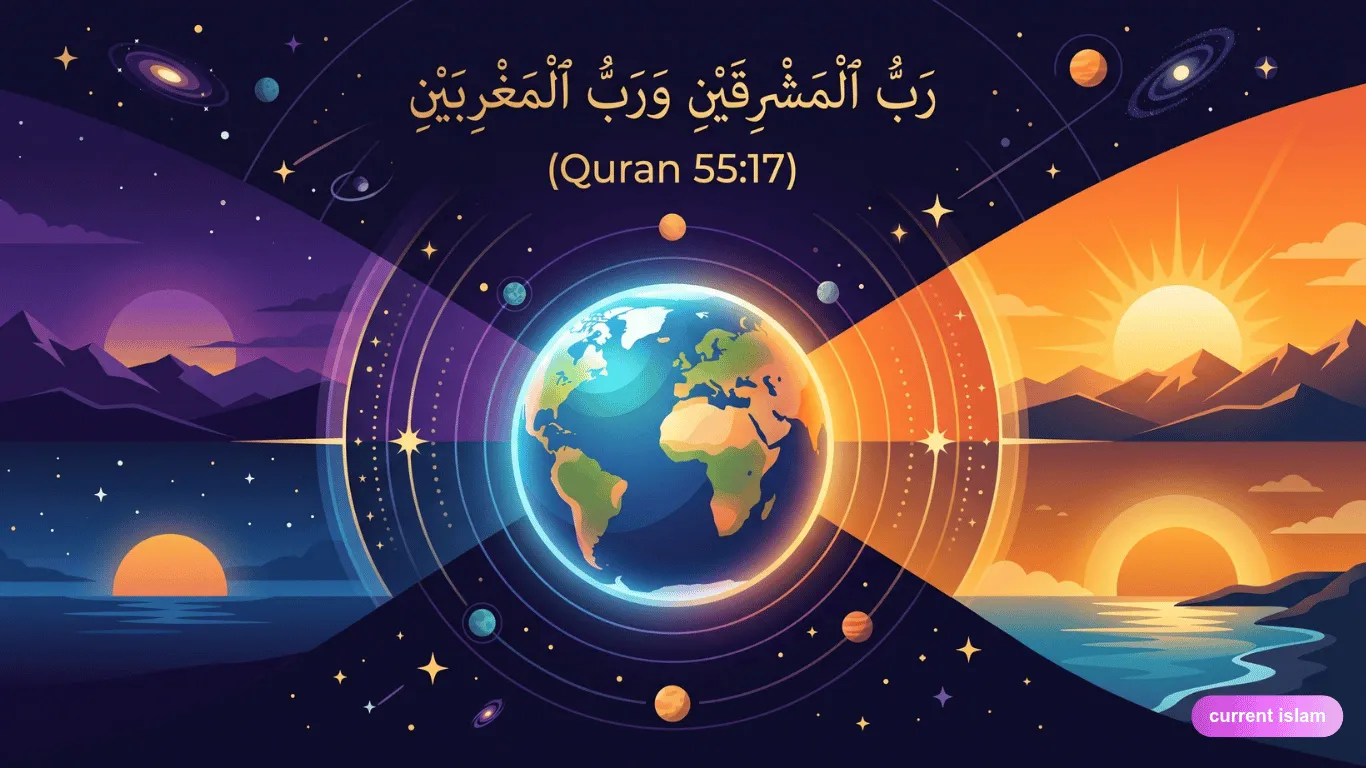
The exact meaning of Rabbul Mashriqain wa Rabbul Maghribain is “Lord of the two easts and Lord of the two wests.” This refers to Allah’s absolute control over the shifting points of sunrise and sunset during the summer and winter solstices, demonstrating His dominion over time and seasons.
Let’s break down the exact meaning of this verse. Surah Ar-Rahman is renowned for its rhythmic structure built entirely on pairs—mankind and jinn, sweet and salt water, heaven and hell. By using the dual Arabic linguistic form (Muthanna), the verse highlights a magnificent astronomical reality that governs our physical world.
Surah Ar-Rahman (Verse 17)
- Arabic Text: رَبُّ ٱلۡمَشۡرِقَيۡنِ وَرَبُّ ٱلۡمَغۡرِبَيۡنِ
- Transliteration: Rabbul mashriqayni wa rabbul maghribayn
- English Translation: [He is] Lord of the two easts and Lord of the two wests.
- Urdu Translation: وہ دونوں مشرقوں کا رب ہے اور دونوں مغربوں کا رب ہے۔
- Hindi Translation: वह दो पूर्वों का रब है और दो पश्चिमों का रब है।
Because of the Earth’s 23.5-degree axial tilt, the sun does not rise in the exact same eastern spot every morning. Instead, it travels back and forth along the horizon like a pendulum over the course of a solar year. Classical scholars noted this centuries ago. The sun reaches its northernmost rising point during the summer solstice and its southernmost rising point during the winter solstice. These two extremes are the “two easts” and “two wests.”
Here is why this matters for your daily routine. Acknowledging the shifting seasons is not merely a scientific observation; it is a profound realization of dependency. The Creator who masterfully manages the intricate tilt of the planet is more than capable of managing your daily struggles, career challenges, and family dynamics.
Scientific Precision Meets Spiritual Revelation
The Quranic mention of two easts perfectly aligns with modern astronomy. The Earth’s axial tilt means the sun sets at distinct extreme boundaries during the solstices. Recognizing this cosmic engineering forces the human mind to acknowledge the perfection and absolute capability of the Divine Creator.
Long before modern telescopes, the Quran established this undeniable physical reality. But how do we apply this at work or school? When you walk outside and feel the heat of the summer sun or the chill of a winter morning, let it serve as a physical trigger. The changing of the seasons is a deliberate, mathematically precise system created for human sustenance. Recognizing this system brings immediate psychological grounding.
The Core Difference: Quran 55:17 vs. Quran 73:9
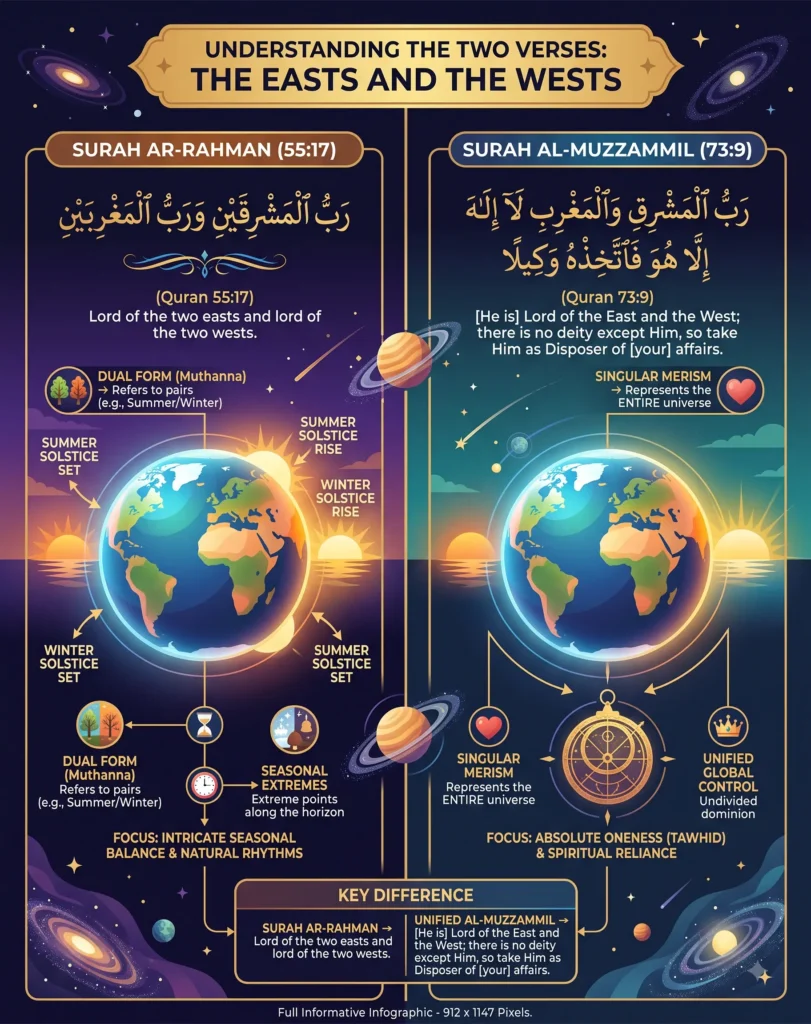
The primary difference is that Surah Ar-Rahman (55:17) uses the dual form to highlight physical planetary balance and changing seasons. Surah Al-Muzzammil (73:9) uses the singular form to declare unified dominion over the entire universe, reinforcing strict monotheism and ultimate reliance on God.
When you study classical Tafseer, such as the comprehensive works of Ibn Kathir, the nuances of these two verses become incredibly clear. They are speaking to two entirely different aspects of human faith. Surah Ar-Rahman highlights the tangible favors of Allah that we can see, feel, and measure. Surah Al-Muzzammil, however, commands an internal, spiritual action: surrendering control.
Surah Al Muzzammil Ayat 9
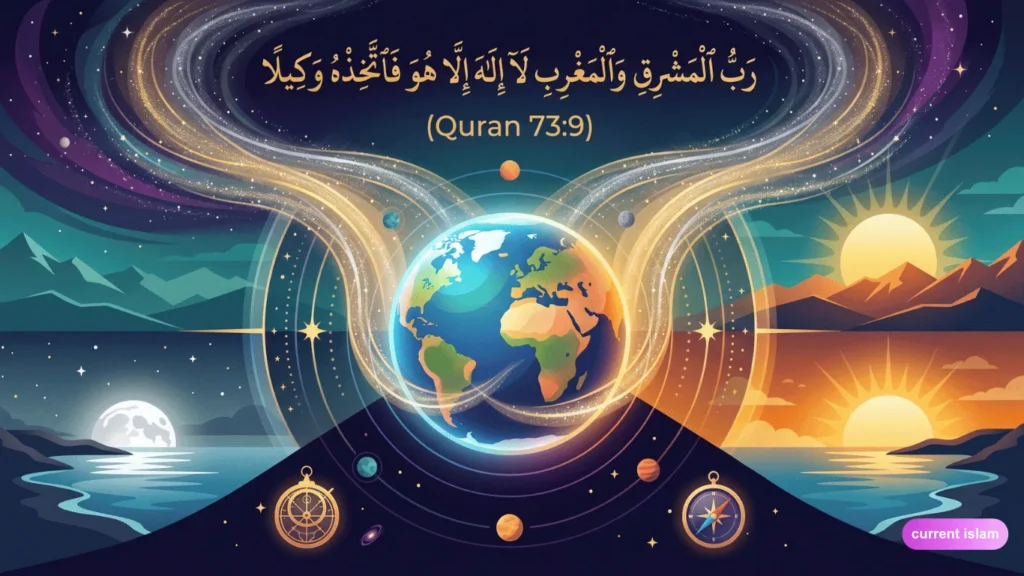
- Arabic Text: رَّبُّ ٱلۡمَشۡرِقِ وَٱلۡمَغۡرِبِ لَآ إِلَٰهَ إِلَّا هُوَ فَٱتَّخِذۡهُ وَكِيلٗا
- Transliteration: Rabbul mashriqi wal maghribi la ilaha illa Huwa fattakhithhu wakeela
- English Translation: [He is] Lord of the East and the West; there is no deity except Him, so take Him as Disposer of [your] affairs.
- Urdu Translation: مشرق اور مغرب کا رب (وہی ہے) اس کے سوا کوئی معبود نہیں، پس اسی کو کارساز بنا لیں۔
- Hindi Translation: वह पूर्व और पश्चिम का रब है; उसके सिवा कोई पूज्य नहीं, अतः उसी को अपना कार्यसाधक बना लो।
Notice the shift in language. The terms Mashriq (East) and Maghrib (West) are singular here. This is an Arabic linguistic device representing the entirety of existence—from one absolute end of the universe to the other. There is no duality highlighted here; rather, it is a statement of singular, absolute power (Tawhid).
Historical Context (Asbab al-Nuzul) of Surah Al-Muzzammil
The reasons for revelation (Asbab al-Nuzul) for Surah Al-Muzzammil center around the intense psychological pressure faced during the early days of Prophethood. This verse was revealed to anchor the Prophet’s heart, instructing him to rely entirely on the ultimate Disposer of Affairs amidst severe opposition.
Prophet Muhammad (PBUH) was facing a deeply hostile society. The command to take Allah as a Wakeel (Disposer of Affairs) was a strategic spiritual lifeline. A Wakeel is someone you trust implicitly to handle matters you cannot control. For modern Muslims living in the West, the application is direct. You will face workplace discrimination, academic stress, and economic uncertainty. You cannot control the environment, but you can control who you hire as your Wakeel.
Activating Tawakkul Daily
To activate Tawakkul, build a habit loop where you recite these verses during your morning remembrance. Recognizing that the Disposer of Affairs controls the vast East and West immediately neutralizes personal anxiety, replacing panic with profound Sabr (patience) and clarity.
We often think of habits strictly in terms of productivity and fitness. Let’s look at the Islamic version of a habit loop. By anchoring your emotional state to the reality of Allah’s dominion, you create an impenetrable psychological fortress. Authentic narrations from Sahih Bukhari and Sahih Muslim repeatedly emphasize the immense spiritual protection granted to those who consciously recognize Allah’s power at the break of dawn.
When you recite the morning Adhkar (remembrances), you are aligning your internal state with the external reality of the rising sun. You are actively declaring that the same God who brings light to the physical world will bring clarity to your personal affairs.
Data Visualization: Comparing the Verses
Recitation and Beneficial Knowledge
To truly benefit from these verses, you must pair the deep semantic understanding of Allah’s dominion with measured, rhythmic recitation (Tarteel) and a daily, conscious plea for beneficial knowledge.
It is no coincidence that the command for absolute reliance on Allah (Quran 73:9) appears in the exact same chapter that revolutionized how Muslims interact with the Divine text. Just five verses earlier, Allah provides the exact methodology for absorbing these heavy spiritual truths.
If you want to internalize the weight of Surah Al-Muzzammil and completely surrender your anxieties to the Wakeel (Disposer of Affairs), you cannot rush through the Arabic. You must apply the divine instruction to recite the Quran with Tarteel (Aw zid ‘alaihi warattilil quran tarteela). This measured, deliberate pacing forces your brain to slow down, allowing the reality of Allah’s absolute control over the East and West to bypass your intellect and settle directly into your heart.
But how do we ensure that this spiritual practice translates into real-world clarity and doesn’t just remain a morning ritual?
Recognizing the intricate planetary balance of the “two easts and two wests” (Surah Ar-Rahman 55:17) requires more than just reading the translation. It requires divine guidance to comprehend both the physical science and the spiritual weight of the verse. This is precisely why the Prophet Muhammad (PBUH) structured his morning routine around asking for Ilm (knowledge) that actually provides tangible value in this life and the next.
To complete your spiritual habit loop, immediately after your morning recitation, anchor your day with the powerful Prophetic supplication: Allahumma inni as-aluka ilman nafia (O Allah, I ask You for beneficial knowledge).
Pairing this specific Dua with a slow, measured recitation ensures that the profound theological truths you read at dawn will transform into actionable Sabr (patience) and Tawakkul (reliance) the moment you step out of your door.
People Also Ask
These answers provide quick, authoritative clarity regarding the Lord of the East and West. They demystify the physical interpretations of the Quranic text while delivering immediate, actionable spiritual benefits for your daily practice.
The most powerful Quranic declaration for relying on Allah is found in Surah Al-Muzzammil (73:9): “Rabbul mashriqi wal maghribi la ilaha illa Huwa fattakhithhu wakeela.” This translates to taking Him as the ultimate Disposer of your affairs, completely eliminating the need to panic over worldly outcomes.
Surah Ar-Rahman, verse 17 (Quran 55:17) explicitly states, “Rabbul mashriqayni wa rabbul maghribayn”—declaring Allah as the Lord of the two easts and Lord of the two wests, which specifically refers to the extreme planetary solstices.
Understanding that the Creator flawlessly manages the mechanics of the entire solar system puts personal problems into immediate perspective. This cosmic awareness naturally builds Sabr (patience), allowing you to navigate daily challenges with a calm, spiritually grounded mindset.
Read our complete guide to morning duas for American Muslims to fully optimize your daily spiritual routine and protect your peace.
