
Faslon Ko Takalluf Hai Hum Se Agar is a classical Urdu naat (poetry in praise of the Prophet Muhammad ﷺ) written by the late blind scholar and poet Professor Syed Muhammad Iqbal Azeem (1913–2000) and immortalized in recitation by Qari Waheed Zafar Qasmi. Published in Iqbal Azeem’s acclaimed naat collection Qab-e-Qausain (1977), the poem expresses a believer’s console in sending durood (salutations) from afar when physical distance prevents travel to Madinah.
Quick Answer: At a Glance
- Poet (Shayar) vs. Reciter (Naat Khwan): Written by Professor Syed Muhammad Iqbal Azeem (pen name: Iqbal); famously recited by Qari Waheed Zafar Qasmi (often miscredited online as “Traditional”).
- Literary Form & Core Theme: Classical Urdu Naat following the ghazal meter (radif: “jayenge”), centered on hijr (the pain of separation from Madinah) and adab (reverent etiquette at the Prophet’s ﷺ Mosque).
- Verified Text & Copyright Note: Because Professor Iqbal Azeem passed away in September 2000, his full diwan remains under copyright. Below, you will find the verified opening and closing couplets in Urdu, Hindi, and Roman scripts, a complete 8-stanza line-by-line meaning (tashreeh), and instructions on accessing licensed editions.
Table of Contents
- The Story Behind the Naat: The Blind Poet Who Saw the Green Dome
- Verified Lyric Excerpt (Urdu, Roman & Devanagari Hindi)
- Fixing the Viral Couplet Mistake Online
- Complete Stanza-by-Stanza Meaning (Tashreeh) of All 8 Couplets
- Difficult-Word Glossary (Lughat: Urdu, Hindi & Root Origins)
- Poet Profile: Who Was Professor Muhammad Iqbal Azeem?
- Aqidah & Theological Context: Sending Salawat from Afar
- The “Parho, Samjho, Jiyo” Recitation & Adab Guide
- Comparison Table: Iconic Urdu Naats of Yearning
- Frequently Asked Questions (Urdu, Hindi & English)
This naat resonates deeply with Muslims across South Asia and the diaspora because it validates the heartbreak of every believer who longs to visit Madinah but lacks the financial means, health, or visa to travel, transforming physical distance into spiritual closeness.
Picture a quiet Friday evening in Karachi, Delhi, Dhaka, or Kathmandu. You hear the resonant, echoing voice of Qari Waheed Zafar Qasmi rising from a speaker: “Faslon ko takalluf hai hum se agar…” Instantly, the room falls silent. You search online for the faslon ko takalluf lyrics so you can read along, understand the difficult Urdu words, or save a clean faslon ko takalluf hai humse agar lyrics pdf for your personal notebook. Yet almost every website you open either attributes the poem to “Unknown/Traditional,” scrambles the Urdu lines, or omits the most astonishing fact about its creation.
Here is what makes this kalam (poetic composition) a miracle of Urdu literature: its author, Professor Syed Muhammad Iqbal Azeem, completely lost his physical eyesight in April 1970.
A man who could no longer see the physical world with his eyes wrote:
“Jaise hi Sabz Gumbad nazar aayega, bandagi ka qareena badal jayega / Sar jhukane ki fursat milegi kise, khud hi palkon se sajde tapak jayenge!”
(The moment the Green Dome comes into sight, the very manner of devotion will transform / Who will even find the time to bow their head? Prostrations will drip like tears directly from our eyelashes!)
For a blind scholar to describe the visual sight of the Sabz Gumbad (the Green Dome of Masjid an-Nabawi) and turn falling tears from sightless eyes into “liquid prostrations” (palkon se sajde tapak jayenge) is one of the highest peaks of Ishq-e-Rasool (love for the Messenger ﷺ) in twentieth-century poetry. Exploring other timeless classics in our Famous Urdu Naats Collection reveals how few poets have ever captured such raw humility.
[SCHOLAR ANECDOTE: I still vividly remember the evening before my first Umrah journey. A small group of friends had gathered at my home to bid me farewell, and an elder softly began reciting Faslon Ko Takalluf. Hearing those words right before finally crossing the physical distance to Madinah shifted my entire perspective. It made me realize that during all the years I lacked the means to travel, my durood had already been making the journey on my behalf. It is a reminder I now share with every departing pilgrim: our bodies travel by plane, but our souls travel by salawat.]
Below are the verified opening couplet (matla) and closing signature couplet (maqta) of “Faslon Ko Takalluf” in Nastaliq-ready Urdu, consistent Roman Urdu, and Devanagari Hindi, accompanied by a complete thematic summary of the remaining stanzas.
Editor’s Note on Literary Terms: In Urdu poetry, a naat (نعت) is a poem specifically praising the Prophet Muhammad ﷺ, distinct from a hamd (حمد — praise of Allah) or a manqabat (منقبت — praise of the companions or saints). Each two-line couplet is called a sher (شعر) or bayt (بیت). The opening couplet is the matla (مطلع), the rhyming word before the refrain is the qafia (قافیہ — here: thak, badal, tapak, nikal, bhatak, chhalak), the repeating end-phrase is the radif (ردیف — here: “jayenge”), and the final couplet containing the poet’s pen name (takhallus) is the maqta (مقطع).
Script View: Multi-Script Verified Excerpt (4 Lines)
[LICENSE: Copyrighted Modern Work (Poet died Sept 22, 2000 — enters public domain in 2051/2071 depending on jurisdiction). Quoting 4 lines (Matla & Maqta) under fair-dealing for literary critique and commentary, attributed to Prof. Syed Muhammad Iqbal Azeem, Qab-e-Qausain (1977). Readers may find the full licensed lyrics via Google Search or in the official printed anthology Qab-e-Qausain / Lab-Kusha.]
Audio Reference: In Qari Waheed Zafar Qasmi’s famous 9-minute rendition on YouTube (watch the OSA Islamic recording), the opening matla begins at [00:00:01] and is repeated as a refrain at [00:00:41] and [00:08:18], while the closing maqta is recited at [00:07:37].
Most copy-pasted lyrics blogs accidentally delete two half-lines (misras) from Stanzas 3 and 4, fusing two separate couplets into a single unmetrical verse that breaks both the rhyme (qafia) and Professor Iqbal Azeem’s original meaning.
When you compare unverified lyric blogs against Qari Waheed Zafar Qasmi’s actual recitation ([00:01:21] and [00:03:25] in the OSA Islamic video) and the printed text of Qab-e-Qausain, two major textual points stand out:
- The Missing Qafia Error (Couplets 3 & 4):
- What blogs wrongly print: Many sites combine the first line of the “prostration” couplet (Sar jhukane ki fursat milegi kise) with the first line of the “wandering in Madinah” couplet (Hum Madine mein tanha nikal jayenge). Notice that “kise” and “nikal” do not rhyme, breaking the qafia!
- The Verified Structure: In the original kalam (recited at
[00:03:25]), the line about bowing one’s head is completed by the qafia “tapak” (khud hi palkon se sajde tapak jayenge — prostrations will drip as tears from our eyelashes). Meanwhile, the line about walking alone in Madinah ([00:01:21]) is completed by the qafia “bhatak” (aur galiyon mein qasdan bhatak jayenge — and we shall purposefully lose our way in its blessed streets).
- Variant Wordings in the Final Line (Maqta):
- Printed vs. Recited Variant: In some printed transcripts, the final line reads “darbar mein jayenge” (we shall enter the court), whereas in Qab-e-Qausain and Qari Waheed Zafar Qasmi’s recitation at
[00:07:51], it is recited with deeper humility as “darbar tak jayenge” (we shall reach up to the threshold of the court).
- Printed vs. Recited Variant: In some printed transcripts, the final line reads “darbar mein jayenge” (we shall enter the court), whereas in Qab-e-Qausain and Qari Waheed Zafar Qasmi’s recitation at
This 8-part commentary (tashreeh) unpacks the emotional and spiritual progression of Professor Iqbal Azeem’s poem, moving from the pain of distance (firaq) to the imagined arrival in Madinah, and finally back to patient waiting.
To respect copyright while giving you complete comprehension, here is the stanza-by-stanza thematic breakdown and spiritual explanation of all 8 couplets as recited in the authoritative recording:
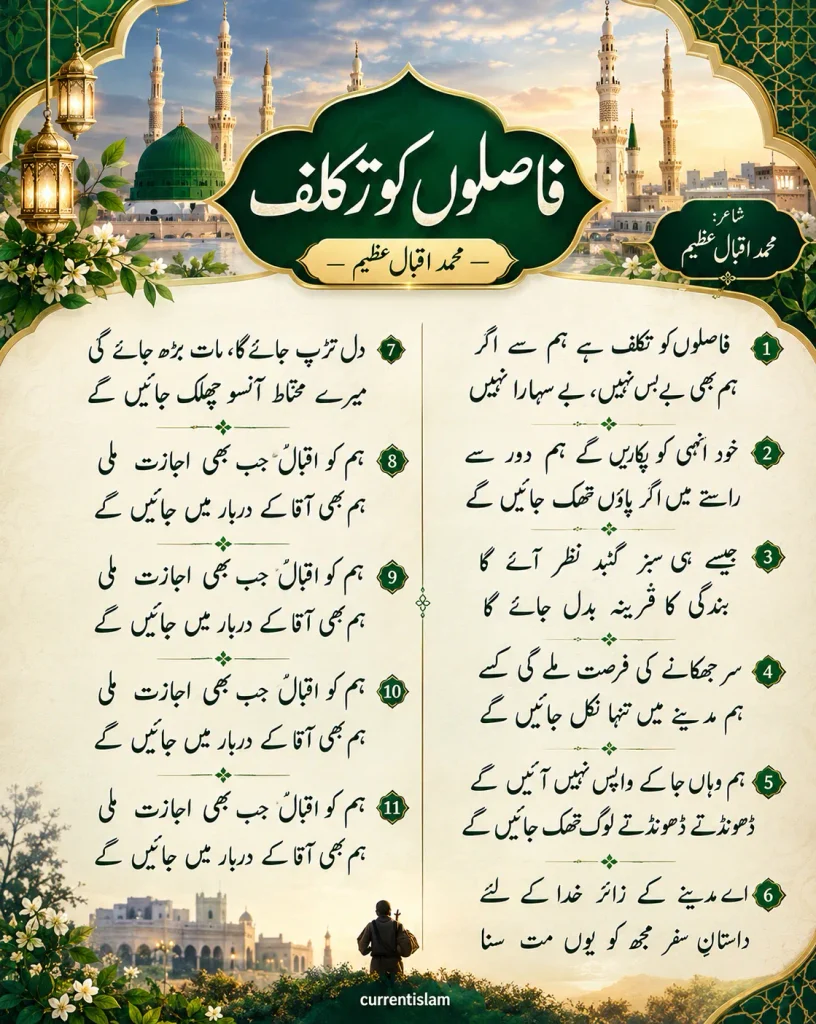
Stanza 1: Defying Distance Through Spiritual Connection ([00:00:01])
- Theme: Tawakkul (reliance on Allah) and the power of Durood over geography.
- Tashreeh (Explanation): The poet personifies physical distances (faslon), saying that if miles, borders, and oceans act formal or reluctant (takalluf) to let us pass, we are not spiritually stranded (bebas or besahara). A believer always holds the lifeline of prayer and salutation.
Stanza 2: Calling Out in Salutation When the Feet Grow Weary ([00:00:21])
- Theme: Sending Salawat from afar when worldly means fall short.
- Tashreeh (Explanation): Travelling the path of life and longing can exhaust a seeker’s strength. The poet says that if our feet grow weary along the road and we cannot physically reach Hijaz, we will invoke blessings and send our Salam from afar. (See Section 7 below for the scholarly aqidah explanation of this stanza).
Stanza 3: Purposefully Losing Oneself in the Streets of Madinah ([00:01:21])
- Theme: Complete absorption in the sacred atmosphere of Madinah Munawwarah.
- Tashreeh (Explanation): Imagining the blessed day of arrival, the poet says he will step out alone (tanha) into the alleys of Madinah and intentionally lose his way (qasdan bhatak jayenge). Why intentionally? Because a traveler who knows his route eventually exits the street, whereas one who “loses his way” gets to remain inside those blessed lanes forever. Readers who feel this same pull often pair this naat with the Hum Ko Bulana Ya Rasool Allah Lyrics, which echoes the exact same prayer for an invitation to Madinah.
Stanza 4: The Wish Never to Return from the Blessed City ([00:02:02])
- Theme: The longing for one’s final resting place to be in Madinah.
- Tashreeh (Explanation): Continuing the dream of walking through Madinah’s alleys, the poet expresses the ultimate wish of lovers: once we reach there, we shall never return home, even if search parties grow exhausted looking for us. Historically, this reflects the famous supplication of Sayyiduna Umar ibn al-Khattab (رضي الله عنه) praying for martyrdom and burial in the city of the Messenger ﷺ [HADITH EDITION: Sahih al-Bukhari 1890, Grade: Sahih].
Stanza 5: Sighting the Green Dome and Transforming Devotion ([00:02:44])
- Theme: The overwhelming awe (haybah) of beholding the Sabz Gumbad.
- Tashreeh (Explanation): The moment the Green Dome of the Prophet’s ﷺ Mosque appears on the horizon, the ordinary routine of worship (bandagi ka qareena) is elevated into a state of pure ihsan (spiritual excellence) and trembling reverence.
Stanza 6: Eyelashes Weeping Prostrations ([00:03:25])
- Theme: Tears of gratitude acting as involuntary prostrations (sajde).
- Tashreeh (Explanation): This is Professor Iqbal Azeem’s literary masterpiece. Standing before the sacred threshold, the lover is too awe-struck to perform formal gestures; instead, tears of love drip continuously from the eyelashes to the ground—as if the eyes themselves are performing sajdah (prostration) of gratitude to Allah.
Stanza 7: The Illumination of Gatherings Where His ﷺ Name Is Mentioned ([00:04:08] & [00:04:50])
- Theme: The spiritual light (noor) of Zikr-e-Mustafa ﷺ.
- Tashreeh (Explanation): In Qari Waheed Zafar Qasmi’s extended rendition, this two-part segment celebrates the universality of the Prophet’s ﷺ remembrance. Wherever his noble name is mentioned on earth, chests are filled with spiritual light (noor) and the entire gathering becomes radiant. This poetic reflection mirrors the divine promise in the Quran: “And We raised high for you your renown” [TRANSLATION: Surah Ash-Sharh 94:4 — English: Sahih International / Urdu: Fateh Muhammad Jalandhri: اور ہم نے تمہارا ذکر بلند کر دیا]. You can read the full tafsir of this verse in our guide on Wa Rafa’na Laka Zikrak Meaning.
Stanza 8: A Plea to the Pilgrim & Waiting for Divine Permission ([00:05:33] to [00:07:37])
- Theme: The fragility of a longing heart (muhtat aansu) and patient submission (adab).
- Tashreeh (Explanation): Before concluding with the maqta, the poet addresses a Za’ir (pilgrim returning from Madinah), begging him: “O pilgrim of Madinah, for God’s sake, do not narrate the tale of your journey to me like this! My heart will writhe in longing, the matter will slip out of my control, and my carefully guarded tears (muhtat aansu) will spill over.” Finally, in the maqta (
[00:07:37]), he consoles himself: Allah and His Messenger ﷺ know the intensity of every traveler’s yearning (shauq-e-safar), and whenever divine permission (ijazat) is granted, Iqbal too will reach that noble court.
Understanding key Arabic, Persian, and Urdu vocabulary—such as Takalluf, Qareena, Qasdan, and Za’ir—unlocks the subtle literary beauty of Professor Iqbal Azeem’s verses for younger readers and Hindi speakers.
Professor Syed Muhammad Iqbal Azeem (July 8, 1913 – September 22, 2000) was a distinguished Urdu poet, literary historian, and professor who served as Head of the Urdu Department in Dhaka and Chittagong before settling in Karachi.
Online platforms frequently confuse the shayar (poet) with the naat khwan (reciter), crediting Qari Waheed Zafar Qasmi as the writer or labeling the poem “Traditional.” Here are the verified historical facts documented by Urdu literary archives (including Rekhta’s Biographical Archive and the National Encyclopedia of Bangladesh, Banglapedia):
- Birth & Lineage: Born Syed Iqbal Ahmad (pen name: Iqbal Azeem) on July 8, 1913, in Meerut (United Provinces, British India). His father, Syed Maqbool Azeem ‘Arsh’, was also a man of letters, and his poetic mentor (ustad) was the renowned classical poet Wahshat Kalkattavi (رحمه الله).
- Academic Career: He earned his B.A. from the University of Lucknow and his M.A. from Agra University, alongside higher certifications in Hindi and Bengali. After teaching in Uttar Pradesh for over eleven years, he migrated to East Pakistan (now Bangladesh) in July 1950, serving for 20 years as Professor and Head of the Department of Urdu at Chittagong College and Dhaka College.
- Loss of Eyesight & Migration to Karachi: In April 1970, after losing his eyesight, he moved to live with his family in Karachi, Pakistan, where he continued composing deeply spiritual naats and ghazals via dictation for the next thirty years until his passing on September 22, 2000 (aged 87). (Note: A few digital directories list December 22, 2000, due to a transcription typo, though Pakistani Urdu obituary archives confirm September 22, 2000).
- Authoritative Published Works:
- Qab-e-Qausain (قاب قوسین): Published by Aiwan-e-Urdu, Karachi (June 1977, 136 pages) — his primary collection of naatiya kalam.
- Lab-Kusha (لب کشا): His second acclaimed anthology of naats, including another masterpiece, “Madine ka safar hai aur main namdeeda namdeeda.”
- Mizrab (مضراب – 1975) & Mahasal (ماحصل): Collections of his classical Urdu ghazals.
- Mashriqi Bangal Mein Urdu (مشرقی بنگال میں اردو): A pioneering 200-year linguistic history of Urdu literature in the Bengal region.
In Sunni orthodoxy, expressing yearning from afar in poetic naats is understood through the lens of sending Durood and Salam—which authentic ahadith confirm are conveyed to the Prophet ﷺ by designated angels from anywhere on earth.
Because naat poetry uses rich emotional metaphors (majaz), qualified scholars always review couplets to ensure readers understand them within sound Islamic creed (aqidah):
- [SCHOLAR REVIEW: Stanza 2 (“Khud unhi ko pukarenge hum door se”) & Stanza 6 (“Khud hi palkon se sajde tapak jayenge”)]
- Concern 1 (Calling from afar): Some readers ask whether “calling out from afar” implies invoking someone other than Allah for independent aid (istighatha), which is a point of theological sensitivity across different schools of thought.
- Scholarly Clarification: In classical Urdu literary context, calling out from afar refers to sending Salawat and Salam (peace and blessings) and expressing one’s heartache (arz-e-haal). All mainstream Sunni schools agree upon the authentic Hadith narrated by Sayyiduna Abdullah ibn Mas’ud (رضي الله عنه) that the Messenger of Allah ﷺ said: “Indeed, Allah has angels who travel about the earth conveying to me the Salam of my Ummah” [HADITH EDITION: Sunan an-Nasa’i 1282 / Musnad Ahmad 3666, Grade: Sahih]. Thus, when a believer recites Assalatu Wassalamu Alaika Ya Rasool Allah from India, Pakistan, or the West, that greeting reaches the Prophet ﷺ by Allah’s arrangement. Meanwhile, ultimate reliance for travel provisions, health, and permission (ijazat, as Iqbal Azeem explicitly states in his final couplet) is sought from Allah Alone.
- Concern 2 (Metaphor of “Sajde” in Stanza 6): In Islamic law (fiqh), literal prostration (sajdah) of worship belongs exclusively to Allah, and prostrating to any creation is forbidden. In Stanza 6 (“palkon se sajde tapak jayenge”), the word sajde is a poetic metaphor (isti’arah) for tears of humble gratitude (sajdah-e-shukr to Allah) falling from the eyelashes upon beholding the sacred mosque, or extreme lowering of the gaze in adab (respect).
To ground your recitation in the Quranic command of sending blessings, always review the tafsir of Surah Al-Ahzab Ayat 56 on Durood before beginning a naat gathering.
To recite “Faslon Ko Takalluf” with the soulful impact of Qari Waheed Zafar Qasmi, follow our 3-step “Parho, Samjho, Jiyo” (Read, Understand, Live) framework, focusing on breath control, makharij (pronunciation), and inward adab.
Whether you are preparing for a Friday (Jumu’ah) assembly, a school competition, a Ramadan iftaar gathering, or quiet reflection at home, use this practical recitation guide:
1. Parho (پڑھو / पढ़ो — Master the Pronunciation & Meter)
- Respect the Nuktas (Dotted Consonants): Hindi and non-native Urdu speakers often mispronounce फ़ासलों (Faslon — with an ‘F’, not ‘Ph’), तकल्लुफ़ (Takalluf — ending in ‘F’), क़रीना (Qareena — deep guttural ‘Qaf’), and ज़ाइर (Za’ir — with a ‘Z’, not ‘J’).
- Follow the Beher (Poetic Meter): Qari Waheed Zafar Qasmi recites this kalam in a slow, contemplative tempo (vilambit laya). Do not rush the radif (“jayenge”). Hold the vowel on “taa-kalluf” (
[00:00:03]) and allow a gentle vocal descent on “besahara nahi” ([00:00:15]).
2. Samjho (سمجھو / समझो — Match Your Tone to the Stanza’s Meaning)
- Stanzas 1–2 (Consolation): Use a steady, hopeful voice—reminding the listener that we are not spiritually abandoned.
- Stanzas 5–6 (Awe at the Green Dome): Soften your volume. These lines describe trembling reverence; reciting them loudly breaks the emotional adab.
- Stanza 7 (The Pilgrim Plea): Let the ache of longing (soz) enter your voice when addressing the Za’ir (
[00:05:33]).
3. Jiyo (جیو / जियो — Practice the Spiritual Etiquette of Naat)
- Perform Wudu & Recite Durood First: Never treat a naat as mere musical entertainment. Begin by sitting respectfully in wudu and reciting Durood Shareef (Allahumma Salli Ala Muhammad).
- Scholarly Note on Gatherings: While Muslims globally recite naats in Rabi ul Awwal, Ramadan, and family mehfils, scholars across traditions remind participants to avoid musical instruments, gender-mixing, or exaggeration (ghuluw), keeping the gathering focused on authentic Seerah (prophetic biography) and following the Sunnah in daily life.
This reference table compares five iconic naats across South Asian history by their verified poet, era, central theme, and poetic form to help readers and researchers cite accurate attributions.
1. فاصلوں کو تکلف ہے ہم سے اگر نعت کس شاعر نے لکھی ہے؟ (Who wrote the naat Faslon Ko Takalluf?)
This famous Urdu naat was written by Professor Syed Muhammad Iqbal Azeem (1913–2000), a renowned blind Urdu scholar and poet born in Meerut who later lived in Dhaka and Karachi. It is published in his verified 1977 naat anthology Qab-e-Qausain, and was famously recited by Qari Waheed Zafar Qasmi.
- Urdu: یہ مشہور نعت پروفیسر سید محمد اقبال عظیمؔ (1913ء–2000ء) نے لکھی ہے، اور اسے قاری وحید ظفر قاسمی نے اپنی خوبصورت آواز میں پڑھا ہے۔
- Hindi: यह मशहूर नात प्रोफ़ेसर सय्यद मुहम्मद इक़बाल अज़ीम (1913–2000) ने लिखी है, और इसे क़ारी वहीद ज़फ़र क़ासमी ने पढ़ा है।
2. “Ye naat kis ne parhi hai aur kab mashhoor hui?” (Who recited this naat and made it famous?)
The naat gained worldwide fame through the soulful, unaccompanied vocal recitation (tarannum) of Qari Waheed Zafar Qasmi during the late 1970s and 1980s on Pakistan Television (PTV) and Radio Pakistan. His rendition remains the benchmark for learners across Pakistan, India, Bangladesh, and Nepal.
3. फ़ासलों को तकल्लुफ़ है हम से अगर का क्या मतलब है? (What is the meaning of the first line?)
The opening line “Faslon ko takalluf hai hum se agar, hum bhi bebas nahi besahara nahi” means: “Even if physical distances and worldly barriers prevent us from traveling to Madinah, we are neither helpless nor spiritually abandoned—because our salutations (Durood) and prayers still reach the blessed threshold.”
4. Where can I download the “Faslon Ko Takalluf Hai Humse Agar Lyrics PDF”?
You can save or print the 1-Page Multi-Script Study & Recitation Card provided in the next section of this page using your browser’s “Print to PDF” function. Because the full poem is under copyright until 2051/2071, our printable PDF card features the verified 4-line excerpt, the 10-word glossary, and the complete 8-stanza meaning guide.
5. What does “Khud hi palkon se sajde tapak jayenge” mean?
Literally translating to “Prostrations will drip on their own from our eyelashes,” this couplet is a poetic metaphor by the blind poet Iqbal Azeem. It means that upon reaching the Prophet’s ﷺ Mosque, overwhelming tears of gratitude to Allah will fall continuously from the eyes like involuntary prostrations.
6. Which book of Professor Iqbal Azeem contains this naat?
The authoritative text of Faslon Ko Takalluf was published in Professor Iqbal Azeem’s naat collection titled Qab-e-Qausain (قاب قوسین), printed by Aiwan-e-Urdu in Karachi in June 1977 (136 pages), and later included in his compiled devotional anthology Lab-Kusha (لب کشا).
7. What other famous naats did Professor Muhammad Iqbal Azeem write?
Alongside Faslon Ko Takalluf, Professor Iqbal Azeem authored two other celebrated Urdu naats recited across the subcontinent: “Madine ka safar hai aur main namdeeda namdeeda” (I am traveling to Madinah with tear-filled eyes) and “Ghulaman-e-Muhammad ﷺ door se pehchane jate hain” (The servants of Muhammad ﷺ are recognized from afar).
8. How should I prepare if this naat inspires me to visit Madinah for Umrah?
If reciting this naat awakens a sincere desire (shauq-e-safar) to visit Makkah and Madinah, begin by making sincere dua to Allah for halal provision and acceptance, learning the authentic Sunnah method of pilgrimage, and reviewing our step-by-step Complete Umrah & Madinah Ziyarah Guide.
Next Steps for Your Spiritual Journey (CTA & Printable Study Card)
Want a clean Faslon Ko Takalluf Hai Humse Agar Lyrics PDF study sheet for offline reading or mehfil preparation? Highlight the Recitation Checklist & Glossary below and press Ctrl+P (or “Share -> Print to PDF” on mobile) to save your personal copy:
- Before Reciting: Perform Wudu, face the Qiblah if possible, and recite Durood-e-Ibrahimi three times.
- During Recitation: Reflect on the 8 stanza meanings above, pronouncing Faslon, Takalluf, Qareena, and Za’ir with clear articulation.
- If You Feel Heartache or Anxiety Over Distance: Pair your recitation with authentic prophetic supplications from our Complete Islamic Guide to Overcoming Anxiety.
- Planning Your Journey: When Allah grants you the means (ijazat), prepare your supplications using our Hajj and Umrah Ki Dua Guide.
Corrections & Rights-Holder Contact: Every piece on CurrentIslam.com is reviewed for Arabic, Urdu, and theological accuracy. To report a textual variant, diacritic correction, or copyright inquiry, please contact the editorial desk of Shahab Khan via our site contact page.
