
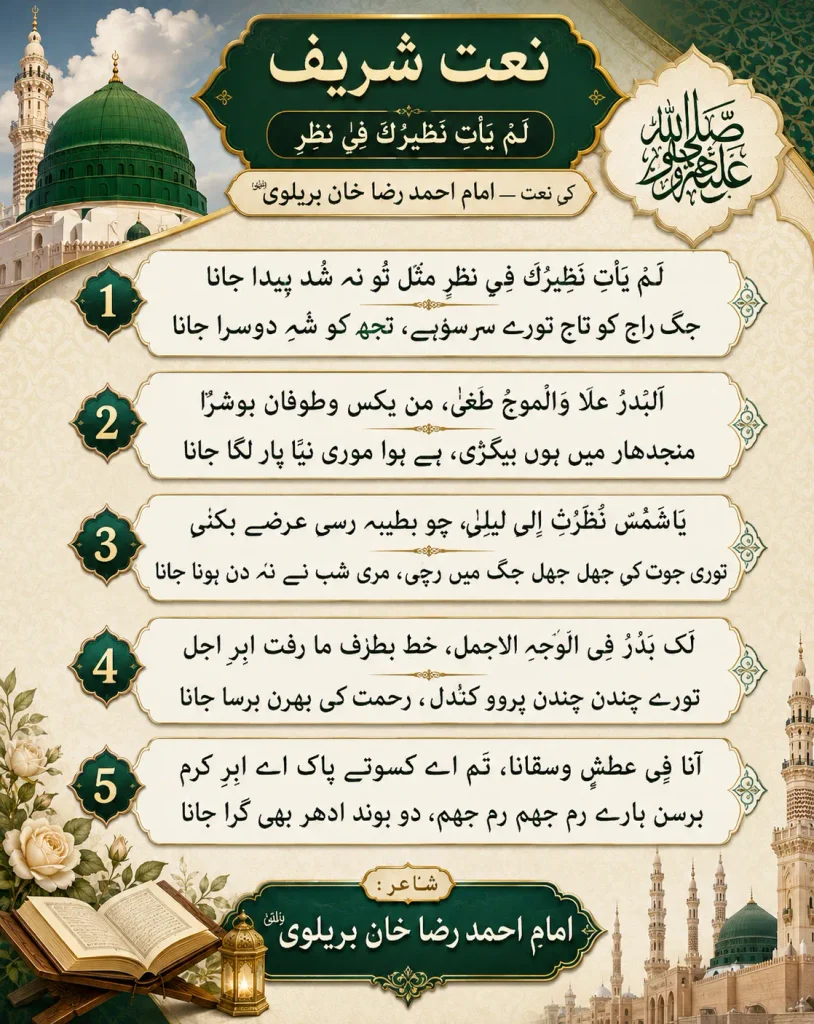
Lam Ya’ti Nazeeruka Fi Nazarin (لَمْ يَأْتِ نَظِيرُكَ فِي نَظَرٍ) is a celebrated quadrilingual naat (devotional poetry in praise of the Prophet Muhammad ﷺ) composed by the 19th-century Islamic scholar, jurist, and poet Imam Ahmad Raza Khan Barelvi (رحمۃ اللہ علیہ). Published in his authoritative poetry collection (diwan) Hadaiq-e-Bakhshish, this masterpiece weaves four distinct languages—Classical Arabic, Persian, Braj Bhasha (Classical Hindi), and Urdu—into every single couplet (sher).
Quick Answer (At a Glance)
- Poet (Shayar): Imam Ahmad Raza Khan Barelvi (رحمۃ اللہ علیہ) [1856–1921 CE]. Note that renowned vocalists like Alhaaj Owais Raza Qadri are reciters (naat khwans) of this work, not its author.
- Form & Theme: A Mulamma’ (macaronic or multilingual) naat celebrating the unmatched status of the Prophet ﷺ, spiritual longing for Madinah, and humble supplication.
- Verified Source & License: Sourced directly from Hadaiq-e-Bakhshish (Part 1). Because the poet passed away over a century ago, the original text is in the Public Domain.
Why Finding an Accurate Version of This Naat Matters
You hear a moving recitation of “Lam Ya’ti Nazeeruka Fi Nazarin” during a Friday gathering or a spiritual evening and immediately search online for the words so you can recite along. Almost immediately, you hit a wall: most lyric images circulating on WhatsApp and social media are riddled with automated scanning errors that distort the Arabic and Persian phrases, and few pages explain where one language ends and the next begins.
Just as sending blessings upon the Prophet ﷺ is rooted in the Quranic command explained in our guide on Surah Al-Ahzab Ayat 56 and Durood, reciting prophetic praise with accurate pronunciation and clear understanding honors the etiquette (adab) of devotional poetry. Below is the complete, verified text from Hadaiq-e-Bakhshish, restored with proper diacritics, consistent Roman transliteration, Devanagari Hindi, and line-by-line English meaning.
The authentic text of Lam Ya’ti Nazeeruka Fi Nazarin consists of ten couplets (ash’aar). The first nine couplets follow a strict four-language sequence—Arabic, Persian, Braj Hindi, and Urdu—while the tenth closing couplet (maqta) uses Persian and Urdu to explain why the poem was written.
[LICENSE: Public Domain — Verified from Hadaiq-e-Bakhshish, Part 1, Author: Imam Ahmad Raza Khan Barelvi (d. 1921 CE)]
Many lyric images shared on social media suffer from optical character recognition (OCR) errors that replace classical Arabic and Persian words with nonsensical phrases. Reciting these misprints alters both the poetic meter (bahr) and the theological meaning of the couplets.
| Couplet | Corrupted Viral Image Text | Authentic Hadaiq-e-Bakhshish Text | Why the Correction Matters |
| Couplet 2 | Al-badru ‘ala… man yaks wa toofaan boshra (البدرُ علا… بوشرّا) | Al-bahru ‘ala… man bekas-o-toofaan hosh-ruba (اَلْبَحْرُ عَلَا… ہوش رُبا) | The verse describes a raging sea (Al-Bahr), not the full moon (Al-Badr). Furthermore, boshra is a misprint of the Persian compound hosh-ruba (“sense-stealing”). |
| Couplet 2 | Manjdhaar mein hoon be-kadi (منجدھار میں ہوں بیکڑی) | Manjdhaar mein hoon bigri hai hawa (مَنجدھار میں ہُوں بِگڑی ہے ہَوا) | The original phrase is bigri hai hawa (“the winds have turned hostile”), completing the nautical storm metaphor. |
| Couplet 4 | Khat ba-tarf ma raft abr-e-ajal (خط بطرف ما رفت) | Khat haala-e-mah zulf abr-e-ajal (خَط ہالَۂ مَہ زُلف اَبرِ اَجَل) | The sacred facial down (khat) is compared to the luminous halo around the moon (haala-e-mah), not “walking toward us.” |
| Couplet 4 | Toray chandan chandan parwar kundal | Toray chandan chandr paro kundal (تورے چَندَن چَندَر پَرو کُنڈَل) | The first word is chandan (sandalwood) and the second is chandr (moon in Hindi/Sanskrit), followed by paro (hanging/lying). |
| Couplet 5 | Ana fi ‘atashin wa saqana, tum aye kiswate paak | Ana fi ‘atashin wa sakhaka atamm, aye gesu-e-paak (وَّسَخَاكَ اَتَمّ اے گیسوئے پاک) | The Arabic is wa sakhaka atamm (“and your generosity is most complete”), followed by the Persian address aye gesu-e-paak (“O sacred tresses!”). |
Because this naat bridges four literary traditions, understanding key vocabulary from Arabic, Persian, Braj Hindi, and Urdu unlocks the emotional depth of every hemistich (misra).
Each couplet in Lam Ya’ti Nazeeruka Fi Nazarin progresses from high theological praise in Arabic and Persian to intimate, folk-inspired devotion in Hindi and Urdu, anchored by the homonymic refrain (radif) “Jaana.”
Couplet 1: The Peerless Status of the Prophet ﷺ
The opening couplet (matla) declares that no eye has ever witnessed anyone equal to the Prophet Muhammad ﷺ, nor has anyone like him ever been born. Shifting into Braj Hindi and Urdu, the poet states that the crown of universal sovereignty (jag raaj ko taaj) suits only his blessed head. Just as Allah elevated the Prophet’s remembrance across creation—a reality explored in our commentary on Warafa’na Laka Zikrak in Surah Alam Nashrah—believers recognize him as the spiritual leader of both worlds (Shah-e-Dosara).
- Hadith Context: In Sahih Muslim (Book 43, Hadith 2278 — Grade: Sahih), the Prophet ﷺ stated: “I will be the leader of the children of Adam on the Day of Resurrection, and I do not say this out of pride.”
Couplet 2: The Spiritual Tempest and the Plea for Rescue
Here, the poet uses the classical metaphor of a violent sea storm: “The sea has risen high and the waves surge rebelliously; I am helpless while the tempest steals my senses.” Caught in the midstream whirlpool (manjdhaar), the poet pleads for his frail boat (nayya) to be guided safely to shore.
- [SCHOLAR REVIEW: Line “Mori nayya paar laga Jaana” — Theological Context on Poetic Metaphor and Wasilah]: In classical Sunni devotional poetry, asking the Prophet ﷺ to “steer the boat across” is understood as a figurative plea (majaz) seeking his intercession (shafa’ah) and spiritual means (wasilah) by the permission of Allah, who alone is the ultimate rescuer. Other scholarly traditions prefer avoiding direct vocative pleas to anyone other than Allah in poetry to safeguard strict monotheism (tawhid). Readers can explore the broader theological framework of intercession in our guide on what Dua-e-Tawassul means in Islam, and pair their recitation with the Quranic supplication for distress, Hasbunallahu Wa Ni’mal Wakeel.
Couplets 3, 4 & 5: Cosmic Light, Sacred Aesthetics, and the Rain of Mercy
In Couplet 3, the poet addresses the sun as a traveler heading westward toward Taybah (Madinah), asking it to convey how the Prophet’s radiant light (jot) illuminates the cosmos while the poet’s own dark night of separation remains unbroken.
Couplets 4 and 5 transition into Shama’il (descriptions of the Prophet’s blessed features), comparing his luminous countenance to the full moon (badr) and fragrant sandalwood (chandan), and his dark locks (gesu-e-paak) to heavy rain clouds of grace (abr-e-karam). Parched with spiritual thirst (‘atash), the poet asks for just “two drops” (do boond) of that gentle rain (rim-jhim), echoing the core Quranic truth that the Prophet ﷺ was sent as pure mercy—as detailed in our study of Surah Al-Anbiya: Wama Arsalnaka Illa Rahmatal-lil-Alameen.
Couplets 6 & 7: The Heartbreak of Leaving Madinah
Drawing upon the classical Arabic Qasida tradition, Couplet 6 addresses the desert caravan (Ya qafilati), begging the camel-driver to extend their stay in Madinah because the mere thought of departure makes the poet’s heart tremble and pound (mora jiyara larje darak-darak). Couplet 7 sighs over the fleeting hours (suway’atin) spent in the sacred presence, echoing the intense yearning found in other beloved classics like Hum Ko Bulana Ya Rasool Allah lyrics. For believers preparing to experience those blessed moments in person, our Umrah 2026 complete guide for first-time pilgrims walks through the spiritual and practical preparation for visiting the Haramain.
Couplets 8 & 9: Wounded Hearts and Consuming Devotion
In Couplet 8, internal wordplay mirrors emotional overwhelm: shajin (wounded) pairs with shujoon (branching sorrows) in Arabic, while pat (protector of honor) pairs with bipat (calamity) in Hindi. When worldly grief feels unbearable, believers combine poetic reflection with prophetic supplications such as our Dua for anxiety and depression and the comforting words of Dil Ghabrane Ki Dua. Couplet 9 reaches the crescendo of Sufi love (ishq), where the poet declares that having already given his body, mind, and wealth (tan, man, dhan), he longs for his remaining soul to be completely purified in the flame of prophetic love.
Imam Ahmad Raza Khan Barelvi (1856–1921 CE) was a prominent Hanafi jurist, theologian, and polymath from Bareilly, India. In the final couplet (maqta), he states that writing in folk Hindi idioms and four-language grids is not his usual style, noting that he composed it only to honor the insistent request of beloved companions (Irshad-e-Ahibba).
- Verified Biography: Born on June 14, 1856 (10 Shawwal 1272 AH) in Bareilly, Uttar Pradesh, and passed away on October 28, 1921 (25 Safar 1340 AH). His poetic anthology, Hadaiq-e-Bakhshish, remains a cornerstone of Urdu and Persian devotional literature.
- The Story Behind “Irshad-e-Ahibba Naatiq Tha”: Throughout Hadaiq-e-Bakhshish, Imam Ahmad Raza Khan typically wrote in highly formal, scholarly Urdu and Persian. Using earthy Braj Bhasha words (mori, tori, nayya, jiyara) and complex quadrilingual gymnastics (san’at-gari) felt foreign to his natural inclination, as he believed the court of the Prophet ﷺ demanded pure humility rather than literary showmanship. However, when close associates requested a four-language naat, he fulfilled their wish while humbly apologizing in the closing line [VERIFY: Exact primary biographical page citation in Hayat-e-Ala Hazrat or Malfuzat identifying the specific companions referenced in the double-meaning phrase Irshad-e-Ahibba].
[SCHOLAR ANECDOTE: In the Maqta (closing couplet), Imam Ahmad Raza Khan Barelvi (رحمۃ اللہ علیہ) expresses humility and devotion before the Beloved Prophet Muhammad ﷺ. His words remind every Naat reciter that sincerity (Ikhlas) and Adab (reverence) matter more than technical vocal display. A beautiful voice may move the ears, but heartfelt love, humility, and respect give a recitation its deeper meaning. When we recite with a sincere heart and observe the proper etiquette of Naat, our words become an expression of devotion rather than a performance.]
To recite Lam Ya’ti Nazeeruka Fi Nazarin properly, a reciter must adjust vocal articulation across all four languages within each breath—rendering the Arabic quarter with crisp phonetic clarity (makharij), the Persian with flowing lyricism, and the Hindi-Urdu conclusion with gentle humility.
- Begin with Salawat: Always open and close your recitation by sending blessings upon the Prophet ﷺ. You can read the full text and virtues in our guide to Durood Shareef (Allahumma Salli Ala Muhammadin) or explore the meaning of Assalatu Wassalamu Alaika Ya Rasool Allah.
- Master the Language Transitions: Pause slightly (a micro-caesura) between the Arabic and Persian halves of the first line so listeners can register the shift in language.
- Occasions for Recitation: Frequently recited during Jumu’ah gatherings, Rabi’ al-Awwal programs, and family spiritual circles. (Note: While Islamic scholars hold varying juristic views regarding the formal structure of seasonal Mawlid gatherings, praising the Prophet’s character and reciting authentic poetry with proper etiquette is cherished across classical Islamic scholarship.)
South Asian Islamic literature features several iconic devotional poems that blend Arabic, Persian, and local vernaculars. The table below compares Lam Ya’ti Nazeeruka Fi Nazarin with other renowned works covered on CurrentIslam.com.
For readers building a personal collection of devotional poetry, browse our curated famous top 10 Naats list in Urdu or read the beloved contemporary classic Meetha Meetha Hai Mere Muhammad Ka Naam lyrics.
Lam yati nazeero lyrics with Urdu Translation pdf
1. Who wrote the naat Lam Yati Nazeero Kafi Nazarin?
Lam Ya’ti Nazeeruka Fi Nazarin was written by the renowned Islamic scholar and poet Imam Ahmad Raza Khan Barelvi (رحمۃ اللہ علیہ) [1856–1921 CE] and is published in the first volume of his poetry anthology, Hadaiq-e-Bakhshish. Vocalists like Owais Raza Qadri are reciters (naat khwans) of the poem, not its writer.
2. What is the English meaning of “Lam Ya’ti Nazeeruka Fi Nazarin”?
The Arabic phrase “Lam ya’ti nazeeruka fi nazarin” (لَمْ يَأْتِ نَظِيرُكَ فِي نَظَرٍ) literally translates to: “None equal to you has ever come into anyone’s sight.” Here, nazeer means peer or equal, and nazar means sight or vision.
3. Which four languages are used in every couplet of this naat?
The first nine couplets are composed in Classical Arabic (first half of line 1), Classical Persian (second half of line 1), Braj Bhasha / Purbi Hindi (first half of line 2), and Classical Urdu (second half of line 2). In Eastern poetics, this multilingual technique is called San’at-e-Mulamma’.
4. What does the refrain word “Jaana” mean at the end of every verse?
Imam Ahmad Raza Khan uses the word “Jaana” as a homonymic pun (Tajnees-e-Taam). In the Persian context, Jānā means “O Beloved!” or “O Life of my soul!” In the Urdu and Hindi contexts, it shifts meaning between “to recognize/know” (Couplet 1), “to depart” (Couplets 6 and 7), and an auxiliary verb of request.
5. What is the meaning of “Toray chandan chandr paro kundal” in Couplet 4?
This Braj Hindi hemistich describes the blessed physical features (Shama’il) of the Prophet ﷺ. Toray means “your,” chandan chandr means “fragrant sandalwood-like moon face,” and paro kundal means “encircled by coiled locks of hair.”
6. Why did the poet write “Al-bahru ‘ala wal-mawju tagha” in Couplet 2?
In Arabic, “Al-bahru ‘ala wal-mawju tagha” means “The sea has risen high and the waves have surged rebelliously.” It sets up a vivid spiritual metaphor of a believer caught in a worldly storm, leading naturally into the Hindi and Urdu plea for safe passage across the whirlpool (manjdhaar).
7. What does “Waahan li-suway’atin dhahabat” mean in Couplet 7?
This classical Arabic phrase means “Ah, how wondrous were those brief, precious moments that passed!” Suway’atin is the diminutive plural of saa’ah (hour), expressing how the blessed time spent visiting the Prophet’s mosque in Madinah felt as fleeting as a few seconds.
8. Are the lyrics of Lam Yati Nazeero Kafi Nazarin copyright-free?
Yes. Because the author, Imam Ahmad Raza Khan Barelvi, passed away in October 1921—more than 105 years ago—the original text in Hadaiq-e-Bakhshish is in the Public Domain worldwide and may be shared freely with proper attribution.
Next Steps for Your Spiritual Journey
- Explore More Classic Naats: Read the full lyrics and translation of Ya Nabi Salam Alaika lyrics and Hasbi Rabbi Jallallah naat lyrics.
- Strengthen Your Daily Azkar: Pair your love for prophetic poetry with authentic daily supplications in our guide to Morning and Evening Azkar.
- Editorial & Correction Policy: Last Reviewed: October 18, 2026 by [SHAHAB KHAN]. If you spot a diacritical typo or wish to submit a scholarly note, please reach out via our contact page on:
currentislam.com/
