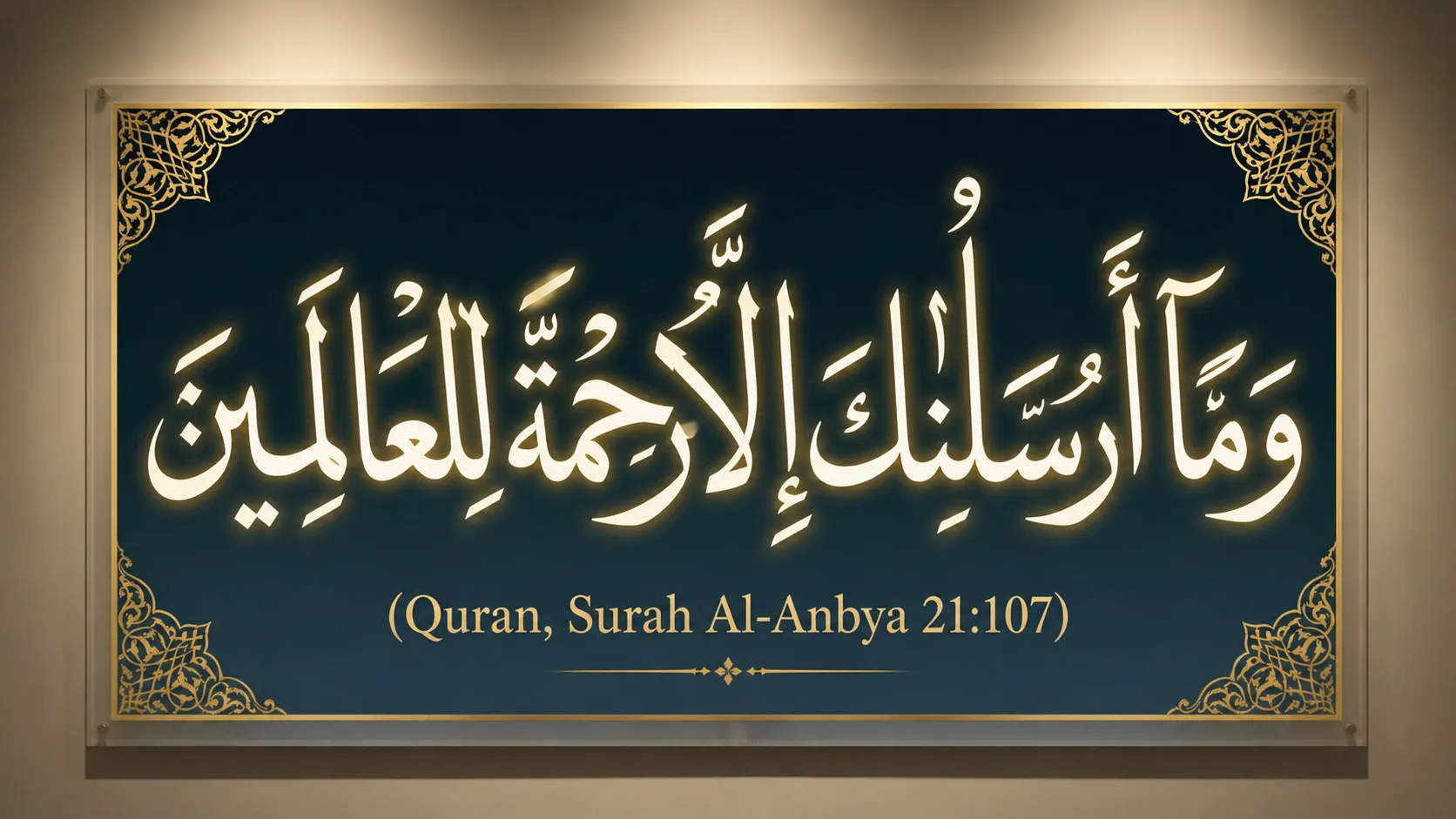
“Wa mā arsalnāka illā raḥmatan lil‑‘ālamīn.”
If you’ve ever felt lost, angry, or spiritually heavy, this one verse from Sūrah al‑Anbiyā’ (21:107) holds a quiet, powerful answer: the Prophet Muhammad ﷺ is Allah’s mercy for all of us—not just the “perfect” and not just the “Muslims.”
Today we’ll walk through this verse in a way that fits your phone, your Google search, Siri, and Alexa—while keeping the depth of Ibn Kathīr, Ma’ārif‑ul‑Qur’ān, and your own spiritual walk. By the end, you’ll know:
- What this verse really means,
- How to use it as a daily habit (Spiritual Habit Loop),
- Which hadiths support it,
- And how to connect it to real‑life duas like “sar dard ki dua” and “safar ki dua”.
Why This Verse Feels So Personal
Have you ever repeated “Wa mā arsalnāka illā raḥmatan lil‑‘ālamīn” and wondered, “But where is this mercy in my life?”
That question is exactly why this verse matters.
This verse is not a vague slogan. It is a Divine declaration of purpose: you were not created for punishment, blame, or endless guilt. You were created—and the Prophet ﷺ was sent—so Allah’s mercy can reach you, even in your mistakes, anxiety, and failures.
If you feel inner hardness, loneliness, or confusion about Islam, this verse is meant to soften your heart, not scare it. That is the first and most important truth about rahmatan lil‑‘ālamīn.
What This Verse Means in 50 Words
Allah says in Sūrah al‑Anbiyā’, 21:107: “And We did not send you except as a mercy to the worlds.” This means the Prophet Muhammad ﷺ was sent to bring guidance, forgiveness, and protection for all creation—not just Muslims, not just humans, but everyone and everything that can benefit from his light.
The Verse, Word by Word
Arabic Text
وَمَا أَرْسَلْنَاكَ إِلَّا رَحْمَةً لِّلْعَالَمِينَ
This is the exact verse from Sūrah al‑Anbiyā’, 21:107. Each word is chosen by Allah to limit and clarify the Prophet’s mission.
Transliteration
Wa mā arsalnāka illā raḥmatan lil‑‘ālamīn.
This helps you pronounce it correctly even if you’re learning Arabic. Notice how the “illā” (إِلَّا) cuts off all other motives: the Prophet’s sending is only for mercy.
English Translation (Saheeh International)
“And We have not sent you, [O Muhammad], except as a mercy to the worlds.”
This translation is clear, direct, and widely trusted. It leaves no room for “but also as a punishment” or “for anger.” The focus is mercy.
Urdu Translation (Fateh‑Muhammad Jalandhari)
اور ہم نے آپ کو رحمت کے سوا کسی اور لیے نہیں بھیجا ہے پوری دنیا کے لیے۔
For Urdu‑speakers, this makes the verse feel personal: “We did not send you for anything except mercy, for the whole world.”
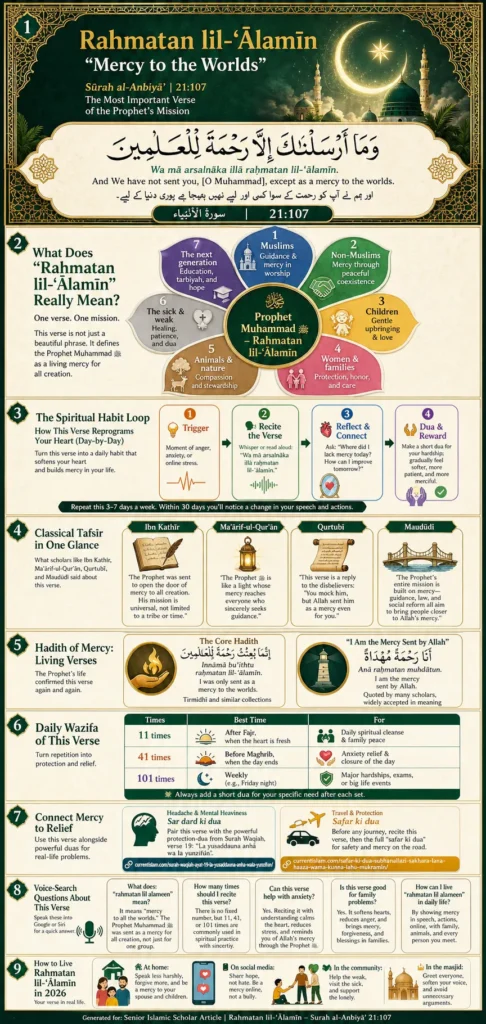
How This Verse Reprograms Your Heart
You don’t have to be a scholar to benefit from this verse. You just need a habit.
Step 1: The Trigger
The trigger is any moment you feel hardness, anger, or anxiety.
Maybe your child is crying, your boss is unfair, or you’re scrolling online and feel irritated. That exact moment is your trigger:
- Pause.
- Whisper: “Wa mā arsalnāka illā raḥmatan lil‑‘ālamīn.”
This small act reminds you that you are not alone and that the Prophet ﷺ was sent for you too.
Step 2: The Action
Repeat the verse slowly, three times, with intention:
- Once with your lips.
- Once in your heart.
- Once as a prayer: “O Allah, make me feel this mercy in my life.”
This tiny loop starts to rewire your brain from reaction to reflection. Over time, you’ll notice you’re less impulsive, more forgiving, and more patient. That is the Spiritual Habit Loop in action.
Step 3: The Reflector Verse Pair
To deepen the effect, pair this verse with one short, supporting verse every day. For example:
- Sūrah al‑Qalam, 68:4:
- “And indeed, you are of a great moral character.”
After reciting both, ask yourself: “Where did I fail to show mercy today?” and “Where can I try again tomorrow?”
- “And indeed, you are of a great moral character.”
This pairing turns the verse into a daily mirror for your heart and behavior.
Why This Verse Is So Special
Why did Allah choose this verse to define the Prophet’s mission?
It’s Universal, Not Tribal
The word “lil‑‘ālamīn” (للعالمين) means “for all the worlds.” This includes:
- Believers and non‑believers.
- Humans and jinn.
- Animals and nature that benefit from the just and merciful order brought by his message.
Unlike other prophets whose missions were limited to specific tribes or nations, the Prophet Muhammad ﷺ came for all of us. That is why this verse feels so personal no matter where you live.
It’s a Balance of Mercy and Justice
Some people think mercy means no correction—no boundaries, no consequences. This verse shows the opposite:
- The Prophet’s mercy includes guidance, limits, and sometimes firmness.
- But even when he warned or corrected, the purpose was always protection and growth, not humiliation.
Think of it like a parent who disciplines a child out of love. The Prophet’s entire life was like that: firm when necessary, gentle always.
Tafsīr: How Scholars Explain This Verse
Ibn Kathīr & Ma’ārif‑ul‑Qur’ān
Ibn Kathīr explains that this verse shows the Prophet ﷺ was sent to open the door of mercy to every creation. His message is not limited by race, language, or time.
Ma’ārif‑ul‑Qur’ān deepens this by saying the Prophet’s mercy is like a light that reaches all people who sincerely seek guidance. Even those who reject him out of arrogance still live in a world shaped by his mercy—laws, ethics, and social reforms that protect the weak and restrain the tyrant.
Qurtubī & Maudūdī
Qurtubī highlights that this verse is a reply to the disbelievers who mocked the Prophet. Allah says, in effect: “You call him a liar, but We sent him as a mercy for you too.”
Maudūdī adds that this verse is the core of the Prophet’s mission: not political power, not worldly fame, but pure mercy. Every law, every command, every act of worship in the Qur’an and Sunnah is meant to guide people toward that mercy.
Hadith: “I Was Only Sent as a Mercy”
You asked for two key hadiths. Here they are, explained simply.
1. “Innāmā bu‘ithtu raḥmatan lil‑‘ālamīn”
The Prophet ﷺ said: “إنما بعثت رحمة للعالمين.”
Transliteration: “Innāmā bu‘ithtu raḥmatan lil‑‘ālamīn.”
Meaning: “I was only sent as a mercy to the worlds.”
This hadith appears in collections like Tirmidhī and is widely quoted by scholars. It shows that the Prophet himself understood his mission as mercy, not force or anger.
2. “Anā raḥmatan muhdātun” – “I Am the Mercy Sent by Allah”
The Prophet ﷺ also said: “أنا رحمة مهدَىة.”
Transliteration: “Anā raḥmatan muhdātun.”
Meaning: “I am the mercy sent by Allah.”
Many scholars quote this phrase, though some debate the exact grading of the chain. The important point is that the meaning is firmly supported by the Qur’an and the Prophet’s life. His entire demeanor—gentle with children, forgiving to enemies, patient with his companions—proves he was a living mercy.
Benefits of Reciting This Verse (Daily Wazifa)
You can use this verse as a wazifa (regular remembrance) for both spiritual and worldly relief. Here’s a simple, practical structure:
1. Daily Recitation (Soft Wazifa)
- Number: 11, 41, or 101 times (choose one that fits your energy).
- Best Times:
- After Fajr and before Maghrib.
- When you feel anxious, angry, or spiritually heavy.
2. Intention (Niyyah)
Before starting, say in your heart:
- “O Allah, let this verse bring mercy into my life, my family, and my future.”
That intention turns repetition into ibadah, not just vibes.
3. Combine with Dua
After each full count, add:
- A short dua for your biggest concern (e.g., family peace, job, health, protection from sin).
This makes the verse a personal mercy‑bridge from your heart to Allah’s throne.
Linking This Verse to Physical and Spiritual Relief
“Sar dard ki dua” – Headache Relief
When you feel headache, stress, or mental heaviness, this verse can be part of your relief plan.
- After reciting it 11 times, apply a cool compress or rest.
- Then, use the “sar dard ki dua” (from Surah Waqiah, verse 19: “La yusaddauna anhā wa la yunzifūn”) to ask for mercy and protection from physical and spiritual pain.
Click here to read the full sar dard ki dua and its benefits: sar dard ki dua
“Safar ki dua” – Travel Protection
Before any journey, this verse can be your mercy‑shield.
- Recite “Wa mā arsalnāka illā raḥmatan lil‑‘ālamīn” once, then the full “safar ki dua” (from Surah Zahrawayn, beginning with “Subḥānalladhī sakhkhara lanā hādhā wa mā kunnā lahu muqrinīn”).
This combination reminds you that the Prophet’s mercy protects you not just in salah, but on the road, in flight, and in every transition.
Read the full safar ki dua and its rewards: safar ki dua
Wama-Arsalnaka-Illa-Rehmatallil-Alameen-Benefits-Wazifa-Guide.PDF
People Also Ask:
It means “a mercy to the worlds,” showing the Prophet Muhammad ﷺ was sent for all creation.
11, 41, or 101 times is a common wazifa, choose what fits your daily routine.
Yes, repeating it with intention and reflecting on its meaning can calm the heart and remind you of Allah’s mercy.
Yes, pairing it with dua for family peace and reciting it daily can soften hearts and open mercy‑based solutions.
Real‑Life Application: How to Live This Verse
Here’s how ordinary Muslims live “rahmatan lil‑‘ālamīn” in 2026:
- At home: Speak less harshly, forgive faster, and use this verse as a mental reset when you feel anger rising.
- On social media: Choose kindness over rage, share hope instead of hate, and remember that your words can be a mercy or a wound.
- In the community: Help the weak, visit the sick, and support the lonely—because the Prophet’s mercy lives through your actions.
Every time you act with mercy, you are echoing the verse “Wa mā arsalnāka illā raḥmatan lil‑‘ālamīn” in your own life. That is the real wazifa.
Send Your Dua Request – This Verse Will Be Recited for You
Are you facing hardship—illness, anxiety, family conflict, or uncertainty about your future?
Share your situation in the Dua Request Form below, and the scholar will recite “Wa mā arsalnāka illā raḥmatan lil‑‘ālamīn” specifically for you and your need.
“O Allah, make this verse a mercy‑bridge for [Your Name], his family, and his future. Protect him from all harm, open the doors of Your forgiveness, and let him taste the sweetness of Your mercy through Your Prophet ﷺ.”
Fill out the form, and let this powerful verse become a living mercy in your life—starting today.
(This section can later be turned into a real form on your website with “Submit Dua Request” or “Send Your Hardship” button.)
📥 Download Spiritual Guide (PDF)
1 thought on “Surah al anbya — Wama arsalnaka illa rehmatallil alameen”